The Day We’re Not Allowed to Drink Water…

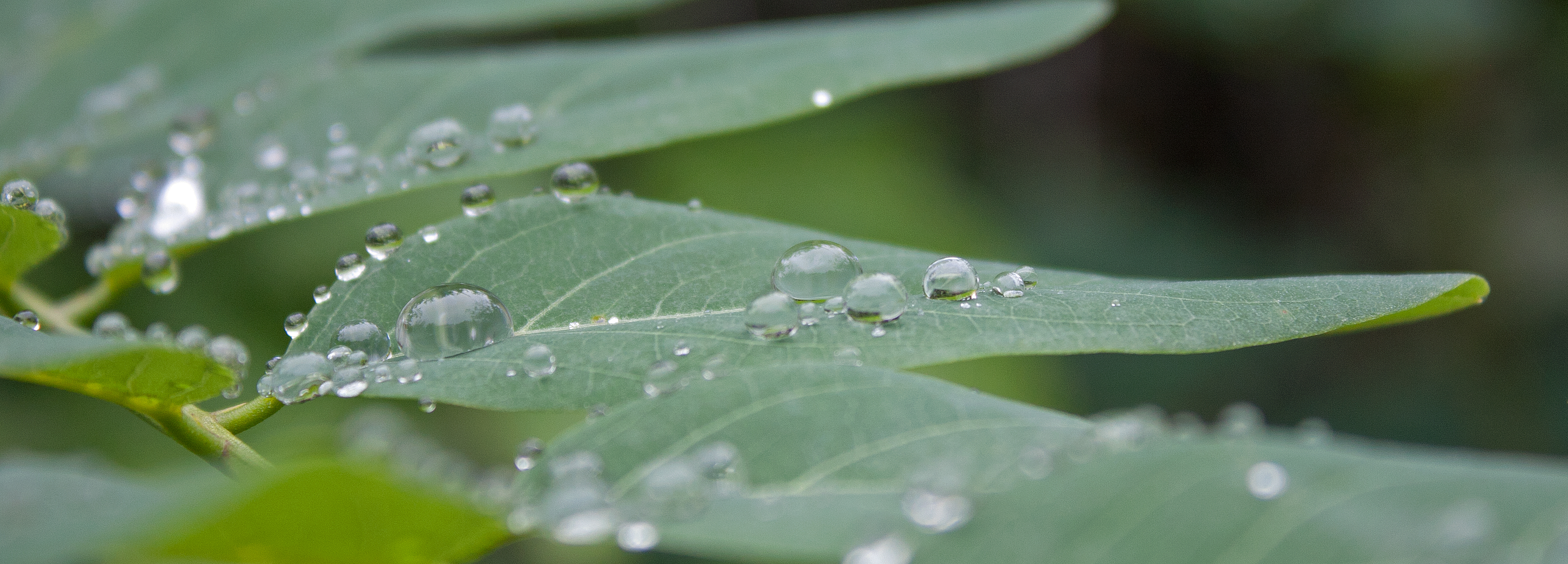
Dew drops on Hawkweed hairs, ON (photo by Nina Munteanu)

That day may seem like science fiction or the far future, but as William Gibson famously proclaimed, “The future is already here—it’s just not very evenly distributed.”

This is partly why I’ve been recently writing speculative (mundane) science fiction in which components of fiction blur with non-fiction. In a recent interview on the SolarPunk Magazine Podcast, I discussed with hosts Justine and Bria how my recent novel A Diary in the Age of Water blurred fiction with non-fiction. The novel achieved this through the use of a diary to create a gritty realism in a mundane narrative hard to put down. The intention was to achieve personal relevance for the reader to what was going on, particularly with climate change—a water-driven phenomenon. In The Temz Review, Marcie McCauley postulated that “[Munteanu] does not appear to view fiction and non-fiction as separate territories; or, if she does, then this book is a bridge between them.” I had to laugh when I read this; “she gets me,” I concluded.

In the near-future of A Diary in the Age of Water, Canada has privatized its water utilities after the Conservative Party comes into power, and a giant company called CanadaCorp removes municipal water connections from people’s homes and imposes strict water rations, all while selling off Canada’s precious water to US states like California that would otherwise be uninhabitable.

In her entry for July 13, 2049, Lynna the diarist writes:

“Today CanadaCorp announced that the collection of rainwater was illegal. As of today, I could be arrested for using my rain catcher and cistern. I’ve decided to continue using the cistern, and I’ve warned Hildegard not to breathe a word to anyone at school about what we’re doing with the water. Thankfully, I have time to train her in the art of subterfuge before she starts Grade Two in the fall.”

Nina Munteanu, A Diary in the Age of Water
Raindrops on a black locust leaf, ON (photo by Nina Munteanu)

What follows in the novel is complete commodification of water and further restrictions for citizens in the form of house tap closures and daily water quantity quotas from paying public water taps. No form of water is free or available without payment. And if you can’t pay, well…

Dizzy and shivering in the blistering heat, Hilda shuffles forward with the snaking line of people in the dusty square in front of University College where her mother used to teach. The sun beats down, crawling on her skin like an insect. She’s been standing for an hour in the queue for the public water tap… The man behind Hilda pushes her forward. She stumbles toward the tap and glances at the wCard in her blue-grey hand. Her skin resembles a dry riverbed.

Heart throbbing in her throat, Hilda fumbles with the card and finally gets it into the reader. The reader takes it. The light screams red. Her knees almost give out. She dreaded this day…

A tiny water drop hangs, trembling, from the wTap faucet mouth, as if considering which way to go: give in gravity and drop onto the dusty ground or defy it and cling to the inside of the tap. Hilda lunges forward and touches the faucet mouth with her card to capture the drop. Then she laps up the single drop with her tongue. She thinks of Hanna and her throat tightens.

The man behind her grunts. He barrels forward and violently shoves her aside. Hilda stumbles away from the long queue in a daze. The brute gruffly pulls out her useless card and tosses it to her. She misses it and the card flutters like a dead leaf to the ground at her feet. The man shoves his own card into the pay slot. Hilda watches the water gurgle into his plastic container. He is sloppy and some of the water splashes out of his container, raining on the ground. Hilda stares as the water bounces off the parched pavement before finally pooling. The ache in her throat burns like sandpaper and she wavers on her feet. The lineup tightens, as if the people fear she might cut back in. She stares at the water pooling on the ground, glistening into a million stars in the sunlight…and knows she is dying of thirst…

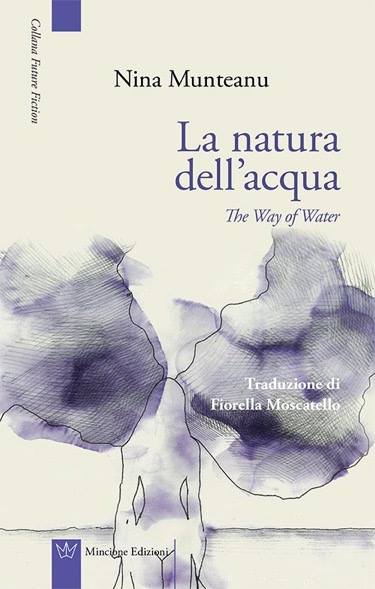
Nina Munteanu, The Way of Water / la natura dell’acqua

This excerpt from my bilingual short story “The Way of Water / la natura dell’acqua” (Mincione Edizioni, 2016) follows the life of Hilda Dresden, daughter of Lynna, the diarist in “A Diary in the Age of Water.”

Science fiction, you think…

Far future, you think…

Think again…

In 2010, Mike Adams of Natural News reported that collecting rainwater was now illegal in several states of the USA. Utah, Washington and Colorado had outlawed individuals from collecting rainwater on their own properties because, according to officials, that rain belonged to someone else.

In 2015, thousands of citizens in two of America’s poorest cities, Detroit and Baltimore, had their water shut off for being behind on their water bills (which had been sharply increased).

Both are inhumane examples of government-imposed oppression over what should be a public and free resource: water.

Dew drops on hawkweed hairs and Mealy Pixie Cup lichens, ON (photo by Nina Munteanu)

Maude Barlow, the Chairperson of the Council of Canadians, writes in Boiling Point of the water crisis in Canada—perhaps our best kept secret, considering that Canada is supposedly so water-rich. Are we giving it all away? And what of our indigenous communities, some of whom have not had potable water for decades?

So, I agree with Gibson about the future not being evenly distributed. This is because the present isn’t evenly distributed. Much of this disparity arises from an extractive and exploitive mentality and practice. One that commodifies what needs to remain free and available for all users. Capitalism ensures an uneven future by focusing on fear and stressing competition, separation, and exclusion.

In his book Designing Regenerative Cultures Daniel Christian Wahl talks about changing our evolutionary narrative from one based on fear defined by a perception of scarcity, competition, and separation to one based on love defined by a perception of abundance, a sense of belonging, collaboration and inclusion.

And moving forward we can take a lesson from Robin Wall Kimmerer, author of Braiding Sweetgrass, who talks about a gift economy—an economy of abundance—whose basis lies in recognizing the value of kindness, sharing, and gratitude in an impermanent world.

This is what she says: “Climate change is a product of this extractive economy and is forcing us to confront the inevitable outcome of our consumptive lifestyle, genuine scarcity for which the market has no remedy. Indigenous story traditions are full of these cautionary teachings. When the gift is dishonored, the outcome is always material as well as spiritual. Disrespect the water and the springs dry up. Waste the corn and the garden grows barren. Regenerative economies which cherish and reciprocate the gift are the only path forward. To replenish the possibility of mutual flourishing, for birds and berries and people, we need an economy that shares the gifts of the Earth, following the lead of our oldest teachers, the plants.”

So, “The Day We’re Not Allowed to Drink Water…”

…Let that day never come.

Make it so…

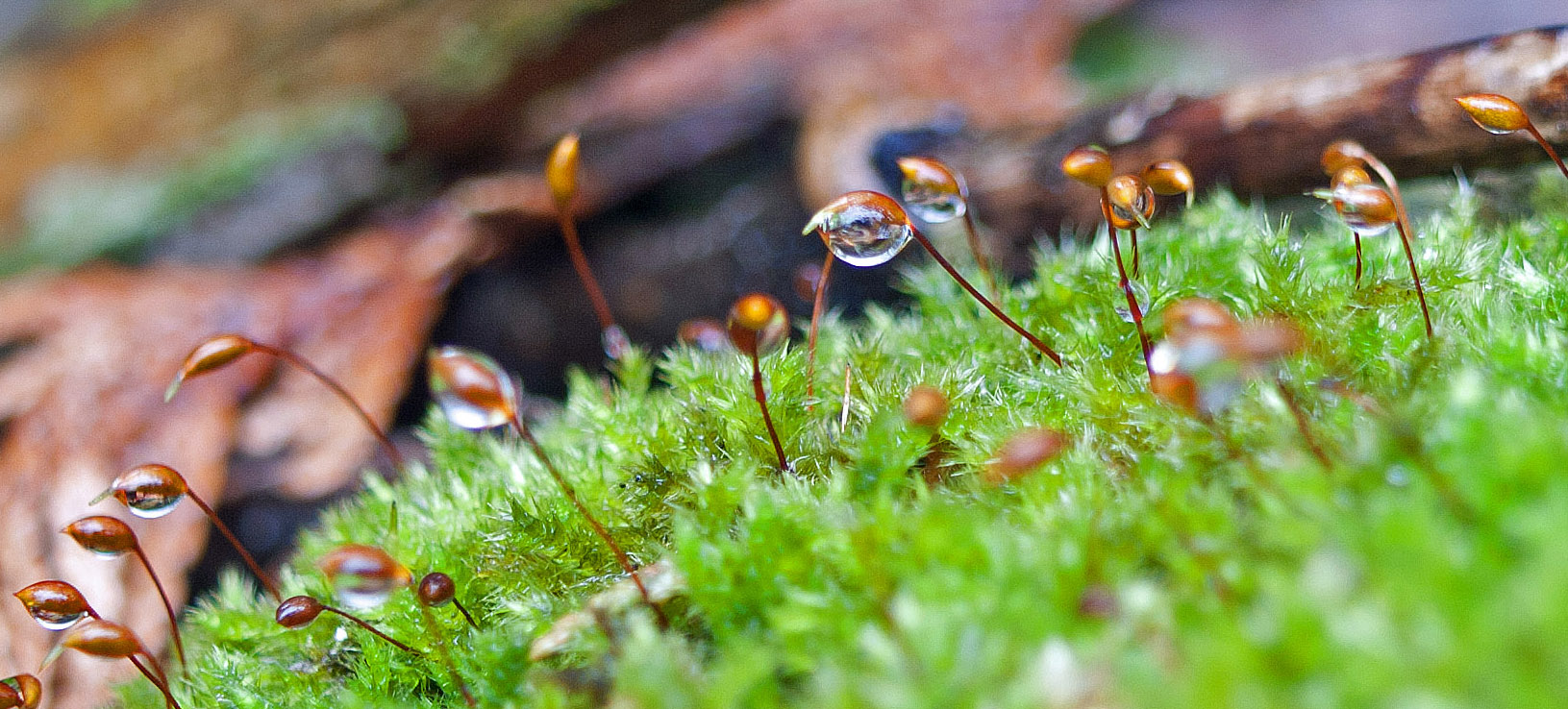
Moss with raindrops on capsules, ON (photo by Nina Munteanu)

References:

Barlow, Maude. 2016. “Boiling Point: Government Neglect, Corporate Abuse, and Canada’s Water Crisis.” ECW Press, Toronto. 312pp.

Kimmerer, Robin Wall. 2020. “The Serviceberry, An Economy of Abundance.” Emergence Magazine, December 10, 2020.

Munteanu, Nina. 2016. “La natura dell’acqua / The Way of Water.” Mincione Edizioni, Roma. 114pp.

Munteanu, Nina. 2020. “A Diary in the Age of Water.” Inanna Publications, Toronto. 300pp.

Wahl, Daniel Christian. 2016. “Designing Regenerative Cultures.” Triarchy Press Ltd. 288pp.

Raindrops ‘float’ on a black locust leaf in a light rain, ON (photo by Nina Munteanu)


Nina Munteanu is a Canadian ecologist / limnologist and novelist. She is co-editor of Europa SF and currently teaches writing courses at George Brown College and the University of Toronto. Visit www.ninamunteanu.ca for the latest on her books. Nina’s bilingual “La natura dell’acqua / The Way of Water” was published by Mincione Edizioni in Rome. Her non-fiction book “Water Is…” by Pixl Press(Vancouver) was selected by Margaret Atwood in the New York Times ‘Year in Reading’ and was chosen as the 2017 Summer Read by Water Canada. Her novel “A Diary in the Age of Water” was released by Inanna Publications (Toronto) in June 2020.
The Witch’s Hat and Other Fungi Tales

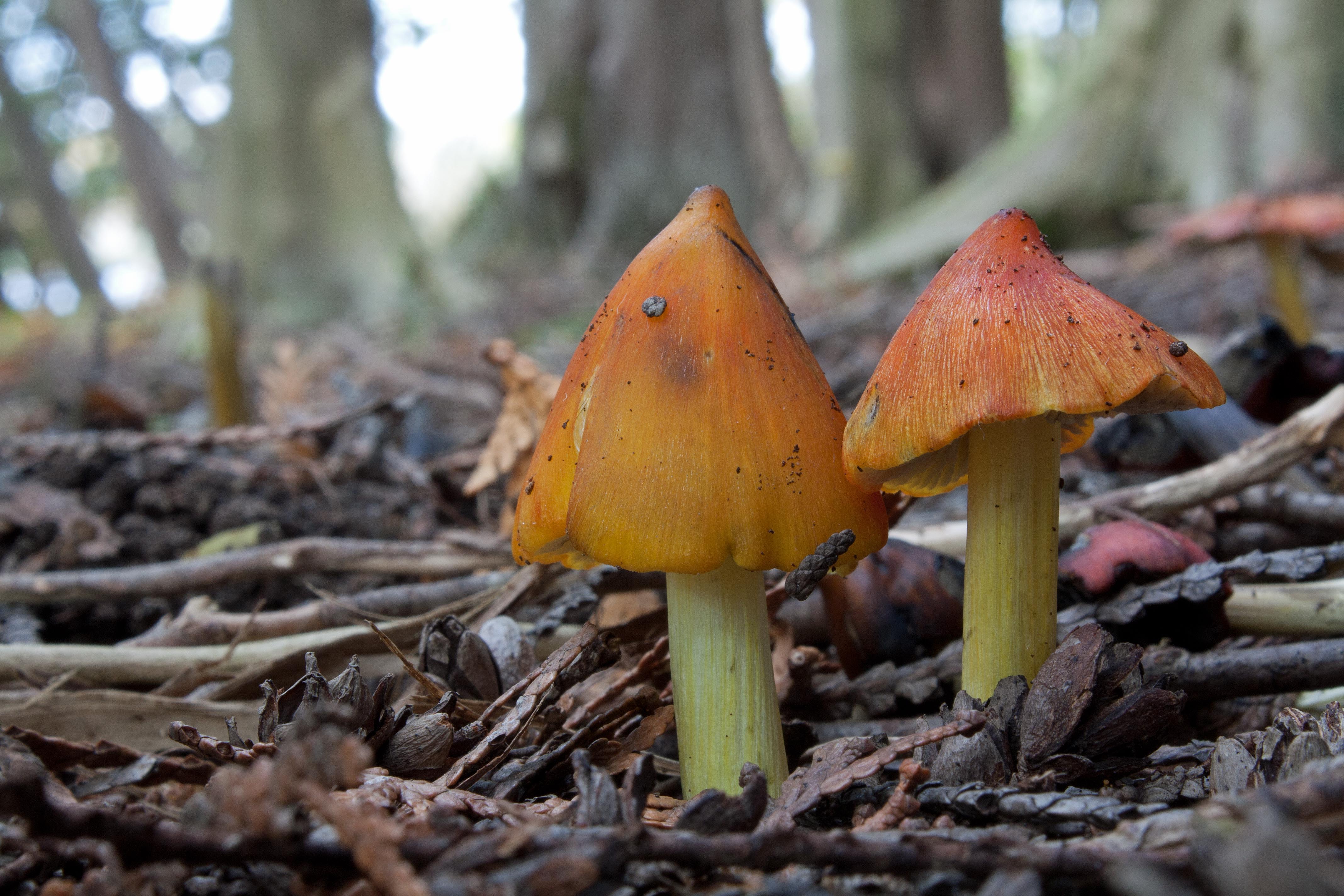
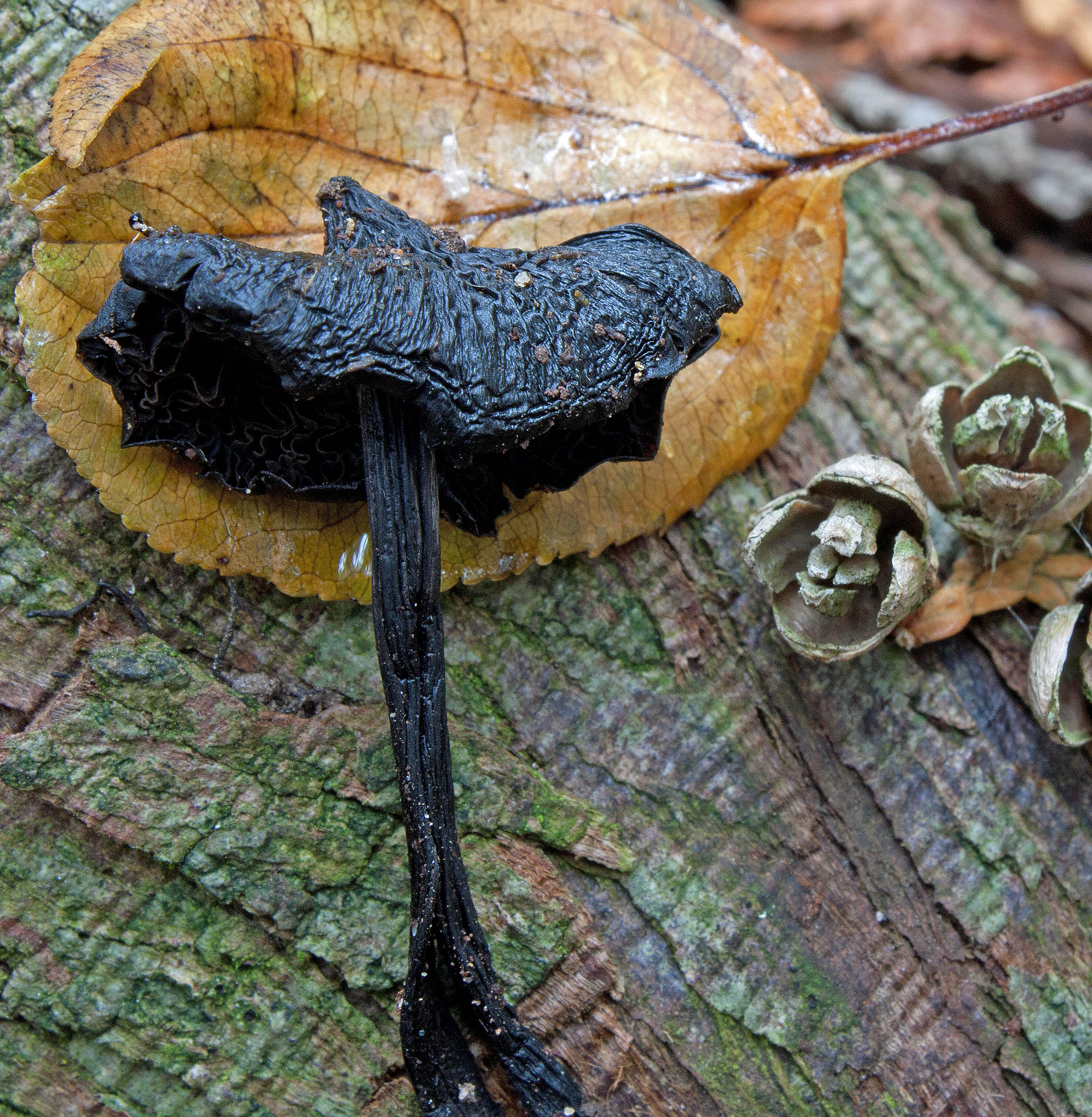
Witch’s Hat (Hygrocybe conica) by cedar tree, ON (photo by Nina Munteanu)

In my recent wanderings in the small cedar forest by the river near my house, I chanced upon a community of emerging reddish-orange fungi. They sat among the cedars in a crowded aggregation. Some pushed their way up through the duff like little buds, barely visible; others rose up with pointed steep caps; and others had opened further into tiny ‘witch’s hats’ and blackened.

Several stages of Witch’s Hat, including blackening stage, cedar forest, ON (photo by Nina Munteanu)

According to Frank Dugan, fungus plays a key role in many folktales and fairy tales. “They appear as foods, poisons, diseases, decorations, dyes or tinder, and even in insults, compliments, graffiti and video games,” says the author of Fungi, Folkways and Fairy Tales: Mushrooms & Mildews in Stories, Remedies & Rituals, from Oberon to the Internet.

Fungi figure in wonderfully with stories of and about witches. “Witches have long used fungi in their potions in Europe,” Fungal Folklore tells us. Even ferry rings are called “Hexen Rings” in Germany; Hexe means witch and this refers to “the dancing of witches on Walpurgis night (the eve of May Day) when the old pagan witches were thought to hold high revelry,” writes Dugan.

Baba Yaga (Wikipedia Commons)

Baba Yaga

In the Slavic folktale, Baba Yaga is an ancient swamp witch; she’s a cruel ogress who steals, cooks and eats her victims, usually children; OR offers them help. It’s complicated; she’s either a maternal helper or a cannibalistic villain; or both. Certainly a trickster.  Baba Yaga is guardian of the fountains of the water of life and lives in a forest hut perched on bird’s legs, surrounded by pine trees and glowing skulls. She can manipulate earth and wood, and can mesmerise. Baba Yaga has lately become something of an icon for feminism and the power of the feminine.

Says Marissa Clifford in Vice: “Like other witches, deistic Baba is agent of transformation, who, according to Kitaiskaia, exists ‘kind of outside of the things which constrain human society, like time and morality.’ She may well be so compelling for women today because of her rejection of social standards, and the power that comes from that. She’s an outlier with power that isn’t derived from her beauty, or her relationships with others. Instead, it comes from within her—earth, hut, and firey stove.”

Baba Yaga (illustration by Tatyana Chepkasova)

Witches, Fungi & Potions

“Witches have long used fungi in their potions in Europe,” The Fungus Among Us tells us. According to Dugan, the dung-loving Panaeolus papilionaceus (Petticoat Mottlegill) was used in witch’s concoctions in Portugal. The entheogen Amanita muscaria (Fly Agaric)—the elixir of ancient alchemists—is known as Hexenpils (‘Witches’ mushroom’) in Austria.  Among German tribes, it is associated with Woton/Odin, god of ecstasy, war and shamanic knowledge.  Puffballs were reportedly used in potions by witches in the Basque country. Witch’s butter (Exidia spp.) also figures in folklore. “Stabbing, burning or otherwise destroying these fungi were believed to harm the witch herself,” writes Owen. The Witch’s Hat (Hygrocybe conica) is aptly named for its blackening witch-style ‘hat’ that starts bright red-orange and turns coal black.

Many country folk through the sixteenth and nineteenth centuries performed rituals to protect their crops from the devastation wrought by witches and spirits. Thiselton-Dyer discusses the malignant Roggenwolf (‘rye wolf’ of Germanic folklore) who stole children and fed on them and the various rituals peasants used to appease these Feldgeister (field spirits), such as leaving a sheaf of rye in the fields over the winter. The Roggenwolf is, of course, the personification of ergot, the fungus Claviceps purpurea, which caused convulsions, burning, “massive-appetite”, and “the sense of becoming an animal.” People who contracted ergot poisoning from the contaminated rye were accused of being witches and brutally killed.

Young Witch’s Hats push up through the cedar forest floor, ON (photo by Nina Munteanu)

Ergot and The Last Summoner

In my historical fantasy “The Last Summoner,” young Vivianne Schoen, Baroness of Grunwald—accused of being a witch—is chased by her father’s guard to be burnt at the stake. Blamed for the sudden stupor of her father and the chaplain who both love their rye bread, it didn’t help that Vivianne possesses unnatural powers in metal manipulation, has weird markings or blemishes on her back or that suspicions of her preternatural mother being a witch precede her. Then odd things start to happen; cattle stop producing milk and other farm animals behave strangely. At a feast to celebrate her own coming nuptial to a foreign stranger and just after she is falsely accused of adultery, people suddenly succumb to fits of convulsions, facial distortions, hallucinations and paralysis. Targeted as the obvious candidate to blame, she must flee her home or be burnt alive at the stake:

…With a final unintelligible gasp that wet her cheek with flying spittle, he convulsed violently and pitched to the floor, shaking and vomiting his dinner.

Vivianne stared at her father, rolling and twitching in a seizure on the floor and crying out gibberish. She turned to the castle community, who were now pointing and shouting at her. Their faces had twisted from transfixed revulsion into fear and anger. Somehow they blamed her for both the stranger’s accident and her father’s sudden paroxysm. Perhaps for losing them a battle in the bargain too. Even Père Daniel’s face looked stricken with confused accusation. Until now Vivianne hadn’t realized how much his opinion of her meant to her. She felt his faltering faith drive like a blade into her heart and would have burst into tears had the crowd not suddenly grown very surly, which demanded her sudden attention.

Gertrude, the new dairymaid she’d assisted earlier, flung the first accusation: “She’s a witch!”

“Witch!” another echoed. “You heard her father call her one!”

Another servant swiftly followed with, “Just like her mother! She’s bewitched the baron! Put a spell on him with her wicked look!”

The crowd ignited to a raucous mob and a spate of accusations gushed out like a dam breaking: “My butter failed to churn because of her!”

“Look at the witchling’s eyes! They blaze with the devil’s own fire!”

“She appeared in Weikhard’s dream and now he’s ill!”

“She touched my cow and afterwards it couldn’t stand!”

“I saw the nursemaid bringing her a daily potion of nettle, mustard and mint with wine to make her lustful!”

Oh, no! They were implicating Uta along with her!

“I smelled basil and cloves in her bed chamber!”

Vivianne had used both to mask the rank odor of Uta’s anti-plague potions, completely innocent of their aphrodisiac properties. Vivianne stared in anguished despair as Père Daniel stood by, mutely sanctioning their actions. She’d thought him her champion once. But obviously this was too much for him to bear. He’d lost his trust in her. As their eyes met briefly, he suddenly gasped out strange words of gibberish. A violent shudder convulsed through him. It threw him forward, as if the devil itself were animating him, then felled him to the ground where he vomited alongside her retching father.

“She’s taken the priest!” someone shouted. “He’s doing the Viper’s dance!” Another screamed in a panic, “Watch out for her eyes!”

Vivianne turned back to the crowd. Whomever her gaze alighted upon shrank back and averted their face in terrified alarm. They were convinced that she could strike them down with a glance. To her horror a few of the castle servants jerked out of their seats with startled cries of gibberish then fell writhing to the ground; some began to vomit. Vivianne recognized the true onslaught of an epidemic. The same illness that had inflicted her father and the chaplain was attacking the staff. And again, the timing was impeccable, thought Vivianne with wry cynicism. As though God was plotting against her.

Gertrude pointed to her. “Seize her! Burn the witch! Before she kills us all!”

“Someone find her demon cat too!” Vivianne heard the doctor shout.

Several of the baron’s knights surged forward, swords drawn. As if suddenly awoken from a stupor, the Teutonic Knights at the high table leapt into action and drew their swords.

NO! Vivianne backed away in alarm. She envisioned their swords suddenly pointing back toward themselves. To her amazement, their swords flung back and the knights dropped them in shocked fright.  

In that surreal moment, as the world staggered into slow motion, Vivianne saw the entire castle household draw in a long breath. Still on the floor, Père Daniel’s shakes abated long enough for him to fix lucid eyes upon her and silently mouth, “Cours, ma petite! Cours! Sauves toi!”

After a last glance at her convulsing father, Vivianne took the Père’s advice and ducked through one of the curtained archways behind the table to the kitchen stairwell, and pelted down the stairs.

“After her!” she heard the booming voice of Doctor Grien. “The witch is getting away!”

*****

Vivianne later discovers what caused the sudden ‘bewitchment’ of members of her community: all the people who became ill had eaten the rye bread. She learns about ergot poisoning of rye by the fungus Claviceps purpurea. Conditions had been ideal for ergot to thrive: damp and rainy cool weather.

Young Witch’s Hat with peaked cone-shaped pileus, amid cedar duff, ON (photo by Nina Munteanu)

The Witch’s Hat

Witch’s Hats are a small agaric (cap from 1-4 cm across) that start out bright red to orange, sometimes almost yellow as they thrust up through the cedar duff, looking like buds.

The conical pileus is often curved steeply with a fairly sharp top and sometimes with edges that curve slightly inward. The stem (stipe) is often white at the base blending to yellow and will stain black with age.

Witch’s Hat mushroom showing inward curve of cap, with key to show size, cedar tree, ON (photo by Nina Munteanu)

As the waxcap mushroom develops, the cap spreads out with a discernable brim while maintaining the hat peak of a witch’s hat. As it ages, it turns a deeper red-orange that blackens, often from the edges inward.

Three stages of Witch’s Hat, from early conical to spreading and blackening hat, cedar tree, ON (photo by Nina Munteanu)

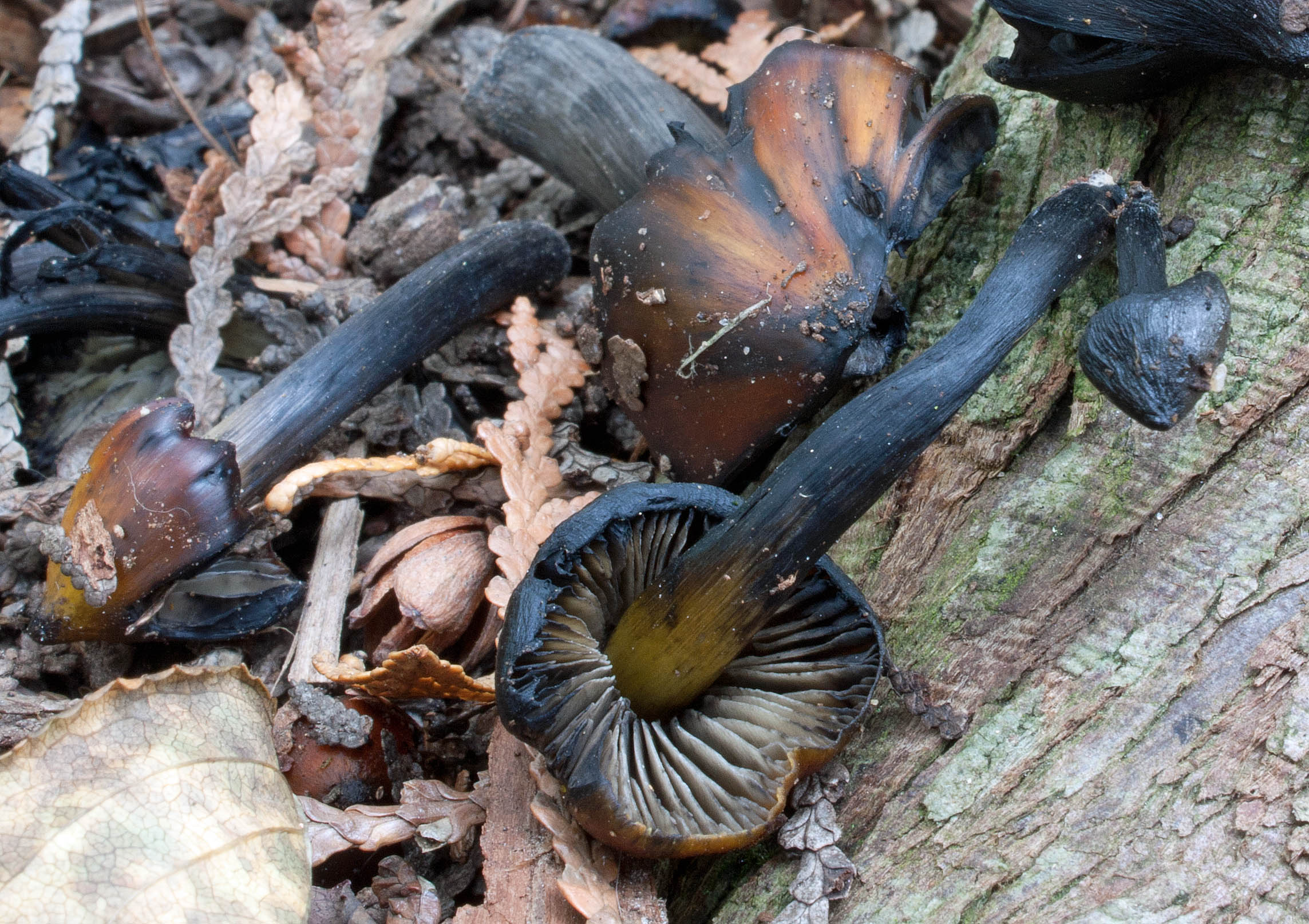
This tendency to blacken from bruising or with age is a good diagnostic for this mushroom. Very few others show this trait. Its gills “have the consistency of soft wax when rubbed between the fingers,” Fungus Fact Friday tells us. The gills start white to yellowish and gradually yellow and stain black.

Stages of Witch’s Hat from budding to opening cap to blackening cap and gills, cedar forest, ON (photo by Nina Munteanu)
Blackened and blackening Witches Hat caps and stems, ON (photo by Nina Munteanu)
Hygrocybe conica well-represents its common name Witch’s Hat as it keeps its peak and turns totally black, cedar in Ontario forest (photo by Nina Munteanu)

The Witch’s Hat (Hygrocybe conica), also known as Blackening Waxcap (for the obvious reason), shows a diversity of habitat preference and high variability. It tends to grow on the ground under hardwood and conifer trees. The community I stumbled upon fanned out from a few cedar trees in a small mixed cedar forest. The Witch’s Hat also likes mossy areas, where I found several near the river. The saprobic Hygrocybe conica is also a mycorrhizal fungus, sending tendrils from tree to tree.

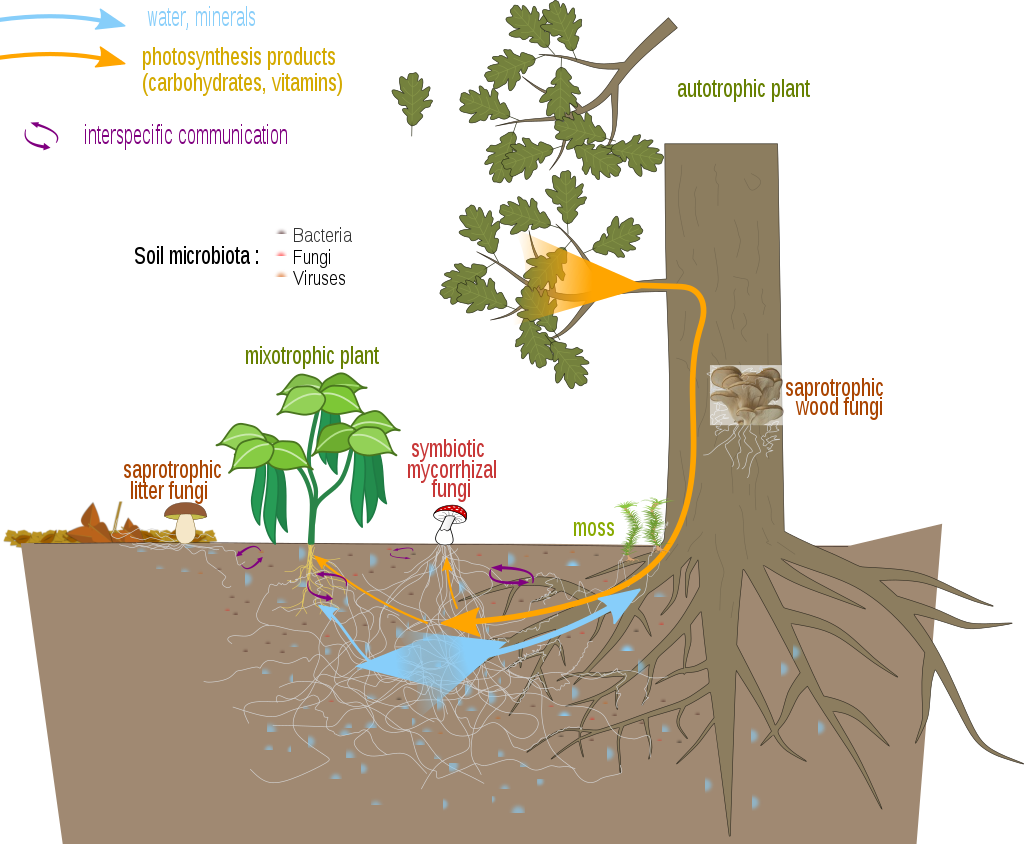
Mycorrhizae are symbiotic relationships that form between fungi and plants. The fungi colonize the root system of a host plant—in this case some cedar trees—providing increased water and nutrient absorption capabilities while the plant provides the fungus with carbohydrates through photosynthesis.

Mycorrhizal network (illustration by Charlotte Roy, Wikipedia)

References:

Dugan. 2008. “Fungi, folkways & fairy tales.” North American Fungi 3(7): 23-72.

Morgan, A. 1995. “Toads and Toadstools: The Natural History, Folklore, and Cultural Oddities of a Strange Association.” Celestial Arts. Berkeley, California.

Munteanu, Nina. 2012. “The Last Summoner.” Starfire World Syndicate. Louisville, KY.

Owen, E. 2003. “Welsh Folk-Lore: A Collection of the Folk-Tales and Legends of North Wales. Kessinger Publishing. Whitefish, Montana.

Thiselton-Dyer, T.F. 1898. “Folk-Lore of Plants.” D. Appleton and Co., New York.

Young emerging Witch’s Hats through cedar duff, ON (photo by Nina Munteanu)
Witch’s Hat in cedar forest, ON (photo by Nina Munteanu)

Nina Munteanu is a Canadian ecologist / limnologist and novelist. She is co-editor of Europa SF and currently teaches writing courses at George Brown College and the University of Toronto. Visit www.ninamunteanu.ca for the latest on her books. Nina’s bilingual “La natura dell’acqua / The Way of Water” was published by Mincione Edizioni in Rome. Her non-fiction book “Water Is…” by Pixl Press(Vancouver) was selected by Margaret Atwood in the New York Times ‘Year in Reading’ and was chosen as the 2017 Summer Read by Water Canada. Her novel “A Diary in the Age of Water” was released by Inanna Publications (Toronto) in June 2020.

On Writing Hopeful Dystopias and the Blur of Fiction with Non-Fiction

‘Hopeful dystopias’ are much more than an apparent oxymoron; they are in some fundamental way, the spearhead of the future—and ironically often a celebration of human spirit by shining a light through the darkness of disaster. I discussed this in a recent interview on Solarpunk Futures Podcast.

In a recent interview on the CBC Radio show Ideas “Beyond Dystopia”, Canadian author Margaret Atwood (who penned the dystopic The Handmaid’s Tale and Maddaddam trilogy) said much the same thing. Atwood argued that dystopias and cautionary tales ultimately embrace an element of hope, through a character’s experience. Dystopias can serve as a road map for individual endurance, resilience, and triumph through disaster.

I talked with Solarpunk Futures about how the purposeful blur of fiction with non-fiction in my latest eco-novel A Diary in the Age of Water produced a heightened relevance to the dystopic journey for the reader.

Solarpunk: Your latest book is an eco-novel, or rather something of a fiction-nonfiction hybrid perhaps, called A Diary in the Age of Water. Tell us a bit about that novel and the role that water plays in the story.

Nina: A Diary in the Age of Water follows the climate-induced journey of Earth and humanity through four generations of women and their battles against a global giant that controls and manipulates Earth’s water. The book spans over forty years (from the 2020s to the 2060s) and into the far future, mostly through the diary of a limnologist, which is found by a future water-being. While A Diary in the Age of Water is a work of fiction, its premise and much of its story are firmly based on real events, people and phenomena. The dramatization of these through four main characters carry the reader into consequence and accountability. Water’s relationship with each character provides four different perspectives on the value of water to humanity—from the personal and practical to the spiritual and existential. For readers with an evidence-based approach to learning about water’s importance, the diarist provides interesting facts on water in each of her entries in the form of epigraphs (mostly from Robert Wetzel’s Limnology). Things like: watershed, hypolimnion, aquifer, thalweg, clapotis gaufre, and petrichor, to name a few…

I chose a diary format to purposely blur the fiction with non-fiction. I was writing about both the far and the near future and much of it was based—like Margaret Atwood and her books—on real events and real people. I wanted personal relevance to what was going on, particularly with climate change. I also wanted to achieve a gritty realism of “the mundane” and a diary felt right. Lynna—the diarist—is a reclusive inexpressive character, so I thought a personal diary would help bring out her thoughts and feelings. There’s nothing like eves-dropping to make the mundane exciting. The diary-aspect of the book characterizes it as “mundane science fiction” by presenting an “ordinary” setting for characters to play out. The tension arises from insidious cumulative events and circumstances that slowly grow into something incendiary. The real events are the fuel that incite a slow-burn fictional drama that blurs the reader’s perception of reality and heightens its relevance.

Solarpunk: Can you give us an example of an event in your book where the lines between fiction and nonfiction get blurred?

Nina: In the diary entry entitled “Watershed,”, for July 14, 2049, Lynna writes:

Today, CanadaCorp announced that the collection of rainwater was illegal. As of today, I could be arrested for using my rain catcher and cistern. I’ve decided to continue using the cistern, and I’ve warned Hildegard not to breathe a word to anyone at school about what we’re doing with the water. Thankfully, I have time to train her in the art of subterfuge before she starts Grade Two in the fall.

What follows in the story is a series of greater water restrictions that mimic some of the currenet ongoing scenarios in other parts of the world (e.g. illegal rainwater collection in parts of the USA; shutting down of home water taps in Detroit; required and restricted water collection at public water taps in parts of the world).

Lynna’s August 13, 2051 diary entry in my 2020 novel seemed to predict the atmospheric river disaster that befell British Columbia in November 2021:

In the mid- to late-twenties the west coast succumbed to massive atmospheric river storms. San Francisco. Los Angeles. Seattle. Even earthquakes seemed to follow climate change’s lead. The earthquake / tsunami that hit Vancouver Island in 2029 shifted the Earth’s axis by three inches, Daniel informed me. The American military stormed over the border with swift aid. “Did you know that they never left?” Daniel asked me. I hadn’t known that. But I wasn’t surprised either.

Of course, these “predictions” were really just good research into the current scientific knowledge and what current circumstances may naturally generate in the future. I was just doing a good job at reading water.

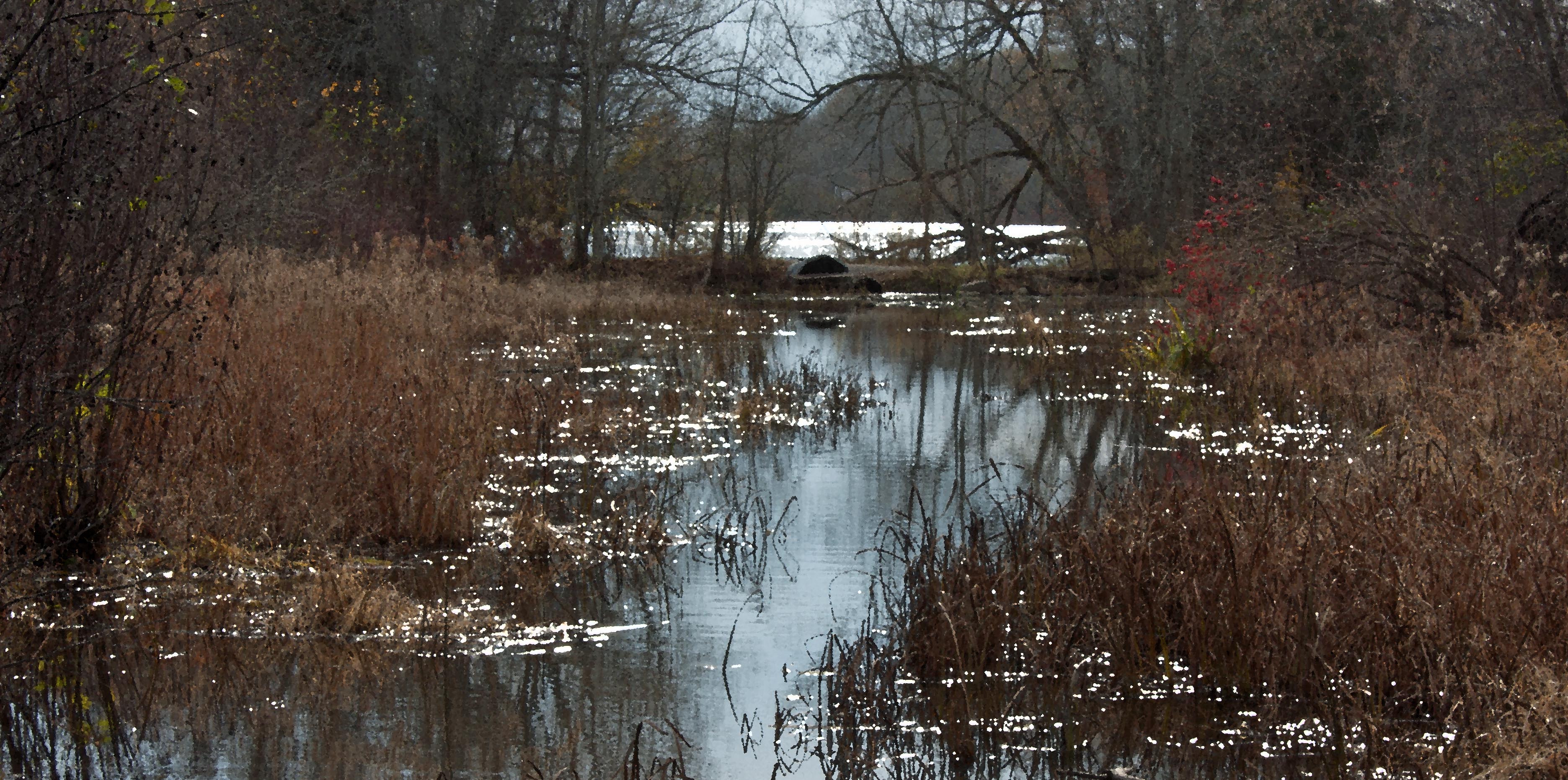
Thompson Creek marsh in early winter, ON (photo and rendition by Nina Munteanu)

Given that cli-fi features climate change, environmental destruction, and species extinction, you must think ‘how can it not be all doom and gloom?’ But dystopias often do reflect—in their depiction of terrible circumstance—an element of triumph, of overcoming adversity, and ultimately of hope. In fact, dystopias generally draw on a writer’s optimism; else, why would we write these cautionary tales? A strong belief in humanity underlies much of eco-fiction. Solarpunk is a rising light of eco-fiction that has emerged recently in response to the denial-despair dilemma many of us face when we think of climate change. This kind of eco-fiction features ingenuity, generativity, independence, and community. And it ultimately leads us through it all toward the light. A Diary in the Age of Water is in fact a dystopia with elements of solarpunk.

You can listen to the entire podcast interview on Solarpunk Futures: Imagining a New World here.

Thompson Creek Marsh in early winter, ON (photo and rendition by Nina Munteanu)

Nina Munteanu is a Canadian ecologist / limnologist and novelist. She is co-editor of Europa SF and currently teaches writing courses at George Brown College and the University of Toronto. Visit www.ninamunteanu.ca for the latest on her books. Nina’s bilingual “La natura dell’acqua / The Way of Water” was published by Mincione Edizioni in Rome. Her non-fiction book “Water Is…” by Pixl Press(Vancouver) was selected by Margaret Atwood in the New York Times ‘Year in Reading’ and was chosen as the 2017 Summer Read by Water Canada. Her novel “A Diary in the Age of Water” was released by Inanna Publications (Toronto) in June 2020.
Solaris: Planet as Alien Character in Science Fiction

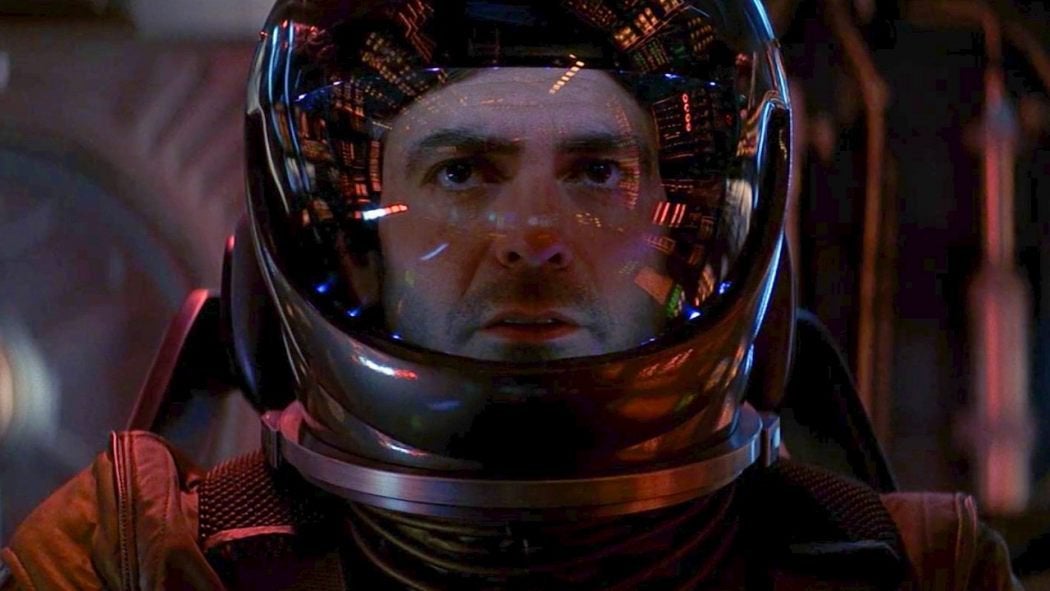
Kelvin (played by George Clooney) arrives on Solaris in Steven Soderberg’s 2002 film

Some time ago, I participated in an inquiry to name my choice of “Best Alien in Science Fiction,” posed by John DeNardo at SF Signal. “Aliens are a classic trope dating back to the earliest days of science fiction,” John said. They are the quintessential “other” archetype in science fiction.

From conquering warlords (War of the Worlds) to instructing sages (The Day the Earth Stood Still) to victimized pacifists (Martian Chronicles), how the “other” is portrayed and how humanity interacts with it, has been explored throughout science fiction since it began with Mary Shelley’s Frankenstein.

Of course, in science fiction—a metaphoric literature of grand scope—these ‘others’ / aliens make representation through archetype. So, the aliens of War of the Worlds represent a conquering nation; Klaatu of The Day the Earth Stood Still may represent a benevolent dictator; the Martians of Martian Chronicles represent our indigenous peoples under the yoke of settler colonialism and an exploitive resource-extraction mindset; and the monster of Frankenstein exemplifies the disabled/deformed unsavory departure from our ‘perfect’ self-image. Author Brian Ott tells us that “it is a profound mistake to interpret the genre [of science fiction] literally.” He reminds us that it is not what the aliens are but what they represent that matters (except when, in some cases, they are one in the same). Science fiction is both “the great modern literature of metaphor” and “pre-eminently the modern literature not of physics but of metaphysics,” adds Peter Nicholls, Australian scholar and critic.

Steven Spielberg’s 2005 film of H.G. Wells’s book “War of the Worlds”

In a previous article entitled “Dreams and Perceptions And ‘the Other” I described an experience with the unfamiliar. Have you ever done the same? Looked backward while driving through a familiar scene to gain a different perspective? And just felt different for a moment? Like you’d entered a different dimension and briefly glimpsed ‘the other.’

What is it like to meet ‘the other’?

In story, characters are defined through their experience and their approach to the unfamiliar. A new relationship. A stranger in town. A different culture. An alien encounter… How does the character react? Is it with fear? Wonder? Curiosity? A mixture of these? By describing “the other” science fiction writers describe “us”, given that it is through our own eyes that the other is viewed and described.

In his book Orientalism: Western Conceptions of the Orient Edward W. Said contended that for there to be an ‘us’, there has to be a ‘not-us.’ According to Patricia Kerslake of Central Queensland University, this arises from a postcolonial notion of ‘the Other’, through a mutual process of exclusion. This exclusion inspires the very idea of ‘alien’ by imposing expectation on perception. Kerslake argues that: “When one culture imposes its perceptions on another, in that it begins to see the Other not as they are but as, in Said’s words, ‘they ought to be’, then the process of representation becomes inevitable: a choice is made to see a ‘preferred’ real.”

Klaatu greets humanity in “The Day the Earth Stood Still”

In her 1975 article “American SF and the Other,” Ursula K. LeGuin unequivocally scolded the Western SF genre for representing and promoting colonialism and androcratic motives by “othering” or making inconsequential the poor, the uneducated, the marginalized and women.

…The question involved here is the question of The Other—the being who is different from yourself. This being can be different from you in its sex; or in its annual income; or in its way of speaking and dressing and doing things; or in the color of its skin; or the number of its legs and heads. In other words, there is the sexual Alien, and the social Alien, and the cultural Alien, and finally the racial Alien…

The people in SF are not people. They are masses, existing for one purpose to be led by their superiors…

If you deny any affinity with another person or kind of person, if you declare it to be wholly different from yourself–as men have done wo women, and class has done to class, and nation has done to nation–you may hate it, or deify it; but in either case you have denied its spiritual equality, and its human reality. You have made it into a thing, to which the only possible relationship is a power relationship. And thus you have fatally impoverished your own reality.

You have, in fact, alienated yourself.

Ursula K. LeGuin

Written 45 years ago, Le Guin’s scathing article may have accurately represented the North American science fiction community of writers of that time. Today, despite the remnants of a strong old guard that still promotes a patriarchal colonialist hegemony, the science fiction genre has matured and grown beyond this self-limiting view. This is partly because current authors—many who are women and many who are representatives of minority or marginalized groups—have given SF a new face and voice that promises to include equality, inclusion, and a fresh look at exploration and ‘the other.’ In most cases it is ‘the other’ whose voice—for so long missing—is now being expressed.

The genre of science fiction has diversified and matured to embrace “mundane science fiction,” literary fiction, speculative fiction, climate fiction, cli-fi, eco-fiction, indigenous futurisms and more. Each of these genres provide new opportunities that give voice to ‘the other’ from women (Octavia Butler’s Parable of the Sower and N.K. Jemison’s The Broken Earth series) to disabled people (Mishell Baker’s Borderline) to the indigenous human (Cherie Dimaline’s The Marrow Thieves) to the non-human (Costi Gurgu’s RecipeArium) and the environment such as water (Emmi Itäranta’s The Memory of Water and my own A Diary in the Age of Water).

My Choice for ‘Best’ Alien Character: Solaris

The most memorable aliens for me have been those that helped illuminate our history and our very humanity, whether they played the archetype of simple antagonist or misunderstood as “commentator” on human prejudice, insecurities, greed, heroism, compassion and honor. I can think of several aliens who have provided excellent examples of this: the victimized ” prawns” of Peter Jackson’s District 9 come to mind. Each provided a platform for the exploration and exposition of human’s strengths and weaknesses. How we handle or even recognize “the other” is very compelling and illuminating.

The planet Solaris

My choice for alien character is the ‘self-aware’ planet in Stanislaw Lem’s Solaris: see my film review of Steven Soderbergh’s film interpretation of Stanislaw Lem’s book Solaris in a previous article on this site. What follows is a brief summary:

In response to his friend’s plea, a depressed psychologist with the ironic name of Kris Kelvin (George Clooney), sets out on a mission to bring home the dysfunctional crew of a research space station orbiting the distant planet, Solaris. Kelvin arrives at the space station, Prometheus, to find his friend, Gibarian, dead by suicide and a paranoid and disturbed crew obviously withholding a terrible secret from him. It is not long before he learns the secret first-hand: some unknown power (apparently the planet itself) taps into his mind and produces a solid corporeal version of his tortured longing: his beloved wife, Rheya (Natascha McElhone) who years ago had committed suicide herself. Faced with a solid reminder, Kelvin yearns to reconcile with his guilt in his wife’s death and struggles to understand the alien force manifested in the form of his wife. He learns that the other crew are equally influenced by Solaris and have been grappling, each in their own way, with their “demons,” psychologically trapping them there.

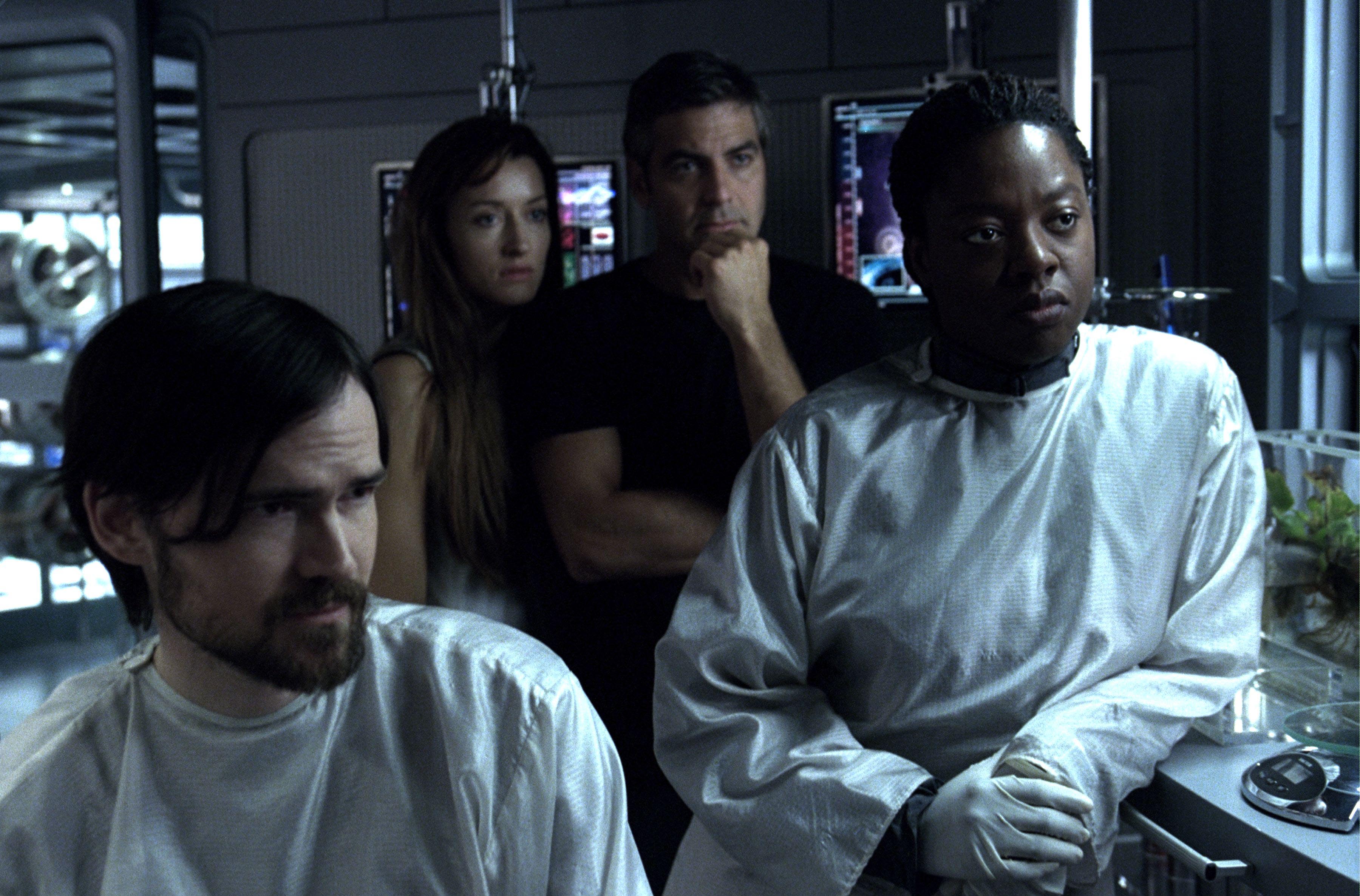
Crew onboard the Prometheus orbiting Solaris: Snow (Jeremy Davies), Rheya (Natascha McElhone), Kelvin (George Clooney) and Gordon (Viola Davis)

Ironically, our hero’s epic journey of great distance has only led him back to himself. The alien force defies Kelvin’s efforts to understand its motives; whether it is benign, hostile, or even sentient. Kelvin has no common frame of reference to judge and therefore to react. This leaves him with what he thinks he does understand: that Rheya is a product of his own mind, his memories of her, and therefore a mirror of his deepest guilt—but perhaps also an opportunity to redeem himself.

Kelvin and his ‘dead’ wife Rheya onboard the Prometheus orbiting Solaris

Solaris is the epitome of the “other”, a force and entity unrecognizable and unfathomable. Lem’s existentialist portrayal of “the other”—and by extension of humanity—serves as excellent commentary on what is important to us and our identity. Unlike the familiar human-like figures of a Spock, Zhaan or the fremen, Solaris accomplishes its ‘other’ role through arcane manipulation of the human characters’ dreams and yearnings. We never understand its motivations or intelligence, yet we are drawn to its force and reflective mirror of our souls. It is its very incomprehensibility that attracts us, as to an abstract artwork, and challenges our very identities. Solaris shows neither judgment nor morality. It exists through the lens of paradox. Both there and not there. Fluid but enduring. Fractured yet whole. Like water. 

All lead to the ultimate question asked of science fiction: who are we and why are we here?

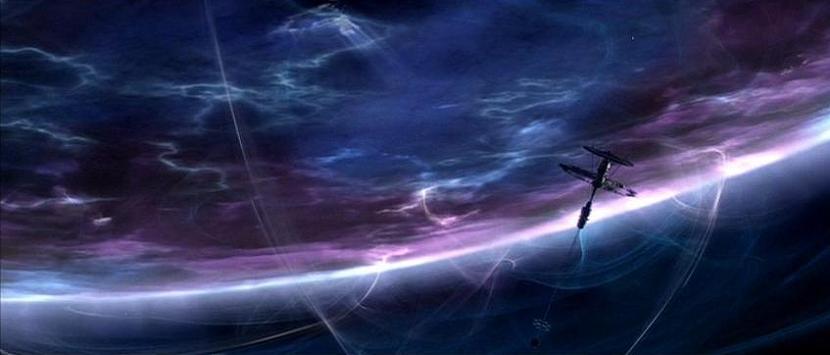
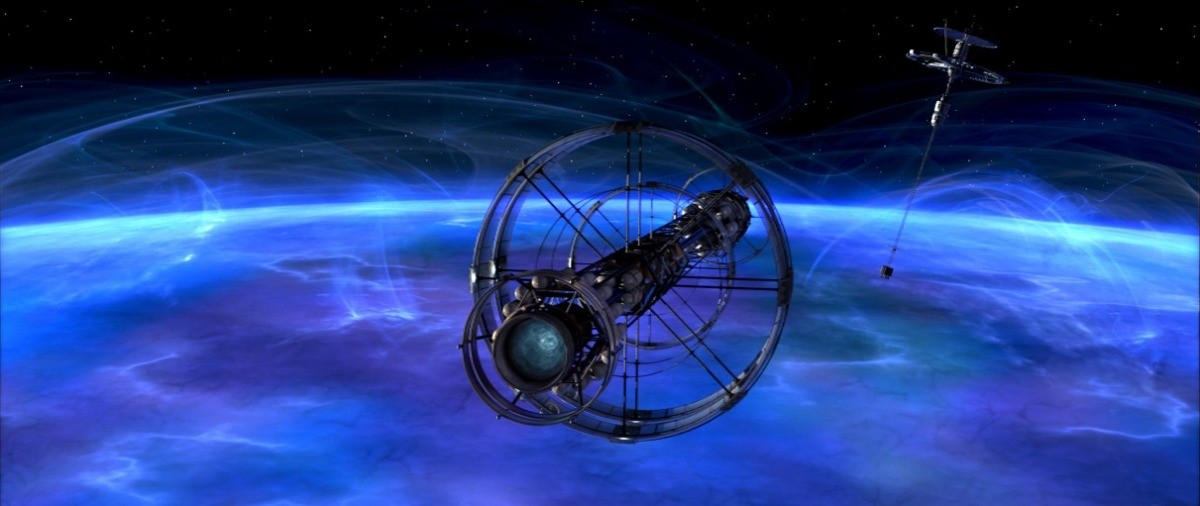
Kelvin arrives at the space station orbiting Solaris

Nina Munteanu is a Canadian ecologist / limnologist and novelist. She is co-editor of Europa SF and currently teaches writing courses at George Brown College and the University of Toronto. Visit www.ninamunteanu.ca for the latest on her books. Nina’s bilingual “La natura dell’acqua / The Way of Water” was published by Mincione Edizioni in Rome. Her non-fiction book “Water Is…” by Pixl Press(Vancouver) was selected by Margaret Atwood in the New York Times ‘Year in Reading’ and was chosen as the 2017 Summer Read by Water Canada. Her novel “A Diary in the Age of Water” was released by Inanna Publications (Toronto) in June 2020.
Overcoming Climate Change, One Story at a Time: “Stories for Earth” Interviews Nina Munteanu

I was recently interviewed by Forrest Brown on his podcast Stories for Earth, a site in Georgia devoted to entertaining and informing its audience on matters to do with climate change and environment and how literature represents and influences our understanding and behaviour in the current and future issues of planet Earth. The site’s mission statement reads: “Stories for Earth seeks to foster hope and emotional resilience by discussing cultural narratives that contain parallels and takeaways to our current predicament. Cultural narratives provide stories for our past, present, and future, and Stories for Earthcritically engages with these narratives through all mediums.”

This is what Forrest says about how and why he started his podcast:

I founded Stories for Earth in the summer of 2019. As a writer and lifelong lover of stories, I never suspected my two biggest interests might have something to do with fighting climate change. That is, until one day when I came across an article about an interesting class at the University of Washington Bothell.

This class, taught by senior lecturer Dr. Jennifer W. Atkinson, sought to help students struggling with the emotional effects of climate change, specifically with the feelings of hopelessness and despair associated with climate grief. Atkinson is a professor of environmental humanities and American literature, so naturally she chose to do this by examining climate change through what she knows best: literature.

After I read this, something clicked. Of course literature can help us face climate change, I thought. Literature and stories in general have helped humanity overcome countless struggles throughout the course of our history—why can’t they help us overcome climate change too?

Stories for Earth is my personal realization of that idea. I want to read books, watch movies, and engage with stories through any other medium out there that can better prepare me to fight climate change in my own way without losing my mind. This podcast is my way of sharing what I learn with you, the listener, and I hope you’ll follow along. If anything you hear sticks or helps you in some way, consider sharing it with a friend who might also benefit from it. We must take care of each other.

Here’s the blurb on the site for our interview

Nina Munteanu is a prolific and insightful Canadian science fiction writer who has published nine novels, including her most recent novel A Diary in the Age of Water. This novel imagines a Canada in the not-so-distant-future where water is becoming increasingly scarce, partially because water sources are drying up and partially because the US and China are buying up water from all the recently privatized Canadian utilities. As a limnologist–literally a fresh water scientist–it makes sense for Nina to be the one telling this story, and our conversation ranges from water shortages in the present day to Ray Bradbury to the need for a new paradigm for living.

We also discuss the connection between exploitive capitalism/colonialism and climate change, then move onto the new paradigm for living by looking at regenerative cultures, the gift economy used by many indigenous peoples, and the creation of an ecological civilization. 

Here’s the interview:

Here’s part of our interview:

  1. Tell me about yourself. How did you become a writer? Why do you think stories are important in the climate action movement?

I wasn’t much of a reader as a kid. While my older brother and sister devoured The Hardy Boys and Nancy Drew series, I hid myself in the back corner of Williams General store and read comics: Superman, Supergirl, Magnus Robot Fighter. I was obviously enamoured with the fantastic. When I earnestly started to read things other than comics, I came across the SF classics: Huxley, Orwell, LeGuin and Asimov to name a few. Ray Bradbury moved me and his “Martian Chronicles” made me cry. I wanted to write science fiction like him and move readers like he’d done with me. But I’d also discovered the sensual classics like Thomas Hardy. So, like most beginner writers, I started by imitating my favourites. Imagine the genre-confused chimeric stuff I was writing: Thomas Hardy crossed with Ray Bradbury? It wasn’t until I found my unique voice, which blended these with my passion for the environment, that my own voice emerged. The environment and how we treat it (and ourselves by extension) has always been something important to me since I was a kid when littering was a pet peeve—it still is… I think that the stories we tell help us define ourselves and our role on this planet. Climate fiction and eco-literature and solarpunk provide us with important narratives that both entertain and educate: from cautionary tales to constructive visualizations of a potential future.  

  • Your new novel A Diary in the Age of Water is the story of a young girl in the future who discovers a diary from a Canadian woman who wrote about her experiences living in an increasingly water-scarce Canada in the 2040s. What inspired you to write this story?

It started with a short story I was invited to write in 2015 about water and politics in Canada.  I had long been thinking of potential ironies in Canada’s water-rich heritage. The premise I wanted to explore was the irony of people in a water-rich nation experiencing water scarcity: living under a government-imposed daily water quota of 5 litres as water bottling and utility companies took it all. I named the story “The Way of Water.” It was about a young woman (Hilda) in near-future Toronto who has run out of water credits for the public wTap; by this time houses no longer have potable water and their water taps have been cemented shut; the only way to get water is through the public wTaps—at great cost. She’s standing two metres from water—in a line of people waiting to use the tap—and dying of thirst. The short story begged for more and that inspiration came when I attended a talk by Maude Barlow on her book Boiling Pointabout the water crisis in Canada. We were in a church and I noticed a young mother and her little six-year old daughter in the balcony; I wondered what kind of mother would bring her little girl to a political talk about water in Canada? The diarist character, Lynna, and her mother, Una, were born. It went from there with Lynna—the diarist—writing about not just water shortage but water related phenomena such as climate change, habitat destruction, hormone disruption and the alarming increased infertility in humans.

  • Coincidentally, I just interviewed another author, C.C. Berke, about his novel Man, Kind, in which people also become infertile in the future. I’ll be honest, this isn’t a problem I was really aware of until recently, but humans are indeed becoming less fertile with every new generation. Is this something you hoped to raise awareness about with your novel?

The short answer is yes! I hope it helps spark the much needed discussion. Rising infertility is an issue that seems to embarrass us … something we feel we must hide under the rug, so to speak. Like our misbehaving Uncle Zeek. But if we don’t talk about it, we can’t understand the underlying reasons for it, many of which are environmentally induced—things we should be addressing. 

  • Politics and big business play huge roles in your novel, as they do in real life as well. Canada has privatized its water utilities after the Conservative Party comes into power, and a giant company called CanadaCorp removes municipal water connections from people’s homes and imposes strict water rations, all while selling off Canada’s precious water to US states like California that would otherwise be uninhabitable. Given that Canada is home to a huge portion of the world’s freshwater, what role do you see Canada playing in the coming years when many prominent people—including the Vice President of the United States—have predicted that wars will one day be fought over water?

She’s right. But this isn’t just in the future; water wars are occurring right now and have for some time. Perhaps not between our two countries. Certainly in the middle east and Asia. There are tensions between Egypt, and nine upstream countries for control of water in the Nile watershed; the Sudanese and Ethiopians are building dams and Egypt plans to pump water from Lake Nassar into the Sahara. India, Pakistan, Bangladesh, and China are in conflict over control of rivers such as the Indus, Ganges, and particularly the Brahmaputra. India’s River Link Plan impacts Bangladesh. Meantime Pakistan, Kashmir and India fight over more and more water, as the Indus dries up and no longer flows into the ocean.

But let’s move closer to home, to North America and the premise of water conflicts here… Considering what you mentioned about Canada’s huge water storage of freshwater, water conflicts are inevitable. Canada and America border some significant water bodies such as the Great Lakes and various rivers like the Columbia River in the west. We’ve formed joint commissions along with treaties to manage these trans-boundary water bodies. They’ve often been highly electrified politically. The book by Eileen Delhanty Pearkes—“A River Captured”—explores the controversial history of the Columbia River Treaty and the huge dams built on that system that impacted ecosystems, indigenous peoples and local cultures in the Pacific Northwest. That didn’t go very well for Canada and particularly not for some of its indigenous peoples.  Another example that my book features is from the 1960s: the NAWAPA project, a plan by Ralph Parsons Company and the Army Corps of Engineers to make the entire Rocky Mountain Trench into a giant 800-km long reservoir to hydrate the US by inundating a fifth of British Columbia’s prime habitat, several towns and indigenous communities and literally destroy a fishery. But guess what? Congress was seriously looking at it and the plan keeps resurfacing among corporate entrepreneurs, engineers and politicians.

  • Going back to big business, do you think industry and sustainability are compatible? I know some cultural movements like solarpunk emphasize DIY and more small businesses over mass production and giant corporations. Do you have any thoughts on this? This is one of the defining questions of our time, but can we have both capitalism and a livable planet?

Some people—mostly economists—would say definitely yes; we just need to be conservationist in our approach to doing business. But the very basis of capitalism is exploitation, not conservation. The driving force behind capitalism is fear and uncertainty and its main process is exploitation. From an ecologist’s perspective, this makes sense for a community during its early succession and growth stage… when it first colonizes a new area. Ecologists call this approach r-selected (for rate), based on profligate and fast growth. But as we reach a climax community and our carrying capacity—where we are now—this r-selected approach no longer works. We need an economic model that better matches this new paradigm. NOT based on continued growth! A climax global economy, one based on cooperation not competition. Elisabet Sahtouris calls this ecological economy ecosophy. In his book “Designing Regenerative Cultures” Daniel Christian Wahl talks about changing our evolutionary narrative from one based on fear defined by a perception of scarcity, competition, and separation to one based on love defined by a perception of abundance, a sense of belonging, collaboration and inclusion. 

And moving forward we can take a lesson from Robin Wall Kimmerer who talks about a gift economy—an economy of abundance—whose basis lies in recognizing the value of kindness, sharing, and gratitude in an impermanent world. This is what she says: “Climate change is a product of this extractive economy and is forcing us to confront the inevitable outcome of our consumptive lifestyle, genuine scarcity for which the market has no remedy. Indigenous story traditions are full of these cautionary teachings. When the gift is dishonored, the outcome is always material as well as spiritual. Disrespect the water and the springs dry up. Waste the corn and the garden grows barren. Regenerative economies which cherish and reciprocate the gift are the only path forward. To replenish the possibility of mutual flourishing, for birds and berries and people, we need an economy that shares the gifts of the Earth, following the lead of our oldest teachers, the plants.”

  • The diary entries in your novel make frequent reference to the post-truth era we seem to be living in. I feel like we’ve been heading in this direction for a while (it seems as though books like Manufacturing Consentby Noam Chomsky and Edward S. Herman and 1984by George Orwell have documented this), but I think many people feel as though we officially entered the post-truth era when Kellyanne Conway used the term “alternative facts” in a Meet The Pressinterview in 2017. Again, this is another huge question of our time, but how do those of us pushing for climate action make progress when entire political parties like the Republican Party in the US and the Conservative Party of Canada are in blatant denial of reality? (Actually, it seems worse than denial of reality—they use the fascist tactic of disregarding reality and replacing it with their own reality, even though they know what they’re doing.)

I have absolutely no answer for that! LAUGH! ARGH! But seriously, how do you convince someone about an evidence-based truth when they are living by a faith-based or agenda-based truth? As a scientist who has lived most of her life doing research and learning to accept the truth of evidence, I find this belief or stance incomprehensible. So you weren’t asking me a question, were you? Well, I’ve heard some great advice on this actually and that is to appeal to a person’s compassion, their kindness, their links to family and friends and find some common ground through their humanity in the phenomenon—say a local manifestation of climate change—then work from there. Keep it local and practical and nonthreatening. In other words, take the science out of it and the belief out of it and appeal on humane grounds. You can’t convince someone to change their belief, but you might be able to persuade them to accept an aspect of something if it doesn’t threaten their belief. 

  • I’d like to talk about the persistence of colonialism and how it’s tied to the climate crisis. In your novel, enormous swaths of British Columbia have been turned into reservoirs to store water to sell to Americans. Doing this displaces lots of people, especially indigenous and First Nations people. But things like this are happening even now. In Minnesota, the Canadian energy company Enbridge has spent hundreds of thousands of dollars paying local police departments to stop Water Protectors from blocking construction of Line 3, which would desecrate indigenous land and transport tar sands oil to US refineries. Could you talk a little about the importance of protecting indigenous and First Nations people’s rights, especially in the climate action movement?

You cite a great example of capitalist exploitation in the fossil fuel industry, which is occurring everywhere on the globe. As I mentioned already, Local and Traditional Ecological Knowledge lies at the heart of preserving this planet’s health and balanced climate. And Indigenous people around the world are regaining control of their territorial environments to reinvigorate food security, governance, social relations and economies. To quote Steven Nitah of the Dene First Nation, “because of their attachment to, and dependence on the land, Indigenous Peoples have been establishing their own protected areas for millennia.”

Luckily, we’re getting on board with this on a grass roots level and even government level—where it needs to be. An example of this are the Indigenous-led conservation movements like the Indigenous Guardians and the IPCAs (the Indigenous Protected and Conserved Areas) where indigenous governments have the primary role in protecting and conserving ecosystems through indigenous laws, governance and knowledge systems. This is linked to the United Nations Declaration of the Rights of Indigenous Peoples (UNDRIP)—specifically Articles 29 and 32—to govern themselves and their territories and to conserve and protect them. British Columbia in Canada sees many examples of Indigenous-led conservation leadership such with the Tla-o-qui-aht and Haida. 

An example I’m following is the Heiltsuk Nation on the Great Bear Sea who have enacted an Oceans Act to protect their ocean relatives and particularly the Pacific herring—a keystone species. The Heiltsuk-herring relationship have thrived over millennia through a system of traditional ecological knowledge, gwee-ee-las, and sustainable harvesting practices. Under current legislation overseen by DFO, commercial fisheries have pretty much destroyed the herring fishery through unsustainable practices. While the Heiltsuk’s stewardship and governance of this area was recently recognized by Canada’s provincial and federal governments, DFO continued to operate separately through settler law, opening herring seine fishery in violation of Heiltsuk constitutional rights. Then they finally collaborated. We’re working it out. It’s an ongoing conversation. 

  • We live in a time where it is so hard to decipher what is true, what is propaganda, and what is conspiracy theory. Your novel deals with this theme a lot through the character Daniel and his obsession with a social media-like platform called Oracle. Could you talk about writing this character and what inspired his creation?

Daniel is a kind of twisted hipster version of an oracle. Young. Wise. Naïve all at the same time.  I brought him in as a trickster archetype, and a kind of foil to Lynna, the main character in the diary part of the book. He’s her technician and work mate and ends up being her link to the world of gossip and dark truths repressed by the corporations via the traditional internet. He finds these gems in the quagmire of the net to share with her over coffee. He’s really a very bright and astute technologist, but he also seems naïve in some ways. For instance, he’s a researcher who dabbles in conspiracy theory. He’s all about health but he smokes. So, a man of contradictions. So, even though he is Lynna’s coffee companion and amuses her, he also unsettles her. In true trickster fashion, he finds out her secret and pays for it. His character allows me to explore the best and worst of the diarist character Lynna. 

  • I hope I’m not giving too much away with this question (we can skip it if you don’t want spoilers), but I want to talk about one of the central themes of the book: is it possible to save the Earth while saving humanity? The author of the diary, Lynna, writes about her water activist daughter, Hilde, a little over halfway through the book: “Does Hilde realize that she’s an oxymoron? To fight for water and the environment is to fight against humanity. Because at the root of Daniel’s question—would you save the planet at the expense of humanity?—lies the deeper question: can humanity exist without destroying the environment? And has Hilde made her prognosis? I know Una still believed in her heart that we could. I always thought her optimism was naïve.” For a long time, it seems like a narrative of the environmental movement was that humans are a virus. But now, there’s a big pushback against this narrative, with activists pointing to the systemic players who bear the most responsibility for the climate crisis. What do you think? Are humans the root problem?

On the surface, I’d say yes. Of course we are. But that is a far too simple and easy answer. It’s the easy way out. It isn’t so much that we’re human that created the climate crisis. It is that we— most of us—live and subscribe to a worldview and belief system that came from a place of great uncertainty with a perception of scarcity and an existential model based on fear and separation. Ancient peoples and most indigenous people today do not hold themselves as separate from the land; they already live in ecological civilizations. An ecological civilization is both a new and ancient idea. Buddhist, Taoist, and other traditions base their spiritual wisdom on the deep interconnectedness of all things. According to Robin Wall Kimmerer “In indigenous ways of knowing, it is understood that each living being has a particular role to play. Every being is endowed with certain gifts, its own intelligence, its own spirit, its own story…The foundation of education is to discover that gift within us and learn to use it well.” I think we’re starting to do this. Partly through listening to the Traditional Ecological Knowledge of our indigenous peoples.

I do believe that human nature is basically empathic and cooperative over selfish and competitive; I think we are born the former and taught to be the latter. That is what needs to change. How we are taught. 

  1. On a related note, the issue of overpopulation is a highly controversial topic in the environmental movement. This has led to some fear-mongering from Conservative politicians who tell their constituents that climate activists want to make a “one child” law like the draconian one-child policy in China that began in the late 70s as part of a government program to curb population growth. Yet, overpopulation is an enormous problem, with Project Drawdown saying, “Education lays a foundation for vibrant lives for girls and women, their families, and their communities. It also is one of the most powerful levers available for avoiding emissions by curbing population growth. Women with more years of education have fewer and healthier children, and actively manage their reproductive health.” Do you think overpopulation needs to be part of the conversation in the environmental movement? Do you think there are times when pointing to this issue as it relates to climate change is problematic?

It certainly can polarize and spark conflict. Reproduction and the right to reproduce is an innate impulse of all life: to make more of itself. So, we’re in conflict with ourselves already. I agree with Project Drawdown. But how to enter into a rationale and productive discussion on this issue relies on the players, their rationale, perspective, and their personal feelings on the matter. We kind of know there should be fewer of us but how to achieve that is another matter. It comes down to ecological footprints and living lightly on the earth and other philosophical considerations. You and I talked earlier about infertility. It seems a macabre kind of irony going on with habitat degradation caused partially by over-population sparking infertility in humans through endocrine disrupting chemicals in our drinking water…

  1. Change is another big theme in your novel, reminding me of Octavia E. Butler’s masterpiece Parable of the Sower, in which she writes, “God is change.” In your novel, Lynna writes, “Trapped by our preordained notion of change, we no longer see what we’re not prepared to see. And that’s the change that kills us.” The problem with climate change is that everything is happening too fast for biological evolution to keep pace. There’s a lot of buzz about transhumanism right now—do you think we’re approaching a point where humans will have to take evolution into our own hands, so to speak, if we want to survive?

It isn’t our intelligence—our cleverness—that will save us; it is our kindness and compassion that will do that. We don’t need to invent some techy thing or reinvent ourselves or implant some intelligent virus into us. What we simply need to do is accept ourselves with humility, find and express joy. Give in to the beauty of our world and our own part in it. Become a participant. Embrace the feminine. Respect Nature and all that lies in it. Find something there to love, cherish it and protect it. The rest will follow. 

Nina Munteanu and Forrest Brown on “Stories for Earth” Podcast

Nina Munteanu is a Canadian ecologist / limnologist and novelist. She is co-editor of Europa SF and currently teaches writing courses at George Brown College and the University of Toronto. Visit www.ninamunteanu.ca for the latest on her books. Nina’s bilingual “La natura dell’acqua / The Way of Water” was published by Mincione Edizioni in Rome. Her non-fiction book “Water Is…” by Pixl Press(Vancouver) was selected by Margaret Atwood in the New York Times‘Year in Reading’ and was chosen as the 2017 Summer Read by Water Canada. Her novel “A Diary in the Age of Water” was released by Inanna Publications (Toronto) in June 2020.

Nina Munteanu Talks About ‘Water Is…’ and ‘A Diary in the Age of Water’ with Dr. Steven Miletto

Nina Munteanu appears on “Teaching, Learning, Leading, K-12” Podcast with Dr. Steven Miletto

I was recently interviewed by Dr. Steven Miletto in Georgia on his podcast “Teaching Learning Leading K12”—Episode 401. We talked about my two recent books on water,Water Is…and A Diary in the Age of Water. The 1-hour interview covered a range of topics from why water makes us feel so good, to the study of limnology, and writing both non-fiction and fiction about water. In the latter, I talked about water as a character in story. We also talked about how characters form in a story and how to keep going when the muse or the joy buries itself.

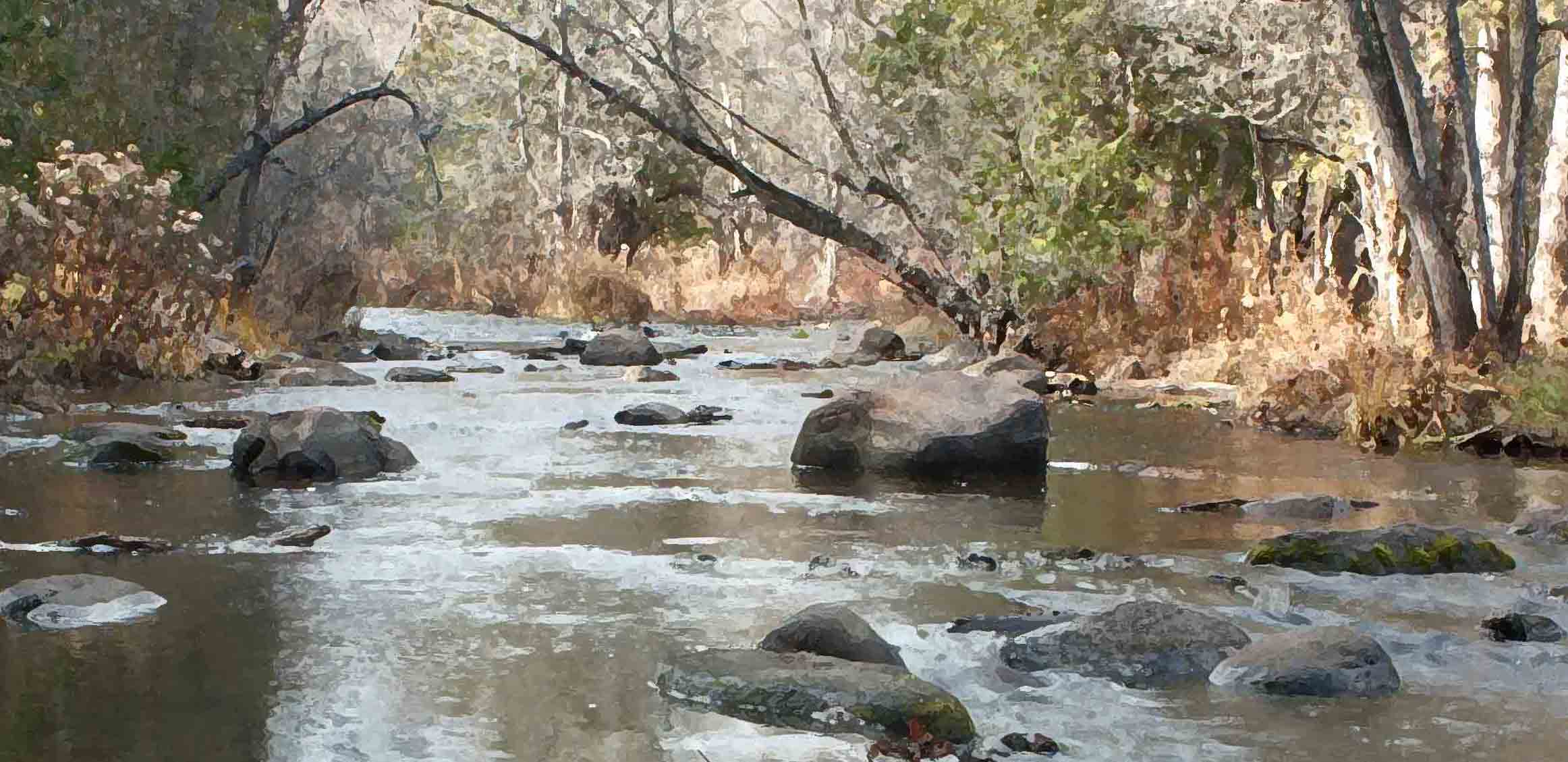
Jackson Creek, ON (photo and dry-brush rendition by Nina Munteanu)

Nina Munteanu is a Canadian ecologist / limnologist and novelist. She is co-editor of Europa SF and currently teaches writing courses at George Brown College and the University of Toronto. Visit www.ninamunteanu.ca for the latest on her books. Nina’s bilingual “La natura dell’acqua / The Way of Water” was published by Mincione Edizioni in Rome. Her non-fiction book “Water Is…” by Pixl Press(Vancouver) was selected by Margaret Atwood in the New York Times ‘Year in Reading’ and was chosen as the 2017 Summer Read by Water Canada. Her novel “A Diary in the Age of Water” was released by Inanna Publications (Toronto) in June 2020.

Nina Munteanu Talks Books, Water and Climate Change on Warren Lawrence’s Morning Show WKNY am Radio Kingston

I recently appeared on Warren Lawrence’s Morning Show on WKNY am Radio Kingston, New York, where we talked about water as a life-giving substance and a force of climate change. We talked, of course, about my recent eco-fiction novel “A Diary in the Age of Water”, which Warren had totally enjoyed and recommended to his listening audience (to my delight!) 

Warren asked me to share my process of writing this particular book as a diary and a work of “mundane science fiction:”

I was writing about both the far and the near future and much of it was based—like Margaret Atwood and her books—on real events and real people. I wanted personal relevance to what was going on, particularly with climate change. I also wanted to achieve a gritty realism of “the mundane” and a diary felt right. Lynna—the diarist—is a reclusive inexpressive character, so I thought a personal diary would help bring out her thoughts and feelings. There’s nothing like eves-dropping to make the mundane exciting. The diary-aspect of the book characterizes it as “mundane science fiction” by presenting an “ordinary” setting for characters to play out. The tension arises from insidious cumulative events and circumstances that slowly grow into something incendiary. The real events are the fuel that incite a slow-burn fictional drama that blurs the reader’s perception of reality and heightens its relevance.

We talked at length about the blur between real events and the fiction of this book and how the diary conspired in that felt blur for the reader. To Warren’s question of what I expected my audience to get from the book, particularly on the importance of water, I responded: 

While A Diary in the Age of Water is a work of fiction, its premise and much of its story are firmly based on real events, people and phenomena. The dramatization of these through four main characters carry the reader into consequence and accountability. Water’s relationship with each character provides four different perspectives on the value of water to humanity—from the personal and practical to the spiritual and existential. For readers with an evidence-based approach to learning about water’s importance, the diarist provides interesting facts on water in each of her entries in the form of epigraphs (mostly from Robert Wetzel’s Limnology). Things like: watershed, hypolimnion, aquifer, thalweg, clapotis gaufre, and petrichor, to name a few. 

Regarding whether Canadians see water, deforestation, pollution, or climate change differently than Americans, I responded:

My first response to that is no, we’re all North Americans. If there is a noticeable divergence, it is between North Americans and the rest of the world, based on our shared capitalist worldview and mixed settler and indigenous heritage. But Canadians do share some subtle differences from our southern neighbours. We are a northern people; much of our land lies in the unsettled northern boreal forest. Our population is far more sparse at five people/km2vs. close to 40 people/km2in America. With a majority of our population occupying the most southerly ten percent, Canada has large regions of pristine natural environments. I once entertained a ‘romantic’ metaphoric notion of Canadians resembling the settlers of Winterfell in the Westeros of Game of Thrones; a people more attuned to their land. Canadians profess to place environment high on our list of values and concerns. And yet we share a legacy of appalling forest management, rampant clearcutting of old-growth forest in British Columbia, insufficient federal and provincial water legislation, and environmentally-catastrophic mining practices in the oil tar sands of Alberta, the northern boreal forest of Canada and abroad.

Warren and I also talked about New York state and NYC, particularly to do with climate change, and how NYC fared in the novel (not well, I’m afraid). As example, I read a portion of the book from the diarist’s entry called “Climate Change”:

When I was growing up, we were already feeling the effects of a changing climate. The most obvious change was in the hundred-year floods calculated by engineers; they started to occur every other year. When I was five years old, Houston suffered a devastating flood and the city and surrounding area basically crashed under the wind and rain deluge of Hurricane Harvey. They lost power. Then their sewers backed up. But it didn’t get ugly until they lost their drinking water.

Five years later the Category 3 Hurricane Norma stormed though New York City with a twelve-metre-high wall of water. Manhattan drowned. Subways and car tunnels drowned. Kennedy Airport drowned. Homes drowned. People drowned.

The same storm put Providence, Rhode Island, under twenty feet of water.

A few days ago, Daniel told me that New York City water is still unfit to drink. “New York will be the new Pudong District,” he quipped with churlish humour. All of Florida south of Orlando is already there. “Like they weren’t warned,” he scoffed.

–A Diary in the Age of Water
Pond lilies in Thompson Creek marsh, ON (photo and rendition by Nina Munteanu)

Nina Munteanu is a Canadian ecologist / limnologist and novelist. She is co-editor of Europa SF and currently teaches writing courses at George Brown College and the University of Toronto. Visit www.ninamunteanu.ca for the latest on her books. Nina’s bilingual “La natura dell’acqua / The Way of Water” was published by Mincione Edizioni in Rome. Her non-fiction book “Water Is…” by Pixl Press(Vancouver) was selected by Margaret Atwood in the New York Times‘Year in Reading’ and was chosen as the 2017 Summer Read by Water Canada. Her novel “A Diary in the Age of Water” was released by Inanna Publications (Toronto) in June 2020.
Nina Munteanu Talks Water, Writing, and Weather on ‘All About Canadian Books’

I recently had the pleasure of chatting with Crystal Fletcher on “All About Canadian Books” about my recent clifi dystopian novel “A Diary in the Age of Water.” We covered a number of topics from water’s over 70 anomalous properties–virtually all of them life-giving–to how water seems to inform all aspects of my life, particularly my writing life. Crystal was particularly fascinated with the four generations of women in the book and we talked at length about how these characters were developed and the roles they played in the greater saga.

After bringing up the Toronto Star’s question of me (“What keeps you up at night about climate change”) in which I admitted that I lose sleep over the thought of how my son and his children will fair in this changing world, Crystal admitted that “Your book, Nina, is an eye opener…it freaked me out when I was reading it…and now I’m losing sleep!”

Hardwood forest back lit by glittering Otonabee River, ON (photo and rendition by Nina Munteanu)

Nina Munteanu Talks Water and Writing on Kentucky’s WMST-am Radio

Dan Manley interviews Nina Munteanu on Mid Morning on Main WMST-AM Radio

I was recently interviewed (on June 21) by Dan Manley on Kentucky’s Mid-Morning on Main show on WMST-AM Radio. I’ve visited Kentucky several times before, including the famous Bardstown Road in Louisville, but this time it was a virtual visit.

Dan and I talked about how I became a limnologist and ecologist, about my growing up in a small town and playing in the local forest with my older brother and sister and how we made ‘potions’ out of moss, soil, evening nightshade and water.

We talked about my recent eco-novel “A Diary in the Age of Water” and why I wrote it and its effect on people. We covered the difference between stereotypes and archetypes and how science informs me and my writing. We also explored how life changes us and our writing and how writing, in turn, changes us.

We covered a vast range of water-related topics from the movie “Water World” to the TV show “Bonanza.” We talked about water scarcity and water politics and what Canada was doing and what’s happening in America.

I really enjoyed this interview because Dan asked me some surprising and challenging questions that led us into interesting territory. My interview with him starts about 43 minutes into the show. Go have a listen!

Otonabee River sparkles behind a hardwood forest in spring, ON (photo and dry brush rendition by Nina Munteanu)

Nina Munteanu is a Canadian ecologist / limnologist and novelist. She is co-editor of Europa SF and currently teaches writing courses at George Brown College and the University of Toronto. Visit www.ninamunteanu.ca for the latest on her books. Nina’s bilingual “La natura dell’acqua / The Way of Water” was published by Mincione Edizioni in Rome. Her non-fiction book “Water Is…” by Pixl Press(Vancouver) was selected by Margaret Atwood in the New York Times‘Year in Reading’ and was chosen as the 2017 Summer Read by Water Canada. Her novel “A Diary in the Age of Water” was released by Inanna Publications (Toronto) in June 2020.

Squirrel Joy

Grey squirrel munching on a maple seed, ON (photo by Nina Munteanu)

Do you believe in serendipity or destiny? That all things are interconnected in a flowing web that responds like a super consciousness? 

Swiss psychiatrist Carl Jung called it “meaningful coincidence.” Bohm used the term “implicate order”; the Vedas call it “akasha; Goethe gave it the name “the ground of all being”; and Mae-Wan Ho described it as “quantum entanglement”: when puzzle pieces cooperatively arrange themselves into a symbiotic pattern of synchronicity to provide meaning. 
The universe provides…

I’ve come to rely on it in my writing: moments when key things of interest reveal themselves to me just when I need them. I call it writing in sync. Time and again, I’ve serendipitously discovered just what I needed for a plot point or something to complete a backstory: a news event, a conversation with a friend, or an image on the internet. Synchronicity occurs all around us. Birds flying in formation during migration. Electrons synchronizing by the billions and passing through impenetrable barriers. Fireflies flashing in harmony.

Rupert Sheldrake , British botanist and author of The Rebirth of Nature, suggests that “our minds are extended in both space and time with other people’s minds, and with the group mind or cultural mind by way of their connection to the collective unconscious.” Sheldrake posits that we tune into archetypal fields or patterns and “our minds are much broader than the ‘things’ inside our brains. He’s talking about Jungian archetypal gestalt synchronicity. The notion of consciousness as a global phenomenon that occurs everywhere in the body, not just our brains. “Consciousness, at its most basic, [is] coherent light,”writes science journalist Lynne McTaggart in her book The Field

young black squirrel lies on the branch of a silver maple tree (photo by Nina Munteanu)

It started when I was lunching with good friend Merridy and we were observing several young black and grey squirrels stretched out, lying down on the grass or a branch of the silver maple. They were obviously litter mates and had just finished a playful romp on the grass with sneak-ups, great leaps in the air, twirls and ‘attacks’ and rolls. Such fun! Merridy and I agreed that they looked satisfied and happy after their play, stretched out and languishing in the sun. We talked about how playful squirrels were and how science didn’t seem to acknowledge this. That led to a discussion on people’s perception being largely based on worldview. I shared how we see only what we’re prepared to see and we discussed how science, in its preoccupation with objectivity, can take the ‘soul’ out of life by not observing as much as it could by observing. The concept of anthropomorphism—ascribing exclusively human traits and behaviours to other animals—is based on our own limited definition of what is an exclusively human trait. Who unequivocally proved that only humans are capable of thought or feelings? This recalled a quote of Goethe that I used in the preface of my book Water Is…: “Whatever you cannot calculate, you do not think is real.” We are often blinded by our beliefs and hubris. 

Young grey squirrel climbs up the silver maple tree, ON (photo by Nina Munteanu)

During the 1600s in what is ironically called the “Age of Enlightenment,” the highly regarded philosopher René Descartes denied thought to animals; he claimed that animals could not process pain through thought and certainly not through emotions such as joy, sadness, or embarrassment. Only humans were conscious, had souls, and were capable of meaningful communication and language. What he failed to observe—in his own pet dog, even—was that animals other than humans are capable of these thoughts and emotions. One need only pay attention through an unrestricted lens to recognize their expressions and behaviours. 

In western exploitive society and religions particularly, this Cartesian view has persisted into the present day with those who still argue that animals are incapable of altruism or empathy, can’t reason or calculate, are bound by the “selfish gene”, and don’t have souls. These persist in the face of scientific evidence to the contrary and ironically serve an economic and social worldview of Nature exploitation.

Then, in a wonderfully serendipitous moment of synchronicity, Merridy announced the next day that she had just read the following passage by David George Haskell in his recent book The Forest Unseen. It was as though he had overheard our conversation about the squirrels:

Four grey squirrels loaf in the bright upper branches of a dead shagbark hickory tree fifty meters down the slope. I watch them for an hour, and mostly they loll in the sun, limbs sprawled. They seem companionable, sporadically nibbling the fur on one another’s hind legs or tails. Occasionally one will break from sunbathing and chew the fungus-encrusted dead branches, then return to sit silently with the other squirrels.

This scene of scoured tranquility makes me unaccountably delighted. Perhaps I so often see and hear squabbling among the squirrels that today’s ease seems particularly sweet. But something more is behind my delight; I feel freed from some burden carried by my over-trained mind. Wild animals enjoying one another and taking pleasure in their world is so immediate and so real, yet this reality is utterly absent from textbooks and academic papers about animals and ecology.

This insight is not that science is wrong or bad. On the contrary; science, done well, deepens our intimacy with the world. But there is a danger in an exclusively scientific way of thinking. The forest is turned into a diagram; animals become mere mechanism; nature’s workings become clever graphs. Today’s conviviality of squirrels seems a refutation of such narrowness. Nature is not a machine. These animals feel. They are alive; they are our cousins, with the shared experience that kinship implies.

And they appear to enjoy the sun, a phenomenon that occurs nowhere in the curriculum of modern biology.

Sadly, modern science is too often unable or unwilling to visualize or feel what others experience. Certainly science’s “objective” gambit can be helpful in understanding parts of nature and in freeing us from some cultural preconceptions. Our modern scientific taste for dispassion when analyzing animal behaviour formed in reaction to the Victorian naturalists and their predecessors who saw all nature as an allegory confirming their cultural values. But a gambit is just an opening move, not a coherent vision of the whole game. Science’s objectivity sheds some assumptions but takes on others that, dressed up in academic rigour, can produce hubris and callousness about the world. The danger comes when we confuse the limited scope of our scientific methods with the true scope of the world. It may be useful or expedient to describe nature as a flow diagram or an animal as a machine, but such utility should not be confused with a confirmation that our liming assumptions reflect the shape of the world.

Not coincidentally, the hubris of narrowly applied science serves the needs of the industrial economy. Machines are bought, sold, and discarded; joyful cousins are not.

David George Haskell, “The Forest Unseen”
Grey squirrel peers at the camera, ON (photo by Nina Munteanu)
A sugar maple tree flowers in early spring in Ontario (photo and dry brush rendition by Nina Munteanu)

Nina Munteanu is a Canadian ecologist / limnologist and novelist. She is co-editor of Europa SF and currently teaches writing courses at George Brown College and the University of Toronto. Visit www.ninamunteanu.ca for the latest on her books. Nina’s bilingual “La natura dell’acqua / The Way of Water” was published by Mincione Edizioni in Rome. Her non-fiction book “Water Is…” by Pixl Press(Vancouver) was selected by Margaret Atwood in the New York Times ‘Year in Reading’ and was chosen as the 2017 Summer Read by Water Canada. Her novel “A Diary in the Age of Water” was released by Inanna Publications (Toronto) in June 2020.