How Maude Barlow Sparked My Novel “A Diary in the Age of Water”

Maude Barlow, author of Boiling Point, Chairman of the Council of Canadians

Like a car, every novel has its point of ignition: a spark that sets it in motion. This occurs when a premise or idea comes together with an incendiary moment of clarity or a thematic question. Mine—though I didn’t know it at the time—happened in a church on the Summer of 2016.

I was in a United Church on Bloor Street, in Toronto’s Annex, watching a talk given by Maude Barlow on water justice. The radical talk was based on her recent book Boiling Point, a comprehensive exploration of Canada’s water crisis—a crisis that most Canadians weren’t—and still aren’t—aware. Canada is steward to a fifth of the world’s fresh water, after all. It is a water-rich country. Of the dozen largest inland lakes in the world, Canada holds eight of them. So, why water crisis? Barlow explains. And you should read Boiling Point, particularly if you’re Canadian. It will open your eyes to the politics of water and how multinational corporations—like Nestlé—are already grabbing and funneling water away from Canadians and into the global profit machine.

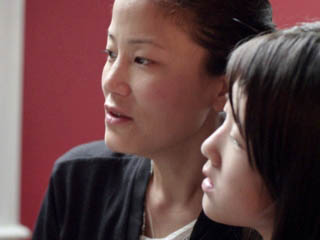
I sat close to the front of the Church sanctuary to best see her. But I soon noticed that many people had elected to sit in the gallery above. I found myself focusing on a young mother and her little girl. The girl had some paper and crayons and was busy with that as the enthusiastic mother listened to Maude deliver dire facts about corporate water high-jacking and government complicity.

I saw a story there.

What mother would take her pre-school child to a socio-political talk on water? I would later reflect that memory of the mother and her little girl through my characters Una and her little daughter Lynna, the diarist in my novel A Diary in the Age of Water (eventually published in 2020 with Inanna Publications).

Fresh water flows down the barrel of a hand-operated water pump.

My novel really began with a short story I was invited to write in 2015 by editors of Future Fiction and Mincione Edizioni about water and politics in Canada; the premise of this story would later find it’s way into the larger novel. I had long been thinking of potential ironies in Canada’s water-rich heritage. The premise I wanted to explore was the irony of people in a water-rich nation experiencing water scarcity: living under a government-imposed daily water quota of 5 litres as water bottling and utility companies took it all. I named the story “The Way of Water.” It was about a young woman (Hilda) in near-future Toronto who has run out of water credits for the public wTap; by this time houses no longer have potable water and their water taps have been cemented shut; the only way to get water is through the public wTaps—at great cost. She is in a line of people; she’s two metres from water—and dying of thirst.

The Way of Water” captures a vision that explores the nuances of corporate and government corruption and deceit together with global resource warfare. In this near-future, Canada is mined of all its water by thirsty Chinese and US multinationals—leaving nothing for the Canadians. Rain has not fallen on Canadian soil in years due to advances in geoengineering and weather manipulation that prevent rain clouds from going anywhere north of the Canada-US border. If you’re wondering if this is possible, it’s already happening in China and surrounding countries.
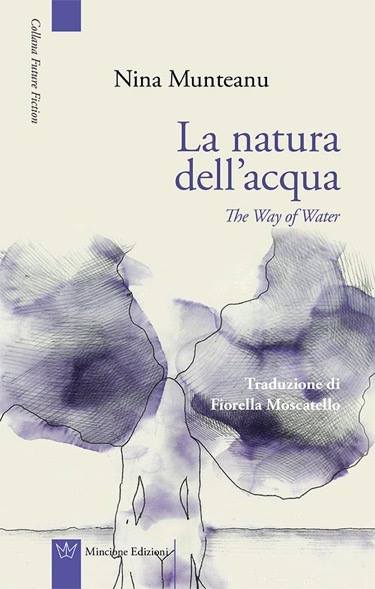
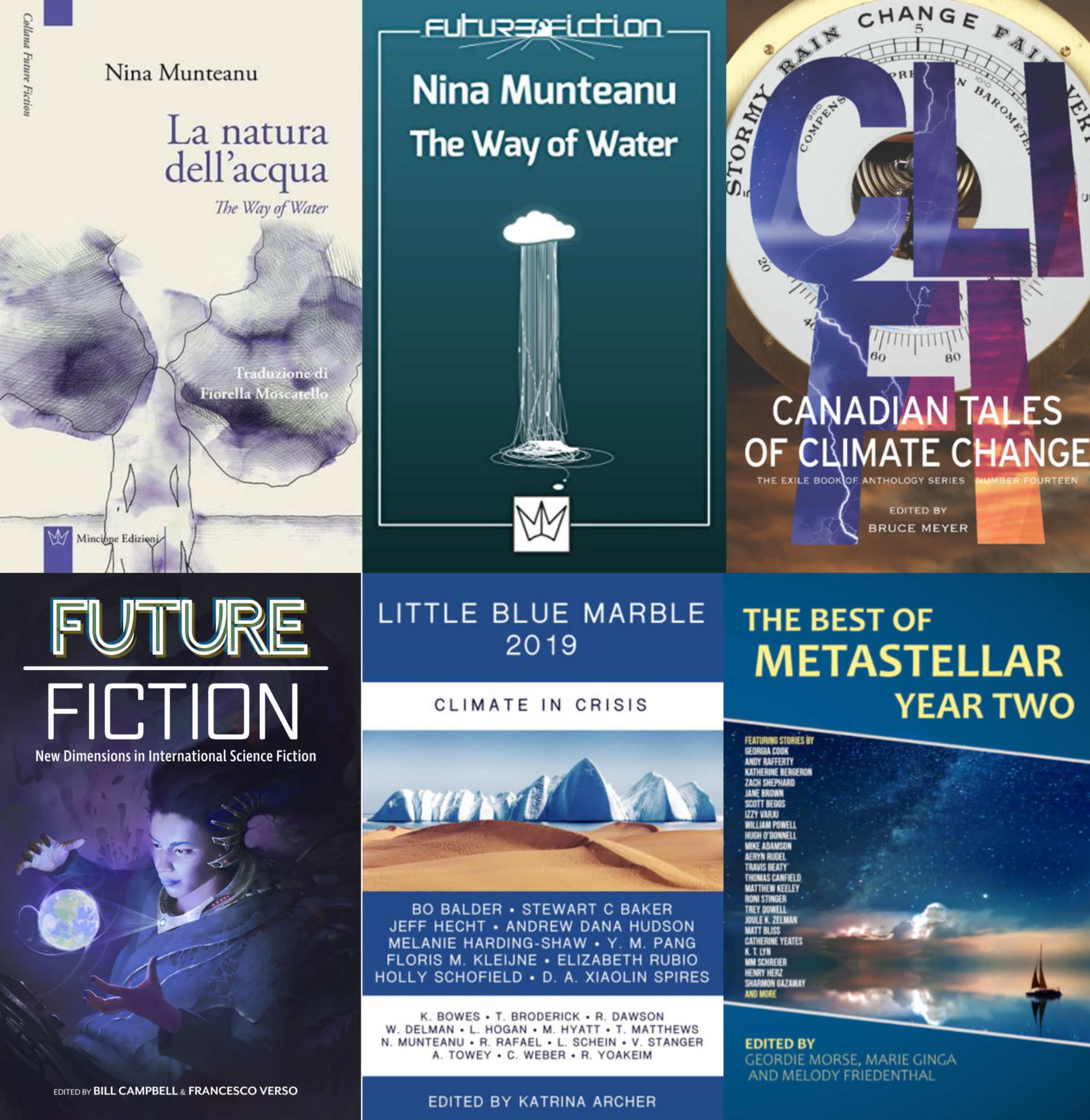
The story first appeared in 2015 in Future Fiction, edited by Francesco Verso, and in 2016 as a bilingual (English and Italian) book and essay published by Mincione Edizioni in Rome. The story has so far been reprinted seven times in magazines and anthologies, including “Cli-Fi: Canadian Tales of Climate Change Anthology” (Exile Editions, Bruce Meyer, ed), in 2017, “Future Fiction: New Dimensions in International Science Fiction” (Francesco Verso & Bill Campbell, eds; Future Fiction / Rosarium Publishing, Rome and Greenbelt, MD) in 2018; and in Little Blue Marble Magazine (Katrina Archer, ed) in January, 2019 and in their ‘Best of’ anthology. It was then published in 2022 in Metastellar Magazine and later in their ‘Best of’ anthology. “The Way of Water” received generous praise from review sites and the press worldwide.

After the success of this short story, I realized that I needed to tell the larger story—how did the world—Canada—get to where Hilda was? Her mysterious mother, the limnologist Lynna who was taken away by the RCMP in 2063, clamored for more attention. I remembered that four-year old girl and her mother in the gallery at Maude Barlow’s talk on water politics. And I thought of my characters: young Lynna and her mother Una. How does a daughter of an activist mother behave and think? How best to express her voice? I had earlier written a short story that was a mix of correspondence (emails) and third person narrative (“The Arc of Time” in Natural Selection, later reprinted in Metastellar Magazine), which I felt captured the voices of the characters well. I realized that a diary by Lynna would be an ideal way for her to express her unique worldview and cynicism—yet allow her vulnerable humanity to reveal itself through this unique relationship with her diary. The remaining characters and their narratives emerged easily from there: Una, her activist mother; Daniel, her conspiracy theorist colleague (and her conscience); Orvil, the water baron (and lover she betrayed); and Hilda, her “wayward” supposedly mind-challenged daughter—who appears in the short story that takes place later.
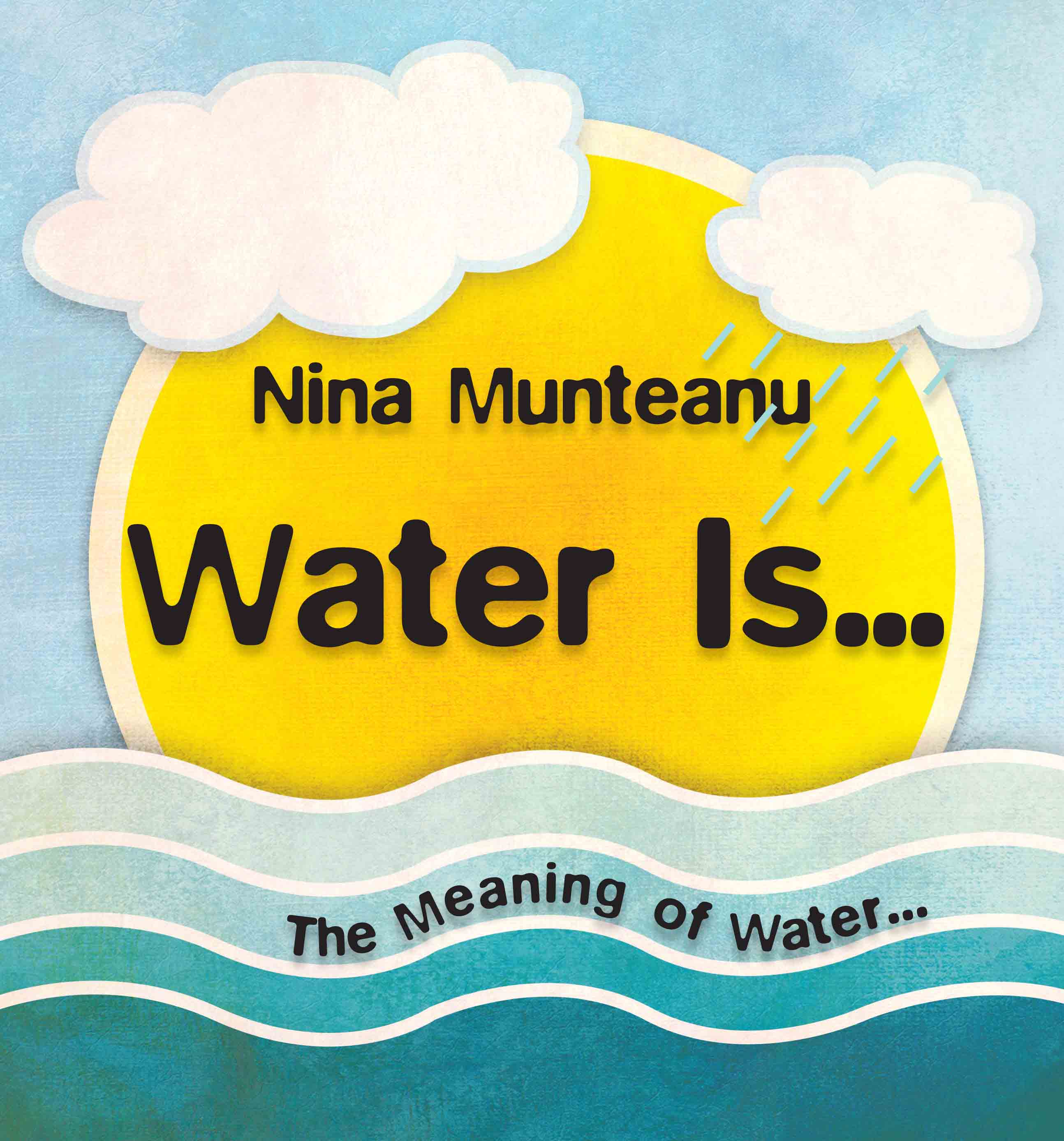
I had a lot of material; I had already been researching water issues and climate change in my activism as a science writer and reporter. In 2016, Pixl Press had published “Water Is… The Meaning of Water”, essentially a biography of water, written from the perspective of mother, environmentalist and scientist. I had practiced as a limnologist for over twenty-five years and could mine my various personal experiences in the field, lab and office with genuine realism. I chose Wetzel’s Limnology (the classic text book I used in my introductory limnology course) for quotes to each of Lynna’s entries; this added an opportunity to provide additional metaphor and irony through Lynna’s scientific voice. I placed the child Lynna (who was born in 2012) into actual events in Toronto, where I currently live. This pushed the story further into the area of documentary and blurred the lines between fiction and non-fiction to achieve a gritty and textured reality. Lynna also taught limnology at the University of Toronto, where I currently teach.
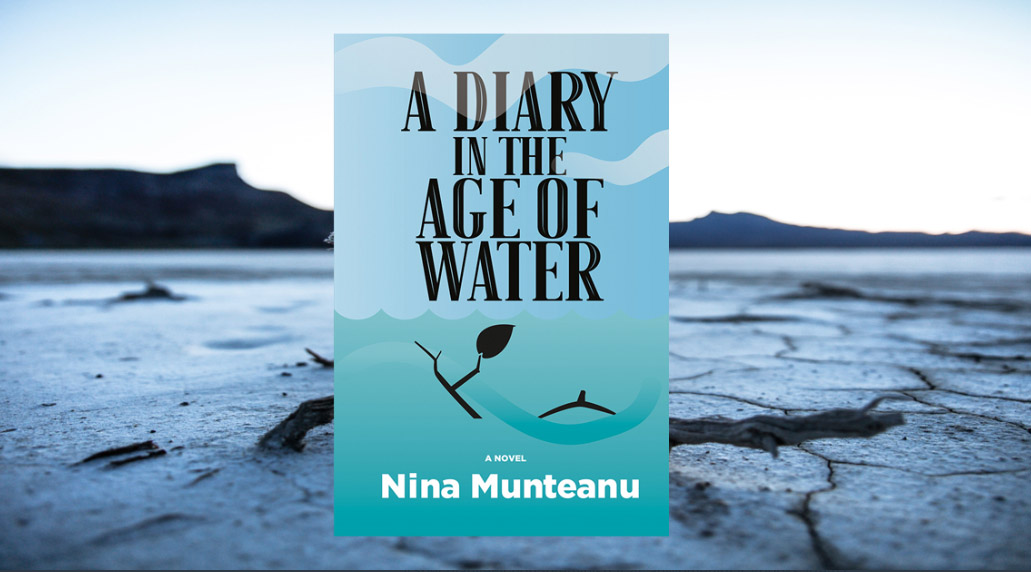
Just as Water Is… served as a watershed for all my relevant experiences as mother, environmentalist and scientist, A Diary in the Age of Water would galvanize many of my personal experiences, doubts, challenges and victories into compelling story. Although parts of the story wrote themselves, the entire book was not easy to write. There were times when I had to walk away from the book to gain some perspective—and optimism—before continuing. When I found myself drowning in Lynna’s voice, I invoked Hilda to guide me to shore. I found a balance that worked and compelled. Ultimately this opened to some of the best internal conflict and tension I have experienced in my writing.

Like water itself, A Diary in the Age of Water expresses through many vessels and in many perspectives, spanning hundreds of years—and four generations of women—with a context wider than human life. Through its characters, A Diary in the Age of Water explores the big question of humanity’s deadlock with planetary wellness and whether one is worth saving at the expense of the other. One of the characters asks Lynna the hard question: “If you had the chance to save the planet [stop the mass extinctions, deforestation and pollution ravaging the planet], but it was at the expense of humanity, would you do it?”

Water is, in fact, a character in the book—sometimes subtle and revealed in subtext, other times horrific and roaring with a clamorous voice. Water plays both metaphoric and literal roles in this allegorical tale of humanity’s final journey from home. The story explores identity and our concept of what is “normal”—as a nation and an individual—in a world that is rapidly and incomprehensibly changing—and in which each of us plays a vital role simply by doing or not doing.

A Diary in the Age of Water promises to leave you adjusting your frame of reference to see the world, yourself—and water—in a different way.

Illustration on Liisbeth article (photo collage by PK Mutch and Dreamstime

This is what PK Mutch of Liisbeth and Ariel Kroon (PhD graduate of English Literature at the University of Alberta and co-editor at Solarpunk Magazine) say about A Diary in the Age of Water, published by Inanna Publications in 2020:
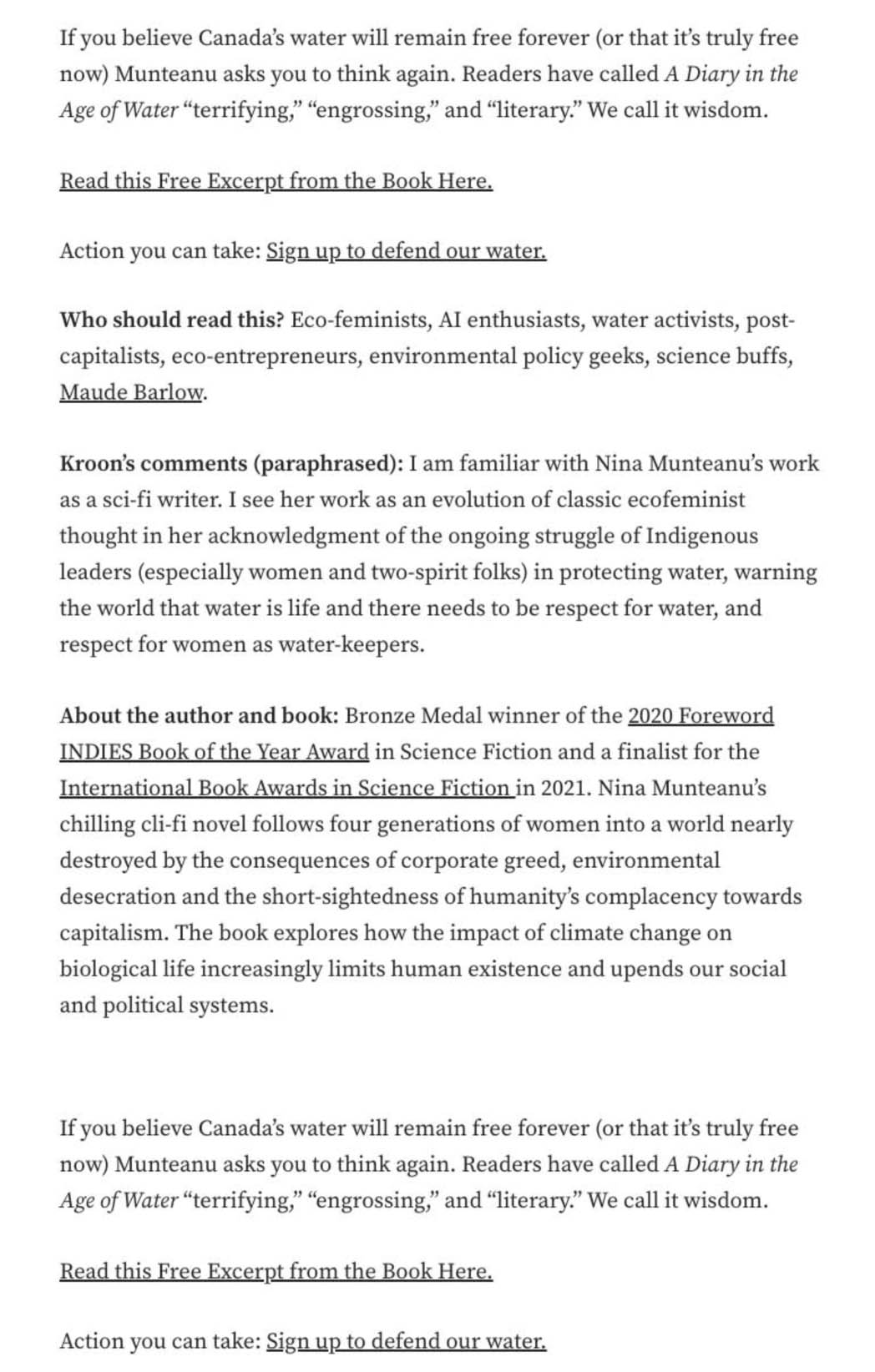
The novel has received wonderful praise and prizes, including the Literary Titan Award, the Foreword Indies Award and finalist in the International Book Awards. I wonder if Maude Barlow has read it?… Maybe I (or someone) should get her a copy, huh?…

Maude Barlow with ‘Save our River’ sign

Maude Barlow is a Canadian activist and author of Blue Gold, Boiling Point and several other books on water justice. She chairs the board of Washington-based Food and Water Watch and Ottawa-based Blue Planet Project. Maude co-founded the Council of Canadians and chaired its board for over three decades.

Maude Barlow arrested in 2011 for environmental activism

Nina Munteanu is a Canadian ecologist / limnologist and novelist. She is co-editor of Europa SF and currently teaches writing courses at George Brown College and the University of Toronto. Visit www.ninamunteanu.ca for the latest on her books. Nina’s bilingual “La natura dell’acqua / The Way of Water” was published by Mincione Edizioni in Rome. Her non-fiction book “Water Is…” by Pixl Press (Vancouver) was selected by Margaret Atwood in the New York Times ‘Year in Reading’ and was chosen as the 2017 Summer Read by Water Canada. Her novel “A Diary in the Age of Water” was released by Inanna Publications (Toronto) in June 2020.

When Water Speaks: quotes from A Diary in the Age of Water

“A society that does not believe in the objective pursuit of truth—even if it challenges your worldview—is doomed to servitude.”

Lynna Dresden

“An insightful novel…A cautionary tale rummaging through the forgotten drawers of time in the lives of four generations…This whirling, holistic and evolving novel comes alive, like we imagine water does.”

Mary Woodbury, DRAGONFLY.ECO
Jackson creek in late fall, ON (photo and rendition by Nina Munteanu)

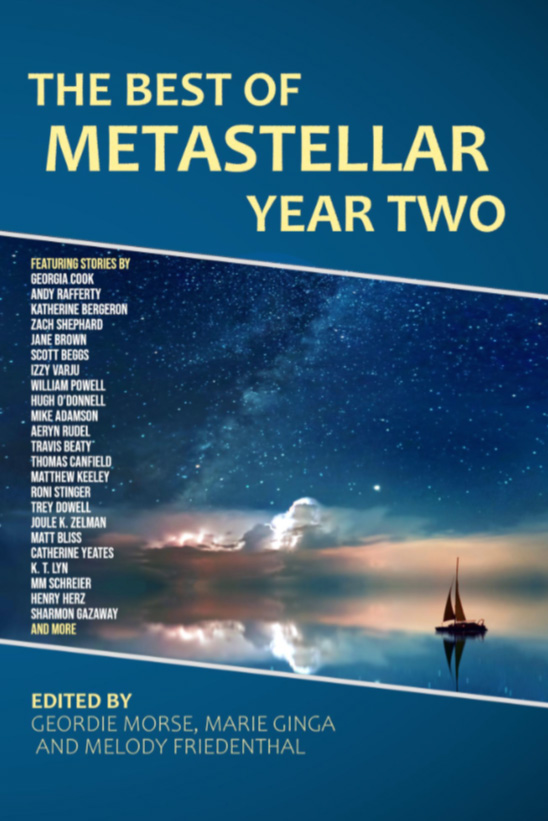
Nina Munteanu’s “The Way of Water” now in Best of Metastellar Year Two Anthology

She imagines its coolness gliding down her throat. Wet with a lingering aftertaste of fish and mud. She imagines its deep voice resonating through her in primal notes; echoes from when the dinosaurs quenched their throats in the Triassic swamps.

Water is a shape shifter.

It changes yet stays the same, shifting its face with the climate. It wanders the earth like a gypsy, stealing from where it is needed and giving whimsically where it isn’t wanted.

Dizzy and shivering in the blistering heat, Hilda shuffles forward with the snaking line of people in the dusty square in front of University College where her mother used to teach. The sun beats down, crawling on her skin like an insect. She’s been standing for an hour in the queue for the public water tap.

The Way of Water

My short story, The Way of Water, which was recently reprinted in Metastellar Speculative Fiction and Beyond (rated the second most popular online sci-fi magazine), is now in The Best of Metastellar Year Two, an anthology of forty-eight stellar short stories previously published with Metastellar.

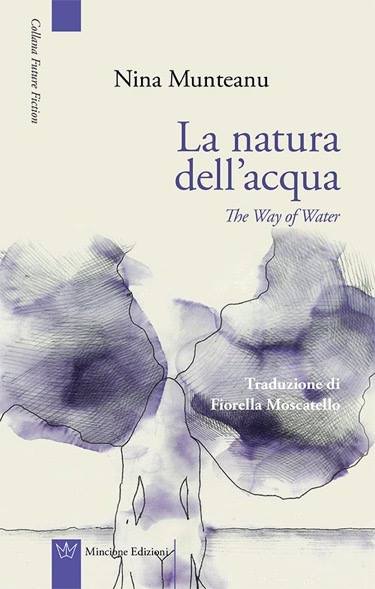
The Way of Water was first published as a bilingual print book by Mincione Edizioni (Rome) in Italian (La natura dell’acqua, translated by Fiorella Moscatello), and English along with a recounting of what inspired it: The Story of Water (La storia dell’acqua) in 2016. The Way of Water has been reprinted several times, in magazines and anthologies, since its first appearance in 2016.

It all started with an invitation by my publisher in Rome in 2015 to write about water and politics in Canada. I had long been thinking of potential ironies in Canada’s water-rich heritage. The premise I wanted to explore was the irony of people in a water-rich nation experiencing water scarcity: living under a government-imposed daily water quota of 5 litres as water bottling and utility companies took it all.

I named the story The Way of Water” (“La natura dell’acqua), about a young woman (Hilda) in near-future Toronto who has run out of water credits for the public wTap; by this time houses no longer have potable water and their water taps have been cemented shut (as was done in Detroit in 2014); the only way to get water is through the public wTaps—at great cost. She’s standing two metres from water—in a line of people waiting to use the tap—and dying of thirst.

The Way of Water” captures a vision that explores the nuances of corporate and government corruption and deceit together with global resource warfare. In this near-future, Canada is mined of all its water by thirsty Chinese and US multinationals—leaving nothing for the Canadians. Rain has not fallen on Canadian soil in years due to advances in geoengineering and weather manipulation that prevent rain clouds from going anywhere north of the Canada-US border. If you’re wondering if this is possible, it’s already happening in China and surrounding countries.

The Way of Water, in turn, inspired my recent dystopian novel A Diary in the Age of Water, which explores the lives of four generations of women and their relationship to water during a time of severe water restriction and calamitous climate change.

Publications (excluding online pubs) that featured The Way of Water

The Way of Water evokes a sense of awareness about issues of access to water and about the dangers of imbalances in that access.”

Derek Newman-Stille, Speculating Canada

“In a short story in which every word has its weight, Nina Munteanu manages to describe a dystopia with ecological, political, social and economic elements and Hilda’s reactions to her situation with a great emotional intensituy. To avoid thirst, Hilda ends up embracing an extreme idea, a last hope linked to water. The Way of Water is a story of the kind you hope is science fiction but you fear is not.”

Massimo Luciani

Nina Munteanu is a Canadian ecologist / limnologist and novelist. She is co-editor of Europa SF and currently teaches writing courses at George Brown College and the University of Toronto. Visit www.ninamunteanu.ca for the latest on her books. Nina’s bilingual “La natura dell’acqua / The Way of Water” was published by Mincione Edizioni in Rome. Her non-fiction book “Water Is…” by Pixl Press (Vancouver) was selected by Margaret Atwood in the New York Times ‘Year in Reading’ and was chosen as the 2017 Summer Read by Water Canada. Her novel “A Diary in the Age of Water” was released by Inanna Publications (Toronto) in June 2020.

When Water Speaks: quotes from A Diary in the Age of Water

“The truth isn’t about telling; no one just tells you the truth. It needs to be coaxed, even tricked, out. The truth is carefully hoarded—like water—and only flows among privileged acolytes who have proven themselves.”

Lynna Dresden

“Those of us who are captivated by fear, who despair in a dead zone—we need to consider new ways to tell familiar stories, to envision different endings. A book like this can change the way that you see the world at this moment, can allow formulae to take root in fiction and grow into a different kind of solution.”

Marcie McCauley, THE tEmz REVIEW
Jackson Creek in early fall, ON (photo and rendition by Nina Munteanu)

Movie Review: “Interstellar”–Is Love the God Particle?

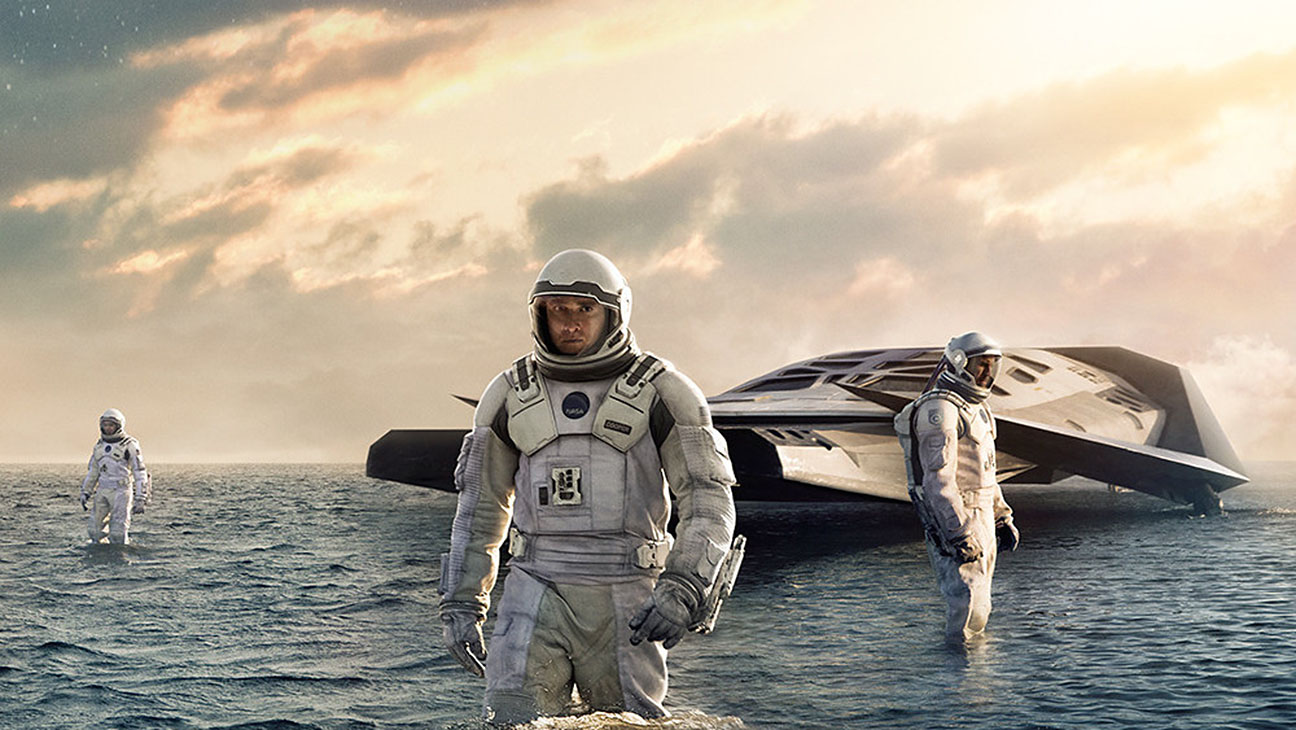
Cooper investigates an alien ice planet

Critical reception for Christopher Nolan’s science fiction blockbuster movie Interstellar was widely mixed. Reviews ranged from being dazzled and awestruck to thinking it utterly ridiculous and silly. Much of the range in opinion had in fact to do with the hard science: hard science that Nolan insisted he get right by hiring theoretical physicist Kip Thorne to best approximate what a black hole and a wormhole will look like and behave. Science so good that it generated a discovery worthy of reporting in a scientific journal (see below). The forums and chats that debated the last half-hour of the movie and its significance were entertaining, if not informative. Interstellar also generated a spate of vitriolic, accusing the film as propaganda for American colonialism (see a few examples below).

I first watched it in an IMAX theatre (the only way to see such an epic—it was filmed using 70mm Imax film, after all), which helped achieve its grandness. Since I was five, I’ve always wanted to be an astronaut. And I’ve always been a sucker for good space adventure—especially well-researched, realistic depictions defined by a good story. And that is exactly what Interstellar is. And so much more…

The ship enters the wormhole

I’ll admit openly that this film swept me up like a giant wave. I sat humbled yet exalted as I journeyed to some magnificent alien worlds: deep space; a powerful spherical wormhole; vast shallow waters between mile-high waves of a tidally locked planet; skimming beneath ice-clouds of a barren ice-planet; and falling—literally—into a black hole. All to the recursive echoes of a mesmerizing score by Hans Zimmer. While I was openly moved during the film, its aftertaste caught me unawares and impressed me the most about Nolan’s talent for subtle paradox. I realized that the journey—and deep space—felt inexplicably vast and intimate at the same time.

the Black Hole, Gargantua

The research by Thorne and Nolan’s visual team generated a scientific discovery. To accurately portray a black hole in the film, Thorne produced a new set of equations to guide the special effects team’s rendering software. Black holes apparently spin at nearly the speed of light, dragging bits of the universe along with it. Based on the notion that it was once a star that collapsed into a singularity, the hole forms a glowing ring that orbits around a spheroidal maelstrom of light, which curves over the top and under the bottom simultaneously. The team then discovered that “warping space around the black hole also warps the accretion disk,” explained Paul Franklin, senior supervisor of Double Negative (the visual experts). “So, rather than looking like Saturn’s rings around a black sphere, the light creates this extraordinary halo.” Thorne confirmed that they had correctly modeled a phenomenon inherent in the math he’d supplied and intends to publish several articles in scientific journals, based on these findings.

Canadian science fiction author Robert J. Sawyer defines good science fiction as: the literature of change; it’s about something “large” (world-important), arises from a scientific premise; and is generally pro-science. Interstellar achieves all of these criteria, particularly the latter.

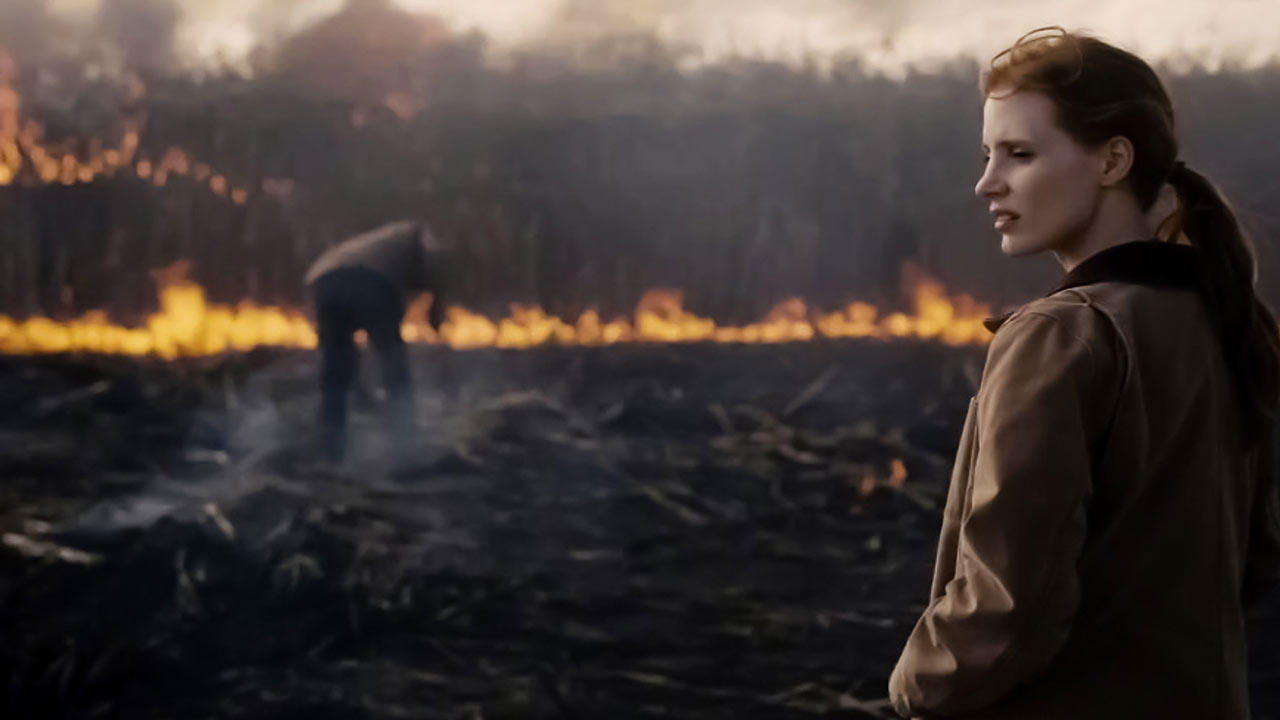
Murph overseas the burning of blighted wheat

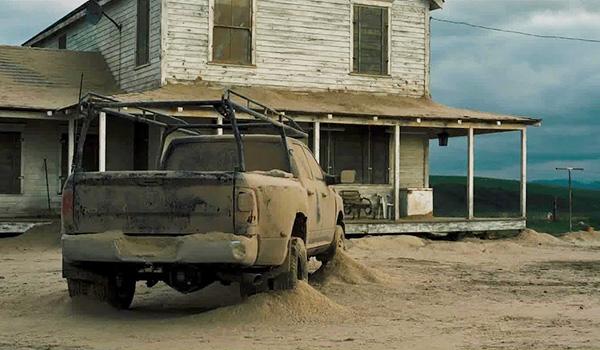
The movie begins in the near-future on a post-climate change Earth, plagued by dust storms and failing crops in a society reverted to parochial superstition. Cooper (Mathew McConaughey), once a NASA pilot and now a farmer, laments: “We used to look up at the sky and wonder at our place in the stars, now we just look down and worry about our place in the dirt.”

In a scene reminiscent of present day schools removing cursive writing from the curriculum or the controversy of teaching evolution (e.g., in favor of creationism), Cooper’s daughter’s teacher, Ms. Kelly, informs him at a parent-teacher meeting that the history textbooks have been rewritten to make known the “truth” about the moon landing: “I believe [the moon landing] was a brilliant piece of propaganda,” attests Ms. Kelly, “that the Soviets bankrupted themselves pouring resources into rockets and other useless machines…And if we don’t want to repeat the excess and wastefulness of the 20th Century, then we need to teach our kids about this planet, not tales of leaving it.”

The Cooper farmhouse after a dust storm

The danger of turning away from scientific exploration—particularly space exploration—in times of great social and economic insecurity is a theme that runs deep in the film. Not only are scientists and engineers portrayed as whole individuals, both smart and compassionate, but they are also marginalized in a future world looking more to blame than to fix. “We didn’t run out of planes and television sets,” the principal of the school tells Cooper. “We ran out of food.”

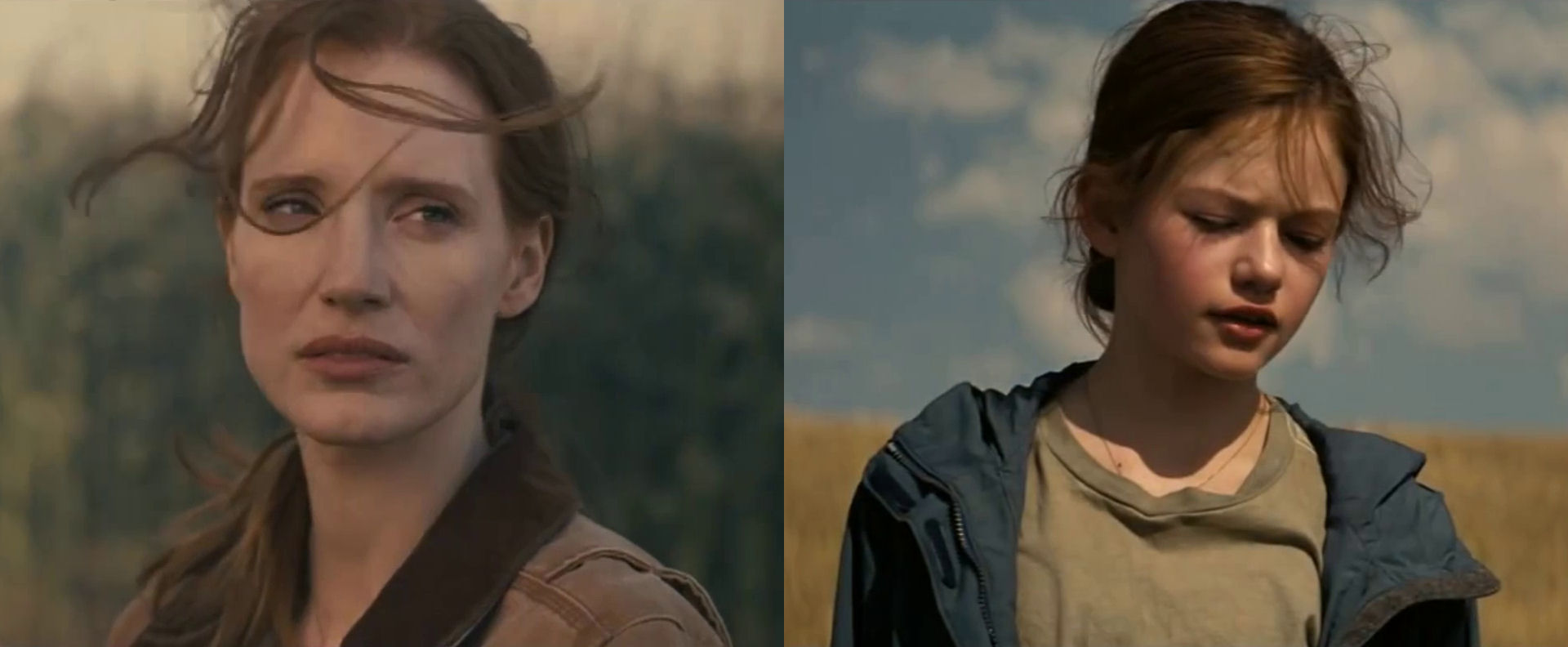
When a gravitational anomaly leads Cooper and his daughter Murph (Mackenzie Foy) to a secret NASA base in the middle of nowhere, an old colleague, Professor Brand (Michael Caine), recruits him to pilot the interstellar Endeavor, NASA’s “Noah’s Ark”, into the far reaches of outer space to repopulate the human race. NASA has turned covert due to public pressure against “irrelevant or politically unfeasible” spending. After showing Cooper how their last corn crops will eventually fail like the okra and wheat before them, Brand answers Cooper’s question of, “So, how do you plan on saving the world?” with: “We’re not meant to save the world…We’re meant to leave it.” Cooper rejoins: “I’ve got kids.” To which Brand answers: “Then go save them.”

The crew arrive on the first planet

Unbeknownst to us—and to Cooper, who leaves his precious children behind on Earth for what turns into a one-way mission—the intention is to literally leave the rest of humanity behind. You see, Cooper’s ship—headed toward one of three potentially habitable worlds beyond a wormhole near Saturn—contains the seeds of humanity and other life that the four astronauts aboard are meant to distribute and nurture. Cooper and Brand’s daughter, Amelia (Anne Hathaway), one of the other three astronauts onboard, both believe that the real ark sits back on Earth in the form of a huge spaceship—awaiting Brand’s solution to the gravity issue. Brand knows, but keeps to himself, that the solution is insolvable and sends his intrepid crew off, knowing that Cooper will never see his young son and daughter again.

While Nolan admits to some iconic comparisons with Kubrick’s 2001; A Space Odyssey, Interstellar actually shares much more with the film Contact (in which Kip Thorne and McConoughey also participated). Contact also centered on a ground-breaking scientist daughter who misses her lost father. Mark Kermode, in a Guardian review also saw the relationship:

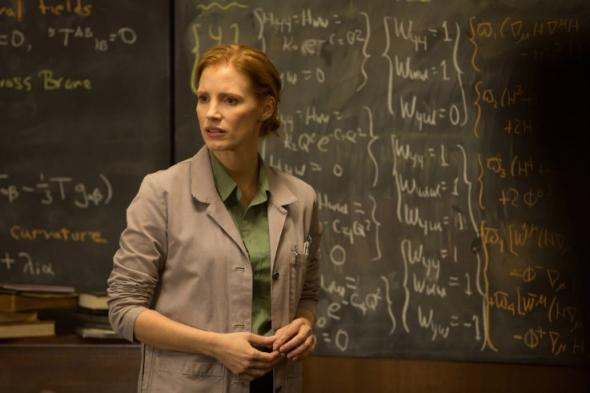
Murph solves the problem of gravity

“In both movies, it is these daughters who detect the first stirrings of an “alien” encounter: Ellie Arroway (Jodie Foster) identifying recurrent sequences in the white noise of interstellar radiation in Contact; Murph (very affectingly played in her younger years by Mackenzie Foy) spying Morse code in poltergeist disturbances in Interstellar. From such discoveries are missions launched, voyaging across time and space at the apparent instruction of a superior intelligence offering cryptic hands across the universe. Intergalactic portals are breached, timescales bifurcated, science and faith reconciled. Crucially, for all their astro-maths exposition, the constant in both stories is neither time, space, nor gravity, but love. More than once I was reminded of Contact’s Ellie striking the outer limits of the universe and breathlessly declaring: ‘They should have sent a poet.’”

The crew investigate the first planet they reach after passing through the wormhole

Interstellar received widely mixed reviews, described as anything from sublime to ridiculous. Its American-centric presentation generated some criticism (e.g., NASA acting alone without any international help; all American actors; American flags erected on settled colonies). Some even vilified the film as “a dangerous fantasy of US colonialism”. Journalist Abraham Riesman raises valid issues to do with human-centric expansionism in Interstellar:

“Coop and his coterie make one assumption that the movie never questions: Humanity (which, for all we ever see, is white, English-speaking America with a couple of black friends and one British guy) deserves to go to the stars and will suffocate if it’s confined to its current environs. That logic was, of course, one of the main justifications for most imperial expansions since the dawn of the 1800s. No one stops to ask whether this civilization (which, in the movie, appears to have murdered its home planet through human-caused climate change, though, for some reason nobody talks about that) needs to make some fundamental changes in its approach to social construction and resource use. Indeed, when we see the bright new future on Cooper Station, it’s all baseball and manicured lawns. Perhaps more important, no one questions whether human expansion will kill off the new planets’ current residents. Sure, we’re told that the planets are uninhabited … but uninhabited by what? Carbon-based humanoid life forms? What if we immediately kill off whatever fragile ecosystems we find once we take off our helmets and exhale our Earthly germs? Of course, I’m reading too much into a movie that isn’t even implying any of the messages I’m inferring, but that’s the problem right there: No one’s even asking the questions, and for humans, that kind of attitude usually leads to bad answers.”

What saves Interstellar from skidding into 20th Century pseudo-jingoistic expansionism with undertones of patriarchal rationalism, is its subversive theme. And because of it, the movie transcends into artistic commentary.

I speak of love.

Love embodied by two of the main characters—both women: Cooper’s daughter, Murph, and his shipmate, Amelia Brand. Love that is irrational. Love that is unscientific. Love that is inexplicable. And love that is all powerful. Inviolate. Eternal. And, I believe, our salvation.

Murph Cooper

Aspects of “imperialist expansionism” and “patriarchal rationalism” interplay through Cooper, who embodies both in his “cowboy” science. It is love that propels his evolution to transcend them. In Cooper, we see the constant tension between rationality of science and the “irrational” faith of love. Related to this, Cooper must continually choose between the personal and the whole in defining his humanity and ultimately his hard choices. First with his daughter and her “ghost”, then with Amelia Brand in their mission to another galaxy.

Amelia Brand

After a botched mission, Amelia appears to abandon the very tenets of hard science to ask the defining question: “Maybe we’ve spent too long trying to figure all this out with theory. Love is the one thing that transcends time and space.” She describes love as a cosmic force, a kind of empathic drive that provides the very basis for humanity’s survival: a link to our wholeness as living beings within a breathing multi-dimensional universe. When Cooper challenges Amelia’s unscientific notions, she responds with, “Love isn’t something we invented. It’s observable, powerful … Maybe it’s evidence, some artifact of higher dimensions that we can’t consciously perceive.” Repeating, almost word for word, what Cooper said to his father about choosing his interstellar mission, Amelia admits, “yes, the tiniest possibility [of seeing Wolf again] excites me. But that doesn’t mean I’m wrong.” To which Cooper answers just as his father did: “Honestly…it might.”

Amelia nails it when she, in turn, challenges Cooper: if the second choice turns out bad, they will have enough fuel to do only one of two things: go on to the third planet in hopes of distributing the seeds of humanity OR go back home to his children and the end of the world. Which will he choose? It’s interesting what he does end up choosing: he chooses love. Love drives him to do impossible feats, like dock his shuttle with a damaged and recklessly spinning Endeavor:

CASE: That’s impossible

COOPER: No, it’s necessary

Love for Murph drives Cooper into the black hole … and out of it. Love directs him to that precise quantum moment where his love for Murph transcends into love for all humanity: to save the world. This is the secret. The secret Mann in his intellectualized definition of what it means to be human could not touch. The window for connection to the whole is through a single tiny grasp of it. The glimpse into Eternity is through the lens of Love. I am reminded of a quote in David Mitchell’s Cloud Atlas: “What is any ocean but a multitude of drops?” In Spielberg’s Schindler’s List, Itzhak Stern quotes the Talmud: “Whoever saves one life, saves the world entire.”

So what is love, then? Is it gravity? Does it communicate through the God particle in the fractal fabric of the Higgs field? What other phenomenon grows from nothing? What other phenomenon is not lessened but in fact grows by giving it away? What other phenomenon provides the very weight and structure—the meaning—of our existence? What other phenomenon is like a whisper in a crowded room, yet creates the most beautiful symphony? Is it that simple?

If gravity is a plane of existence, a fifth dimension that can exist across space-time, is a black hole simply a doorway? Like death? Is love the fuel of evolution, lifting us up into a higher state?

Catholic theologian Peter Kreeft shares: “…Gravity is love on a material level. In fact, [gravity] has two movements: one is towards union, back to the center, the big bang, the past by gravity. And the other is to give itself out to all other beings, out into the future, the expanding universe, by energy and by entropy, which is energy giving itself out to the empty places.”

What struck me the most about Interstellar was how it simultaneously evoked my breathless awe in the vast universe’s existentialist grandeur with a personal connection and incredible intimacy. Interstellar was soul-nourishing, dream-engaging; and its recursive themes called of “home”.

Definitions:

Wormhole: Officially known as an Einstein-Rosen Bridge, a wormhole is a hypothetical topological feature of spacetime that would fundamentally be a shortcut through spacetime.

God Particle: Also known as the Higgs boson or Higgs particle, the God particle is believed to be the subatomic particle that gives everything mass. Without it, nothing would have weight or even structure. The Higg boson is an elementary particle with no spin, electric charge or colour charge. It is considered the smallest possible quantum excitation of the Higgs field that unlike the more familiar electromagnetic field cannot be “turned off”; instead it takes a non-zero constant value almost everywhere.

Higgs Field: In two papers published in 1964, Peter Higgs posited that particles obtain mass by interacting with a mysterious invisible energy force field that permeates the universe: the Higgs field. It is the stuff of stars, planets, trees, buildings and animals. Without mass, electrons, protons and neutrons wouldn’t stick together to make atoms; atoms wouldn’t make molecules and molecules wouldn’t make us. The presence of the Higgs field explains why some fundamental particles have mass while the symmetries (laws of nature) controlling their interactions should require them to be massless, and why the weak force has a much shorter range than the electromagnetic force.

Nina Munteanu is a Canadian ecologist / limnologist and novelist. She is co-editor of Europa SF and currently teaches writing courses at George Brown College and the University of Toronto. Visit www.ninamunteanu.ca for the latest on her books. Nina’s bilingual “La natura dell’acqua / The Way of Water” was published by Mincione Edizioni in Rome. Her non-fiction book “Water Is…” by Pixl Press (Vancouver) was selected by Margaret Atwood in the New York Times ‘Year in Reading’ and was chosen as the 2017 Summer Read by Water Canada. Her novel “A Diary in the Age of Water” was released by Inanna Publications (Toronto) in June 2020.
Movie Review: Venture to “The Beyond”

The Beyond is a 2018 science fiction thriller, set in the near-future, that explores the evolution of our humanity through “first contact.”

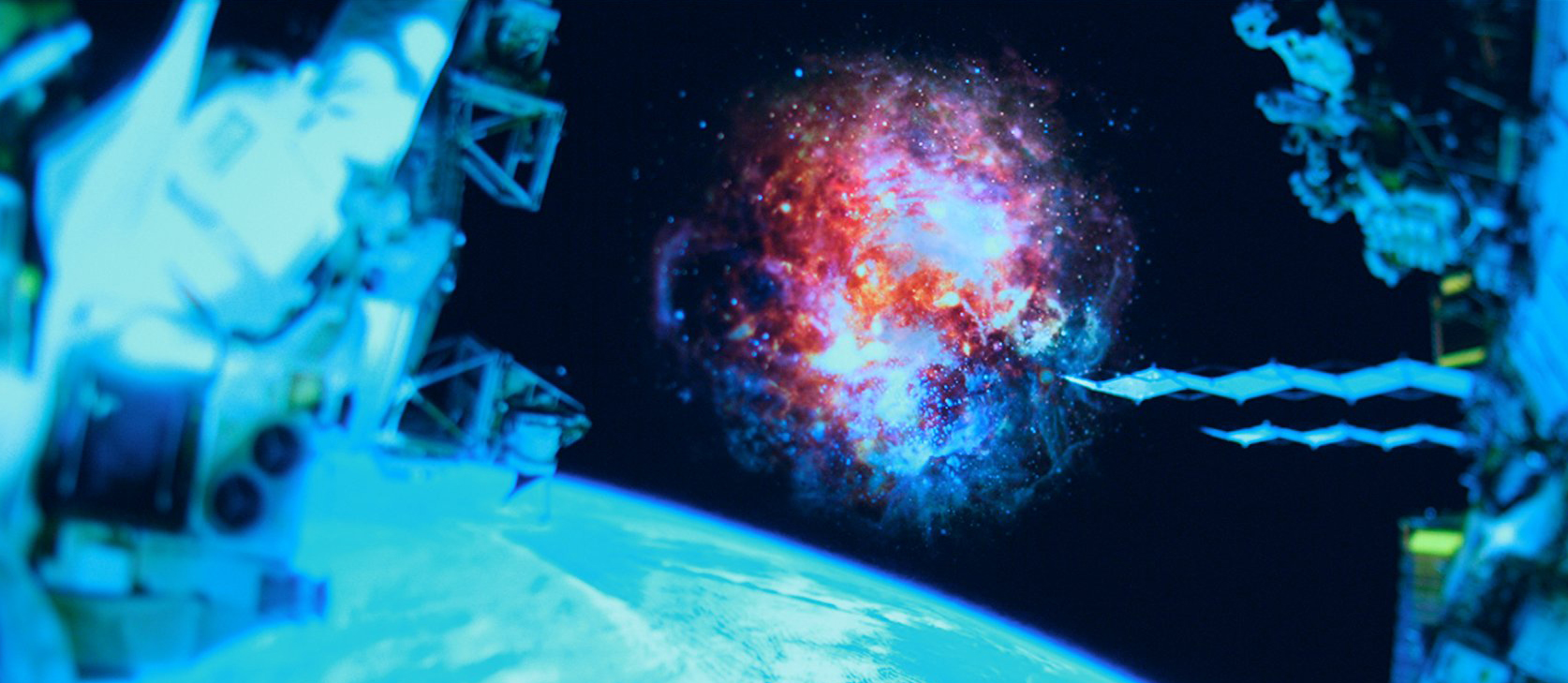
Wormhole suddenly appears

The sudden appearance of a wormhole causes the disappearance of astronaut Jim Marcell during EVA on the space station, followed by associated calamitous phenomena on Earth. Giant dark spherical clouds then appear and settle all over the Earth, disrupting the world’s population, and setting in motion a series of fearful and aggressive reactions by various sectors of humanity; as expected, the military of each nation mobilize, ready to attack. Some do attack, with no consequence.

Alien spheres appear over several cities

With the help of the military’s groundbreaking transhumanism technology, the international space agency sends two transhuman (Human 2.0) astronauts into the wormhole (called the Void) on an information-seeking (and peace-seeking) mission. The astronauts have been modified by advanced robotics to withstand the pressures of the “throat” of the wormhole as they embark on humanity’s first interstellar—possibly inter-dimensional—journey in search of extra-terrestrial sentient life and its intent. One of the astronauts is a soldier, armed with additional weapons built into his physiology. The other is the Space Agency’s chief cosmologist, Jessica Johnson (played by Kosha Engler). When the mission returns unexpectedly, and without the soldier, the space agency races to discover what happened on the “other side.” Of particular interest is evidence indicating that the ship had been away much longer than the days it was actually gone. Johnson later reveals that the soldier had suddenly disappeared from the cockpit and reappeared outside. She saw him stare at his arm, which then detonated like a nuclear bomb—no doubt because his arm was indeed something of that nature.

Jessica transformed into Human 2.0 for space travel

The tag line of the movie says: “to find our place in the universe, we must venture beyond our boundaries.” This imaginative indie film by Hasraf Dulull is all about breaking boundaries and transcending beliefs: such as mission director Gilian’s first lie to her daughter (to contain a bigger lie by the space agency); and chief cosmologist Jessica conquering ethical barriers to embark on a journey that will irrevocably change her.

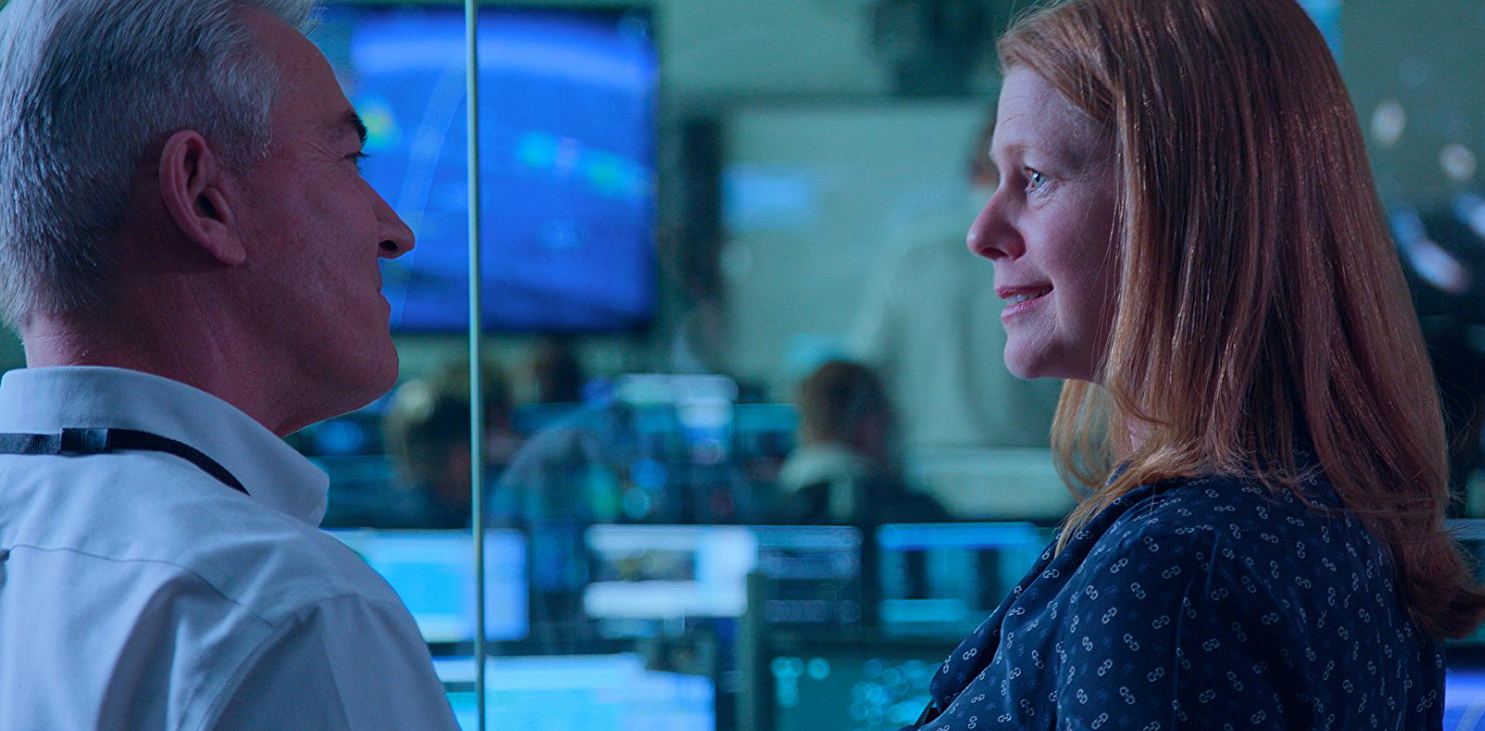
Canadian Gillian Laroux is mission commander

The story unfolds like a docu-drama, making use of interviews with key people and retrieved footage amidst dramatic narrative (similar to Blomkamp’s District 9). The mixed narrative creates an immediacy that grips us emotionally and deeply connects us to the characters in a real-life way. Characters are portrayed as ordinary people who find themselves in extra-ordinary circumstances and performed with genuine candor, particularly the mission commander Gillian Laroux (Jane Perry) who plays a Canadian.

The Beyond appeals to our senses and sensibilities, challenging our assumptions and definitions of what it is to be human through our values, hopes and fears. Told with an unassuming realism, The Beyond is really a simple, yet deeply meaningful story that asks the big questions—and leaves it for us to answer them.

The climax, discovery and resolution is really more of a question. I was somehow unprepared for the discovery and emotionally struck by its trajectory into the denouement. Some reviewers on the Internet were off-put by the shift following “the discovery” that preceded the denouement at the end. I found closure for the chief cosmologist, who had sacrificed her life to seek answers and find a solution for humanity; however, the question remained: what is that solution for humanity? What does that solution look like and how does it encompass more than us? The movie doesn’t have a tidy end; its solution is veiled with more questions.

The film ends with a cautious hope, implicitly asking that big question: are we (humanity) worth saving? When Jessica asks why humanity was offered a second chance by benevolent beings way beyond our comprehension, the returned Jim Marcell (currently a spokesman for the aliens) shows her the GAD (Golden Archive Drive with video images of Earth and humanity—basically our “hello” message to extra-solar life like the one placed onboard NASA’s Pioneer missions) that had accompanied the ship into the wormhole. The message displayed scenes of mothers and their children, people laughing in joy; it also showed scenes of other aspects of this beautiful planet worth saving: the ocean surf, the forests and wildlife. In our hubris, we have lost our perspective about this planet. Perhaps, it wasn’t so much humanity the alien beings intended to save but the Earth itself; we just come along with it. The Earth is, after all, a beautiful, vital and unique world, rich with life-giving water, trees, animals, creatures of all kinds in a diverse network of flowing and evolving beauty. A planet worth saving and that, frankly, functions better without us.

Jessica 2

So, the question remains: is humanity worth saving? For centuries we have hubristically and disrespectfully used, discarded and destroyed just about everything on this beautiful planet. According to the World Wildlife Federation, 10,000 species go extinct every year. That’s mostly on us. They are the casualty of our selfish actions. We’ve become estranged from our environment, lacking connection and compassion. That has translated into a lack of consideration—even for each other. In response to mass shootings of children in schools, the U.S. government does nothing to curb gun-related violence through gun-control measures; instead they suggest arming teachers. We light up our cigarettes in front of people who don’t smoke and blow deleterious second-hand smoke in each other’s faces. We litter our streets and we refuse to pick up after others even if it helps the environment. The garbage we thoughtlessly discard pollutes our oceans with plastic and junk, hurting sea creatures in unimaginable ways. We do not live lightly on this planet. We tread with incredibly heavy feet. We behave like bullies and, as The Beyond points out, our inclination to self-interest makes us far too prone to suspicion and distrust: when met with the unknown, we respond with fear and aggression rather than curiosity and hope. Something we need to work on if we are going to survive–and find our place in the universe.

The Beyond is a simple film made well; something not easy to accomplish. The film delved into existential questions with an emotional intelligence that was both sensitive and insightful. As Gillian Laroux says in the end: “I hope we won’t make the same mistakes of the past and prove that we are in fact worth saving.” Ultimately, I found The Beyond a refreshing change from the senseless soul-gutting violence, and sordid aimless or overly-complicated plots that currently populate most of our current science fiction TV and movies.

The Beyond marks the directorial debut of Dulull, a VFX wiz who spent a year shooting and working on this project (previously titled The Void). Changing the title from The Void to The Beyond is itself an interesting shift in what the film represents and suggests.

Let us tread more lightly on this planet, then…And perhaps we too will be worth saving. Perhaps our destiny won’t be a void but a transcendence beyond…

Nina Munteanu is a Canadian ecologist / limnologist and novelist. She is co-editor of Europa SF and currently teaches writing courses at George Brown College and the University of Toronto. Visit www.ninamunteanu.ca for the latest on her books. Nina’s bilingual “La natura dell’acqua / The Way of Water” was published by Mincione Edizioni in Rome. Her non-fiction book “Water Is…” by Pixl Press (Vancouver) was selected by Margaret Atwood in the New York Times ‘Year in Reading’ and was chosen as the 2017 Summer Read by Water Canada. Her novel “A Diary in the Age of Water” was released by Inanna Publications (Toronto) in June 2020.
When Water Speaks: quotes from A Diary in the Age of Water

“There simply aren’t enough Canadians to protect our wilderness; but if there were enough of us, there’d be no wilderness left to protect.”

Lynna Dresden

“Strangely compelling.”

BURIED IN PRINT

“A Diary in the Age of Water, is simply and beautifully told, profoundly true; a novel that invites us to embrace the wisdom of ages. The story stirs its readers, teaches them about the importance of water, and leaves an imprint on the canvas of the literary and scientific world.”

LUCIA MONICA GOREA, author of Journey Through My Soul
Boys explore the shore of the Otonabee River, ON (photo and rendition by Nina Munteanu)

Movie Review: Advantageous

There are women with voices and brains and power and intelligence that have been waiting for this moment.”—Director Jennifer Phang

Advantageous is a low budget indie film by Jennifer Phang that explores a near-future world—a kind of “pre-dystopia”, according to Katharine Trendacosta of io9—where jobs have become heavily automated and opportunities for education are cutthroat. Women have been generally forced out of the workplace and onto the streets: the logic being that they will be less violent while living on the street than men.

While the world vaguely resembles a vibrant City with flying ships and some bizarrely futuristic architecture (including a high rise that functions as a giant water feature), a sense of unease permeates most scenes, punctuated by occasional terrorist explosions and snippets of disturbing news reports.  Artificial intelligence has supplanted most people in middle management, “The people you do see are either impoverished and disenfranchised or are hidden in the upper floors, the protected places,” says director Jennifer Phang. Unemployment is close to 50% and there are no public schools. The only options for a young girl—if she is not to end up on the streets, either as a beggar or prostitute—is to attend a highly selective free magnet school or a very expensive private school.

Gwen Koh (Jacgueline Kim) is the spokeswoman of the Center for Advanced Health and Living, a wellness corporation that offers health and beauty treatments to an elite who can afford it. When the Center informs her that she looks too old, Gwen—desperate to secure her bright daughter’s expensive education—submits to the experimental treatment she was initially hired to promote. Jules hadn’t made it into the free magnet school, leaving Gwen to come up with extensive funds to get her into a private school. The corporation has subtly backed Gwen into a corner by reminding her that her generation doesn’t have the skills to compete—all of education currently being STEM-based—and they fully understand that she is too old and too unconnected to do anything other than offer herself up to their new procedure to secure her position and a future for her daughter Jules. Constantly walking the edge of privilege, Gwen struggles to make the elite-connections necessary to place Jules. “Gwen is too old, too female, and too unconnected to do anything other than offer herself up as a sacrifice,” writes Trendacosta.

Gwen and here daughter Jules share a moment

The true nature of her sacrifice is not understood at first; it unravels slowly, like an internal wound, until we learn that the procedure—putting her memories into a younger person’s body—means that Gwen’s “mother-connection” awareness with her daughter will be lost when her original body dies in the procedure. This is particularly significant, given their close and loving relationship, which is evocatively conveyed throughout the film.

Advantageous “is riveting, emotionally gripping, and offers up a vision of the future that is disturbingly easy to picture, even as some of the technologies it imagines seem out of reach,” says Ariel Schwartz of Business Insider Magazine. While the trope of mind-upload into a younger, prettier body has been around for while in standard SF, how Phang presents it, in the muted notes and pace of “everyday” and “mundane” events, brings a kind of realism to it that both invigorates and chills. Like watching a building explode in person rather than on TV. The immediacy and reality of it is visceral. Phang does this through sparing use of sound, language and colour. And all presented in a pace that does not rush, but lingers and reflects. Long moments of quiet punctuate scenes of significance, giving us the chance to examine, resonate and reflect in “real-time” with the character. These, in themselves, provide some of the most poignant footage of the film as we are given the time to descend into deeper reflection. Each plays out, short vignettes of life that string together like pearls on a necklace. Life moments. Unflinchingly and confidently performed at the pace of life.  

In one of many quietly powerful scenes, Gwen stumbles upon a street woman, huddled in a small grassy alcove under an old blanket. When Gwen asks her if she is okay, the woman instead responds, “Are you okay?” This is a natural response for a woman; we think of others, of their welfare. We carry the “mother” archetype within us, everywhere we go, no matter what befalls us. This natural sense of compassion and altruism runs through our blood.

And, yes, it makes us a different kind of hero.

Gwen’s heroics are not accompanied by percussive violence or gut-wrenching action; they are silent choices that percolate from deep within. They are choices that ultimately bleed into great consequence.

Gwen and Jules read something together

“The plot suggests a standard ‘body swap’ sci-fi storyline,” says Danielle Riendeau of Polygon. “But Advantageous is much more about motherhood, the sacrifices women make for their children, and to a large extent, the difficulties of being a non-white woman in an increasingly intolerant society. The writing, directing and performances are so strong that they elevate the film far beyond a simple twist on a classic trope. Advantageous is a potent, heartbreaking meditation on parental love and the sacrifices women make for their families. It has a lot to say, and it does so with clear-eyed, fearless intensity.”

Trendacosta writes, “People are going to judge Advantageous by the things it lacks. There are no battles, no mustache-twirling villains, and not even any giant science fiction spectacle sets. People are also going to judge it for what it has. There are some intense discussions of classism, racism, ageism, sexism, and elitism. But don’t judge this movie for either of those things—instead, it’s worth appreciating for all the things it does so incredibly well.”

What Advantageous does so incredibly well is portray a near-future vision worth pondering and discussing.

Nina Munteanu is a Canadian ecologist / limnologist and novelist. She is co-editor of Europa SF and currently teaches writing courses at George Brown College and the University of Toronto. Visit www.ninamunteanu.ca for the latest on her books. Nina’s bilingual “La natura dell’acqua / The Way of Water” was published by Mincione Edizioni in Rome. Her non-fiction book “Water Is…” by Pixl Press (Vancouver) was selected by Margaret Atwood in the New York Times ‘Year in Reading’ and was chosen as the 2017 Summer Read by Water Canada. Her novel “A Diary in the Age of Water” was released by Inanna Publications (Toronto) in June 2020.