How Climate Change Is Altering My Winter

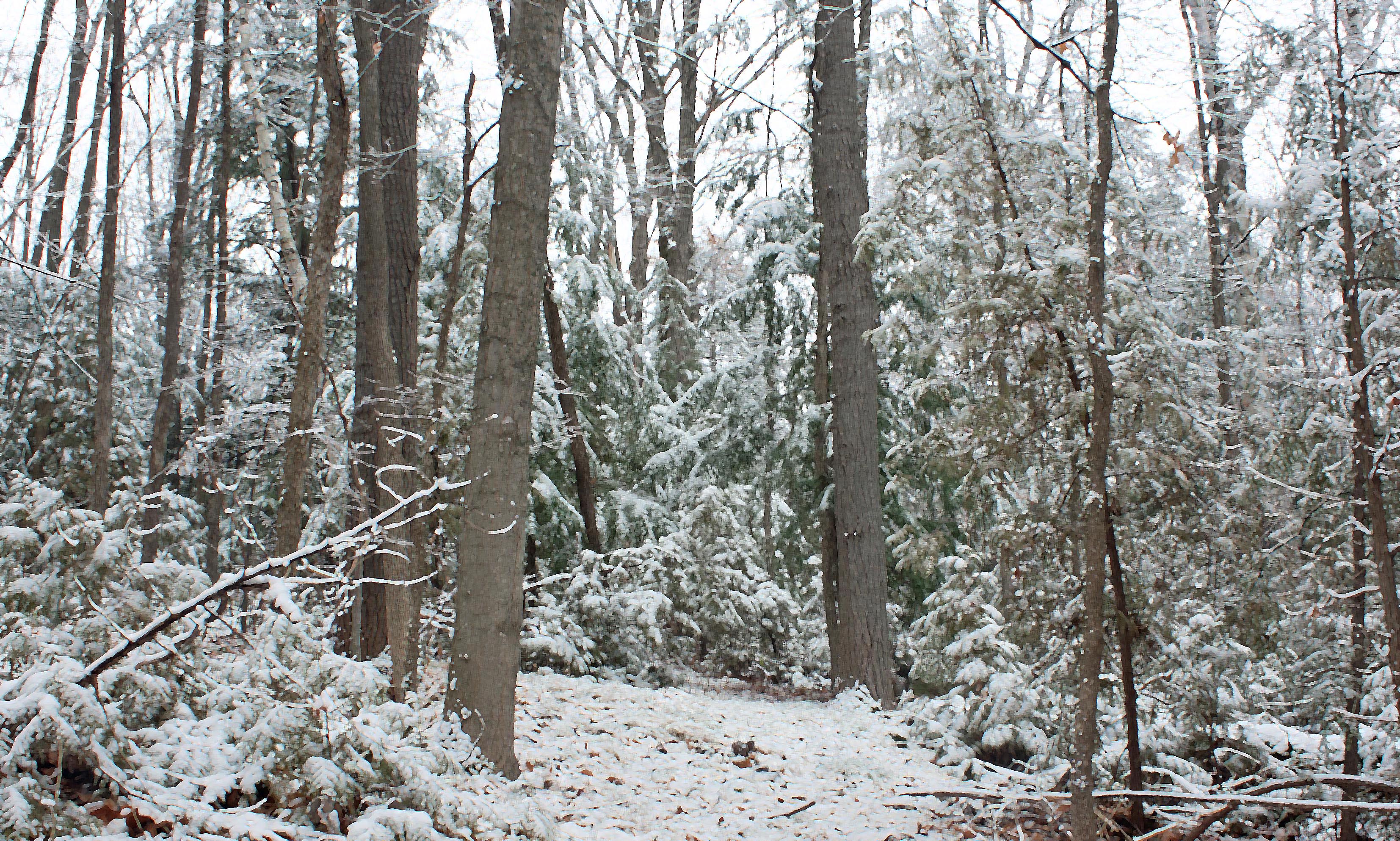
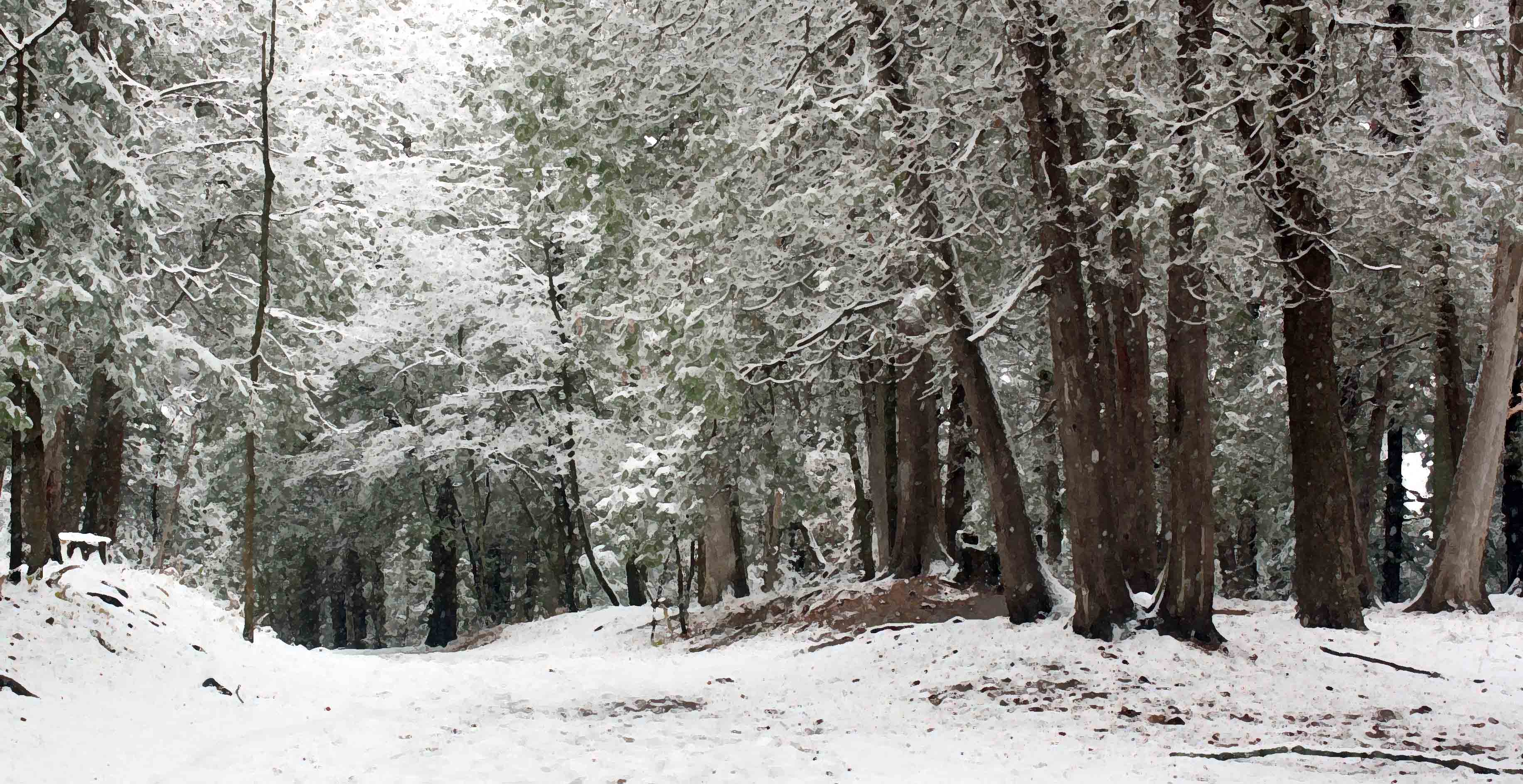
Cedar-pine forest covered in new snow of winter, ON (photo and rendition by Nina Munteanu)

I’m Canadian, and I love the snow. When I grew up in the Eastern Townships of Quebec, we enjoyed a brisk cold winter with deep snow for a good six months of the year. I’ve since lived in Vancouver, British Columbia, which experiences a milder regional climate; I now live in the Kawarthas of Ontario, which has a similar regional climate to what I experienced growing up in Quebec. Living in the Kawarthas reminds me of my childhood days with winter snow.
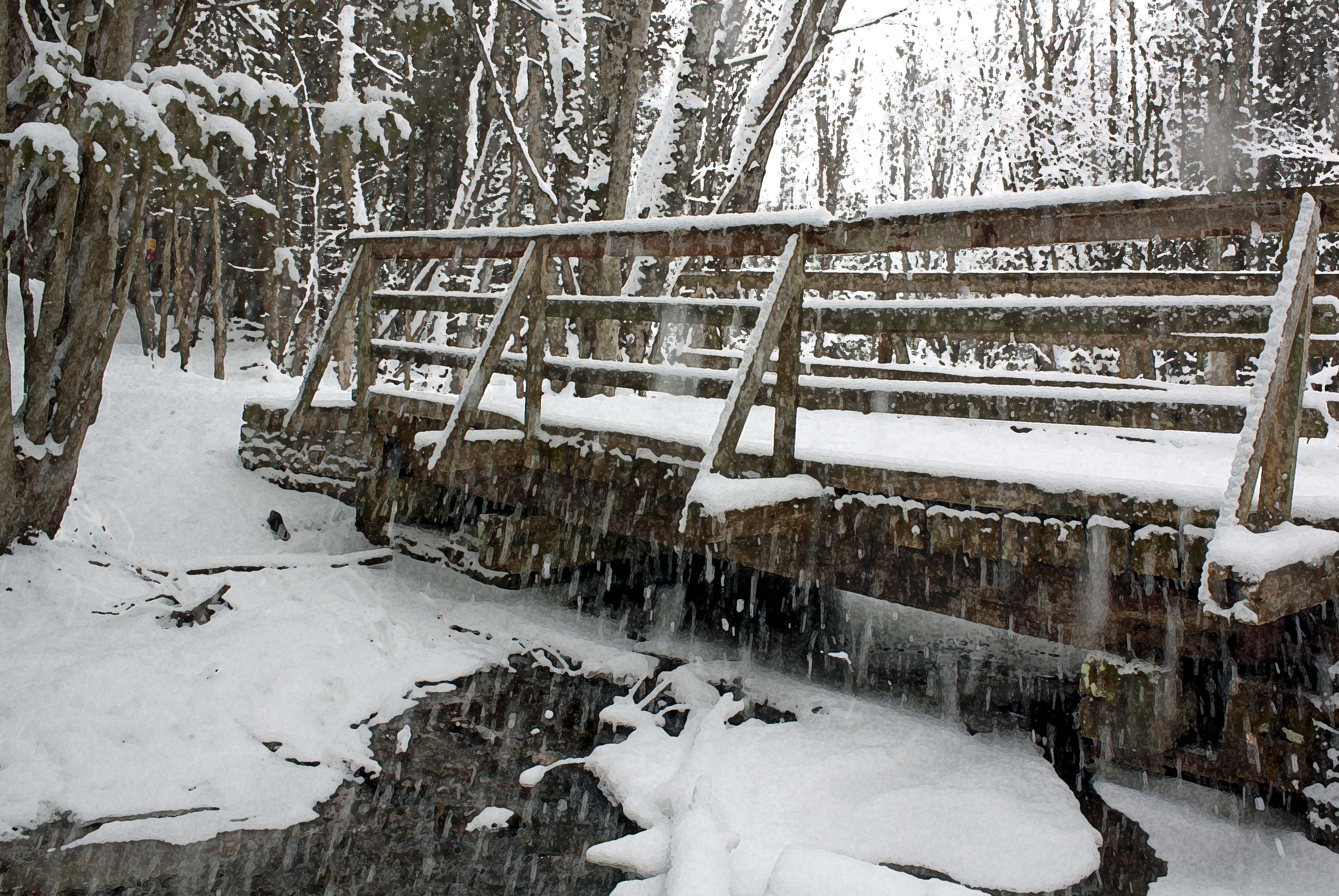
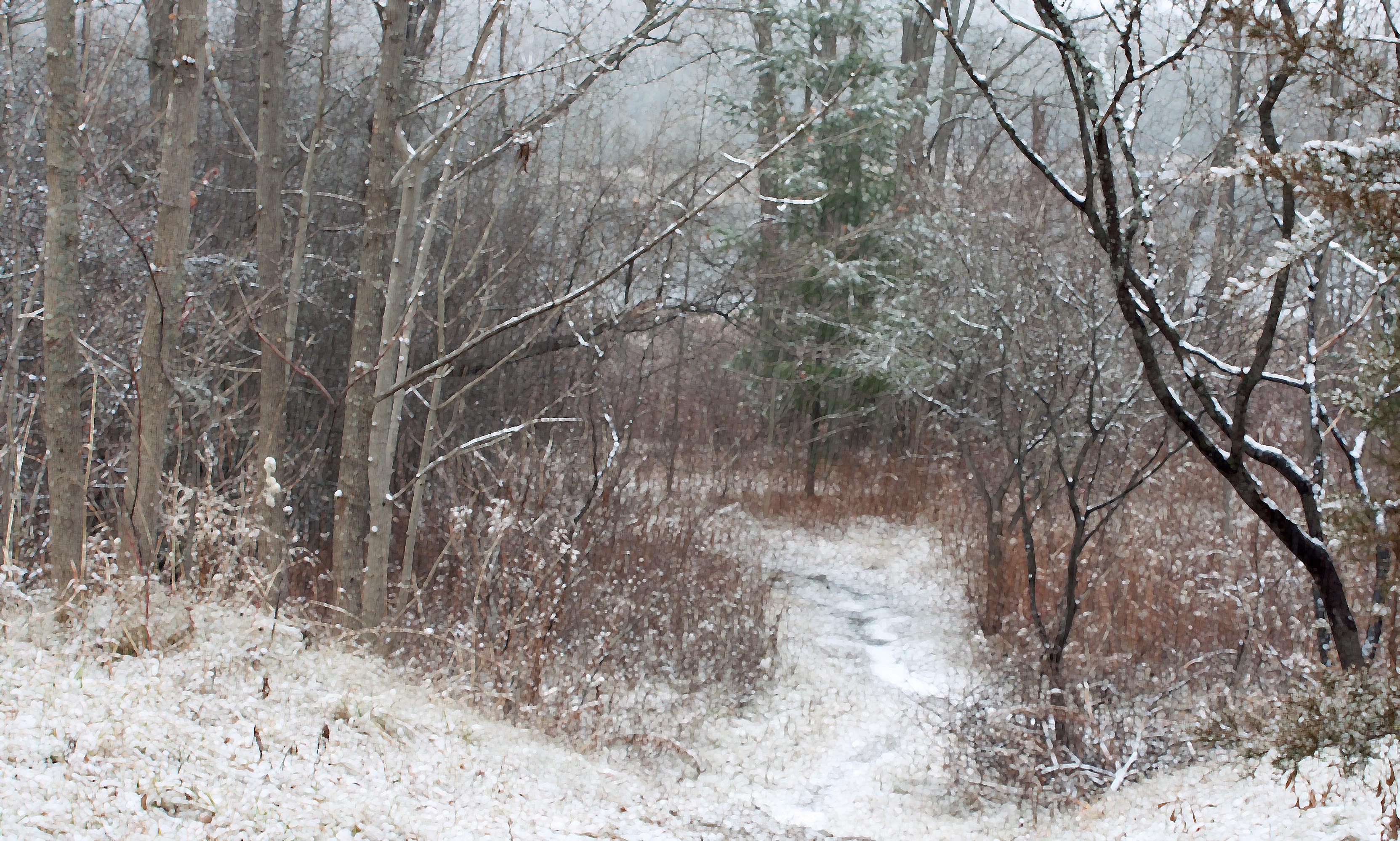
Heavy snowfall in Trent Nature Sanctuary, ON (photo and rendition by Nina Munteanu)

I love how the first snow of the season often comes from the sky in a thick passion. Huge flakes of unique beauty would settle on my coat sleeves and within minutes I’d be covered in snow. I would stand enraptured, arms out to catch snowflakes, and study each individual with admiration.
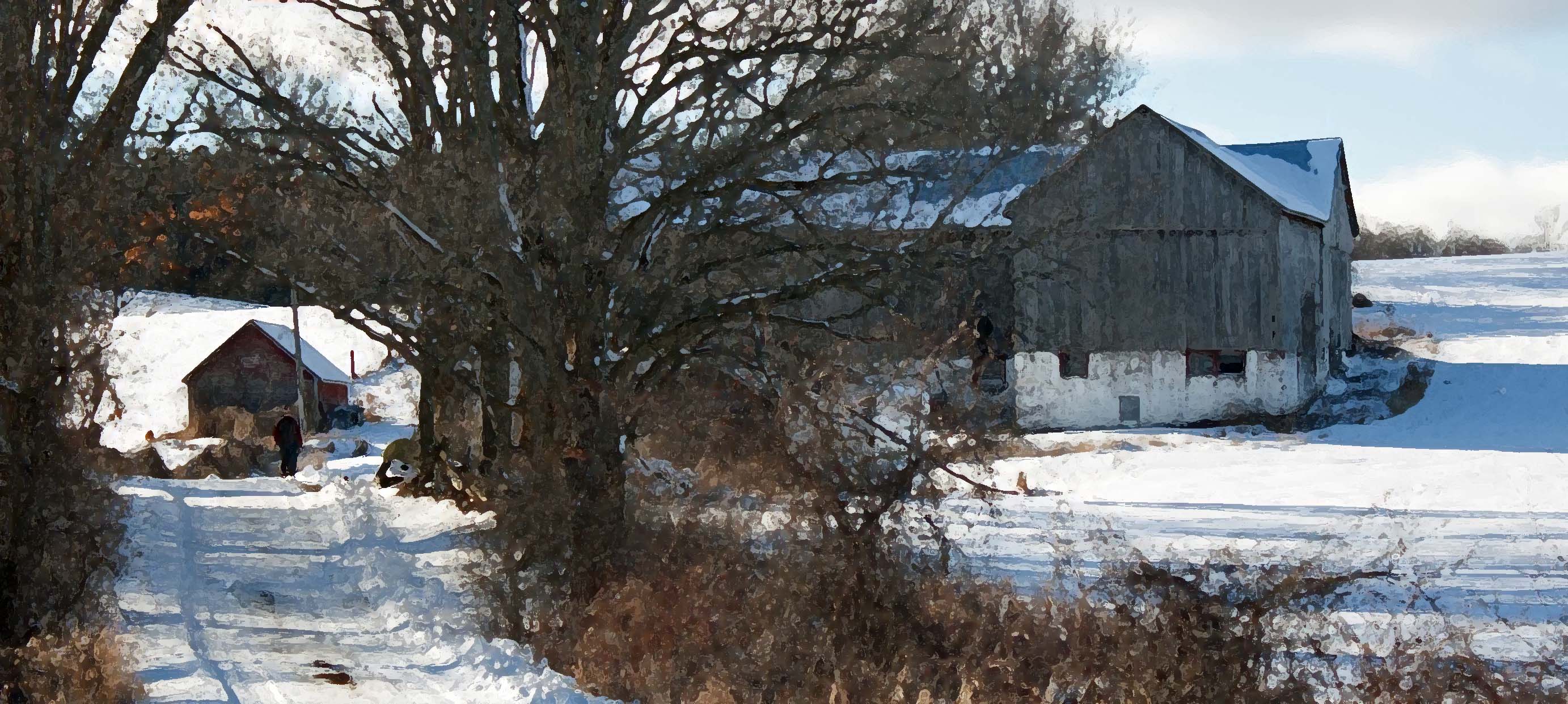
Farm and road in winter in Kawarthas, ON (photo and rendition by Nina Munteanu)
Young locust trees covered in new snow, ON (photo and rendition by Nina Munteanu)

Snow wraps everything in a blanket of soft acceptance. It creates a dazzling face on a dark earth. It refuses to distinguish between artificial and natural. It covers everything—decorated house, shabby old car, willowy trees, manicured lawn—beneath its white mantle. It quiets the Earth.

Trees and shrubs covered in new soft snow during snowfall, ON (photo and rendition by Nina Munteanu)

I often walk a trail through the forest after a fresh snow has fallen and the sun reveals itself on a crisp day. Like a balancing tightrope walker, the snow piles itself on everything, from fat fir branch to thin black locust twig. The snow then gives itself to the vagaries of a playful wind. Occasionally, a gust would send a shower of glitter snow dust raining down on me.

Snow-covered branches overlook path in show, ON (photo and rendition by Nina Munteanu)
Twigs piled with snow on a calm morning, ON (photo and rendition by Nina Munteanu)

I particularly enjoy walking a trail in the evening light after a fresh snow. Boots crunch on the fresh crisp snow that glistens in the moonlight. Each step is its own symphony of textured sound. A kind of collaboration with the deep of the night and Nature’s own whisperings.

Jackson Creek after a snowfall, ON (photo and rendition by Nina Munteanu)

Since moving to the Kawarthas, close to the Otonabee River, I walk daily along the river and its riparian forest. Winters here have graced us with a variety of typical winter morphology: thick and copious snowfall, enduring fog, imaginative ice formations on the river, and glittering hoarfrost and rime everywhere else.  The first snowfall can come in November, large flakes falling on still fully-clothed shrubs and trees, creating a painter’s landscape of reds, yellows, and greens dusted in a white blanket. This is when, some mornings, mist will rise like a cold breath from the river or flow and pool in depressions of the rolling Kawartha drumlins.

Thick first snowfall on Thompson Creek marsh in early winter, ON (photo and rendition by Nina Munteanu)

On cold nights in December, hoarfrost will form filigreed ‘leaves’ over everything—ground, sticks, ice and even snow. For a brief magical moment, this miniature crystal forest glitters like a field of jewels in the morning sun before vanishing by coffee break time. The river ices up in December, first with frazil that froths and fizzes as it coagulates into grease ice then shuga and finally to ice pancakes that crowd the shore, nudging each other like suburban women at a sale, then stitching themselves together into solid ice sheets attached to shore. By January and February, all is in place and the deep winter is upon us until ice break up and snow melt in late April into May. The river ice extends out from the bays in vast thick sheets where people can skate. The snow forms deep banks and drifts everywhere through which only snowshoes or skis can penetrate.

Mist off the river rises like steam on a cold day in winter, ON (photo by Nina Munteanu)
Old shed by the Otonabee River during a snowfall, ON (photo and rendition by Nina Munteanu)

Lately (in the past few years) I’ve noticed that this pattern has become interrupted by extremely mild weather throughout the winter season. January can look like November, with the exception of the absence of leaves on trees and shrubs; the greens and browns of other vegetation such as grasses, forbs and forest litter can still be revealed. The fogs of early winter may also return. The river ice sheets may fragment and flow downstream, only to reform as waters refreeze. The formerly uninterrupted reign of winter is waning and this saddens me with feelings of solastalgia. The Kawarthas still get good dumps of snow and magical frost. But for each champagne powder snow day, and hoarfrost glitter, there is a melt day, when snow melts and it rains, turning the parking lot into a skating rink as temperatures plummet with nightfall.

Snow melt on the side of a country road, ON (photo and rendition by Nina Munteanu)

I grew up in a part of Canada that experienced four distinct seasons. While spring and fall exemplify transition into and out of the two stable seasons of summer and winter, this is no longer the case in many parts of Canada, where formerly well-defined and uninterrupted winters and summers could be predicted. Now all the seasons experience transition and unpredictable phenomena. Winter temperatures in the Kawarthas were often stable at just below zero Centigrade to minus 20°; they now fluctuate more highly from minus 20° to +10.

Author’s car parks on a country road after a snowfall, ON (photo and rendition by Nina Munteanu)

A report by NASA’s Goddard Institute for Space Studies released in 2022 confirmed that global temperatures in 2022 were 1.6 degrees Fahrenheit above the average baseline period of 1951 to 1980 and 2 degrees warmer than the late 19th century average. They reported that the past nine years have been the warmest since modern record keeping began in 1880.

Teenagers walk the Rotary Trail after a snowfall, ON (photo and rendition by Nina Munteanu)

The winter that I grew up with is changing into something else. It, like the changing world, is in transition. There is no denying that global warming is upon us and each region is uniquely experiencing its effects. Climate is changing and the environment is adapting to that change.

Thompson Creek after a snowfall, ON (photo and rendition by Nina Munteanu)

While solastalgia creeps into my psyche at times, I am assiduously learning to pace myself with my changing environment. As the regional weather adapts to the warming climate, I am learning to adapt too. One way is through the equipment I use: I still use my snowshoes (a recent gift from my son) in winter; but, more often, I use snow/rain boots with crampons for terrain that includes wet snow, slush, and ice. Being prepared for change allows me to accept it with grace. I have learned to cherish those moments when fresh snow falls from the heavens like confetti. I charge outside in my snow gear and enjoy it while it’s there. I have learned to live in discovery and to thrill in the unpredictable. Each day is a gift of unknown and thrilling surprise.
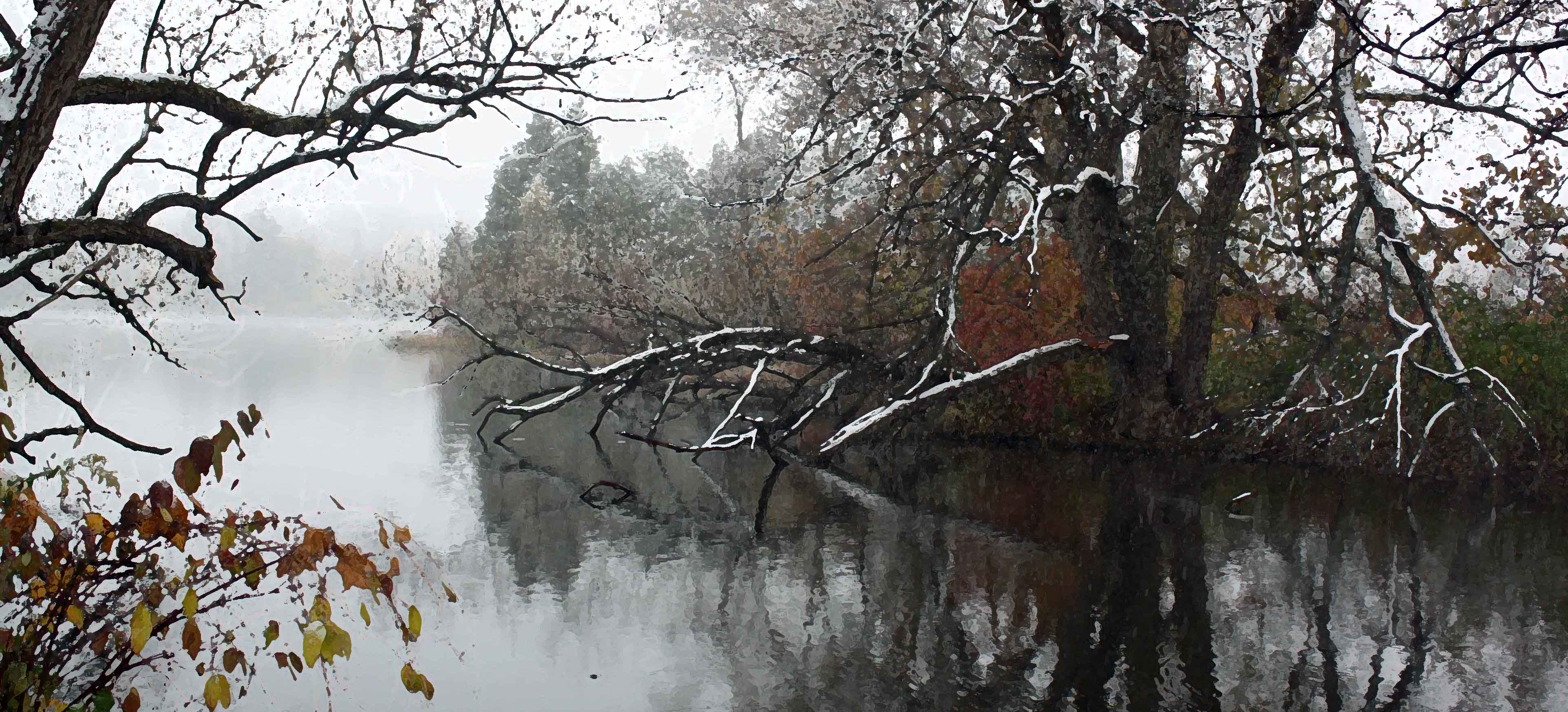
First snow in early winter at Thompson Creek, ON (photo and rendition by Nina Munteanu)

I have learned to live in the moment and to cherish that moment as a gift.

Because, even change is a gift.
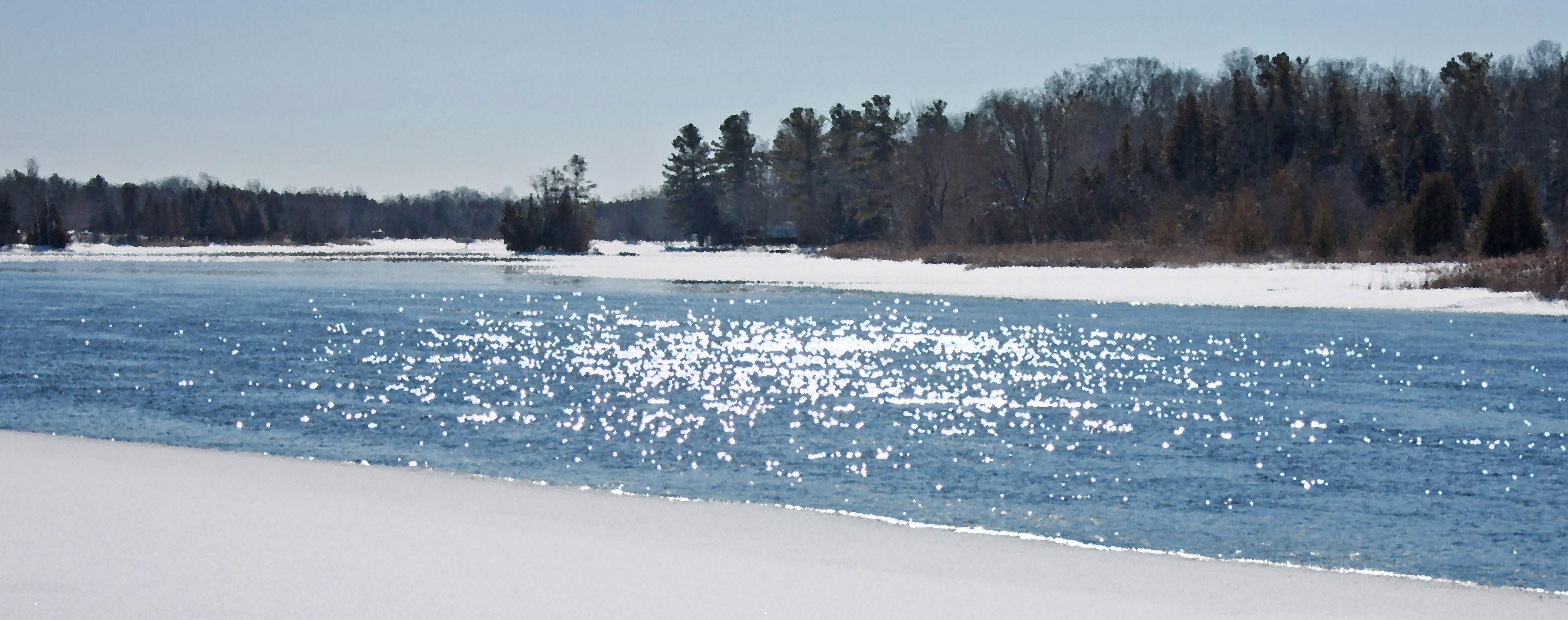
Partially iced over Otonabee River, ON (photo and rendition by Nina Munteanu)

Article originally published January 2023 in Rewilding Our Stories (edited by Mary Woodbury) then January 2, 2024 on Dragon.eco.
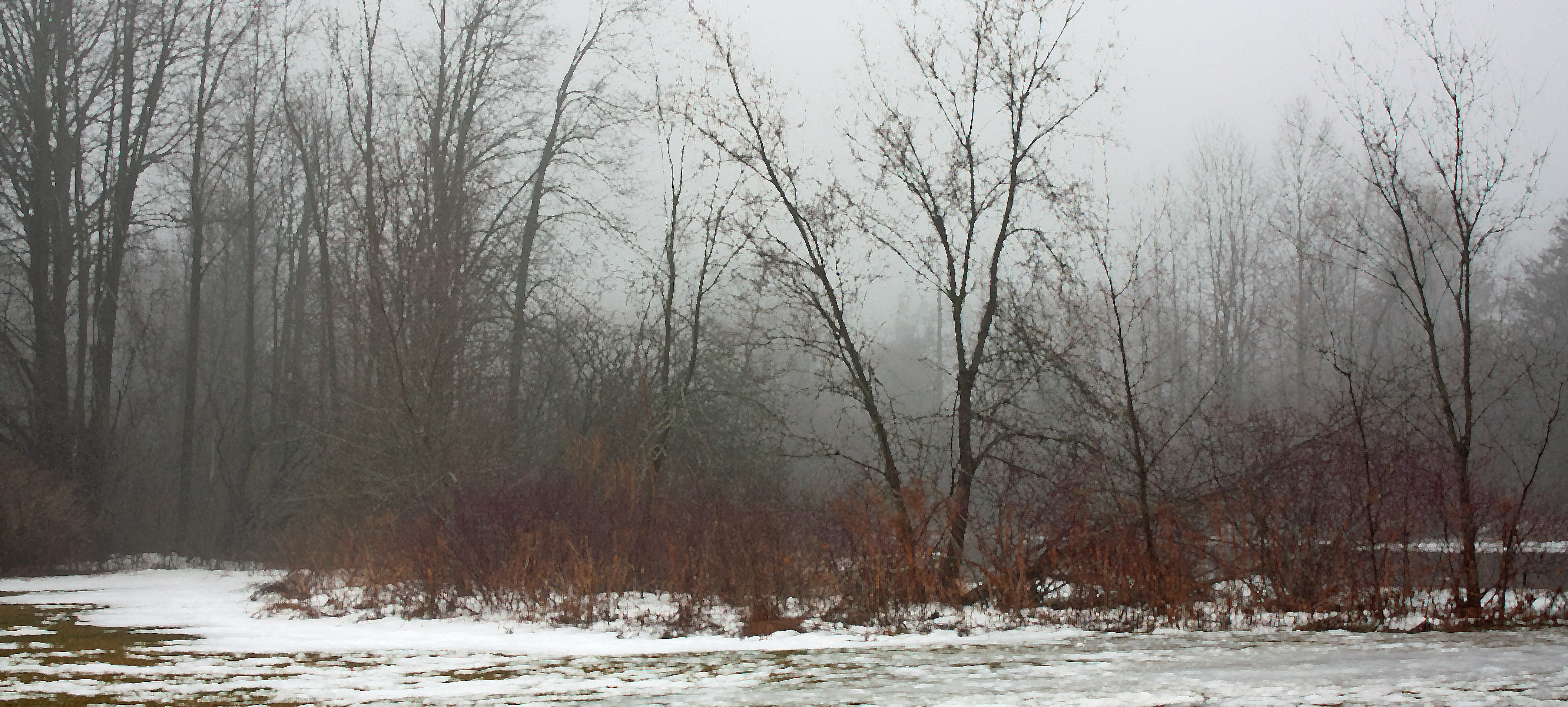
Trees and dogwood shrubs in winter by the Thompson Marsh, ON (photo and rendition by Nina Munteanu)
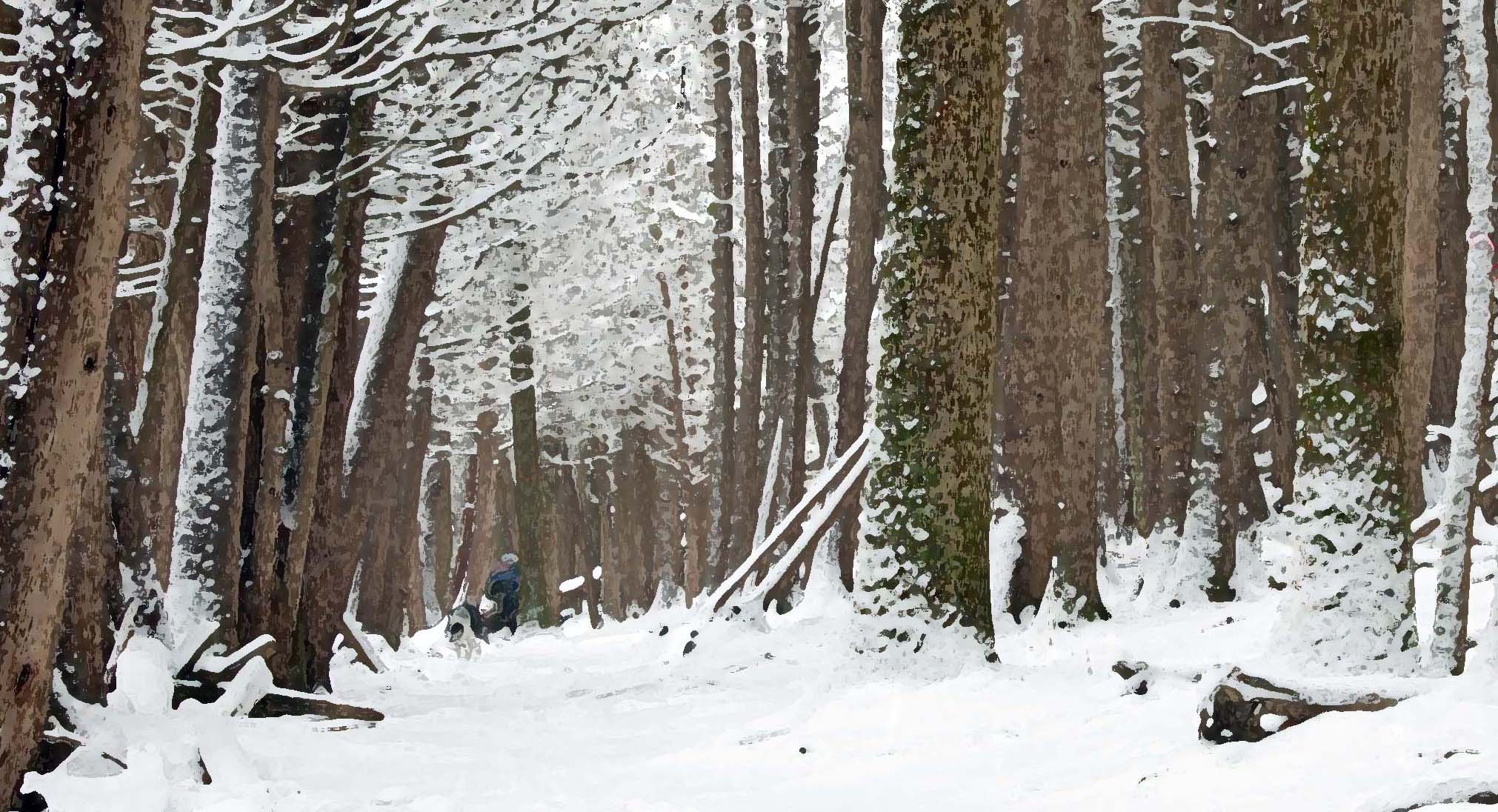
Woman and her dog walk among giant cedars after a snowfall, ON (photo and rendition by Nina Munteanu)

Nina Munteanu is a Canadian ecologist / limnologist and novelist. She is co-editor of Europa SF and currently teaches writing courses at George Brown College and the University of Toronto. Visit www.ninamunteanu.ca for the latest on her books. Nina’s bilingual “La natura dell’acqua / The Way of Water” was published by Mincione Edizioni in Rome. Her non-fiction book “Water Is…” by Pixl Press (Vancouver) was selected by Margaret Atwood in the New York Times ‘Year in Reading’ and was chosen as the 2017 Summer Read by Water Canada. Her novel “A Diary in the Age of Water” was released by Inanna Publications (Toronto) in June 2020.
Losing Myself in the Forest Helps Me Find Myself

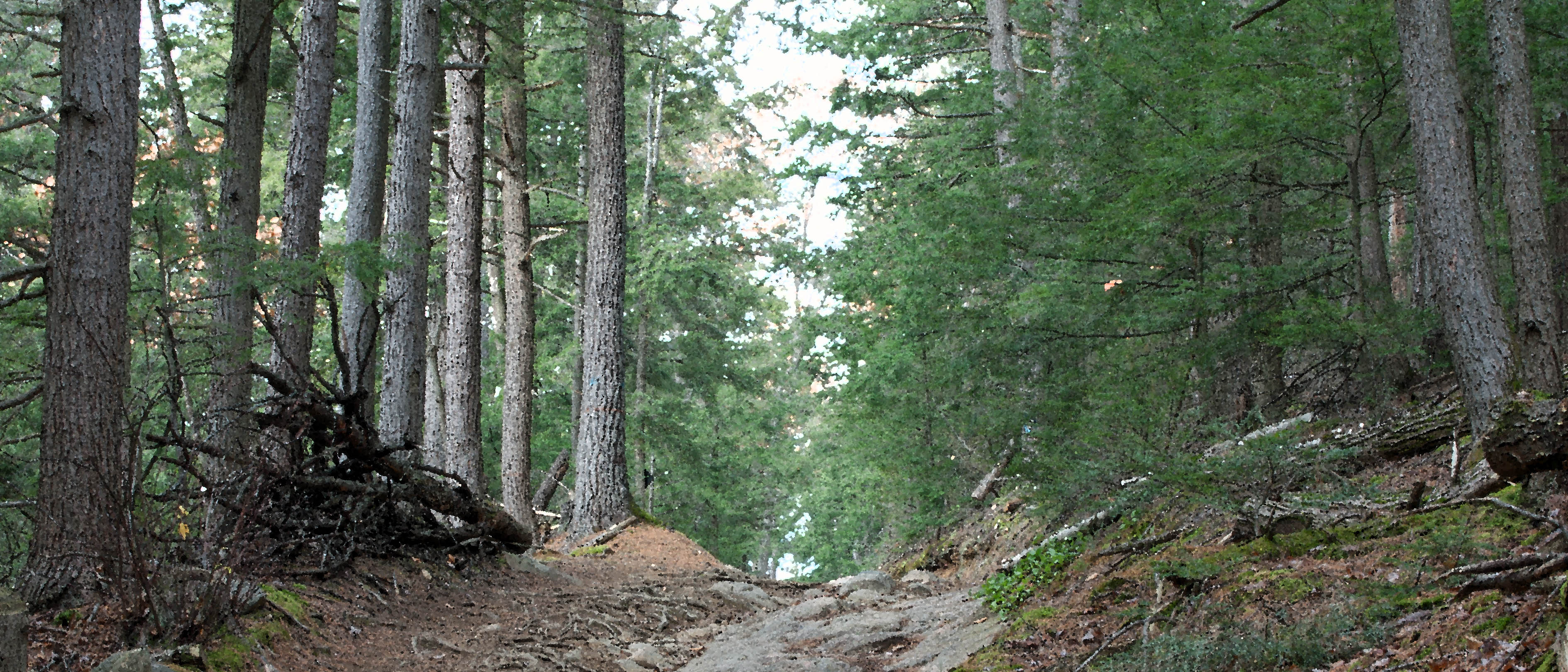
Rocky trail through ancient eastern hemlock forest, Catchacoma Park, ON (photo and rendition by Nina Munteanu)

I look forward to my daily walks. I find that walking helps me centre myself. Depending on the time I have, some walks last half an hour to an hour. Others walks will stretch from three hours to a day long. These aren’t city-walks.

Stream swells in a spring rain in Trent Nature Sanctuary, ON (photo and rendition by Nina Munteanu)

My favourite place to walk is in the forest, by a river.

Perhaps it is the solitude… or the negative ions, the fresh pungent scents of damp loam, moss and trees. The humbling magnificence of these stately trees. The fishy bog smell of algae. Or the unknown treasures hiding in plain sight for me to discover… Whatever the combination, I find it most pleasing. And freeing.

It is also here, wandering in the forest, that my creativity flourishes as I find expression through the joy of discovery.   

Old-growth forest surrounding Pierce Lake, BC (photo by Kevin Klassen)

The first step is to lose myself…

That’s the fun part: not knowing what’s beyond that hillside or down that ravine on the shores of the creek I barely see or around that bend in the root-gnarled trail among the swamp cedars. Like a moth to light, I’m drawn to the unknown. Ever the explorer.

Old-growth cedar forest in Jackson Creek forest, ON (photo and rendition by Nina Munteanu)
Gnarly cedar roots cross a path through morning fog in a swamp cedar forest, ON (photo by Nina Munteanu)

It is often here, as I walk along uneven trails or maneuver through undergrowth, up hills or down stream banks to explore and record with my camera, that I do my best thinking… Well, best in that it does not feel like thinking; more like simply ‘being.’ As my body responds to Nature’s sensual treasures, my ingenuous mind ‘walks away’ from restrictions of consciousness and roams in a kind of euphoric state of simple joy. Freed from thinking to feel and sense.

No need for a destination. The journey is my destination…

Gnarly roots of an old yellow birch snake across the old-growth cedar forest, ON (photo by Nina Munteanu)
Moss-covered boulder erratic (Nina’s Boulder) in old-growth cedar forest of Jackson Creek park, ON (photo by Nina Munteanu)

Walking in a forest unclutters my mind. The forest is simple in its natural complexity. Its beauty combs out the tangles of human encumbrance and grounds me in the simplicity of natural life.

Cookout in old-growth rainforest at Mamquam River near Squamish, BC (photo by Kevin Klassen)

I go prepared. Depending on the kind of walk, I’ll bring my clementine to snack on or a hearty lunch and fruit snacks that I carry in my backpack, along with a notebook and first aid kit. And, of course, I bring my camera. When I stop for lunch or snack, I choose my location thoughtfully, sometimes a place to sit, but mostly with a view of something worth studying. Lunch or snack stops are particularly alluring with unexpected experience.

Moss-covered rocks scatter along the banks of Jackson Creek, ON (photo by Nina Munteanu)

It is then, when I’ve stopped walking and have become quiet, when nature closes around me like a soft blanket and often gifts me with a precious sight or sound. A nearby red squirrel eating a nut. A bird flitting from berry to berry in a viburnum shrub. Oft times, I will be rewarded with the sight of a mushroom right at my feet or next to where I sit. That is often followed by the sight of many more.

As though the one had to be first seen to reveal the many.

Various mushrooms in Ontario forests (photos by Nina Munteanu)

Now lost, I open myself to possibility…

Like the propagules of Virginia creeper, my senses reach out to find the unexpected. I’m looking to be surprised. To discover something new that will draw me outside myself.

Various flowers and trees in southern Ontario (photos by Nina Munteanu)

The river trickles in the background as I step through dappled light and inhale the organic scents of the forest. The forest and the river help me re-align and focus—without trying. That’s the magic of it. It’s in the not trying.

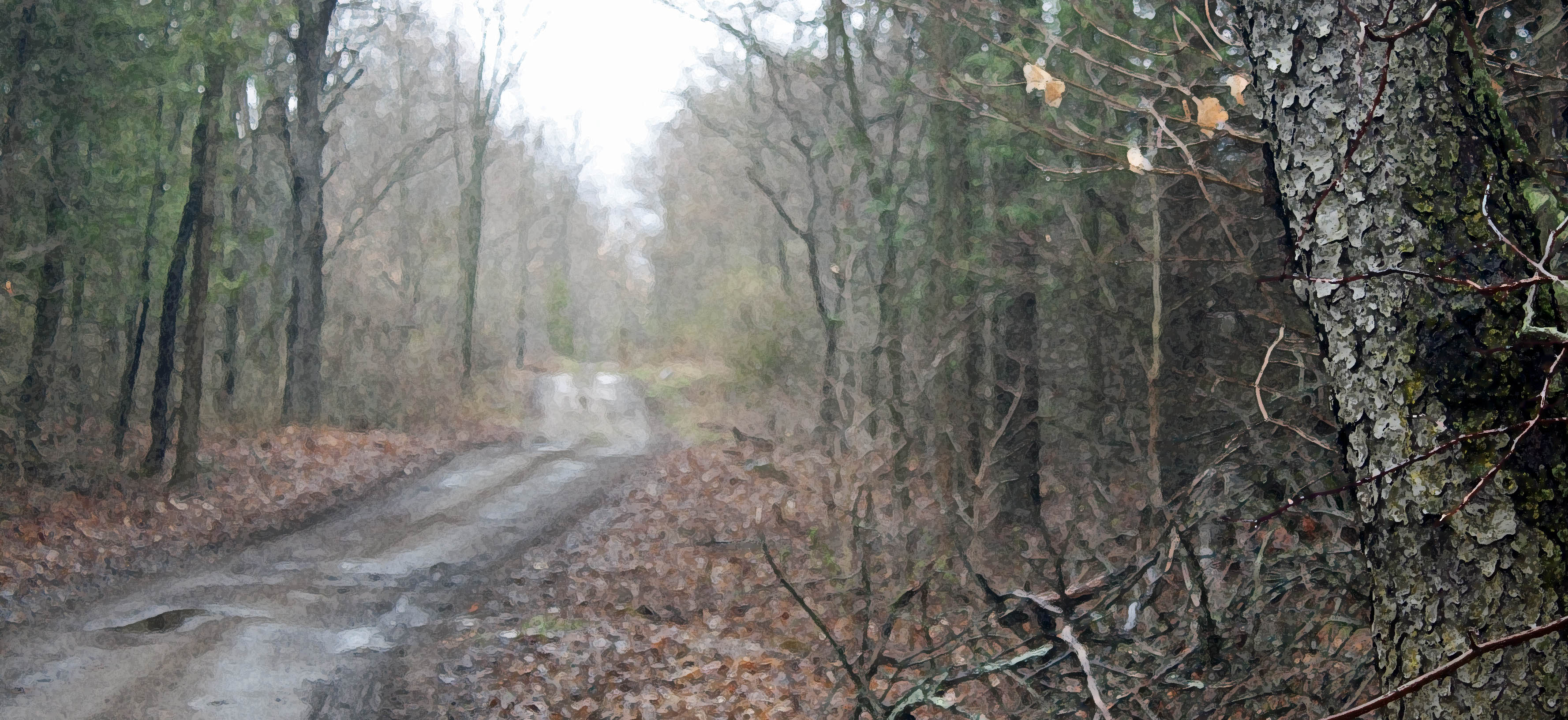
Marcescent beech leaves drape over old road through swamp forest, ON (photo and rendition by Nina Munteanu)

I take my camera (and tripod) with me on most walks for those moments that I can never anticipate: like the time a deer stepped gracefully out from behind a tree not three metres from me in a moss-covered red pine forest. I was in the process of setting up my camera on its tripod to capture the trail through the pines when the deer moved gracefully into my sight. Startled, we both froze and stared at one another for a moment made eternity. The deer then sprang away and loped through the trees, disappearing within seconds. I stood, hands fixed on my camera shutter button, and smiled. I had not taken a picture. But I now basked in that frozen moment of fascination between two curious animals, a deer and a human.

I didn’t need a picture; I already had my prize, the enduring memory of that moment.

Pine trees loom tall at the location where I met the deer in Petroglyph National Park, ON (photo and rendition by Nina Munteanu)

In the April 2014 issue of the Journal of Experimental Pshychology: Learning, Memory and Cognition, Stanford researchers Marily Oppezzo and Daniel L. Schwartz demonstrated that walking boosts creative inspiration. Using the Guildford’s Alternative Uses Test they showed that the act of walking significantly increased creativity for 81% of the participants. Oppezzo and Schwartz were able to demonstrate that the creative ideas generated while walking were not irrelevant or far-fetched, but innovative and practical.

Moss-covered ancient hemlock in the Catchacoma old-growth forest, ON (photo by Nina Munteanu)

It begins with changes to our chemistry. In the September 3 2014 issue of The New Yorker, journalist Ferris Jabr describes why walking opens the mind to creativity:

“When we go for a walk, the heart pumps faster, circulating more blood and oxygen not just to the muscles but to all the organs—including the brain. Many experiments have shown that after or during exercise, even very mild exertion, people perform better on tests of memory and attention. Walking on a regular basis also promotes new connections between brain cells, staves off the usual withering of brain tissue that comes with age, increases the volume of the hippocampus [a brain region crucial to relational memory and contextual learning], and elevates levels of molecules that both stimulate the growth of new neurons and transmit messages between them.”

Beech tree with marcescent leaves in a mixed forest, ON (photo by Nina Munteanu)

So, I walk and I create in my mind and my heart as I prepare to write my next novel…

Payne Line road in the mists of an early morning rain, ON (photo and rendition by Nina Munteanu)

Nina Munteanu is a Canadian ecologist / limnologist and novelist. She is co-editor of Europa SF and currently teaches writing courses at George Brown College and the University of Toronto. Visit www.ninamunteanu.ca for the latest on her books. Nina’s bilingual “La natura dell’acqua / The Way of Water” was published by Mincione Edizioni in Rome. Her non-fiction book “Water Is…” by Pixl Press (Vancouver) was selected by Margaret Atwood in the New York Times ‘Year in Reading’ and was chosen as the 2017 Summer Read by Water Canada. Her novel “A Diary in the Age of Water” was released by Inanna Publications (Toronto) in June 2020.

When a Walk in the Forest Makes My Heart Sing…

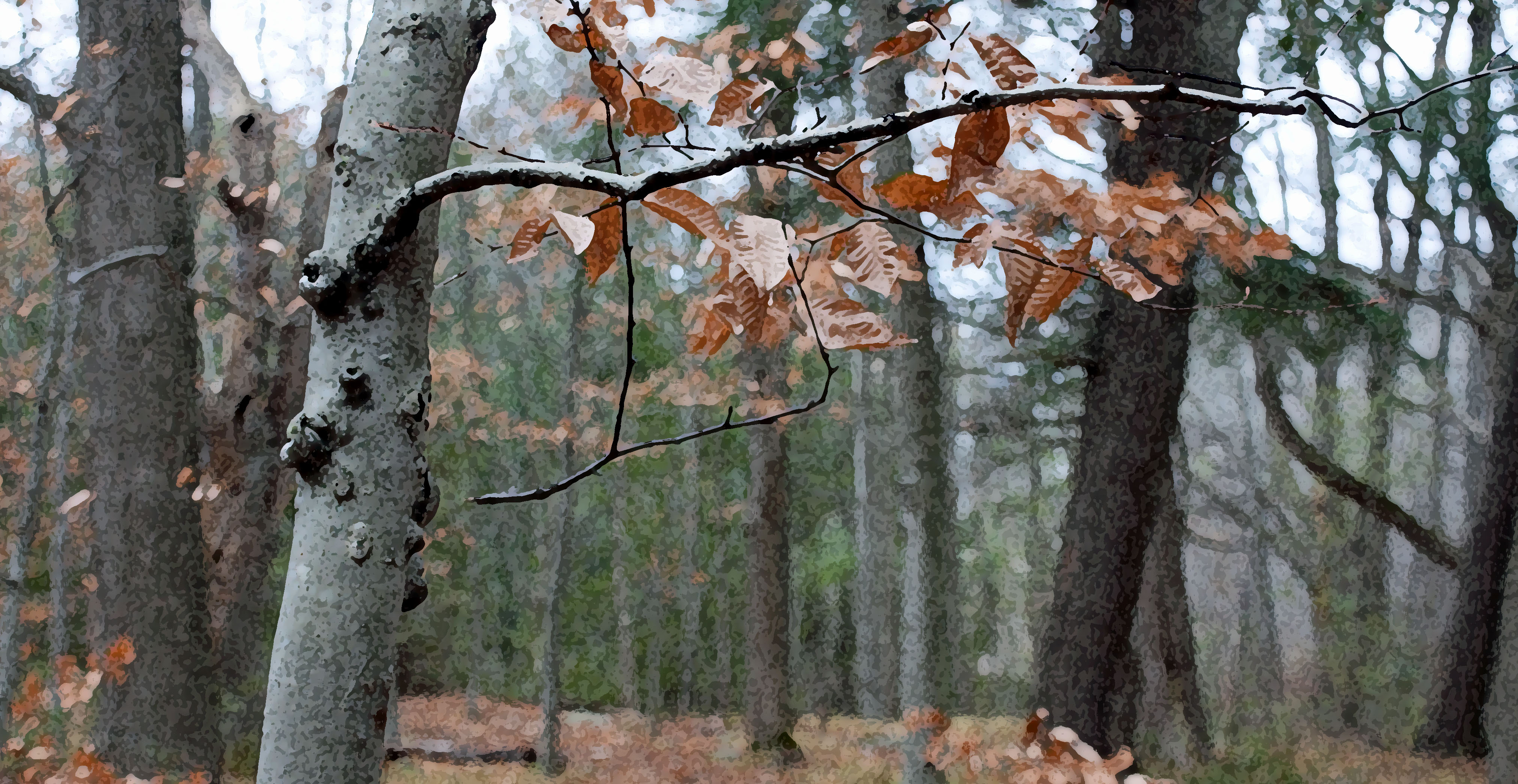
Beech trees stand with bronzed leaves as the snow falls in the mixed forest of South Drumlin park, ON (photo and rendition by Nina Munteanu)

Yesterday, it started snowing near the end of my work shift, and I kept glancing out the window as it turned into a heavy thick snow, the kind I just adore. Whenever this happens, I long for werifesteria

A pair of beech trees stand pale among hemlocks and poplar trees, South Drumlin park, ON (photo and rendition by Nina Munteanu)
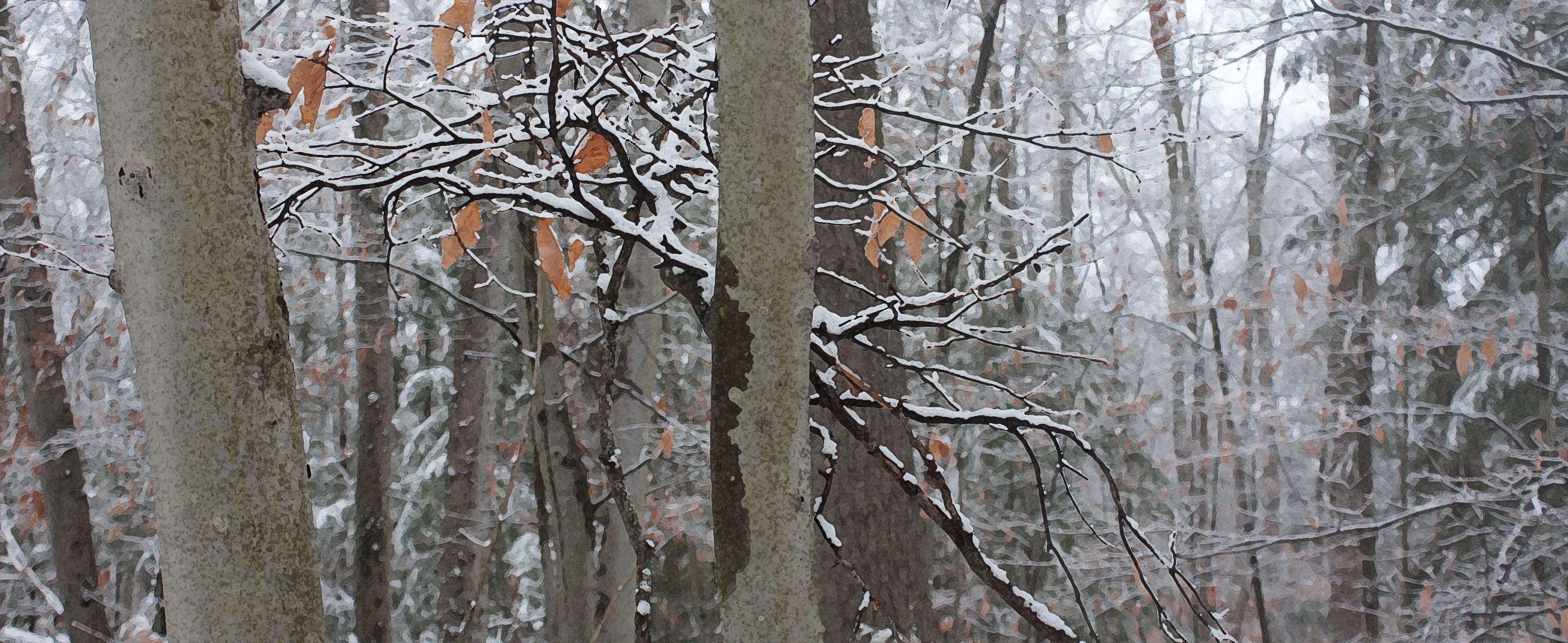
Beech-hemlock forest after a light snow in South Drumlin park, ON (photo and rendition by Nina Munteanu)

As soon as the shift was over, I snatched my gear and rushed off with my camera and tripod and a pack of blueberries to the beech-maple-hemlock forest nearby. The place is called South Drumlin Park, because the forest runs up and down a hogsback with wonderful trails throughout.

Marcescent beech trees greet me along a trail in South Drumlin park, ON (photo and rendition by Nina Munteanu)

I was the only person there. I walked and crunched through snow and frost-hardened leaf litter and I let myself get lost in the labyrinth of trails through the open winter forest. The pale beech trees, because they keep their now copper-coloured marcescent leaves, stood out amid the bare maples, oaks, poplars and birch trees.

Pale bronze beech leaves light up the dark hemlock forest, South Drumlin park (photo and rendition by Nina Munteanu)

I wandered there for hours, inhaling the peaceful freshness and the quiet hush of gentle snowing in the forest. 

There were just a few rowdy red squirrels and one persistent bluejay, but all else lay quiet in the deep of the forest. I had found my magic and mystery … It felt sublime and my heart sang…

Trail through poplars, cedars and hemlocks toward the river, South Drumlin park, ON (photo and rendition by Nina Munteanu)

Nina Munteanu is a Canadian ecologist / limnologist and novelist. She is co-editor of Europa SF and currently teaches writing courses at George Brown College and the University of Toronto. Visit www.ninamunteanu.ca for the latest on her books. Nina’s bilingual “La natura dell’acqua / The Way of Water” was published by Mincione Edizioni in Rome. Her non-fiction book “Water Is…” by Pixl Press (Vancouver) was selected by Margaret Atwood in the New York Times ‘Year in Reading’ and was chosen as the 2017 Summer Read by Water Canada. Her novel “A Diary in the Age of Water” was released by Inanna Publications (Toronto) in June 2020.

Taking Photographs That Match Your Mind

Nina scoping her shot with her iPhone (photo by Merridy Cox)

You see something breathtaking and say to yourself: I have to take a picture of that! You snap it with your camera or phone, happy that you’ve captured the moment. When you return home and review your shots on the computer to share, you get to that breathtaking scene and your first thought is: why on Earth did I take a picture of that?!
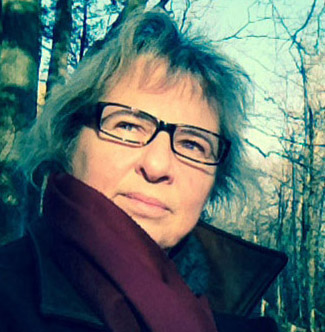
The shot is nothing like what you remembered. That dull and lifeless scene is the farthest thing from breathtaking. What happened?

Nina checks her photo on her iPhone (photo by Merridy Cox)

When Your Mind and Your Camera Don’t Agree

We see with our eyes, but we feel and process meaning with our brain. And it’s the brain that determines what we finally see. What we see is our brain’s interpretation of the scene. We adjust what we see with meaning.

The camera doesn’t interpret. It is a tool that works based on principles of light, focus, depth of field, breadth of field, and resolution & detail. What a DSLR camera set on automatic, a compact camera and a smartphone have in common is that they are all set to capture the best shot, given the right conditions of light, contrast and motion. If you shoot with a camera set on automatic, it is acting as your brain, but without the interpretation of meaning. You’ve given away that power. Like a benevolent dictator, the camera/phone is boss of your shots, dictating what it was designed to do to get the best shot in those particular conditions. The trouble with that is the camera doesn’t see with your brain. Its idea of the ‘best shot’ is based on a set of criteria created by a manufacturer. It works great only in certain conditions—those best anticipated by the manufacturer (e.g. optimum light and distance). But, make no mistake: you will not get what your brain sees. You might think so, but you won’t.

A short while ago, when I was visiting a good friend in British Columbia, we got into talking about photography and I mentioned how I had returned from using a tablet and phone (for convenience) to my Canon DSLR camera (for quality); I had earlier ditched the camera in favour of the light convenient iPhone, which I found easy, particularly when travelling. But I soon became frustrated and disappointed at not achieving what my brain saw. Returning to the DSLR camera allowed me to significantly improve my shots. My friend’s daughter—an avid picture taker with her mobile phone—challenged me: “Are you sure your camera takes better pictures?” I wanted to laugh, but then I realized that she was serious, born from the confidence of her own pictures—which I’d seen and must acknowledge are very good for composition and sharpness. Closer inspection reveals that these were all achieved within a boundary of conditions. The lighting was optimal, the distance was good, the composition sufficiently simple to accommodate the camera’s limitations; so what her brain saw, the camera reflected, at least fairly well.

Nina (decades ago) with her Minolta SLR and long lens (photo by H. Klassen)

But it is impossible for a smartphone or any automatic camera to achieve certain effects that only my DSLR camera set on manual or semi-manual can provide (e.g. setting my depth of field, adjusting for that right bokeh, playing with exposure, achieving natural light and a high resolution image in a low-light situation, getting very close or zooming far away with a dedicated lens). In addition, DSLR cameras outperform smartphone cameras because their sensors are much larger, let in more light, and produce more dynamic range in low-light scenarios. This allows them to capture greater detail than smartphone cameras or compact cameras. Ultimately, as Smartframe acknowledges, “the gap between what’s possible on the smartphones and dedicated cameras remains significant.” The argument is similar for a regular camera set on automatic vs one set on manual or semi-manual.   

I’ve been there. Automatic settings on a camera and smartphone (which is basically like a camera on automatic) can only do so much to match what your brain sees. And they can be mighty annoying—particularly when the camera’s brain prefers to focus on the wrong thing.

Above: automatic setting went for background focus; below, setting corrected for foreground focus (photos of Earthstars in a cedar forest by Nina Munteanu)

If you truly want to get what your brain sees, you have to take over the brainpower of the camera. That means either tricking the automatic setting or going off automatic to manual or semi-manual on a camera (no smartphones currently come with manual settings, nor will they; although they may have some correcting software, which isn’t the same thing.) For the past decade the market is changing for phone cameras and compact cameras—there is Nikon’s Coolpix S800c, which combines an Android OS with a long zoom lens and touchscreen-based interface and Panasonic’s Lumix CM1 blends a traditional smartphone with a 1-inch sensor. Samsung’s Galaxy Camera 2 integrates an Android OS with 3G capabilities and a 21x optical zoom. They all remain limited with respect to matching what your brain sees to what your camera takes.

Getting Your Camera To Agree with Your Brain

Successfully getting your camera (or smartphone) to match your brain-sight starts with recognizing the various aspects of a captured image. These include:

  • focus (sharp or soft): what’s in focus and what isn’t in focus
  • depth of field: how deep the focused region is
  • lighting: colour saturation and contrast
  • resolution (sharpness)
  • motion (or lack of it)
  • composition (what is in focus and what isn’t and where everything sits)
  • bokeh (the look of the unfocused part)

All of these, once recognized, can be manipulated on your camera. On a smartphone or auto-camera, most of these factors must be addressed as best as you can by shifting your position or aim, changing the time of day or lighting when you take your picture, or changing your subject and surroundings. In other words, by manipulating what your brain sees.

I won’t lie; it’s not easy to manipulate what the camera takes to match what your brain sees. It takes dedication and time. But it starts with recognizing what needs manipulating: training your eyes and brain to really see what you’re taking a photo of and understanding what your camera has to do to achieve it.

Nina photographing a tributary of the Otonabee River, ON, with her Canon DSLR (photo by Matthew P. Barker, Peterborough Examiner)

How Our Eyes and Brains See

It helps to understand how our eyes see and how our brains process what we see, particularly what is different from what a camera does. This includes angle of view; resolution and detail; and sensitivity and dynamic range. 

Angle of View: Our angle of view isn’t straightforward like a camera with a particular lens with set focal length (e.g. wide angle vs. telephoto lens). Cambridge in Colour tells us that “even though our eyes capture a distorted wide angle image, we reconstruct this to form a 3D mental image that is seemingly distortion-free.” Our central angle of view—around 40-60º—is what most impacts our perception. “Subjectively, this would correspond with the angle over which you could recall objects without moving your eyes,” says Cambridge in Colour.

Rendition of what eye / brain focuses on (image from Cambridge in Colour)

Resolution and Detail: Cambridge in Colour tells us that 20/20 vision is mostly restricted to our central vision; we never actually resolve that much detail in a single glance. Away from the centre, our visual ability decreases and at the periphery we only detect large-scale contrast and minimal colour. A single glance, therefore, mostly perceives the centre in resolution. Because our brain remembers memorable textures, colour and contrast (not pixel by pixel), our eyes focus on several regions of interest in rapid succession, which paints our perception. “The end result is a mental image whose detail has been prioritized based on interest.” It is our interest that dictates what we see and ultimately informs our memory of that image.

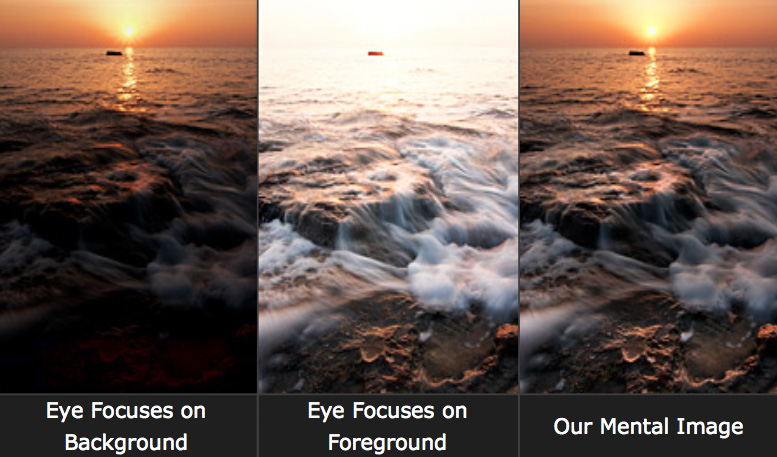
How our eye / brain integrates depth of field and exposure for background and foreground (image by Cambridge in Colour)

Sensitivity & Dynamic Range: According to Cambridge in Colour, our eyes have the equivalent of over 24 f-stops. This is because our brains integrate background and foreground to create a mental image that integrates these.

Matching the Camera to Our Brain

The next step is to learn how to manipulate the camera to achieve these. This means learning how to use the f-stop, how to manipulate the shutter speed, how to change the ISO setting, and what all these, in turn, produce in terms of focus, depth of field, lighting, exposure, saturation, resolution, bokeh and more. Taking a course in photography is a good way to start. Experiment with settings. Learn about the equipment. Lenses. Filters. Tripods. Go on a camera shoot with a photographer who knows about these. It promises to be ultimately rewarding and fulfilling.

I wanted the entire foreground group of Shaggy Main mushrooms to be in focus and the background less focused but recognizable; I therefore set my f-stop at 18, which gave me a slower shutter speed (and I had to stabilize my camera) with sufficient depth of field (photo by Nina Munteanu)
I used a higher speed and smaller f-stop of these cardamom pods and seeds to create a more shallow depth of field that focuses attention on a particular aspect of interest and keeps the image from looking flat (photo by Nina Munteanu)
A medium f-stop allowed me to freehold my camera and capture a crisp shot of the person and sled but a motion-blurred shot of the dog–achieving a sense of motion in the shot (photo by Nina Munteanu)
I oriented my camera for a portrait (vs landscape) shot to showcase the height and gigantic size of these red cedars in Lighthouse Park, Vancouver, and ensured a person was in the shot for perspective (photo by Nina Munteanu)
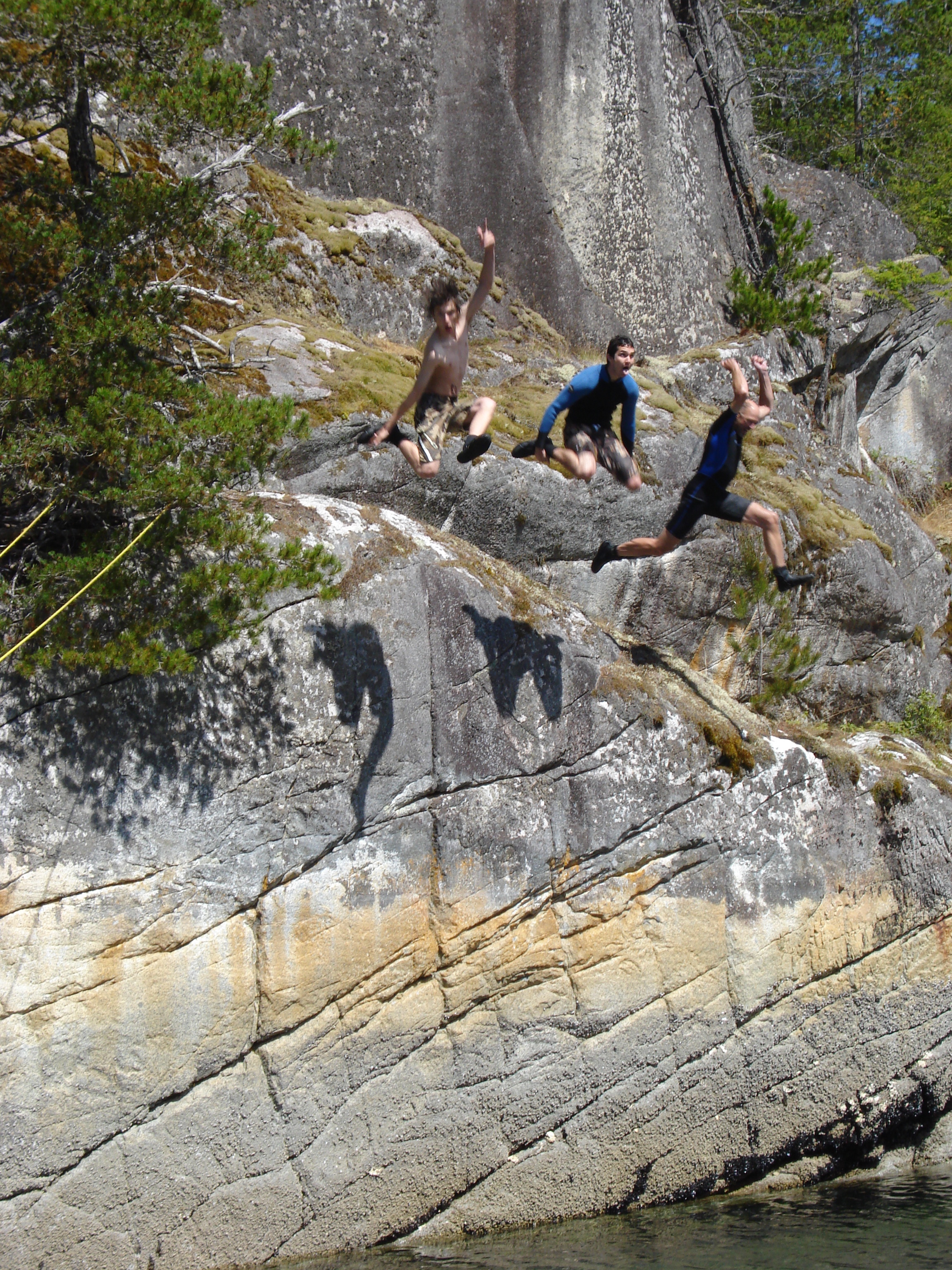
I used a low f-stop (which in good light does not appreciably reduce depth of field) to achieve high speed in capturing the three divers off the cliff (photo of ocean cliff in BC by Nina Munteanu)
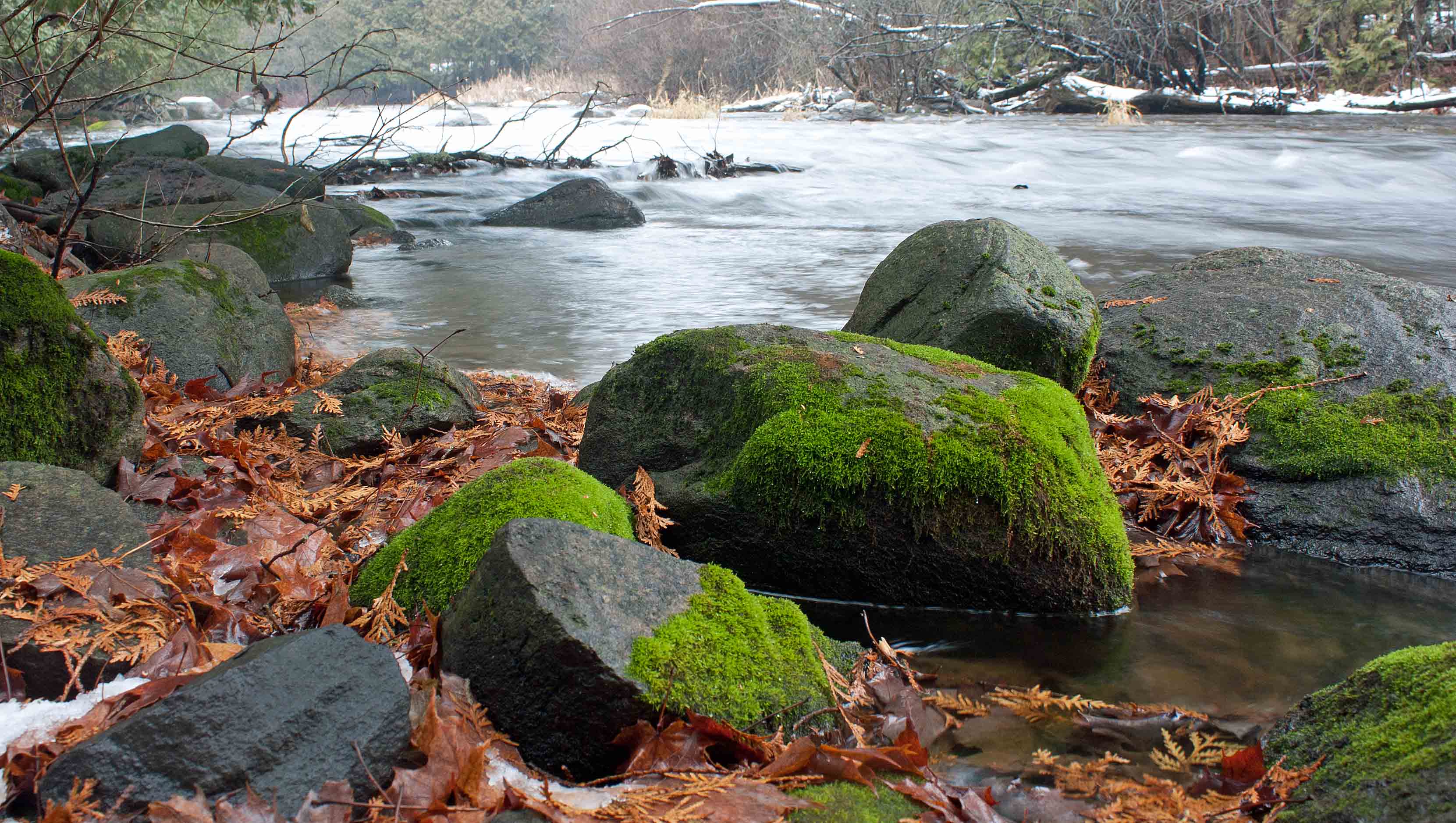
I used a high f-stop and stabilized camera to achieve a softer look to the moving water and also get higher depth of field to see both stationary foreground and background (photo by Nina Munteanu)

I’ve been on my journey for over a decade and I’m still learning. From my son, from others, from my own experiences. That’s the fun part, after all. It’s an adventure of discovery…

My Canon camera on its tripod (photo taken with tablet by Nina Munteanu)

NINA MUNTEANU is a Canadian ecologist / limnologist and novelist. She is co-editor of Europa SF and currently teaches writing courses at George Brown College and the University of Toronto. Visit  www.ninamunteanu.ca for the latest on her books. Nina’s bilingual “La natura dell’acqua / The Way of Water” was published by Mincione Edizioni in Rome. Her non-fiction book “Water Is…” by Pixl Press(Vancouver) was selected by Margaret Atwood in the New York Times ‘Year in Reading’ and was chosen as the 2017 Summer Read by Water Canada. Her novel “A Diary in the Age of Water” was released by Inanna Publications (Toronto) in June 2020.