“In this bonus episode, we continue our conversation with limnologist and cli-fi author Nina Munteanu. We discuss her book A Diary in the Age of Water and what led her to write this dystopian tale of a future that revolves around water scarcity. Nina’s background as a limnologist gives her a unique perspective on the challenges that await us if we do not address climate change.”
Click below to listen:
Nina Munteanu is a Canadian ecologist / limnologist and novelist. She is co-editor of Europa SF and currently teaches writing courses at George Brown College and the University of Toronto. Visit www.ninamunteanu.ca for the latest on her books. Nina’s bilingual “La natura dell’acqua / The Way of Water” was published by Mincione Edizioni in Rome. Her non-fiction book “Water Is…” by Pixl Press(Vancouver) was selected by Margaret Atwood in the New York Times‘Year in Reading’ and was chosen as the 2017 Summer Read by Water Canada. Her novel “A Diary in the Age of Water” was released by Inanna Publications (Toronto) in June 2020.
Those who are inspired by a model other than Nature, a mistress above all masters, are laboring in vain—Leonardo daVinci
You pause at the front door of the eco-house that you and your partner designed in Vancouver’s Point Grey and pull up the collar of your jacket. The air is fresh with the promise of snow and you smile with thoughts of spring skiing at Whistler.
You glance at the time display on your Smart Glasses. You’ve decided to forego the WaveGate and walk to the café; you have plenty of time to walk through the hilly forested streets, with a view of English Bay. You want to check out the refurbished solar-house on Locarno Cresent that your company helped design. Based on a living model of Biomimicry, the house is the latest iteration of your company’s “symbiosis” model of 100% sustainability, in which people live in a cooperative and synergistic partnership with their environment. The house is an intelligent organic facility with self-cleaning floors and walls; heated, fueled and lit by organisms in a commensal relationship. Everything works on a natural cycle of harmonious renewal and natural evolution. You smile, rather self-pleased. It has taken you a few years to convince the city council to accept this new model in community design. Now, it’s happening everywhere.
It’s April 12, 2074. A special day. And a special year. The year of the wooden horse in the Chinese calendar. Also called the green horse, it’s associated with spring, growth and vitality. The horse symbolizes nobility, class speed and perseverance. Horse energy is pure unbridled spirit. Playful, wild and independent, the horse has a refined instinct that flows through action and movement. Together, these symbols promise both chaos and great opportunity. And transformation.
The year of the wooden horse only occurs every sixty years. And sixty years ago today your mom turned sixty. You release a boyish grin at what you intend to do in celebration. On that day, sixty years ago, she celebrated her sixtieth birthday with the release of Natural Selection, her collection of speculative short stories about human evolution, AI, genetic manipulation, transhumanism, and the human-‘machine’ interface. She also celebrated the local printing of Metaverse, the third book of her space detective trilogy, The Splintered Universe. It was the second book to be printed by Toronto Public Library’s newly acquired Espresso Book Machine; one of only two EBMs in Toronto at the time.
A smile slants across your face as you remember what libraries and bookstores used to look like then. Both were struggling with a changing paradigm of reading, writing and publishing. Many of the older folk feared that books—print books, particularly—were going extinct as more exciting channels of communication like videos, interactive games and instant social networking took over. Of course, that didn’t happen. “Story” and “storytelling” were simply evolving and the paradigm shift simply embraced a new model that incorporated more diverse expression. You remember conversations with your mom about Chapters-Indigo, whose face changed from a bookstore to a gift store and tchotchke filled more and more of the storefront. As large bookstores struggled to dominate, the EBM—like its lithe mammal cousins in the Cenozoic Era—created a new niche for itself: the book ATM.
The size of a Smart Car, the EBM could fit nicely in a stylish café, housing and dispensing—Tardis-style—many more books than its diminutive size. In 2014, the EBM carried over eight million titles, including commercial books and out-of print gems. That number has tripled as virtually every publisher embraced the Book ATM model to sell books.
You inhale the tantalizing aroma of freshly ground and brewed coffee before you reach Zardoz Café. The retro-style café is a converted Edwardian-style house with high arched windows and a living roof overlooked by tall sycamore trees. You climb the stairs and enter the café. Its 2020’s style interior that your company helped design is decorated in earthy tones, avant-garde art, a forest of dracaenas and ferns and a stepped creek, complete with goldfish and crayfish. A shiny brass Elektra Belle Epoque espresso maker sits at the bar, bestowing the finest fair trade coffee.
Your sweeping gaze notes several people at the small round tables, enjoying good coffee and conversation; your special guest hasn’t arrived yet. You spot the WaveGate at the back, resembling an old English pay phone. Next to it sits the EBM. Eager to do your deed before your guest arrives, you sidle to the coffee bar and catch Grace’s eye. She smiles; you’re a regular. You touch her wrist with your watch and the data passes onto her embedded interface. She taps her hand to process the book order—she insists that you not pay—then she makes your double-shot espresso—the old-fashioned way. As she grinds and taps and runs the machine, you and she chat about skiing this spring. Just as Grace hands you a perfect crema-topped espresso, the WaveGate shimmers briefly and then its door opens like an accordian.
Your mom emerges from the “tardis”, smartly dressed in an early-century blazer and skirt, and grinning like an urchin. She resembles the seventeenth Doctor a bit, you decide—the first female Doctor Who, finally! Somehow—you don’t know how she does it—her old-fashioned style manages to embrace “retro-cool”. She’s arrived from Switzerland, where she is house and cat-sitting for good friends in Gruyeres. From there she still commutes—Tardis-style—as sessional lecturer at the University of Toronto, where she maintains a tiny book-festooned office.
“Kevy!” she squeals like a girl, obviously happy to see you. You don’t cringe; you’ve grown accustomed to the ripples of interest your mom’s unalloyed enthusiasm usually creates.
“Happy birthday, Mom!” You seize her in a hug. “I’m glad you made it for your 120th birthday.” Traveling the WaveGate suits her, you consider.
“I like the tardis better than you, I think,” she says, smiling sideways at you with knowing. She’s right; you prefer the old-fashioned way of traveling, without having to reconfigure your molecules from one place to another. In fact, you prefer the old-fashioned way of doing a lot of things, you decide with an inner smile.
“I have a surprise for you, Mom,” you say with a knowing grin. Your mom likes surprises. Her eyes light up and she beams at you. You glance at Grace with a conspiratorial look. She takes the cue and starts the EBM.
“Over here,” you say, steering your mom toward the EBM, already humming like an old tomcat getting its chin scratched. Your mom bends down to watch the pages spew out of the paper holder and stack neatly in a tray, then get snatched by robotic fingers as a colour cover is created then laid below, ready to envelope the book interior. After the gluing and binding, the robots trim the book on three sides then summarily send it sliding out a chute on the side.
Your mom has guessed what the book is; but she still squeals with glee when she sees it. It’s Metaverse, of course; the book she first had printed on the EBM in Toronto’s Public Library sixty years ago on her birthday.
“I just thought you’d like another book,” you say with a laugh. Like she needs another book. But this one’s special; it’s sixty years old today. Just like she was, sixty years ago—today. You pull out your PAL and point at your mom, as she seizes the perfectly bound book. “Let me take your picture!”
She poses with the book, looking like a kid with candy. You check the image and laugh. “There it is. You don’t look a year over sixty!” You grin at your 120-year old mother.
“And you don’t look a day over twenty-three!” she teases back. You give her a slanted smile. You’re eighty-three. Beaming, she goes on, “I remember doing this exact thing sixty years ago in Toronto! Those same feelings of overwhelming gratitude and wonder are still there,” she confides. “I remember telling the CBC reporter who covered the EBM launch that it felt like a birthing.” She throws me a crooked grin. “Only the labour was on the computer instead of in the hospital!”
Visibly pleased and touched, she snatches me in a bear hug.
“This is the best present a mom could get from her son. Thanks for remembering. It’s been an incredible ride and it’s all been worth it.”
“Join me in a coffee; then I have a house to show you…” you say, smiling with pride.
The Espresso Book Machine
Many bookstores, libraries, and universities around the world are hosting the Espresso Book Machine® (EBM) by On Demand Books LLC (and associated with Lightning-Ingram). The EBM makes millions of titles available via the EspressNet® software and produces quality paperbacks in minutes at point of sale. The EBM is not a print-on-demand solution, but a powerful new digital-to-print channel that eliminates lost sales due to out-of-stock inventory or the hassle of returns.
Advantages:
Readers: millions of books, multiple languages, made on demand for you.
Bookstores, Libraries and other Retailers: sell (or lend) more titles without the extra inventory; capture the growing self-publishing market.
Publishers: the EBM offers an additional sales channel and greater visibility to a publisher’s titles. It also avoids out-of-stocks and eliminates returns.
Authors: earn additional income otherwise lost through the used-book market.
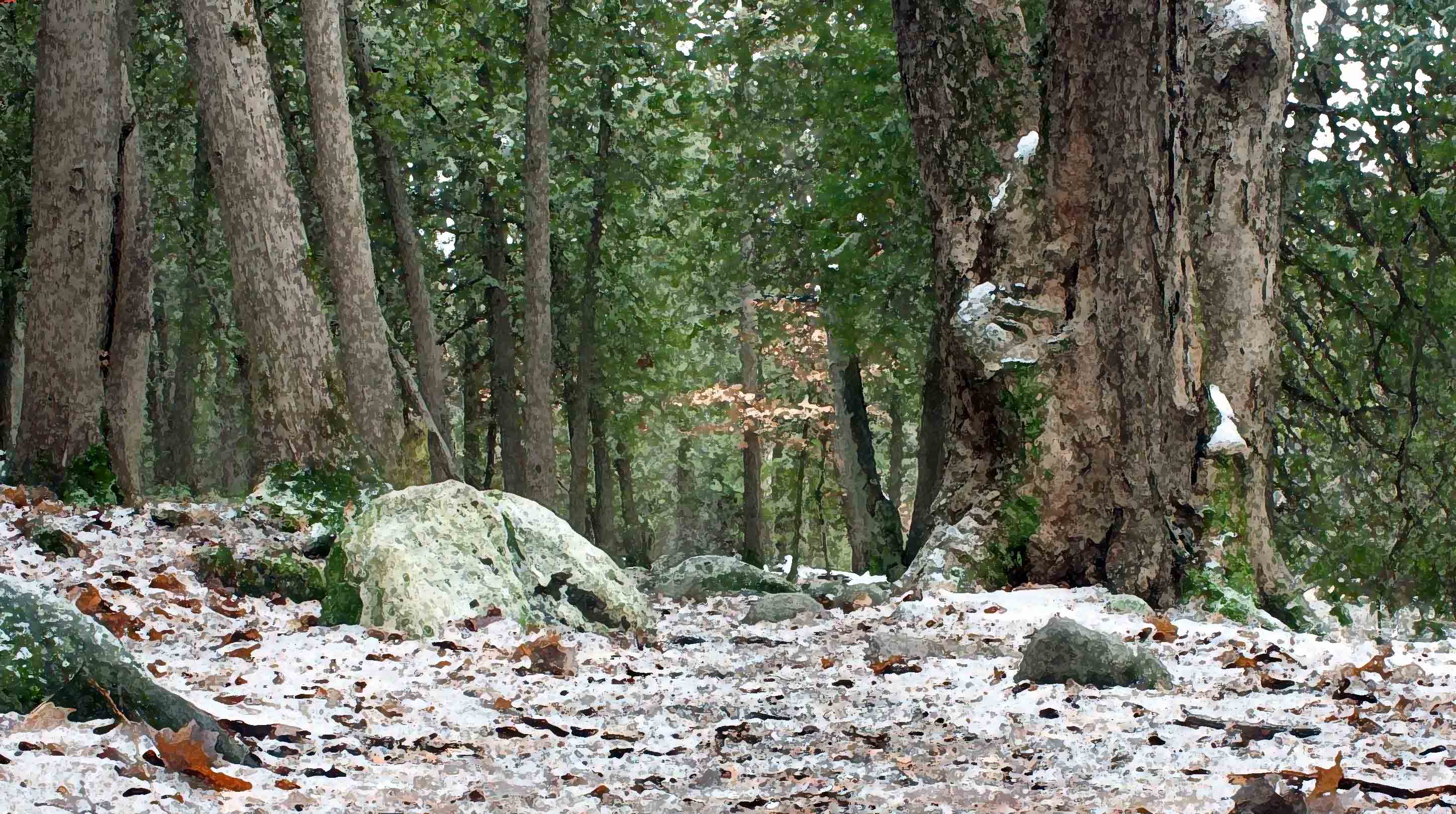
Old maple tree in Jackson Creek Park in December snow, ON (photo and dry brush rendition by Nina Munteanu)
Nina Munteanu is a Canadian ecologist / limnologist and novelist. She is co-editor of Europa SF and currently teaches writing courses at George Brown College and the University of Toronto. Visit www.ninamunteanu.ca for the latest on her books. Nina’s bilingual “La natura dell’acqua / The Way of Water” was published by Mincione Edizioni in Rome. Her non-fiction book “Water Is…” by Pixl Press(Vancouver) was selected by Margaret Atwood in the New York Times ‘Year in Reading’ and was chosen as the 2017 Summer Read by Water Canada. Her novel “A Diary in the Age of Water” was released by Inanna Publications (Toronto) in June 2020.
Nina Munteanu was recently on The Douglas Coleman Show where she and Douglas talked about writing, being scared of water, the sub-genre of eco-fiction and what Canada might have been like if the white settlers hadn’t come.
Here’s the show:
Nina Munteanu is a Canadian ecologist / limnologist and novelist. She is co-editor of Europa SF and currently teaches writing courses at George Brown College and the University of Toronto. Visit www.ninamunteanu.ca for the latest on her books. Nina’s bilingual “La natura dell’acqua / The Way of Water” was published by Mincione Edizioni in Rome. Her non-fiction book “Water Is…” by Pixl Press(Vancouver) was selected by Margaret Atwood in the New York Times‘Year in Reading’ and was chosen as the 2017 Summer Read by Water Canada. Her novel “A Diary in the Age of Water” was released by Inanna Publications (Toronto) in June 2020.
I recently appeared on Episode #142 of award-winning “Sample Chapter Podcast” where I had a wonderful interview with Jason Meuschke and read a sample chapter from my recent eco-novel “A Diary in the Age of Water.”
Jason and I talked about the writing process; what makes good and compelling fiction; creating realistic and interesting characters with flaws–like my flawed detective Rhea Hawke in The Splintered Universe Trilogy‘ writing eco-fiction in which environment can be a character; the “what ifs” in historical fiction and where we get our ideas (The Last Summoner came to me in a dream and later through a single image).
Episode 142 is here with a truly delightful author from Canada, Nina Munteanu. In the episode, Nina and Jason discuss character flaws, having the environment be a character in our prose, the “what ifs” in historical fiction, the writer’s “wavelengths”, and much more all before enjoying a magical chapter reading. Enjoy!
Here’s the podcast:
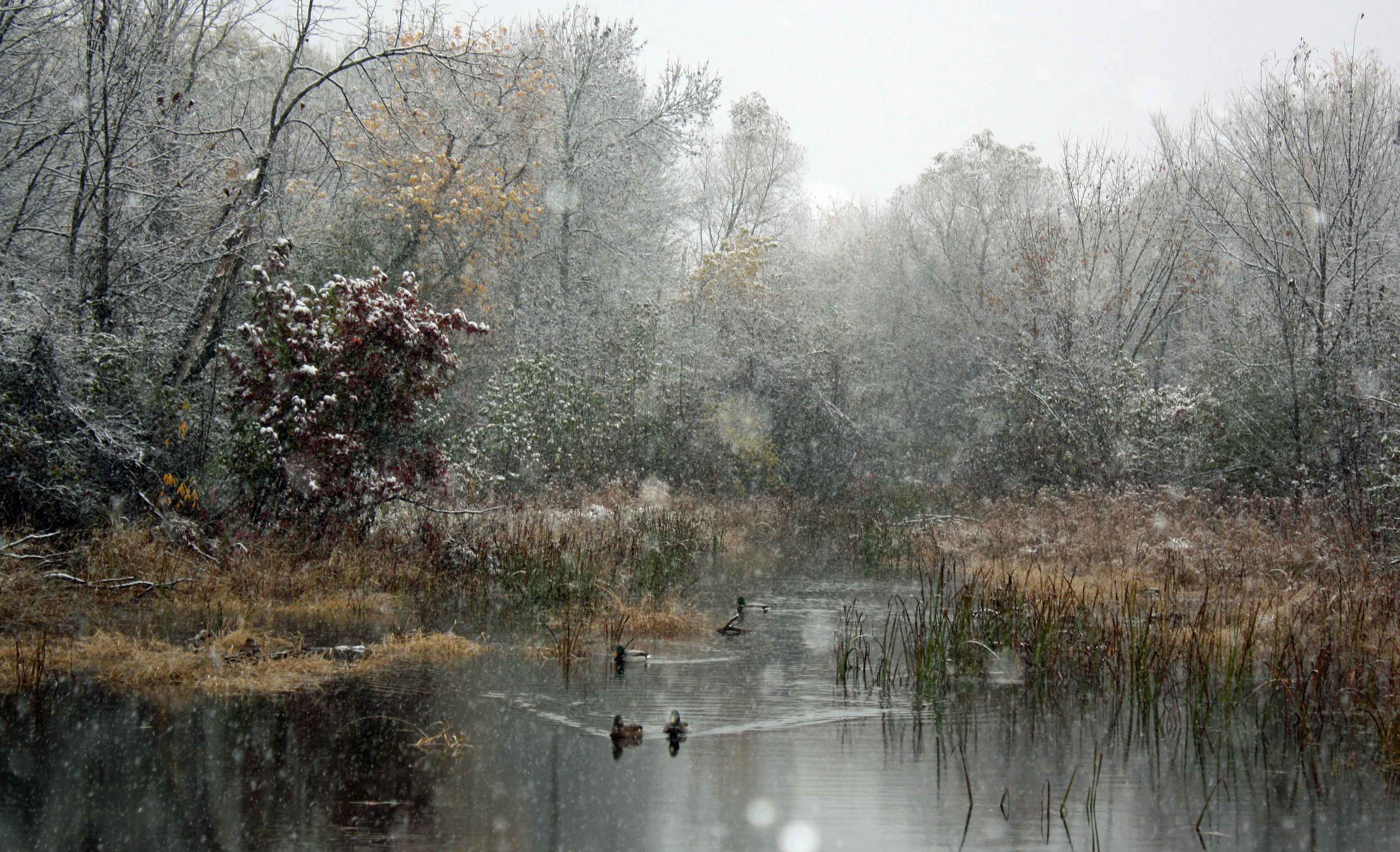
First snow in Thompson Creek marsh, ON (photo by Nina Munteanu)
Nina Munteanu is a Canadian ecologist / limnologist and novelist. She is co-editor of Europa SF and currently teaches writing courses at George Brown College and the University of Toronto. Visit www.ninamunteanu.ca for the latest on her books. Nina’s bilingual “La natura dell’acqua / The Way of Water” was published by Mincione Edizioni in Rome. Her non-fiction book “Water Is…” by Pixl Press(Vancouver) was selected by Margaret Atwood in the New York Times ‘Year in Reading’ and was chosen as the 2017 Summer Read by Water Canada. Her novel “A Diary in the Age of Water” was released by Inanna Publications (Toronto) in June 2020.
Author and reviewer Lee Hall recently compiled their list of the twenty best books they read in 2020. Says Lee:
It’s hard to believe that we’ve got to this point but we have. For all the words you could use to describe the dumpster fire that is and was 2020 I am going to use the word grateful.
Grateful for the authors who have provided me with not only an escape through their wonderful works but grateful to them for providing a vital centre pillar of content for this blog – reviews. Some of these creators have become friends and important connections in the world of online authoring for me. This post is dedicated to them and the best books I have read this year.
While the criteria of ‘best books’ is derived mainly from my own personal taste it is also influenced by how many views the review got on here along with my admiration for the author. These works are an extension of some wonderful personalities who make up an incredible community.
A truly important once in a generation read that flows like a wild river right through your imagination and heart…– Quote from my review
I’m being 100% serious when I say ‘A Diary in the Age of Water’ is one of the most powerful books I’ve ever read. For what it stands for is truly a statement towards our own damning of this beautiful planet and our most precious resource – water. Canadian Author Nina Munteanu has put together a masterful look at where we could possibly end up if we don’t act. This one was another Reedsy Discovery find and thus totally justified my joining of the platform well and truly!
LEE HALL
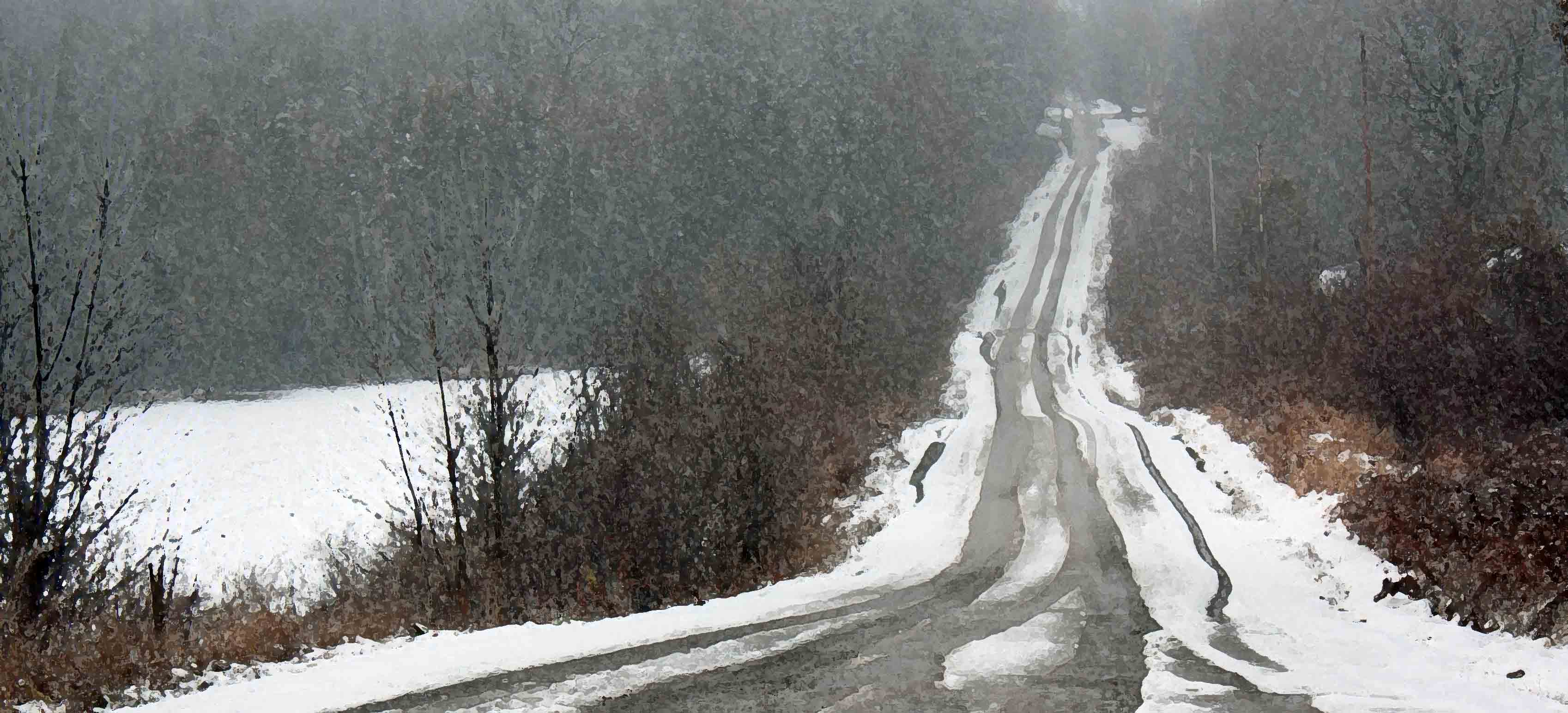
Country road in winter, ON (photo and rendition by Nina Munteanu)
Nina Munteanu is a Canadian ecologist / limnologist and novelist. She is co-editor of Europa SF and currently teaches writing courses at George Brown College and the University of Toronto. Visit www.ninamunteanu.ca for the latest on her books. Nina’s bilingual “La natura dell’acqua / The Way of Water” was published by Mincione Edizioni in Rome. Her non-fiction book “Water Is…” by Pixl Press(Vancouver) was selected by Margaret Atwood in the New York Times ‘Year in Reading’ and was chosen as the 2017 Summer Read by Water Canada. Her novel “A Diary in the Age of Water” was released by Inanna Publications (Toronto) in June 2020.
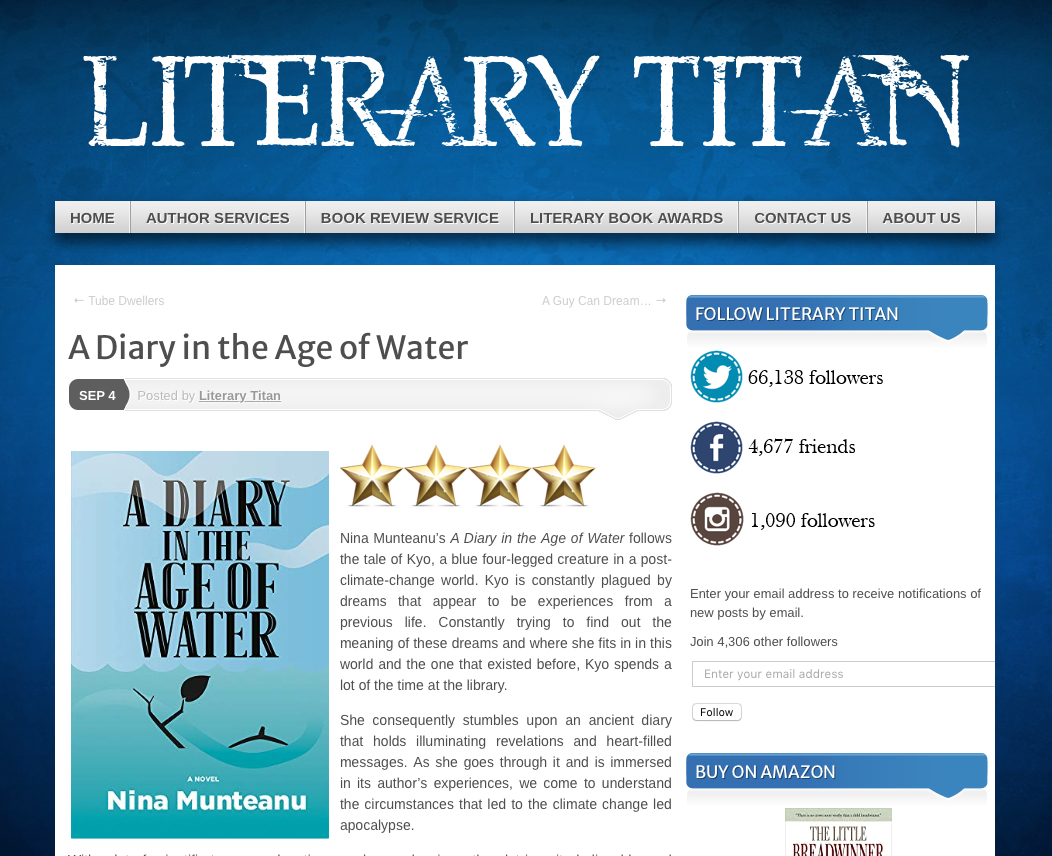
Nina Munteanu’s cli-fi eco-novel “A Diary in the Age of Water” just released in summer of 2020 received several favourable reviews from Kirkus Reviews, The Winnipeg Free Press, and TheMiramichi Reader. The speculative novel about four generations of woman and their unique relationship with water was recently awarded the Literary Titan Award for a book that “expertly delivers complex characters, intricate worlds, and thought provoking themes. The ease with which the story is told is a reflection of the author’s talent in exercising fluent, powerful, and appropriate language.”
“While bringing attention to the current politicization of climate change, the story maintains important underlying themes like family, love, forgiveness, and the complexity of the human soul. The author has gone to great lengths to show that there are different layers to each character, none fully evil nor fully good. A Diary in the Age of Water is an exceptional and thought-provoking dystopian fiction.” —LITERARY TITAN (4-star)
“In Canadian ecologist Munteanu’s novel, a child in a world of climate disaster discovers hidden truths about the past in a mysterious journal. In a story set centuries in the future, a young girl with four arms named Kyo lives on the last vestige of a planet damaged by climate crisis, water scarcity, and a cataclysm brought on by semi-divine figures called the Water Twins. Kyo comes across the 21st-century journal of a limnologist named Lynna; over two decades, the journal’s author details Earth’s fate with scientific observations on the harm wrought by corporate greed, as well as her own personal struggles raising a child in a world of catastrophe and authoritarianism. She’s a deeply relatable and tragically flawed character who’s wracked by doubt, fear, and cynicism—a stark contrast to her fierce environmentalist mother, Una, and her spiritual, idealistic daughter, Hildegard. What unites them all is the study of water: its intrinsic properties, its mysteries, and ultimately its necessity to the planet. In poetic prose (“We’re going down in a kind of slow violence”) with sober factual basis, Munteanu transmutes a harrowing dystopia into a transcendentalist origin myth…the author asks uncomfortable questions and explores the effects of one generation’s actions upon the next as they ripple outward like a stone dropped in a pond. A sobering and original cautionary tale that combines a family drama with an environmental treatise.” —KIRKUS REVIEWS
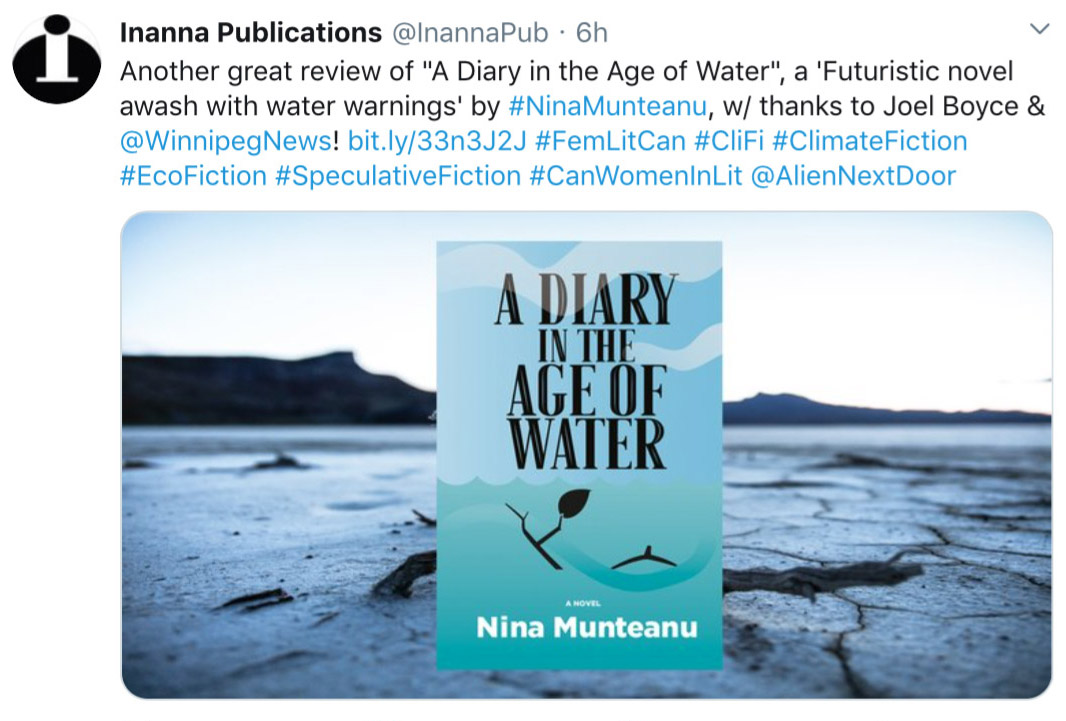
“Futuristic novel awash with water warnings”
“An engaging epistolary novel. An ecologist and environmental activist herself, Munteanu has no difficulty voicing a fully formed literary character who is both scientifically literate enough to understand how quickly human society is entering its final ebb, and humane enough to mourn the fullness of this tragedy.
The prose here is beautiful and purposeful in the tradition of environmentally and socially minded novelists such as Ursula K. Le Guin and Margaret Atwood… It comes down to water: ice sheets, rain and drought, the loss of water tables and the collapse of marine ecologies in an acidifying ocean. The pulse and rhythm of life on this planet is water. Its death throes, too, can be read in the flow of water.
Munteanu has produced something which joins George Orwell and Aldous Huxley, Le Guin and Atwood, a warning of the direction we are heading that will be valuable even if we manage to avert disaster.” —Joel Boyce, WINNIPEG FREE PRESS
“A Diary in the Age of Water commands reader interest on a number of levels…a chilling but believable portrayal of what might happen as fresh water becomes scarcer… Munteanu’s novel provides a cautionary note for what might happen if we fail to pay attention to this precious resource.” —Lisa Timpf, MIRAMICHI READER
Short Synopsis
A Diary in the Age of Water follows the climate-induced journey of the Earth and humanity through four generations of women, each with a unique relationship to her world and to water. Water plays both metaphoric and literal roles in this allegorical tale of humanity’s final journey from home—where male sterility, heat-shock proteins, horizontal gene transfer, and virgin-births rule a changing world of water securitization through ambitious environmental manipulation (e.g., resurrecting the US Army Corps of Engineers 1960s NAWAPA/CeNAWP plan to create the 800 km long Rocky Mountain Trench reservoir and divert most of northern Canada’s water to the USA—drowning a fifth of BC).
Told in far-future and near-future frames, the central part of the story is a diary by a limnologist, whose personal account creates a terrifying realism to the geo-political tension of water securitization, plague containment, and police oppression—the diary spans from 2045 to 2064 (when the diarist disappears herself).
The cli-fi novel begins centuries from now in the dying northern boreal forest with young KYO, a blue water nymph with multiple arms who dreams of the past and of being a normal human. She is on her way to the library to memorize a textbook on the Age of Water and there discovers a piece of her past from that age when The Water Twins destroyed the world. Kyo discovers a diary by a limnologist (who happens to be the mother of one of the Twins). Intrigued, Kyo drops the textbook and reads the diary. The diary, by cynical limnologist LYNNA, describes a near-future Toronto in the grips of severe water scarcity. The gritty memoir describes Toronto in a time when China owns the USA and the USA owns Canada, and aggressively mines its water. While lamenting the greed and destructive nature of her race, Lynna self-servingly helps murder three people; she also gives birth to rebel daughter HILDA (one of the Water Twins) who destroys her world through water and gives virgin-birth to the next stage in human evolution: a mutant who becomes one of the Disappeared who returns centuries later in a dying world as the water keeper Kyo.
“A Diary in the Age of Water” explores identity and our concept of what is “normal”—as a nation and an individual—in a world that is rapidly and incomprehensibly changing.
Poplar trees in northern Ontario in fall (photograph by Nina Munteanu
Nina Munteanu is a Canadian ecologist / limnologist and novelist. She is co-editor of Europa SF and currently teaches writing courses at George Brown College and the University of Toronto. Visit www.ninamunteanu.ca for the latest on her books. Nina’s bilingual “La natura dell’acqua / The Way of Water” was published by Mincione Edizioni in Rome. Her non-fiction book “Water Is…” by Pixl Press (Vancouver) was selected by Margaret Atwood in the New York Times ‘Year in Reading’ and was chosen as the 2017 Summer Read by Water Canada. Her novel “A Diary in the Age of Water” was released by Inanna Publications (Toronto) in June 2020.
“For this year’s holiday gift guide,” writes Dr. Michael Svoboda, “Yale Climate Connections has gathered celebrated anthologies, deep-dives into climate-related science and solutions, inspiring books from or about spiritual leaders, and visionary works of climate fiction.”
All were recently published, some within the month, writes Svoboda. These twelve books address decades of writing on climate change, reassess the challenges, offer hope and guidance for action, and envision very different climate-changed futures.
There is, for instance, the anthology The Fragile Earth: Writing from the New Yorker on Climate Change (Harper Collins),which includes Bill McKibben’s seminal essay “The End of Nature.” The anthology All We Can Save(Penguin Random House) edited by Ayana Elizabeth Johnson and Katharine K. Wilkinson is a collection of works dedicated to leadership “more characteristically feminine and more faithfully feminist, rooted in compassion, connection, creativity, and collaboration.”
Hope, guide to action and challenges are provided by Future Sea (University of Chicago Press) by Deborah Rowan Wright, The New Map (Penguin Random House) by Daniel Yergin, Solved:How the World’s Great Cities are Fixing the Climate Crisis (University of Toronto Press) by David Miller, Let Us Dream (Simon & Schuster) by Pope Francis. Tales of Two Planets (Penguin Random House) edited by John Freeman explores inequality and the impact of climate change.
Stand Up! Speak Up! (Penguin Random House) by Andrew Joyner celebrates the inspiration of youth in taking up action through hope, activism and community. Our Only Home: A Climate Appeal to the World (Hanover Square) by the Dalai Lama and Franz Alt is a manifesto that will empower us to take action and save the environment.
The novel The 2084 Report (Simon & Schuster) by James Lawrence Powell provides an “oral history” through interviews of the devastating effects of the Great Warming, which are both fascinating and frightening. My own novel A Diary in the Age of Water (Inanna Publications) chronicles the journeys of four generations of women, each carrying a unique relationship with water over a time of catastrophic change. Told in the form of a diary by a limnologist, the story explores a Canada mined for its water by United States, which, in turn, is owned by China. The Ministry for the Future (Hachette Book Group—Orbit) a novel by Kim Stanley Robinson uses fictional eyewitness accounts to tell the story of how climate change will affect us all.
Yale Climate Connections:
Edited by veteran journalist and journalism educator Bud Ward, Yale Climate Connections provides content developed by a network of experienced independent freelance science journalists, researchers, and educators across the country.Yale Climate Connections is an initiative of the Yale Center for Environmental Communication (YCEC), directed by Dr. Anthony Leiserowitz of the Yale School of the Environment, Yale University.
Dr. Michael Svoboda, an expert on climate change, is a professor at George Washington University and frequent contributor to Yale Climate Connections.
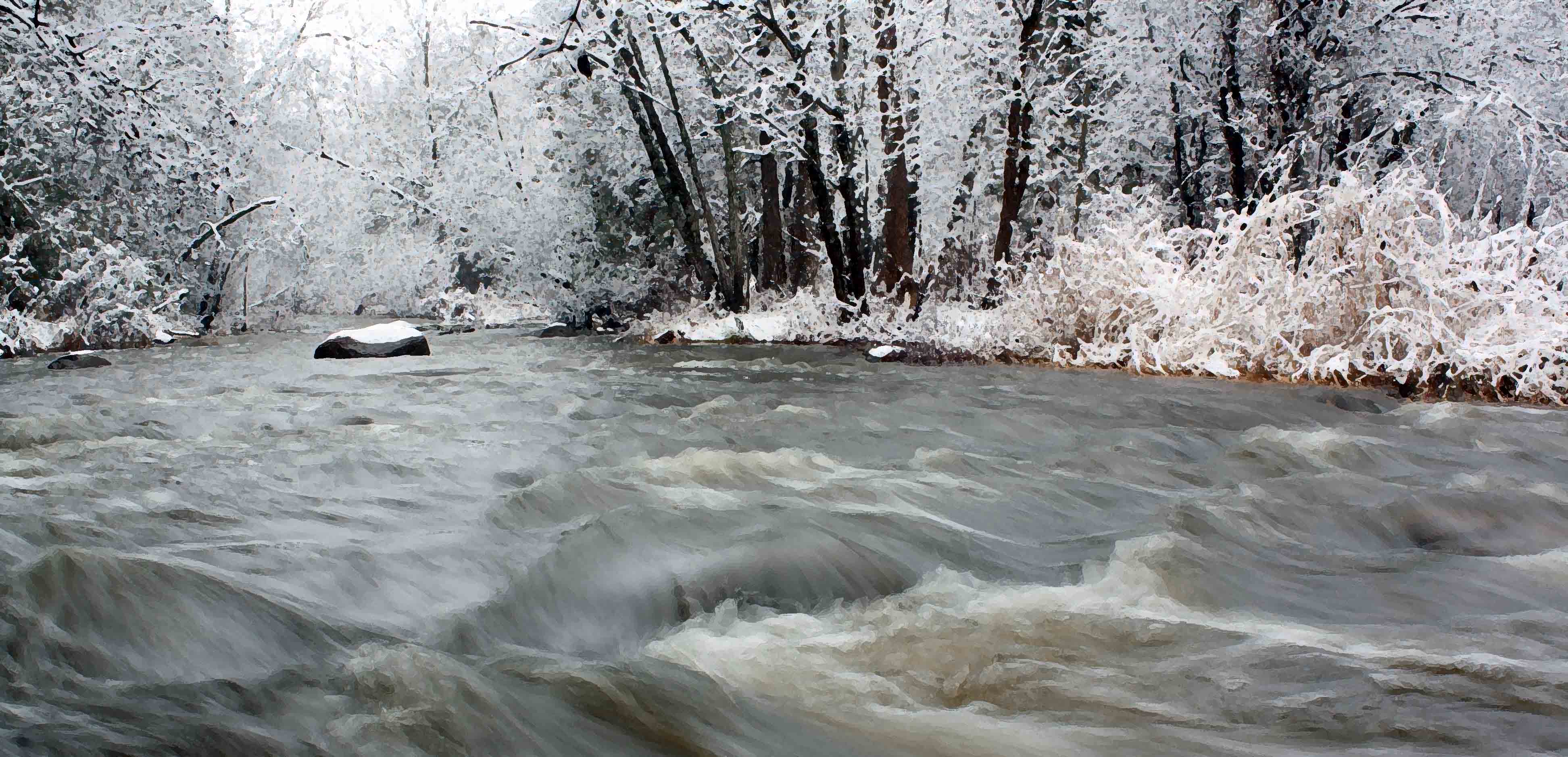
Jackson Creek in early winter, ON (photo and rendition by Nina Munteanu)
Nina Munteanu is a Canadian ecologist / limnologist and novelist. She is co-editor of Europa SF and currently teaches writing courses at George Brown College and the University of Toronto. Visit www.ninamunteanu.ca for the latest on her books. Nina’s bilingual “La natura dell’acqua / The Way of Water” was published by Mincione Edizioni in Rome. Her non-fiction book “Water Is…” by Pixl Press(Vancouver) was selected by Margaret Atwood in the New York Times ‘Year in Reading’ and was chosen as the 2017 Summer Read by Water Canada. Her novel “A Diary in the Age of Water” was released by Inanna Publications (Toronto) in June 2020.
I would have collected slimy waters from the scum ponds and murky puddles near my house. I would have brought them home and exposed them to the light of my microscope. I would then have peered deep into a secret world, where shady characters and alien forms lurked and traded.
It would be many years, when I was in college, before I finally witnessed this world—so alien, it might have inspired the science fiction books I wrote later as an adult. As it turned out, I was led to pursue a Masters of Science degree, studying periphyton (microscopic aquatic communities attached and associated with surfaces like rocks and plants) in local streams in the Eastern Townships of Quebec.
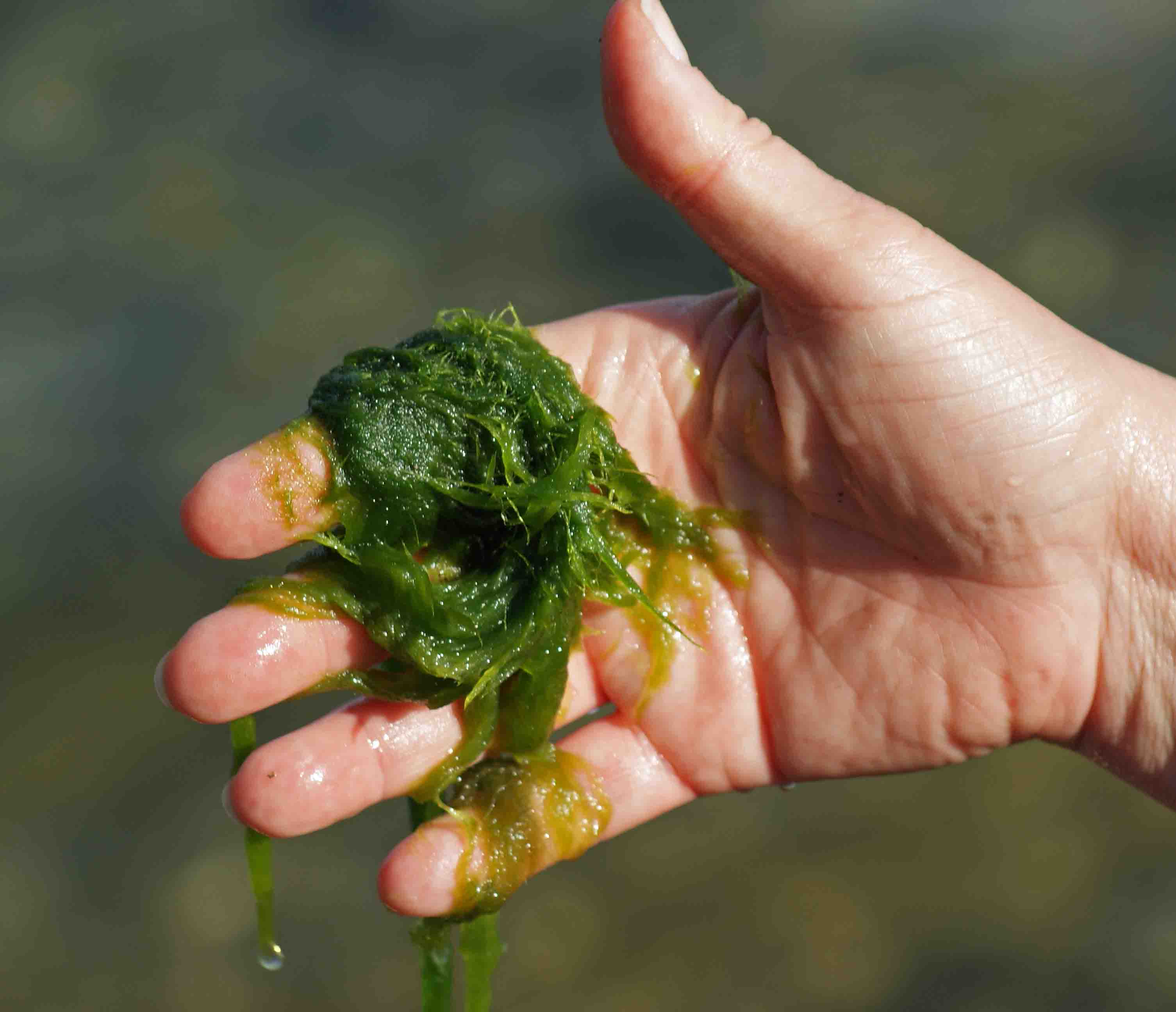
Filamentous algae collected in Lake Ontario, ON (photo by Nina Munteanu)
While my work focused on how diatoms (glass-walled algae) colonized surfaces, micro-invertebrates kept vying for my attention. Water fleas (cladocerans), copepods, rotifers, seed shrimps (ostracods) and water bears sang across my field of vision. They flitted, lumbered, wheeled and meandered their way like tourists lost in Paris. But this wasn’t Paris; I’d taken the blue pill and entered the rabbit hole into another world…
Sketch of common zooplankton and phytoplankton (illustration by Nina Munteanu)
The Secret—and Dangerous—World of Micro-Organisms
Small Freshwater habitats are home to a highly productive and diverse collection of micro-invertebrates—multicellular animals that can barely be seen with the naked eye. Many average from 0.5 to 1 mm in size and resemble little white blobs; however, a scholar can distinguish each invertebrate by its unique movement. For instance, when presented with a jar of pond water, I can usually distinguish among the wheel-like wandering of a gastrotrich, dirigible-like gliding of an ostracod (seed shrimp), the vertical goldfinch-style “hopping” of the cladoceran (water flea) as it beats its antennae, or the halting-jerking movements of copepods (oar-feet) as their antennae drive them along like a dingy propelled by an amateur oarsman.
Alas, puddles, ephemeral ponds and vernal pools pose sketchy habitats, given their tendency to appear and disappear in a wink. And like the thief in the night, they pose a harsh and uncertain home to many small organisms. These environments are ever-changing, unstable, chaotic and unpredictable. Yet, anyone who has studied these variable ecosystems understands that they team with life.
When a puddle or ephemeral pond dries up then reappears with rain, how can these communities thrive? Or do they all die off and then somehow recruit when the pond reappears? Many of these invertebrates have evolved creative ways to survive in very unstable environments. Some form a resting stage—a spore, resting egg or ‘tun’—that goes dormant and rides out the bad weather.
Philodina, a bdelloid rotifer (microscope photo by Bob Blaylock)
Animalcules & the Bdelloid Rotifer
In 1701, Antonie van Leeuwenhoek observed that “animalcules” (likely the bdelloid rotifer Philodina roseaola) survived desiccation and were “resurrected” when water was added to them. He’d discovered a highly resistant dormant state of an aquatic invertebrate to desiccation.
Dormancy is a common strategy of organisms that live in harsh and unstable environments and has been documented in crustaceans, rotifers, tardigrades, phytoplankton and ciliates. “Dormant forms of some planktonic invertebrates are among the most highly resistant … stages in the whole animal kingdom,” writes Jacek Radzikowski in a 2013 review in the Journal of Plankton Research. Radzikowski describes two states of dormancy: diapause and quiescence. (on right: sketch of bdelloid rotifer by Nina Munteanu)
Bdelloid rotifers can go into quiescent dormancy at practically any stage in their life cycle in response to unfavorable conditions. Early research noted that dormant animals could withstand freezing and thawing from −40°C to 100°C and storage under vacuum. They also tolerated high doses of UV and X radiation. Later work reported that some rotifers could survive extreme abiotic conditions, such as exposure to liquid nitrogen (−196°C) for several weeks or liquid helium (−269°C) for several hours. Desiccated adult bdelloid rotifers apparently survived minus 80°C conditions for more than 6 years. The dormant eggs of cladocerans and ostracods also survived below freezing temperatures for years.
Rotifers are cosmopolitan detrivores (they eat detritus) and contribute to the decomposition of organic matter. Rotifers create a vortex with ciliated tufts on their heads that resemble spinning wheels, sweeping food into their mouths. They often anchor to larger debris while they feed or inch, worm-like, along substrates. Some are sessile, living inside tubes or gelatinous holdfasts and may even be colonial. Rotifers reproduce by parthenogenesis (in the absence of mates), producing clones (like cladocerans). Resting eggs (sometimes called zygotes) survive when a pond dries up. Bdelloid rotifers don’t produce resting eggs; they survive desiccation through a process called anhydrobiosis, contracting into an inert form and losing most of their body water. Embryos, juveniles and adults can undergo this process. The bdelloid withdraws its head and foot and contracts its body into a compact shape called a tun; a generally unprotected dormant state that remains permeable to gases and liquids. Like Tardigrades, Bdelloid rotifers can resist ionizing radiation because they can repair DNA double-strand breaks.
The long-term survival and evolutionary success of bdelloid rotifers in the absence of sex arises from horizontal gene transfer via DNA repair.
In my eco-novel A Diary in the Age of Water the limnologist Lynna visits her technician Daniel as he peers through a microscope and makes the observation of why the bdelloid rotifer is well-suited to climate change:
I bent to peer through the eyepiece at what turned out to be a pond sample in a Petri dish. Attached to a pile of detritus shivering in the current, several microscopic metazoans—rotifers—swung like trees in a gale; they were feeding. Their ciliated disk-like mouths twirled madly, capturing plankton to eat. Watching them reminded me of my early research days as an honours undergrad at Concordia University in Montreal. Probably Philodina, I thought; I had seen many during my stream research in Quebec.
“They’re the future,” Daniel said, looking up at me with a smirk as I straightened.
I raised my eyebrows, inviting him to elaborate, which he cheerfully did.
“They’re the future because of their incredible evolutionary success and their ecological attraction to environmental disaster.” He knew he’d piqued my interest. “These little creatures have existed for over forty million years, Lynna. Without sex! And they’re everywhere. In temporary ponds, moss, even tree bark. Bdelloid mothers that go through desiccation produce daughters with increased fitness and longevity. In fact, if desiccation doesn’t occur over several generations, the rotifers lose their fitness. They need the unpredictable environment to keep robust.” They incorporate genes from their environment: they acquire DNA transposons—mobile DNA—through HGT.”
—A DIARY IN THE AGE OF WATER
The bdelloid all-female populations have thrived for millions of years by maintaining a robust and diverse population through epigenetics and DNA repair during dormancy…The dormancy of all-female bdelloids is an elegant technique to ride out harsh conditions. The bdelloids can go dormant quickly in any stage of their life cycle, and they’re capable of remaining dormant for decades. They can recover from their dormancy state within hours when the right conditions return and go on reproducing without the need to find a mate.
Highly variable environments tend to support rare species: organisms that are uniquely equipped for change. These are the explorers, misfits, and revolutionaries who do their work to usher in a new paradigm. They carry change inside them, through phenotypic plasticity, physiological stress response mechanisms, or life history adaptations. Like bdelloid rotifers going dormant through anhydrobiosis. Or blue-green algae forming dormant akinete spores. In tune with the vacillations of Nature, epigenetics-induced adaptation is the only option for keeping up with rapid and catastrophic environmental change, not to mention something as gigantic as climate change. That’s why the bdelloid rotifers survived for millennia and will continue for many more. They adapt by counting on change.
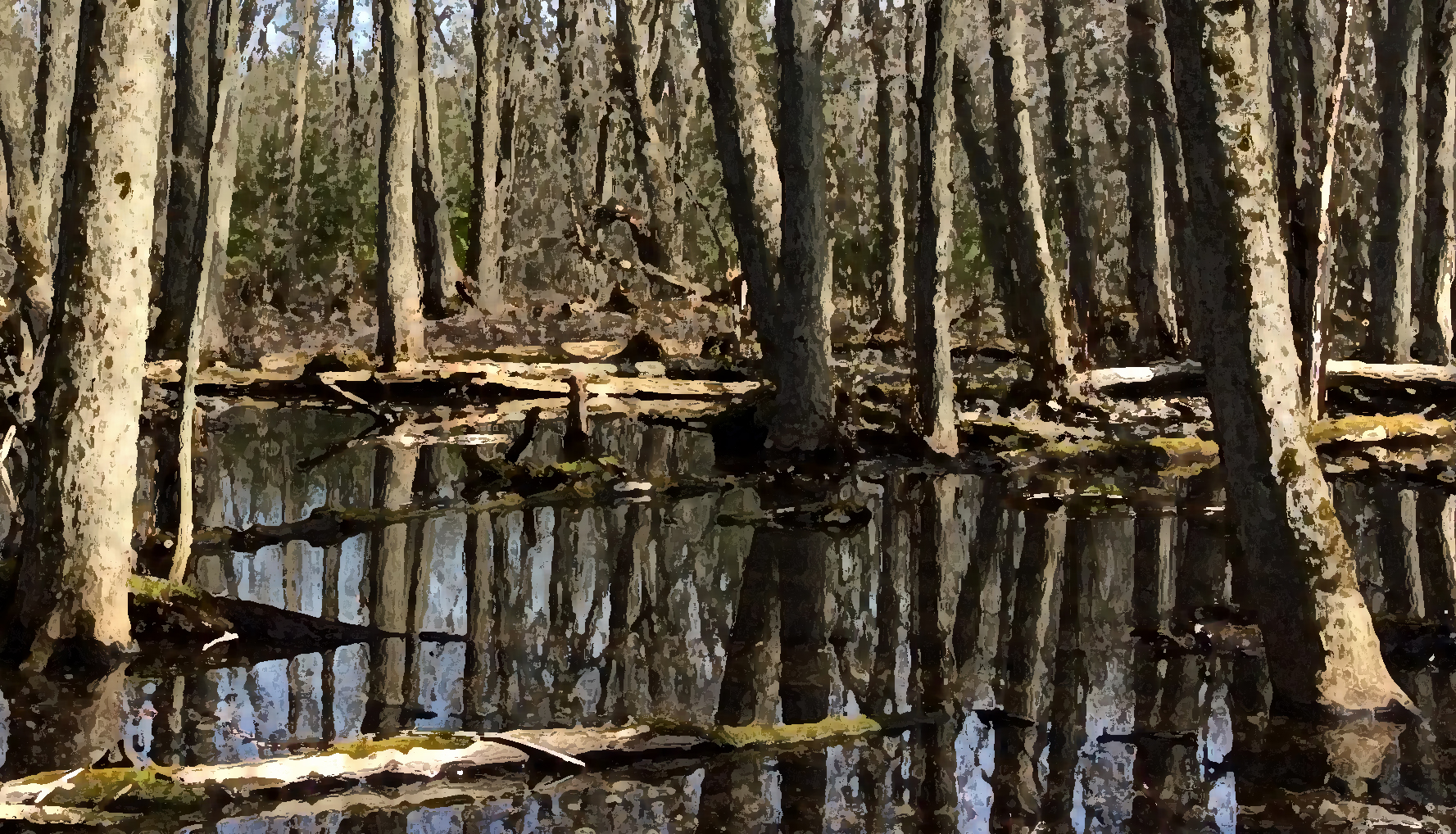
Maple swamp forest in Trent Nature Sanctuary, ON (photo and rendition by Nina Munteanu)
References:
Munteanu, Nina. 2020. “A Diary in the Age of Water.” Inanna Publications, Toronto. 300pp.
Munteanu, Nina. 2016. “Water Is…The Meaning of Water.” Pixl Press, Vancouver. 586pp.
O’Leary, Denise. 2015. “Horizontal gene transfer: Sorry, Darwin, it’s not your evolution anymore.” Evolution News, August 13, 2015. Online: https://www.evolutionnews.org/201508/horizontal_gene/
Ricci, C. And D. Fontaneto. 2017. “The importance of being a bdelloid: Ecological and evolutionary consequences of dormancy.” Italian Journal ofZoology, 76:3, 240-249.
Nina Munteanu is a Canadian ecologist / limnologist and novelist. She is co-editor of Europa SF and currently teaches writing courses at George Brown College and the University of Toronto. Visit www.ninamunteanu.ca for the latest on her books. Nina’s bilingual “La natura dell’acqua / The Way of Water” was published by Mincione Edizioni in Rome. Her non-fiction book “Water Is…” by Pixl Press (Vancouver) was selected by Margaret Atwood in the New York Times ‘Year in Reading’ and was chosen as the 2017 Summer Read by Water Canada. Her novel “A Diary in the Age of Water” was released by Inanna Publications (Toronto) in June 2020.
In 2007, when I started my first blog, The Alien Next Door, I wrote an article that explored the term “Darwin’s Paradox”—it’s not just the title of my science fiction thriller Darwin’s Paradox released that year by Dragon Moon Press—but a term coined by scientists to describe the paradoxical phenomenon exhibited by coral reefs.
Defying The Laws of Thermodynamics
Darwin described coral reefs as oases in the desert of the ocean. Coral reefs comprise one of the richest ecosystems on Earth, in apparent violation of the laws of thermodynamics (high productivity in a low-productivity environment). Productivity ranges from 50 to 250 times more than the surrounding ocean. How do they thrive in crystal-clear water, largely devoid of nutrients? Part of the answer lies in the coral’s efficiency in recycling nutrients like nitrate and phosphate.
First, the rough coral surface amplifies water turbulence at a microscopic level, disrupting the boundary layer that usually settles on objects under water and lets the coral “hoover” up the sparse nutrients. I stumbled upon a similar phenomenon during my grad work on temperate streams and published my serendipitous discovery in the journal Hydrobiologia. I was researching how periphyton (attached “algae”) colonized submerged glass slides and observed that the community preferred the edges of the slides because the micro-turbulence there provided more opportunity for attachment and nutrition.
Second, lots of corals also function symbiotically with specialized algae (called zooxanthelae), which provide the coral with food (through photosynthesis) and, in turn, get food from the wastes created by the coral.
Can the science of symbiosis teach us something about another Darwin’s Paradox?
The Evolution of Compassion
In a September 2013 article in the Jewish World Review, Boston Globe reporter Jeff Jacobywrote:
“Charles Darwin struggled with a paradox: If evolution is a struggle for survival, how could generosity, compassion, and other altruistic virtues have spread through natural selection? Darwin could see the clear evolutionary benefit to groups that inculcated ethical values in their members. Imagine two competing primitive tribes, equally matched — except that ‘one tribe included a great number of courageous, sympathetic, and faithful members, who were always ready to warn each other of danger, [and] to aid and defend each other.’ (Darwin, “The Descent of Man”). There was little doubt that tribes highly endowed with such virtues ‘would spread and be victorious over other tribes.’”
“How did any tribe evolve such ethical qualities in the first place?” asks Jacoby. Brave individuals who risked their lives for others “would on average perish in larger numbers than other men.” It hardly seemed possible, Darwin conceded, that, “such virtues … could be increased through natural selection, that is, by the survival of the fittest.” So, how did it and why?
Jacoby quotes Sir Jonathan Sacks, Britain’s Orthodox chief rabbi, who pointed to “the central drama of civilization: Biological evolution favors individuals,” says Sacks. “But cultural evolution favors groups.… Selfishness benefits individuals [only in the short-term and only in a limited way—my comment], but it is [ultimately] disastrous to groups, and it is only as members of a group that individuals can survive at all.”
Jacoby describes the vast literature in evolutionary psychology and sociobiology that have demonstrated humanity’s hard-wired moral capacity. “We are born with an aptitude for empathy and fairness,” said Jacoby, citing recent neurological experiments that have demonstrated that an act of generosity triggers a pleasurable response in the brain.
Abraham Lincoln summarized it in seven words: “When I do good, I feel good.” Psychologists call it the “helper’s high”. Neuroscientists and behavioral scientists are demonstrating unequivocally the benefits of altruism to our health and happiness. Scientists have designed experiments that actually trace altruism—and the pleasure we gain from it—to specific regions and systems in the brain. Key studies now provide striking evidence that our brains are wired for altruism.
The Social Brain and the Seat of Compassion
In a study published in the Proceedings of the National Academy of Sciences (Moll et al, 2006), a team of neuroscientists lead by Dr. Jordan Grafman, reported that, “when people made the decision to donate to what they felt was a worthy organization, parts of the midbrain lit up—the same region that controls cravings for food and sex.” The brain experiences a pleasurable response when we engage in good deeds that benefit others.
Dr. Grafman found that the subgenual area in the frontal lobe near the midpoint of the brain was also strongly active when his study subjects made the decision to give to charity. The area houses many receptors for oxytocin, a hormone that promotes social bonding. “The finding suggests that altruism and social relationships are intimately connected—in part, it may be our reliance on the benefits of strong interpersonal connections that motivates us to behave unselfishly,” reports Elizabeth Svoboda in the WallStreet Journal. The team also found that the nucleus accumbens, which contains neurons that release the pleasure chemical dopamine, was triggered when a person chose to help another.
A 2007 study headed by neuroscientist Scott Huettel and reported in Nature Neuroscience(Tankersley, et al., 2007) connects altruism to the posterior superior temporal cortex (pSTC), an area in the upper rear of the brain that lets us perceive goal-directed actions by someone or something else. Results suggest that altruism depends on, and may have evolved from, the brain’s ability to perform the low-level perceptual task of attributing meaning and motive in the actions of others.
“Our findings are consistent with a theory that some aspects of altruism arose out of a system for perceiving the intentions and goals of others,” said Dr. Huettel. “To be altruistic, you need to see that the people you’re helping have goals, and that your actions will have consequences for them.”
Research led by Michael Platt reported in Nature Neurosciencein 2012, showed that the anterior cingulate gyrus(ACCg) is an important nexus for the computation of shared experience and social reward. That same year researchers at Mount Sinai School of Medicine in New York published research in the journal Brainthat suggested that the anterior insular cortexis the activity centre of human empathy.
I find it both interesting and exciting that these studies link different brain regions to altruistic and compassionate behavior. “There are certain to be multiple mechanism that contribute to altruism, both in individuals and over evolutionary time,” added Huettel. This is the nature of the brain, whether we look at intelligence, motivation or physical characteristics. And I am convinced that we will someday find that many other areas—if not the entire area—of the brain are involved. Moreover, researchers have shown that engaging—or even witnessing—generous acts can reduce stress, increase immunity (e.g., increased antibody levels), and longevity.
Emiliana Simon-Thomas, science director for the Greater Good Science Center at the University of California, Berkeley, explains the chemical activity that happens in our heads when we commit acts of altruism. “There are multiple reward systems that have been tied to pleasurable feelings when people help others or contribute to the well being of the people around them,” she notes. These reward systems are comprised of three main chemicals that are released when we commit an act of kindness and feel pleasure: Dopamine, Oxytocin and Serotonin. According to Simon-Thomas, Dopamine is most closely related to hedonic pleasure — or pleasure derived from self; oxytocin is tied to more social pleasure — especially with regard to physical contact; and serotonin is implicated in a more broad mood state. “All three of these, again, are sort of intersecting and interacting, and depending on the context that you’re in, represent feelings of pleasure in different context,” she explains. “All these systems are activating and parallel, and sort of influencing one another as you go through life.” So when I do a good deed, I am rewarding myself with a cocktail of wonder drugs that please me and make me smile.
So, what I’ve known since I was a child is now proven: doing good deeds is mutually beneficial to the giver and the receiver.
Path through winter forest in the fog, ON (photo by Nina Munteanu)
Altruism in All Beings
The notion that all aspects of life on this planet—not just humanity—have the capacity to act altruistically remains controversial—even among professional scientists and researchers. We are not unique in experiencing or practicing altruism, in acting altruistically and benefiting from our own altruistic acts. It is however a matter of perspective, bias and open-mindedness. Many examples of altruistic behavior and empathy exist in the rest of the living world on our planet.
Nature’s Heroes
Scientists have been demonstrating for years that cooperation among organisms and communities and the act of pure altruism (not reciprocal altruism or kin/group selection) is, in fact, more common in Nature than most of us realize. Valid examples of true altruism in the wild in many species exist. The key here is “in the wild”—not in captivity, where inherent behavior is often modified (see my Alien Next Door article “The SamaritanParadox Revisited: The Karma Ran Over the Dogma”).
Despite the overwhelming evidence for altruism in every aspect of our world, some researchers continue to design experiments and then draw sweeping conclusions based on animals in captivity to suggest that only humanity possesses the ability to behave altruistically—and then again only by social-instruction (aka “the Selfish Gene” of Richard Dawkins vs. the “Social Gene” of Lynn Margulis).
Examples of altruism abound and range among mammals, birds, invertebrates and even Protista. Some examples include: dogs, cats, ducks, squirrels, wolves, mongooses, Meer cats, baboons, chimpanzees, vampire bats, dolphins, walruses, lemurs, African buffalo—to name a few.
de Waal explained that “evolution favors animals that assist each other if by doing so they achieve long-term benefits of greater value than the benefits derived from going it alone and competing with others” (de Waal 2006). The prevalent phenomenon of altruism is Nature’s answer to the Prisoner’s Dilemma. “Empathy evolved in animals as the main … mechanism for [individually] directed altruism,” said deWaal. And it is empathy—not self-interest—that “causes altruism to be dispensed in accordance with predictions from kin selection and reciprocal altruism theory.” deWaal further proposed that the scientific community has become polarized between evolutionary biologists on the one side, and, on the other, a discrete group of economists and anthropologists that “has invested heavily in the idea of strong reciprocity,” which demands discontinuity between humans and all other animals.
“One of the most striking consequences of the study of animal behavior,” says anthropologist Robert Sapolsky, “is the rethinking … of what it is to be human.” He notes that, “a number of realms, traditionally thought to define our humanity, have now been shown to be shared, at least partially, with nonhuman species.” (Sapolsky 2006). This makes some of us uncomfortable. To some, it threatens to make us less special. The corollary is that this demonstrates that we possess intrinsic virtue, not something “painted” on through cultural teaching or diligent personal effort. Of course, it also means that all other beings possess intrinsic value too. In the final analysis, what we generally “know” is colored by what we believe and want to continue believing.
First big snow in Thompson Creek marsh, ON (photo and dry brush rendition by Nina Munteanu)
Universal Altruism and Gaia
What does all this mean? Does the very existence of altruism demonstrate the connectivity of all life on Earth? Let’s not stop there. Does the grace of altruism reflect a fractal cosmos imbued with meaning and intent? Was it the grace of altruism that allowed it all to happen in the first place? Don’t we all come from grace?
Despite struggles with acceptance for some of us, we are emerging enlightened to the fractal existence of grace and altruism embedded in the very nature and intentions of our universe.
I come full circle to my book Darwin’s Paradox, a tale of fractal intelligence and universal cooperation. A tale of emerging awareness of Self and Other as One…Evolution through cooperation… Creative DNA…Manifestation through thought and intent…Self-organization and synchronicity…A hero’s journey…and coming Home…
In this season of gratitude, we celebrate altruism in giving and in receiving graciously.
Merry Christmas!
First snow over Thompson Creek outlet, ON (photo by Nina Munteanu)
Bradley, Brenda. 1999. “Levels of Selection, Altruism, and Primate Behavior.” The Quarterly Review of Biology, 74(2):171-194.
De Waal, Frans, with Robert Wright, Christine Korsgaard, Philip Kitcher, and Peter Singer. 2006. “Primates and Philosophers: How Morality Evolved”. Princeton: Princeton University Press.
Goodall, Jane. 1990 Through A Window: My Thirty Years with the Chimpanzees of Gombe. Boston: Houghton Mifflin.
Moll, Jorge, Frank Krueger, Roland Zahn, Matteo Pardini, Ricardo de Oliveira-Souza, and Jordan Grafman. 2006. “Human fronto-mesolimbic networks guide decisions about charitable donation.” In: Proc. Natl. Acad. Sci., USA, 103(42): 15623-15628. http://www.pnas.org/content/103/42/15623.full
Sapolsky, Robert M. 2006. “Social Cultures Among Nonhuman Primates.” Current Anthropology, 47(4):641-656.
Svoboda, Elizabeth. 2013. “What Makes a Hero? The Surprising Science of Selfishness.” Current.
Tankersley D et al. 2007. “Altruism is Associated with an Increased Response to Agency.” Nature Neuroscience, February 2007, Vol. 10(2), pp. 150-151.
Warneken, F. & Tomasello, M. 2006. “Altruistic Helping In Human Infants and Young Chimpanzees.” Science, 311, 1301–1303.
Warneken, F., Hare, B., Melis, A. P., Hanus, D. & Tomasello, M. 2007. “Spontaneous Altruism By Chimpanzees and Young Children.” PloS Biology, 5(7), e184.
de Waal, F. B. M. 2008. “Putting the Altruism Back Into Altruism: The Evolution of Empathy.” Annu. Rev. Psychol., 59, 279–300.
de Waal, F. B. M., Leimgruber, K. & Greenberg, A. R. 2008. “Giving Is Self-rewarding for Monkeys.” Proc. Natl. Acad. Sci., USA, 105, 13685–13689.
Nina Munteanu is a Canadian ecologist / limnologist and novelist. She is co-editor of Europa SF and currently teaches writing courses at George Brown College and the University of Toronto. Visit www.ninamunteanu.ca for the latest on her books. Nina’s bilingual “La natura dell’acqua / The Way of Water” was published by Mincione Edizioni in Rome. Her non-fiction book “Water Is…” by Pixl Press(Vancouver) was selected by Margaret Atwood in the New York Times ‘Year in Reading’ and was chosen as the 2017 Summer Read by Water Canada. Her novel “A Diary in the Age of Water” was released by Inanna Publications (Toronto) in June 2020.
We talked about the story, its main characters–including water as a character–and why I write about water. We also covered why the book is written partly as a diary. Margaret Atwood’s name came up a few times…
Nina Munteanu chats with Darshaun McAway of W.O.W. Podcast about her new clifi novel “A Diary in the Age of Water”: a novel about the journeys of four generations of women and their unique relationship with water during a time of great environmental change. Darshaun and Nina talk about her use of water as a character, her choice of heroines and her use of a diary format to tell the story. Nina shares that the book–set in the near future as a limnologist’s diary and the far future with an evolved human–explores the premise of a water-scarce Canada whose water now belongs to the USA, who, in turn, is owned by China. The events about which the diarist writes are based on real historic events and people. Nina brings her considerable scientific, limnological and research skills to bear in describing a future Canada both dystopic and harrowing–yet very familiar. One real event taken as premise in the book that Nina shared with Darshaun is the American NAWAPA plan of the 1960s that went to congress and was (and still is) seriously discussed for years following: the plan was to divert massive amounts of fresh water from Canada and store by inundating the Rocky Mountain Trench and piped south to hydrate dwindling aquifers in the USA.
W.O.W Interview with Nina Munteanu and Darshaun McAway
Nina Munteanu is a Canadian ecologist / limnologist and novelist. She is co-editor of Europa SF and currently teaches writing courses at George Brown College and the University of Toronto. Visit www.ninamunteanu.ca for the latest on her books. Nina’s bilingual “La natura dell’acqua / The Way of Water” was published by Mincione Edizioni in Rome. Her non-fiction book “Water Is…” by Pixl Press(Vancouver) was selected by Margaret Atwood in the New York Times ‘Year in Reading’ and was chosen as the 2017 Summer Read by Water Canada. Her novel “A Diary in the Age of Water” was released by Inanna Publications (Toronto) in June 2020.










 Nina Munteanu Writing Coach