Flooding creek in Trent Nature Sanctuary during a rain, ON (photo and rendition by Nina Munteanu)
One morning, in late spring, I went walking in the rain through the Trent Nature Sanctuary forest. Looking for magic… Moisture covered everything. It coaxed out vivid colours and textures in a tangle of stable chaos. I felt like I’d entered a Tom Thomson painting…
Moss-covered cedar trees after a soft rain in Trent Nature Sanctuary, ON (photo by Nina Munteanu)
The rain intensified the forest’s mosaic of unique scents from pungent, heavy and sharp to floral, fresh and sweet. The gossamer morning light favoured photography with a gentleness that softened and deepened everything, and invited intimacy. Mist hung low and rose like steam from the damp earth, slowing time. It felt as though I was walking through a cloud. The forest emerged ghost-like in glimpses of tree, shrub and grass. The brilliant red of the osier dogwood. The vivid greens of mosses and leaves. A tangle of blue-green lichens and bright red cedar roots. I was witness to a chaotic tapestry of Nature’s art. Infinite shades of green, brown, grey and yellow created a fluid landscape that water painted into a vibrant watercolour scene.
I moved through it, boots squelching along the spongy loam path, as though wrapped in a moving artwork.
Dew drops on hawksweed, lichen fruiting bodies in background, ON (photo by Nina Munteanu)
Moss with spore capsules in the rain, Trent Nature Sanctuary, ON (photo by Nina Munteanu)
Cedar roots and ferns in the heavy mist of a morning rain, Trent Nature Sanctuary, ON (photo by Nina Munteanu)
Cedar root and moss during a mild rain, Trent Nature Sanctuary, ON (photo by Nina Munteanu)
Cedar root and moss shortly after a rain, Trent Nature Sanctuary, ON (photo by Nina Munteanu)
The moisture carried the warbles and fluting chirps of lively bird song amid the hush of raindrops on vegetation. Each surface had a unique voice. And the rainfall—from light drizzle to hard pour—carried its own tune, rhythm and percussion. A symphony of diverse frequency from rich infrasound to beyond.
Nina’s Canon EOS Rebel camera on its tripod, ready to take photos, Trent Nature Sanctuary, ON (photo by Nina Munteanu)
I kept my camera, attached to its tripod, tucked under several water-proof bags and walked with deliberate steps through wet duff, decayed leaves and mud. I had a hood but couldn’t stand to keep it up—I needed to hear and feel all of it: the rain sizzling through the vegetation, the red-winged blackbird’s conk-a-lee! The robin’s cheerily-cheer-up-cheerily-cheer up! The crow’s caw and rattle. The primordial shriek of a blue jay or kingbird. All were out, though not visible, as I navigated the huge puddles and slippery mud-leaf mix. Hair dripping, face in a grin.
Rain falling on the marsh to the Otonabee River, ON (photo by Nina Munteanu)
Pond lilies in the rain, ON (photo by Nina Munteanu)
Rain falls on the Otonabee River, ON (photo by Nina Munteanu)
I felt elation in Nature’s celebration of life. I was the only person in the park and thoroughly basked in that feeling of humbleness that comes with a kind of knowing: of being part of something far greater than oneself and yet in some way being that greater ‘self.’ Like I belonged there. Hard to explain. But it felt truly awesome and eternal.
Nina Munteanu
Boardwalk over the forest swamp, Trent Nature Sanctuary, ON (photo by Nina Munteanu)
Fence post with marsh in the background during a steady rainfall, ON (photo by Nina Munteanu)
Country road in the rain, ON (photo and rendition by Nina Munteanu)
I could have stayed there, wet in the rain, for hours. But I felt sorry for my camera and headed home, thinking of a warm cup of tea…
NINA MUNTEANU is a Canadian ecologist / limnologist and novelist. She is co-editor of Europa SF and currently teaches writing courses at George Brown College and the University of Toronto. Visit www.ninamunteanu.ca for the latest on her books. Nina’s bilingual “La natura dell’acqua / The Way of Water” was published by Mincione Edizioni in Rome. Her non-fiction book “Water Is…” by Pixl Press(Vancouver) was selected by Margaret Atwood in the New York Times ‘Year in Reading’ and was chosen as the 2017 Summer Read by Water Canada. Her novel “A Diary in the Age of Water” was released by Inanna Publications (Toronto) in June 2020.
I recently gave a talk at Orchard Park Secondary School during their “Eco Crawl” week. “Eco crawl is a cross curricular initiative promoting environmental awareness, natural conservation, and well-being,” says Teresa Grainger, Library Learning Commons Technician at the school. The “week long initiative will include animal visitors, presentations, displays, and outdoor activities. We like to involve as many departments as possible.”
The school invited me to participate with a presentation. I spoke about my work as a writer and as a scientist, how I was inspired to write eco-fiction and a little about the process of how I started. I shared the challenges I faced and my victories. I also spoke about the importance of eco-fiction as narrative and the importance of storytelling generally to incite interest, bring awareness and ultimately action.
The word is a powerful tool. And the stories that carry them are vehicles of change.
Here is some of that talk:
My story begins with the magic of water, Quebec water … I was born in a small town in the Eastern Townships of Quebec, a gently rolling and verdant farming community, where water bubbles and gurgles in at least two languages.
Pastoral Eastern Townships and Granby, Quebec; Nina Munteanu as a child
.
I spent a lot of my childhood days close to the ground, observing, poking, catching, destroying and creating. Perhaps it was this early induction to the organic fragrances of soil, rotting leaves and moss that set my path in later life as a limnologist, environmental consultant and writer of eco-fiction.
My mother kept a garden in our back yard that she watered mostly with rain she collected in a large barrel out back. I remember rows of bright dahlias with their button-faces and elegant gladiolas of all colours, tall like sentinels. And, her gorgeous irises.
In the winter, my mother flooded the garden to create an ice rink for the neighbourhood to use for hockey. Somehow, I always ended up being the goalie, dodging my brother’s swift pucks to the net. I got good at dodging—probably a useful life skill in later life…
Our dad frequently took us to the local spring just outside town. We walked a few miles up Mountain Road to an unassuming seepage from a rock outcrop with a pipe attached to it by the local farmer. I remember that the water was very cold. Even the air around the spring was cooler than the surrounding air. I remember that the spring water tasted fresh and that the ice it formed popped and fizzed more than tap water.
I followed my older brother and sister to the nearby forest and local river. We stirred soil, flower petals and other interesting things with water to fuel “magic potions” then told wild stories of mayhem and adventure. I became a storyteller. My passion for storytelling eventually morphed into writing; but, the underlying spark came through environmental activism.
.
In early high school, during the mid-60s, I became an environmental activist, putting up posters and writing in the school paper. I wrote letters to industry and politicians, trying to incite interest in being good corporate citizens and promoting global environmental action. I remember a well-meaning teacher chiding me for my extravagant worldview. “Stick to little things and your community—like recycling,” he suggested patronizingly. I remember the shock of realizing that not everyone felt the planet like I did. Perhaps it was a teenage-thing, or a girl-thing, or a nina-thing. I prayed it wasn’t just a nina-thing…
I started writing stories in high school. Mostly eco-fiction, though I didn’t know that’s what it was at the time. There was no genre called eco-fiction back then. It all went under the umbrella of scifi.
.
I completed my first novel, Caged in World when I was fifteen—in Grade 9—in 1969. Caged in World was a hundred-page speculative story about a world that had moved “inside” to escape the ravages of a post climate-change environment. The eco-novel was about a subway train driver and a data analyst caught in the trap of a huge lie. The story later morphed into Escape from Utopia. Several drafts—and years later—the novel became the eco-medical thriller Angel of Chaos, set in 2095 as humanity struggles with Darwin’s Disease—a mysterious neurological environmental pandemic. Icaria 5 is one of many enclosed cities within the slowly recovering toxic wasteland of North America, and where the protagonist Julie Crane works and lives. The city is run by technocrats, deep ecologists who call themselves Gaians, and consider themselves guardians of the planet. The Gaians’ secret is that they are keeping humanity “inside” not to protect humanity from a toxic wasteland but to protect the environment from a toxic humanity.
Some of the scientific papers, reports and articles I wrote or participated in
.
When I enrolled in college and university, I thought of going into environmental law then decided that I didn’t have the temperament for it and switched to biology. Without realizing it, I put fiction writing on hold while I pursued ecology at university. One professor got me very interested in limnology and it became my focus when I realized that I’d always been fascinated by water. I started out being scared of water—not being a strong swimmer—and the best thing you can do to get over a fear is to study it and understand it. That’s exactly what I did. I did some cool research on stream ecology and published scientific papers, articles and reports. Then I moved to the westcoast to teach limnology at the University of Victoria and do consulting work in aquatic ecology.
So, in a way, I’d gone back to what I loved best as a child—mucking about in nature, spending my days close to the ground, observing, poking, catching, destroying and creating.
Kevin as a toddler
.
In 1991, my son Kevin was born. I felt a miracle pass through me. Kevin became my doorway into wonder. His curiosity was boundless and lured me into a special world of transformation. I took time off work to spend with Kevin when he was young. We went on great trips, from the local mall, where we had a hot chocolate and played with Lego, to the local beach on the Fraser River, where we explored the rocks. When he was no more than three, I took him on endless adventures in the city and its surroundings. We didn’t have to go far. The mud puddles of a new subdivision after a rain were enough to keep our attention for dozens of minutes. We became connoisseurs of mud. The best kind was “chocolate mud,” with a consistency and viscosity that created the best crater when a rock was thrown into it.
Kevin and I often explored the little woodland near our house. We made “magic potions” out of nightshade flowers, fir needles, loam and moss; we fueled our concoctions with the elixir of water from a stagnant pool then told wild stories of mayhem and adventure.
Storytelling kept calling to me. It was the 1990s—twenty years after I finished Angel of Chaos—and I’d published lots of short stories and articles. But no novels.
Some of Nina’s short story publications
I spent several years shopping Angel of Chaos to agents and publishing houses. Although I received many bites, all finally let go. I kept writing short stories, some of which were cannibalized from the book, and several were published; I also wrote Angel’s prequel, The Great Revolution and Angel’s sequel Darwin’s Paradox and shopped them.
Then In 2007, Dragon Moon Press in Calgary made an offer to publish Darwins Paradox; the sequel became my debut novel. Dragon Moon Press later picked up Angel of Choas and published it in 2010 as a prequel. I haven’t stopped publishing books since (with a book pretty much every year), both fiction and non-fiction…including writing guidebooks in my Alien Guidebook Series.
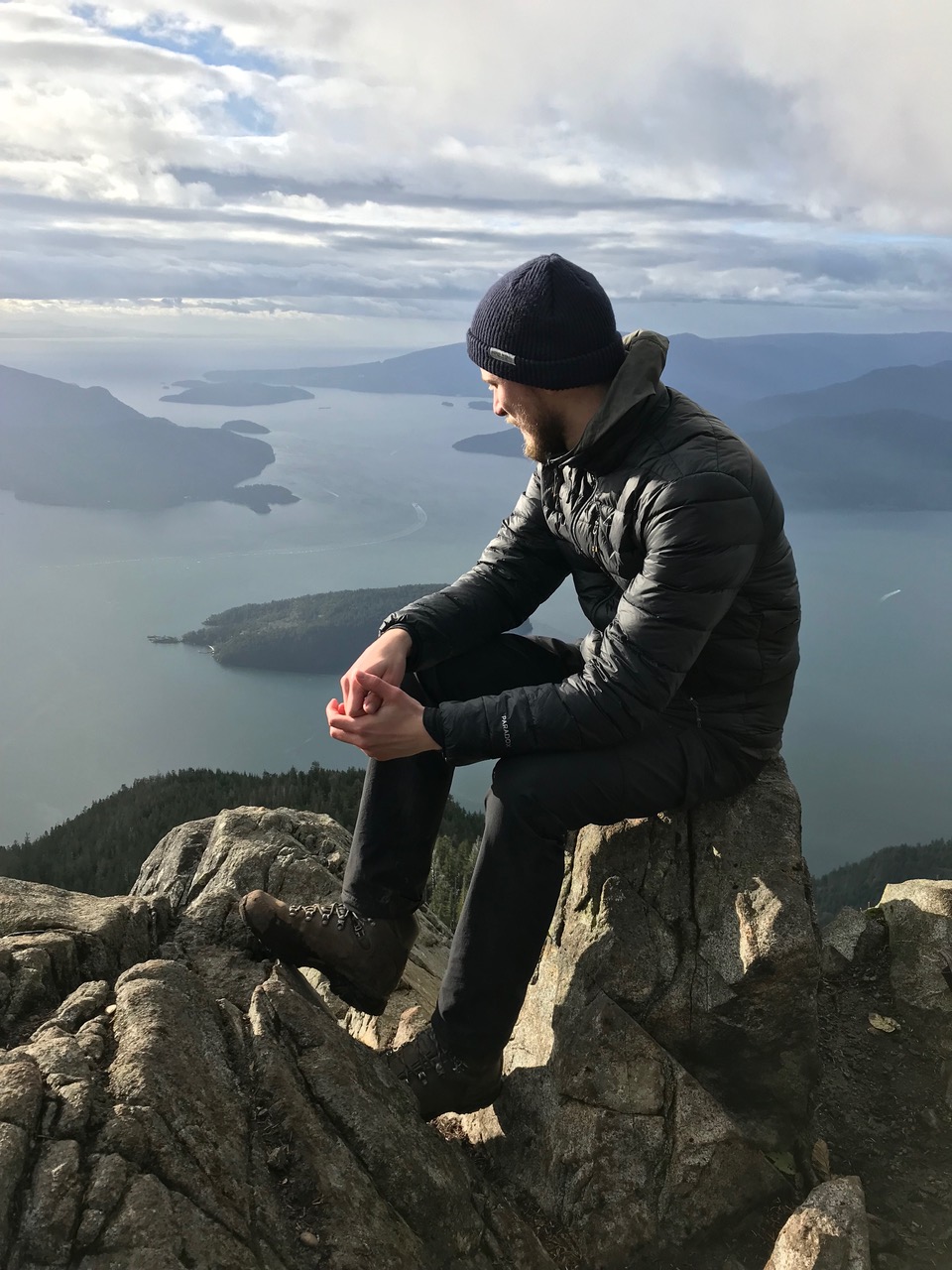
Kevin hiking the mountains of the west coast, BC
My son left the nest to go to university and work and I went on walkabout and eventually left the westcoast, returning to my old home in the east. I did lots of house-sitting in the Maritimes, then ended up teaching at UofT in Toronto.
UofT, west gate to quadrangle of University College, ON (photo by Nina Munteanu)
In 2016, I published Water Is… with Pixl Press in Vancouver. It’s a biography and celebration of water—my attempt to write a lay book on my water science, something that all could appreciate. Turns out that Margaret Atwood really liked it too!
.
On its heels, I got a book deal with Inanna Publications in Toronto for my eco-novel A Diary in the Age of Water. This eco-fiction novel follows the journeys of four generations of women during a time of catastrophic environmental change. The novel explores each woman’s relationship with water, itself an agent of change…
.
Eco-fiction (short for ecological fiction) is a kind of fiction in which the environment—or one aspect of the environment—plays a major role in story, either as premise or as character. For instance, several of my eco-fiction stories give Water a voice as character. In my latest novel,A Diary in the Age of Water, each of the four women characters reflects her relationship with water and, in turn, her view of and journey in a changing world.
In eco-fiction, strong relationships are forged between the major character on a journey and an aspect of their environment and place. Such strong relationship can linger in the minds and hearts of readers, shaping deep and meaningful connections that will often move a reader into action. Our capacity—and need—to share stories is as old as our ancient beginnings. From the Paleolithic cave paintings of Lascaux to our blogs on the Internet, humanity has left a grand legacy of ‘story’ sharing. By providing context to knowledge, story moves us to care, to cherish, and, in turn, to act. What we cherish, we protect. It’s really that simple.
Eco-fiction—whether told as dystopia, post-apocalypse, cautionary tale or hopeful solarpunk—can help us co-create a new narrative, one about how the Earth gifts us with life and how we can give in return. It’s time to start giving.
That starts with story.
NINA MUNTEANU is a Canadian ecologist / limnologist and novelist. She is co-editor of Europa SF and currently teaches writing courses at George Brown College and the University of Toronto. Visit www.ninamunteanu.ca for the latest on her books. Nina’s bilingual “La natura dell’acqua / The Way of Water” was published by Mincione Edizioni in Rome. Her non-fiction book “Water Is…” by Pixl Press(Vancouver) was selected by Margaret Atwood in the New York Times ‘Year in Reading’ and was chosen as the 2017 Summer Read by Water Canada. Her novel “A Diary in the Age of Water” was released by Inanna Publications (Toronto) in June 2020.
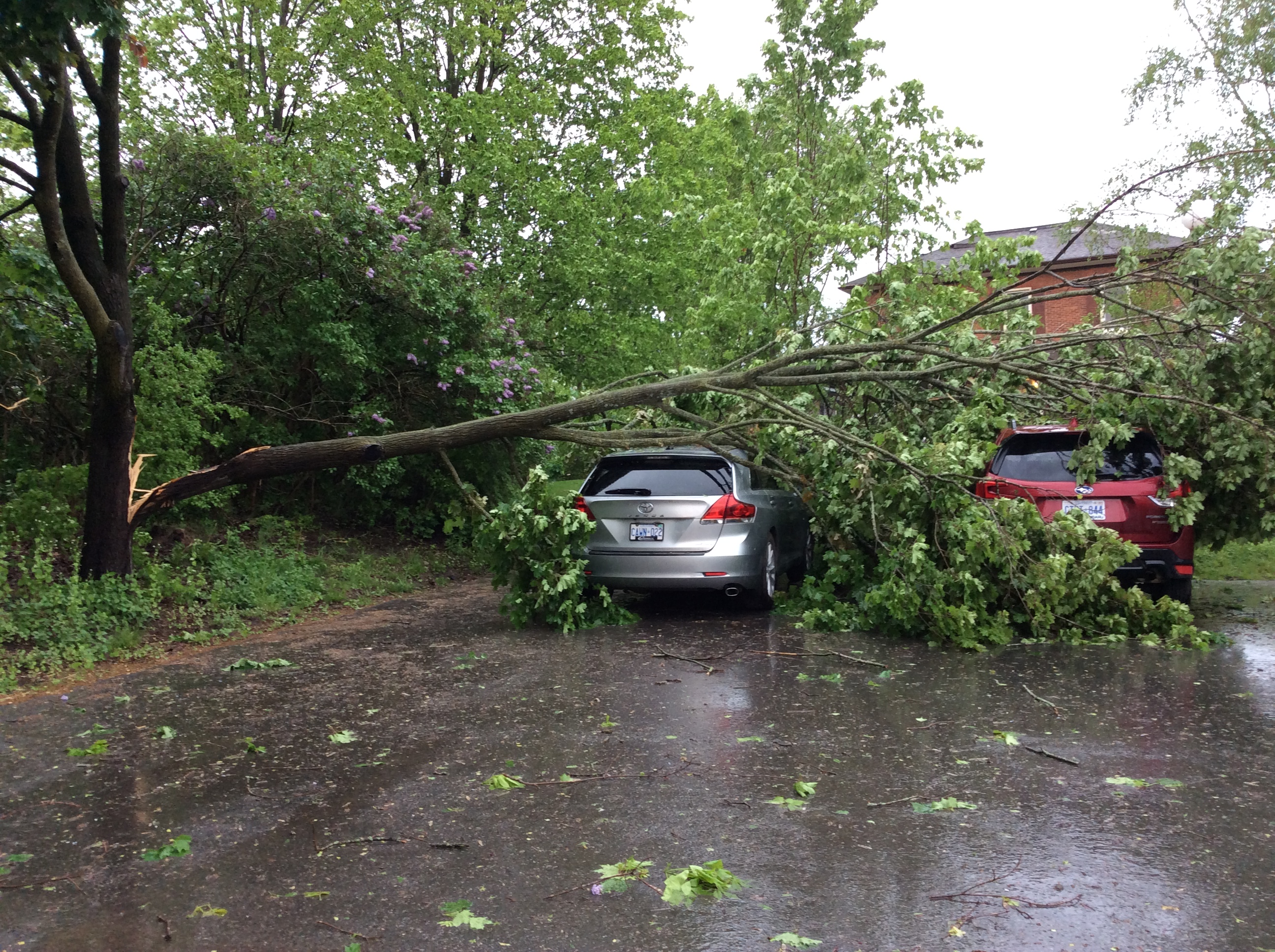
Cars trapped when a sugar maple snaps and falls on them in Saturday’s Derecho, Peterborough, ON (photo by Nina Munteanu)
It’s Wednesday and parts of the city still have no power since Saturday’s storm swept through like a ferocious lion. We got our power yesterday. We’d relied on our kind neighbours, who had a barbecue, to cook up some suppers. The power has come back in stages depending on where lines were brought down by trees or the violent wind microbursts.
A string of power poles and lines downed by the violent winds of the derecho along Highway 29 near Lakefield, ON (photos by Nina Munteanu)
Environment Canada calls Saturday’s storm a derecho: a long line of very active and violent thunderstorms or microbursts that include winds of at least 93 km/h with focused gusts of 121 km/h or greater. According to Environment Canada Senior Climatologist David Phillips, the storm spanned about 1,000 kilometers from Michigan to Maine as it went across Ontario and Quebec. Derechos typically contain numerous downburst clusters (families of downburst clusters) that, in turn, have smaller downbursts, and smaller microbursts. These tight, often cyclic tornado-like bursts within larger linear downbursts are what likely created the random devastation seen in Peterborough, where one tree was entirely uprooted and the tree beside it left untouched.
Birch uprooted on Auburn Street, Peterborough (photo by Nina Munteanu)
A true ‘herald archetype’, environmental disasters incite change, often through disorder. In doing so, they can bring out the best in us. The true mettle of a person is often revealed during such times, through the emergence of compassion and kindness.
I live just off the Rotary Trail in Peterborough, facing a mixed riparian forest of mostly black walnut and locust trees, with some silver maple, willow, Manitoba maple, oak and ash. The trail is well used every day by cyclists and walkers. The tornado-force winds and deluge rains singled out a few trees on the forest edge and flung them across the trail. A quick inspection shortly after the storm revealed that several trees formed obstacles to those using the trail: a silver maple just in front of my good friend Merridy’s place; an old half-dead elm; and a large Manitoba maple whose upper canopy had gotten tangled in the telephone wires.
Various damaged and uprooted trees in Peterborough, ON (photos by Nina Munteanu)
When Merridy and I decided to attempt clearing the Rotary Trail of strewn maple limbs and branches, we weren’t there more than five minutes when a cyclist stopped and without a word helped us; he grabbed large tree limbs and hoisted them aside like Superman then got on his bike and took off without a word—like Spiderman. After more dragging of tree limbs and my deft hand at the tree clippers and the broom, we cleared the trail for walkers and cyclists.
Before (left) and after (right) we cleared the Rotary Trail of downed silver maple from the derecho (photos by Nina Munteanu)
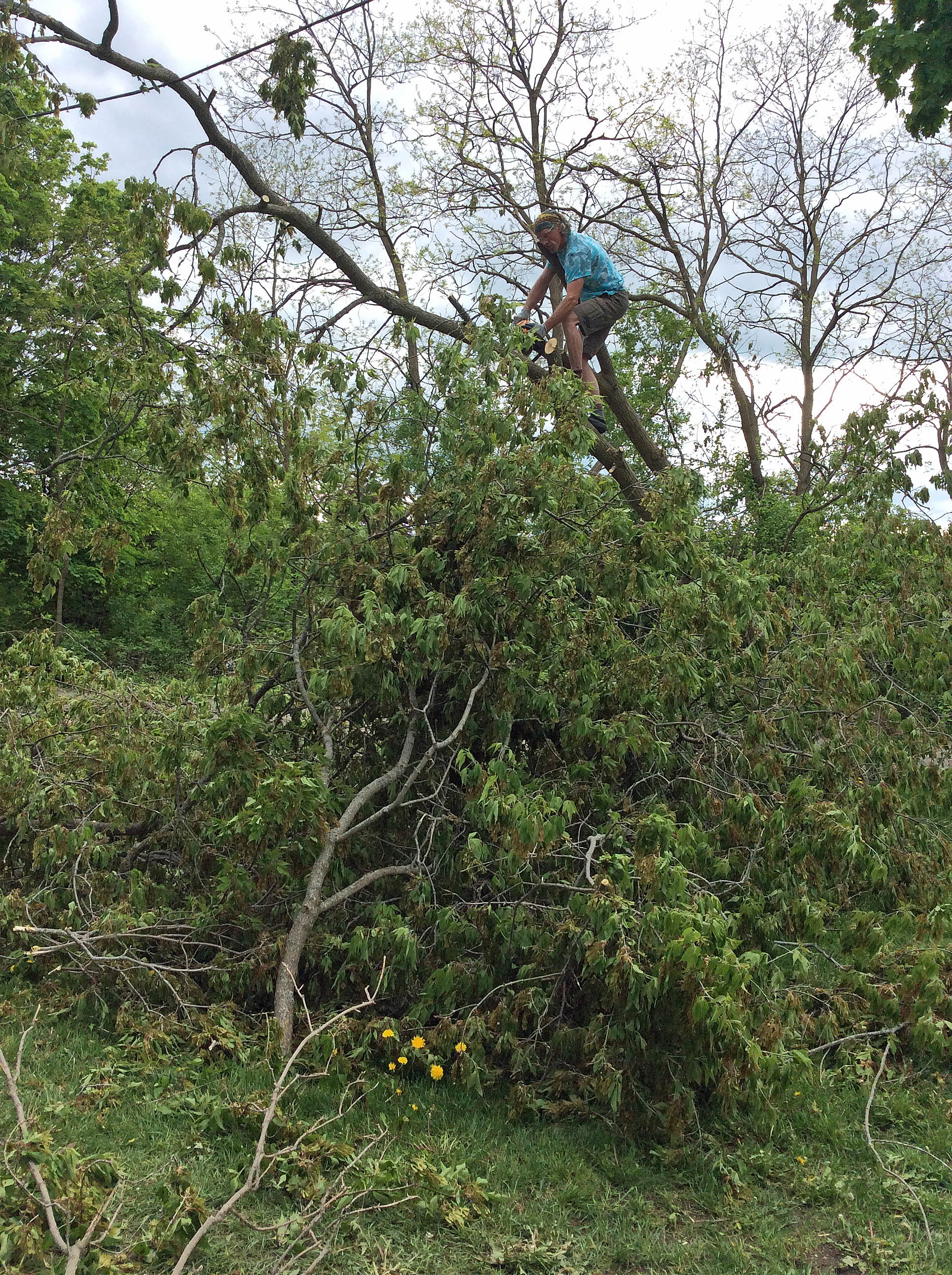
And then there was Charlie … a fashion-savvy quasi hipster-hippy who came cycling in with his chainsaw and hand saw on his back; he’d been all over the trail clearing tree debris just because he could. Charlie set to work on the huge Manitoba maple that had fallen across the trail and was leaning heavily on the telephone wire. Charlie proceeded to climb the tree and saw branches here and there to lighten the limb on the wire before cutting it. Two of us ladies became his cleanup crew, hauling big tree sections off the path as he downed them. By the time he got to the main tree limb on the wire, a group of cheerleaders had formed to watch. We all clapped when the big branch came off the line. One elder lady on two walking canes hobbled out from her home and handed Charlie a Bobcaygeon Petes Lager as thanks.
Charlie sawing off branches from Manitoba maple tangled on telephone wire (photo by Nina Munteanu)
Charlie saws the remaining tree trunk to clear the trail (photo by Nina Munteanu)
At first it was just me and Charlie. Watching him set up, I’d asked him if he was from the city and in the same breath knew he wasn’t—we both knew they were very busy getting the city’s power back on and freeing streets and getting trees off the roofs of houses; it would be a long time before they came to the Rotary Trail and other parks to clear. He responded, “well, that depends… are you a lawyer?” I laughed. We both recognized that Charlie was a rogue Good Samaritan, using less than regular protocol (no safety harness or equipment [except for goggles] and climbing shoes). When I said no, he relaxed and we introduced ourselves and exchanged stories about the storm, then got to work. I was soon joined by Susan, and together we became Charlie’s support team, hauling limbs and branches out of the tangle then rolling large tree bole sections to the side. Eventually several more walkers and nearby residents came to support the work and watch. Within an hour, the entire tree was off the path and off the wire. I felt a wonderful sense of community as people gathered exchanged names and stories about the storm. And it all started with one person’s kindness. Thanks, Charlie!
Before (left) and after (right) Charlie and his gang cleared the way (photo by Nina Munteanu)
I find that we really find our humanity and sense of kindness when a disaster strikes… one of the ‘good’ things about them.
Derecho damage to trees in the forest in Peterborough area, ON (photos by Nina Munteanu)
Nina Munteanu is a Canadian ecologist / limnologist and novelist. She is co-editor of Europa SF and currently teaches writing courses at George Brown College and the University of Toronto. Visit www.ninamunteanu.ca for the latest on her books. Nina’s bilingual “La natura dell’acqua / The Way of Water” was published by Mincione Edizioni in Rome. Her non-fiction book “Water Is…” by Pixl Press(Vancouver) was selected by Margaret Atwood in the New York Times ‘Year in Reading’ and was chosen as the 2017 Summer Read by Water Canada. Her novel “A Diary in the Age of Water” was released by Inanna Publications (Toronto) in June 2020.
Global Newswire announced yesterday that Ryan Reynolds and Blake Lively donated half a million dollars to the Canadian charity Water First Education & Training Inc. to support the locally-based hands-on skills training and education programs with indigenous communities. The program focuses on young indigenous adults in learning water science and becoming certified water operators and environmental technicians.
“One of the most fundamental challenges in Canada today is the lack of sustainable access to safe, clean water in many Indigenous communities,” writes Global Newswire. “Successive federal governments have failed to address the issue, with the likelihood of having no access to safe, clean water still far more prevalent in the lives of Indigenous Peoples, compared to non-Indigenous populations in Canada.”
At least 15%, or approximately one in six First Nations communities in Canada, are still under a drinking water advisory. Everyone has a right to safe, clean water. The water crisis in Indigenous communities is unacceptable.”
Water First
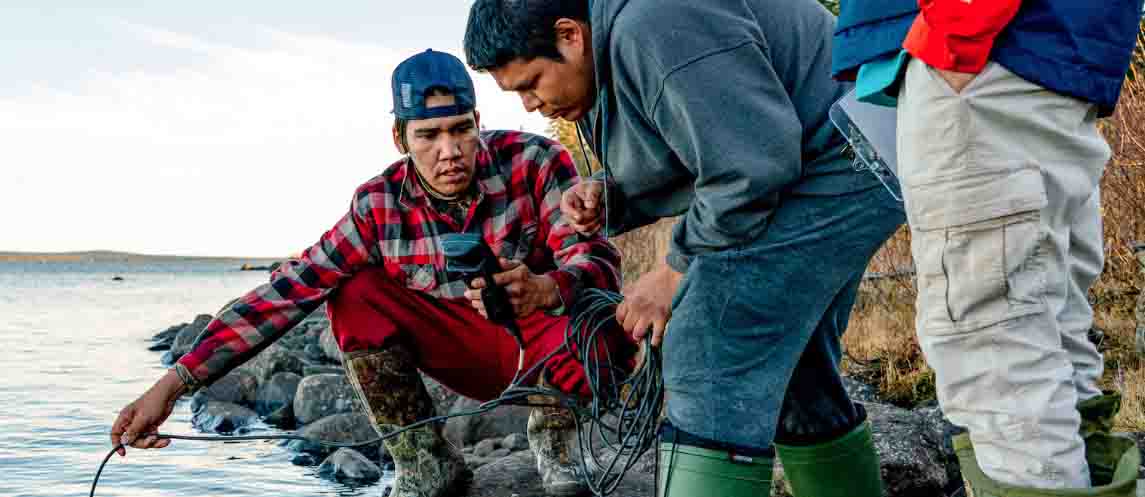
Two Indigenous students test water
“Access to clean drinking water is a basic human right. Canada is home to over 20% of the planet’s freshwater — an abundance that’s envied around the world. There’s absolutely no reason Indigenous communities should not have access to safe, clean water. All the individuals involved, whether they are operating water systems or monitoring their local water bodies, are critical. We appreciate Water First’s focus on supporting young, Indigenous adults to become certified water operators and environmental technicians. These folks are helping to ensure sustainable access to safe, clean water locally, now and for the future. Blake and I are thrilled to support this important work.”
Ryan Reynolds
Using a Van Dorn sampler to collect water at depth
“Nobody understands the evolving challenges and needs more than the people who live there,” says Water First. “Drinking water challenges are complex: in some communities, local concerns may be around infrastructure, for others, source water contamination. And numerous communities have challenges recruiting and training young Indigenous adults to join the drinking water field.”
“Safe water needs skilled people”
Water First
Water First shares that Indigenous communities have identified the need for more young, qualified and local personnel to support solving water challenges. In partnership with indigenous community leaders, Water First customizes local water-focused education and training programs to align with community goals and needs. These partnerships are built on trust, meaningful collaboration and reciprocal learning.
In-situ water testing
Spencer Welling, Water First intern from Wasauksing First Nation shares, “I am doing this for myself, my family and community. It’s important to know how things are done and gives you a better appreciation for it. It’s a good career to have, which I’m sure would ease my parents’ minds knowing that. It also feels good knowing that my community will have a local water treatment operator at the plant for at least a couple decades.”
Water technician learns her skills
In 2018, CBC ran a story on a pilot training project that Water First ran with Indigenous youth to help tackle water challenges in their communities. The program ran as a 15-month paid internship toward ensuring communities have quality drinking water. Ten youth were involved. The training, which included week-long workshops (including mapping, traditional knowledge, and environmental science) and hands-on training at their local water treatment plants, focused towards a provincially recognized certification as a Water Quality Analyst. Certification through an exam at the Ministry of the Environment, Conservation and Parks permits them to do drinking water testing. They can receive further certification as operators through another exam.
Water technician learning his skills
Anyone interested in learning about Water First and its education and training programs can find out more at www.waterfirst.ngo.
Water First Education & Training Inc. (Water First) is a registered Canadian charity that works in partnership with Indigenous communities to address water challenges through education, training and meaningful collaboration. Since 2009, Water First has collaborated with 56 Indigenous communities located in the lands now known as Canada while supporting Indigenous youth and young adults to pursue careers in water science.
For more information, you can contact:
Ami Gopal Director of Development and Communications Water First 1-905-805-0854 ami.gopal@waterfirst.ngo
Collecting sediment samples for testing
Nina Munteanu is a Canadian ecologist / limnologist and novelist. She is co-editor of Europa SF and currently teaches writing courses at George Brown College and the University of Toronto. Visit www.ninamunteanu.ca for the latest on her books. Nina’s bilingual “La natura dell’acqua / The Way of Water” was published by Mincione Edizioni in Rome. Her non-fiction book “Water Is…” by Pixl Press(Vancouver) was selected by Margaret Atwood in the New York Times ‘Year in Reading’ and was chosen as the 2017 Summer Read by Water Canada. Her novel “A Diary in the Age of Water” was released by Inanna Publications (Toronto) in June 2020.
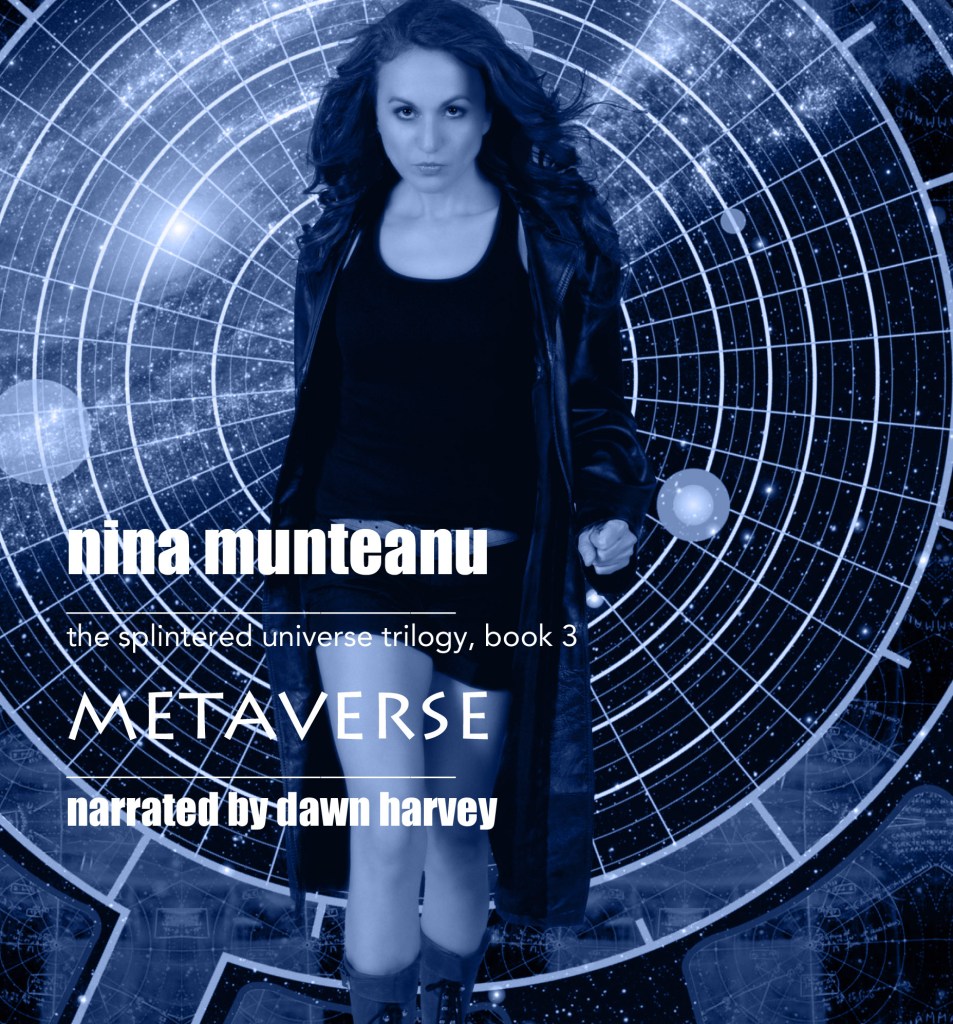
My detective thriller trilogy “The Splintered Universe,” which came out in print and ebook format in 2012-2014 were made into audiobooks by Iambik in 2019 and narrated impeccably by voice artist Dawn Harvey. When Iambik closed its doors, Spoken Realms and Pixl Press picked up the trilogy and reissued them in 2022. They are now remastered and available for purchase. Canadian author Simon Rose recently interviewed me about the re-release of The Splintered Universe Audiobooks. Part of that interview appears below. For the entire interview find the link below.
Interview with Nina Munteanu on New Audiobook Release of “The Splintered Universe” Trilogy
I had the pleasure recently of talking with Canadian author Nina Munteanu about the new release of her audiobook setThe Splintered Universe Trilogy. Nina is a scientist (limnologist) who also writes science fiction and fantasy with a focus on eco-fiction and climate fiction. She has nine novels and five non-fiction books published, including “Water Is…” recommended by Margaret Atwood as her #1 choice in the New York Times ‘Year in Reading’ in 2016.
The Splintered Universe Trilogy follows the thrilling adventures of Galactic Guardian Rhea Hawke, human detective who must save a world she hardly understands. It’s full of exciting planets, space travel, tall secrets, intrigue and even some romance. I interviewed Nina in 2019 about the trilogy when the three formats first became available and we talked about her world building, Rhea Hawke’s cool arsenal of gadgets and weapons, and concepts of metaphysics, existentialism and identity. So, what’s happening with all that now?
Simon:So, tell us about these new releases.
Nina: You’re right, Simon, the audiobooks of the trilogy did all come out in 2019, completing the three formats of print, ebook and audiobook. I was over the moon. What we’ve done recently is remaster the audiobooks and we’re now selling them as a package through the new publishers, Spoken Realms (first two audiobooks) and Pixl Press (third audiobook).
Briefly, the trilogy follows our intrepid (though slightly misguided) detective Rhea Hawke as she tries to solve the genocide of a spiritual sect on some backwater planet. She bungles her mission by killing her only lead and instead discovers a conspiracy to exterminate humanity by an alien race only she thinks exists. It goes downhill for her from there. She gets fired and her sentient ship—her only friend—is impounded. Her whole life comes apart. Her only chance to rebuild it is to prove that her discovery is true. That leads her down a rabbit hole into a dangerous world of intrigue, full of unsavory shape-shifting characters, dust smuggling, giant flying crustaceans, amorous toxic plants, and portals into mirror universes.
Rhea’s inventiveness gets her into even more trouble. She gained some notoriety with her created weapon, the MEC (short for Magnetic-Electro-Concussion) pistol, a versatile wave-weapon that can target DNA signatures and do almost anything you want with a single sweep. Her proprietary MEC design—coveted by shady crime syndicates and her own Guardians alike—becomes the centre piece to a universal war.
“An addictive start to the trilogy”–BOOK ADDICT
Simon:What makes these new audiobooks so special?
Nina: What makes these audiobooks special lies ultimately in their narration. When the original audiobook publisher took on the books as audiobooks, they provided me with three voice artists to audition. I chose Dawn Harvey because I could visualize my main character through her voice. Given that the entire trilogy is told in the first person, the narrator’s voice had to be just right. Dawn’s voice is dark and sultry like coffee. It is sexy and irreverent with a hidden vulnerability and sensitivity that perfectly captured the main character, Detective Rhea Hawke. What I didn’t realize then was how well Harvey would represent the thirty-odd other characters, mostly aliens—one who spoke through several mouths.
“Rhea is a fascinating character from the start and she continues to grow throughout the tale.”–DAB OF DARKNESS
Simon:Tell us about this narration process of the audiobooks.
Nina: Dawn is a dedicated professional. Working with her was an absolute pleasure. She created unique and consistent voices for the books many characters. She ensured that each character had the appropriate vernacular, tone, accent and cadence. She did proofs and confirmed them with me. She also tackled the “alien” vocabulary; many are made-up words. Dawn literally breathed life into Rhea Hawke and all the other characters. When I first listened to the Outer Diverse audiobook in the car on my way to Nova Scotia, I lost myself in her storytelling and forgot that I’d written it.
Here’s what one Amazon review said: “Dawn Harvey breathed incredible life into the lead character, Rhea Hawke—both sarcastic and vulnerable at the same time; a detective with a cynical edge, and sultry voice tinged with wiry sarcasm. The story unfolded through Rhea’s narrative like an old film noir as she unraveled mysteries that led to the greatest one: her own.”
Martha’s Bookshelf wrote: “Ms. Harvey manages to enthuse the personality of the characters into each voice. The wise, gentle Ka has a soft, strong sound that reminds you of a wise old bird. Shlsh She She, a slippery, slimy creature has a slurry, garbled voice like a mouthful of mushy, wet food. Dawn’s reading conveys the loneliness in Rhea, the sexiness of Serge, the frustrated friendliness of Bas, and the faithful coziness of Benny. She is able to bring emphasis to the action or romance, weariness or fear elements of the story. The narration never takes over the story; but rather enhances it.”
“An explosive ending … such a great series!”–LILLY’S BOOK WORLD
Simon:What has been the reception to the audiobooks so far?
Nina: the reception has been wonderful and overwhelming.
Dab of Darkness says: “There’s so much I have enjoyed about this series so far … There’s her AI ship, Benny, her sentient great coat, her special made gun, and her own hidden shapeshifting abilities. Then there’s a cast of interesting characters, good guys and bad guys. I love that I don’t know how things will turn out; the plot keeps me guessing.”
One Goodreads review wrote: “Rhea Hawke is a Galactic Guardian, and I love to say her name. Her name alone lets you know that there is a bad ass super hero of a woman on site. I can picture her boots, her great coat, and her side arms. I want to be her when I grow up.”
Nina: The trilogy can be purchased at most of the usual places in print and ebook formats. These include Amazon all over the world, Kobo, iBooks, Barnes and Noble and other quality retailers.
The audiobooks of the trilogy are available through Audible. The links on Audible for the three audio books are as follows: Outer Diverse, Inner Diverse, Metaverse.
Nina Munteanu is a Canadian ecologist / limnologist and novelist. She is co-editor of Europa SF and currently teaches writing courses at George Brown College and the University of Toronto. Visit www.ninamunteanu.ca for the latest on her books. Nina’s bilingual “La natura dell’acqua / The Way of Water” was published by Mincione Edizioni in Rome. Her non-fiction book “Water Is…” by Pixl Press(Vancouver) was selected by Margaret Atwood in the New York Times ‘Year in Reading’ and was chosen as the 2017 Summer Read by Water Canada. Her novel “A Diary in the Age of Water” was released by Inanna Publications (Toronto) in June 2020.
“Over increasingly large areas of the United States, spring now comes unheralded by the return of the birds. The early mornings are strangely silent where once they were filled with the beauty of bird song.”—Rachel Carson, Silent Spring
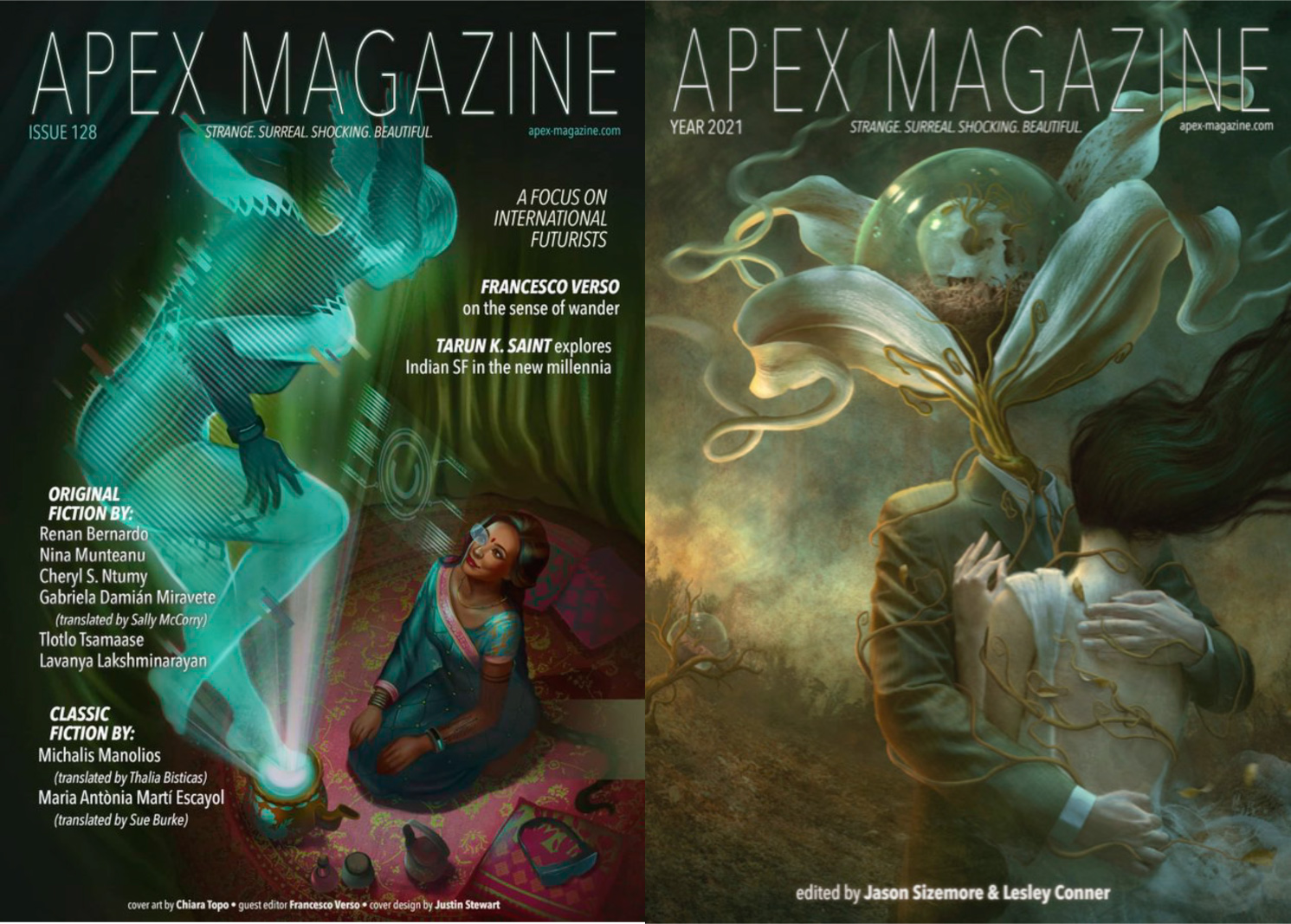
Apex Magazine will release its 2021 Anthology this fall with my short story, Robin’s Last Song in it. They are running an Apex Kickstarter Campaign until April 30 to fund the anthology.
Apex Issue 128 and upcoming Anthology for 2021
Robin’s Last Song first appeared in the #128 Issue of Apex Magazine in 2021. It tells the story of Robin, a blind elder whose digital app failed to warn the world of the sudden global loss of birds with disastrous ecological consequences. After years of living in self-exile and getting around poorly on sight-enhancing technology, a discovery gives her new hope in rekindling her talents in the field of Soundscape Ecology. Here is how it begins:
May, 2071
I rock on the cedar swing on my veranda and hear the wind rustling through the gaunt forest. An abandoned nest, the forest sighs in low ponderous notes. It sighs of a gentler time. A time when birds filled it with song. A time when large and small creatures — unconcerned with the distant thrum and roar of diggers and logging trucks — roamed the thick second-growth forest. The discord was still too far away to bother the wildlife. But their killer lurked far closer in deadly silence. And it caught the birds in the bliss of ignorance. The human-made scourge came like a thief in the night and quietly strangled all the birds in the name of progress.
Robin’s egg, discarded in the forest to distract predators, ON (photo by Nina Munteanu)
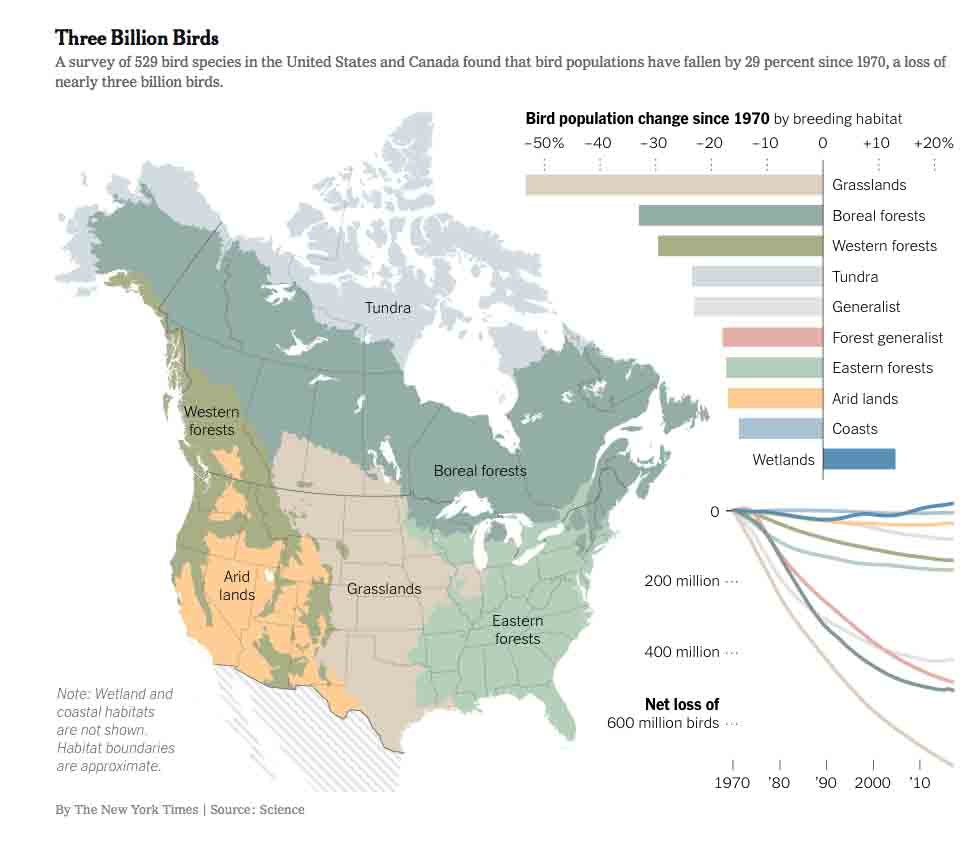
Bird Population Decline
The number of birds in North America has declined by three billion, some 30 percent, over the last half-century. The October 2019 issue of Science magazine reported a staggering decline in North American birds. Kenneth V. Rosenberg and his team of researchers estimated that three billion birds of various species have disappeared in Canada and the US since 1970.
That’s a third of the entire bird population lost in five decades.
Bird population decline since 1970
In North America, warbler populations dropped by 600 million. Blackbirds by 400 million. The common robins, cardinals, and blue jays had noticeably declined. Even starlings—once considered a kind of fast-breeding pest—have dwindled by 50%. The Intergovernmental Science-Policy Platform on Biodiversity and Ecosystem Services have determined that three-quarters of Earth’s terrestrial and two-thirds of the its marine environments have been severely altered by human actions.
Plowing of fields, deforestation, wetland draining, climate change and other land use clearing and treatments have caused great habitat loss. In addition, neonicotinoid pesticides make it harder for birds to put on weight needed for migration, delaying their travel.
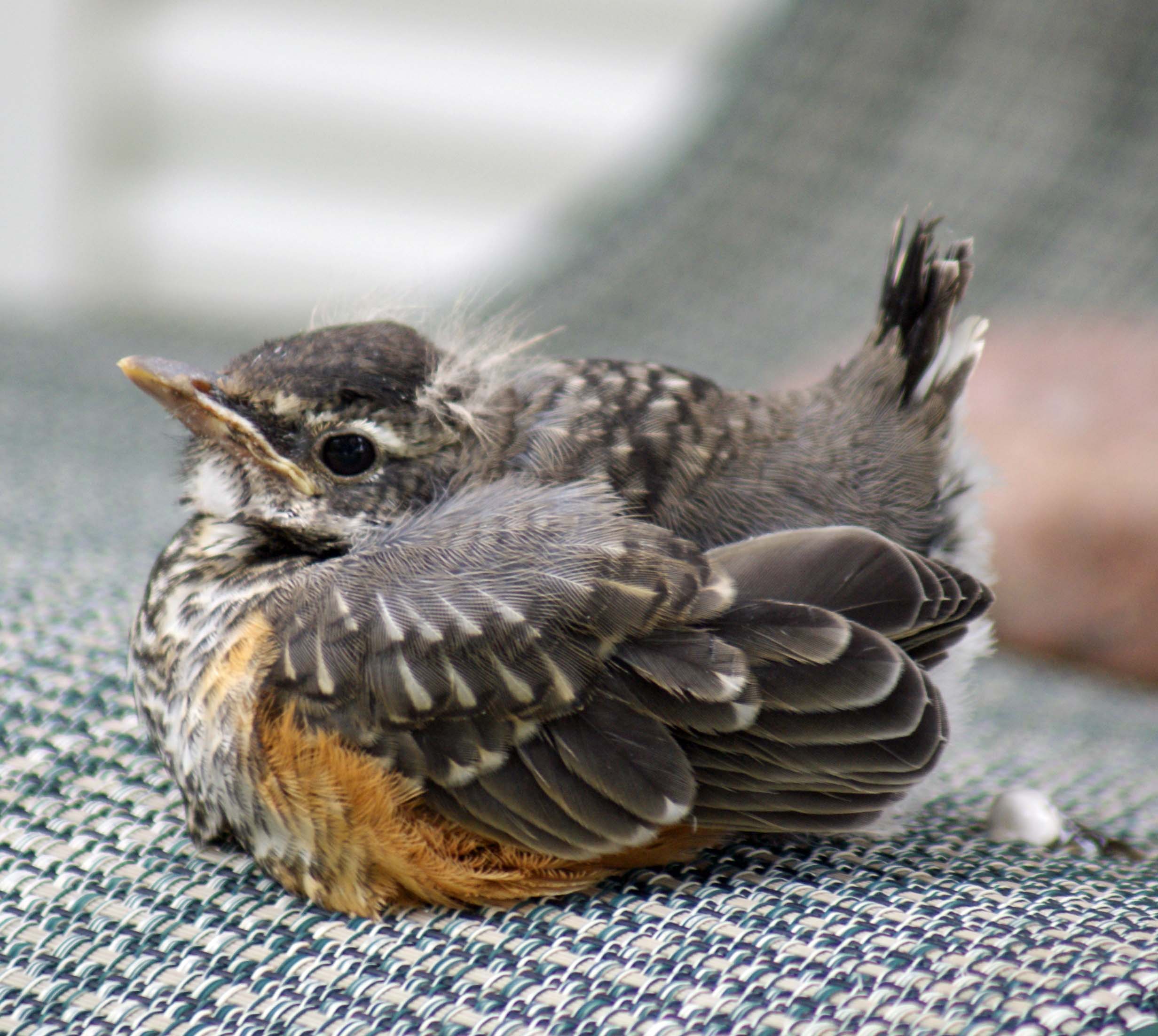
Robin fledgling rests on a patio chair, ON (photo by Merridy Cox)
Common bird species are vital to ecosystems. They control pests, pollinate flowers, spread seeds and help regenerate forests. When these birds disappear, their former habitats lose their functionality. “Declines in your common sparrow or other little brown bird may not receive the same attention as historic losses of bald eagles or sandhill cranes, but they are going to have much more of an impact,” said Hillary Young, a conservation biologist at the University of California. Kevin Gaston, a conservation biologist at the University of Exeter, lamented that: “This is the loss of nature.”
The Trump administration heinously and foolishly demolished or maimed several key bird protection acts, which hopefully the new administration has or will reinstate in full force: Migratory Bird Treaty Act; Clean Air Act; Clean Water Act; National Fish and Wildlife Act; and the Endangered Species Act.
Bernie Krause uses soundscape to measure ecosystem function
Useful Tool: Soundscape Ecology
The new science of soundscape ecology can analyze the health of an ecosystem. Bernie Krause, a soundscape ecologist who has been conducting long-term recordings for many decades recently noted that in Sugarloaf Ridge State Park, not far from his home in Northern California, “the effect of global warming and resulting drought has created the first completely silent spring I’ve ever experienced.” Stuart Winter at Express reports that “many of the iconic birds whose mating calls ring out across woodlands and open fields during early May are vanishing at an alarming rate.”
Rachel Carson and her iconic book, “Silent Spring”
Silent Spring: Rachel Carson’s Ominous Prediction
Rachel Carson was nothing short of prophetic when she published Silent Spring in 1962 (in reference to the dawn chorus most noticeable in spring during breeding). Silent Spring cautioned burgeoning ag-biotech companies (like Monsanto—now Bayer—Sygenta, Dow, and DuPont) who were carelessly and flagrantly spraying fields with pesticides and herbicides—at the time DDT was the main culprit. This would soon become a GMO world where gene-hacked plants of monocultures can withstand the onslaught of killer pesticides like neonicotinoids (currently killing bees everywhere) and Roundup. Roundup is a carcinogenic glyphosate-based weed killer that has recently been shown to kill beneficial insects like bees) and has been linked to Alzheimer’s disease, ADHD, birth defects, autism, and several kinds of cancerin humans.
Despite Carson’s warnings in 1962 and despite some action eventually taken (e.g. the ban on use of DDT in 1972—the precursor to Roundup and other neonicotinoids currently in use), the use of chemicals in big ag-industry has increased over five-fold since the 1960s. And this is destroying our bee populations, other beneficial insects, beneficial weeds, small animal populations and—of course—our bird life.
And it’s making us sick too.
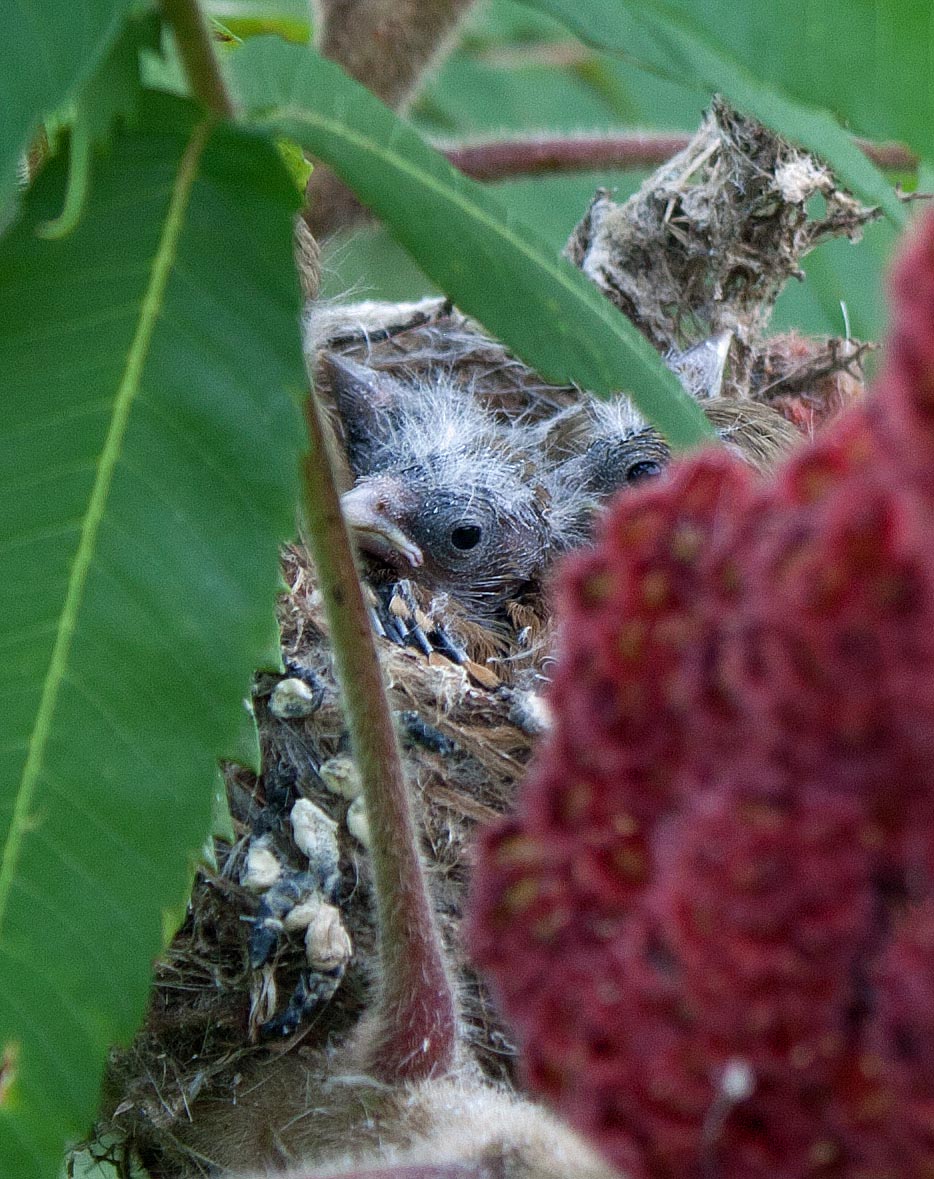
Three baby goldfinches in a nest in a staghorn sumac shrub, ON (photo by Nina Munteanu)
NINA MUNTEANU is a Canadian ecologist / limnologist and novelist. She is co-editor of Europa SF and currently teaches writing courses at George Brown College and the University of Toronto. Visit www.ninamunteanu.ca for the latest on her books. Nina’s bilingual “La natura dell’acqua / The Way of Water” was published by Mincione Edizioni in Rome. Her non-fiction book “Water Is…” by Pixl Press(Vancouver) was selected by Margaret Atwood in the New York Times ‘Year in Reading’ and was chosen as the 2017 Summer Read by Water Canada. Her novel “A Diary in the Age of Water” was released by Inanna Publications (Toronto) in June 2020.
Forget not that the earth delights to feel your bare feet and the winds long to play with your hair
Kahlil Gibran
White birch tree in mixed cedar hemlock forest, ON (photo and rendition by Nina Munteanu)
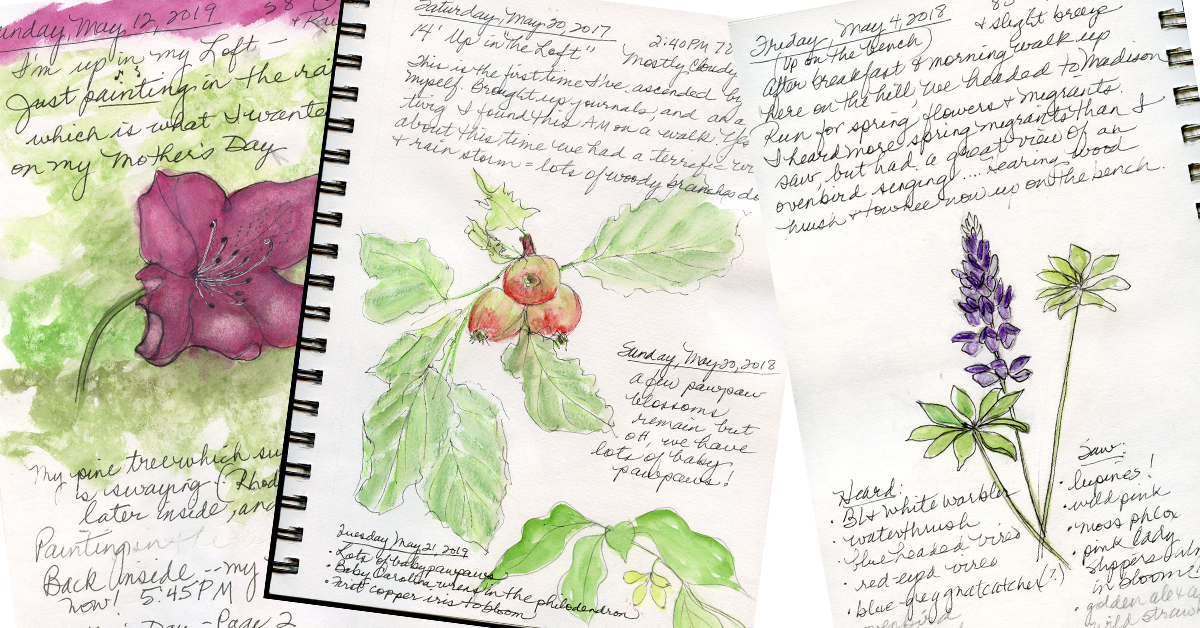
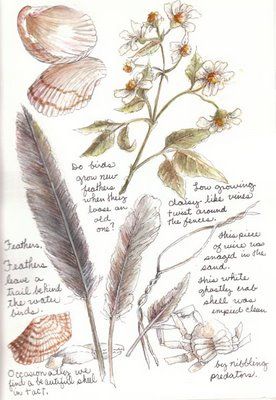
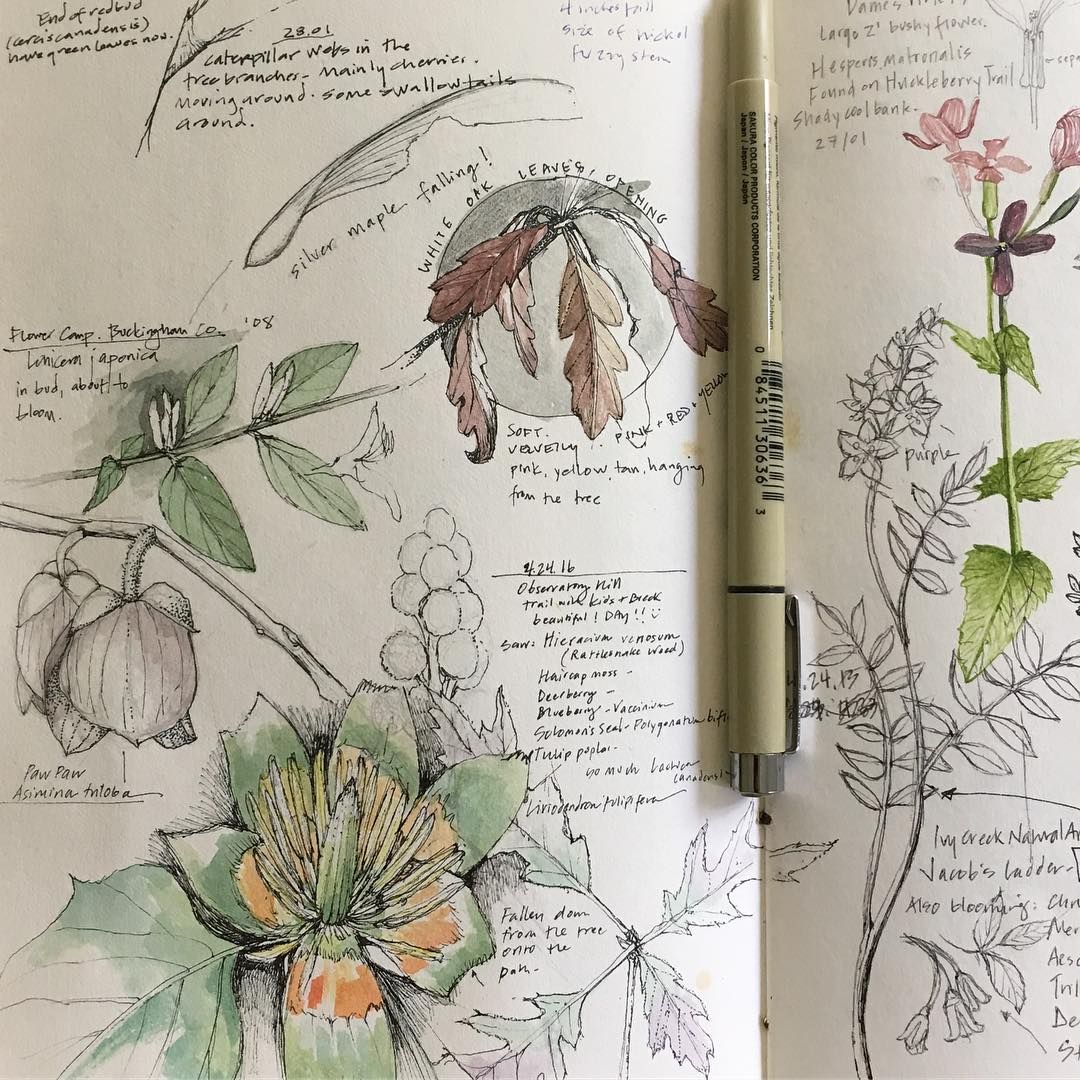
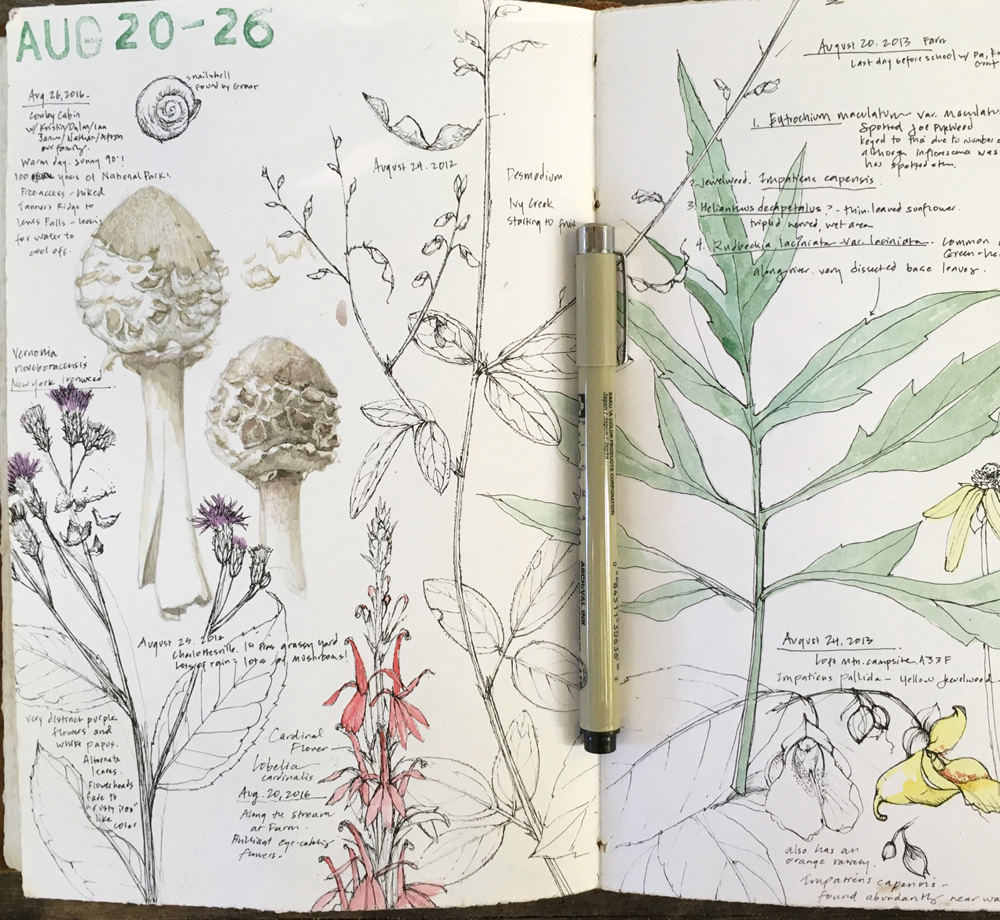
According to naturalist John Muir Laws, “Keeping a journal of your observations, questions, and reflections will enrich your experiences and develop gratitude, reference, and the skills of a naturalist. The goal of nature journaling is not create a portfolio of pretty pictures but to develop a tool to help you see, wonder, and remember your experiences.”
Sketches from “The Laws Guide to Nature Drawing and Journaling” by John Muir Laws
Here are the steps for keeping a nature journal:
Decide on the kind of nature journal you want to make: your decision should take into account whether you wish to include samples, pictures or only text. If you’re using a notebook (not a computer) size is important. Keep it large enough to include what you need but small enough to be portable. You may wish to create a journal only for a specific place, topic, issue or trip (e.g., the river behind your place; local birds; recycling in your community; your trip to Tanzania or the local zoo). There are different kinds of journal styles for different uses. For instance, Grinnell journals are field journals used by scientists and phenology journals are specific to making field observations. If you are really serious about journaling in nature — rain or shine— you can get one with waterproof paper, like Rite in the Rain, or DeckExpert. Butler Survey Supplies also makes waterproof loose leaf paper.
Make or buy a suitable journal: most nature journals are compiled from notebooks or notepads of plain white paper. You can get some that have one side lined for writing and the opposite side unlined for drawing, sketches and pasting in pictures or samples. Make sure your journal is sturdy and protected against the elements. Some covers are waterproof. Otherwise, it might be a good idea to carry a plastic bag with you.
Get the other equipment you need: if you plan to make sketches or paint with watercolor or collect specimens, ensure that you have the equipment: pencils, pencil crayons, paint kit, adhesive tape, camera, other collection material. A backpack would be useful to put your journal and materials into.
Dedicate time and place to journaling: nature journals, like most themed journals, do not need to be kept daily or on a routine. Journal entries will depend on the specific topic or area you have chosen to follow. Keep your journal handy to your journal topic. You may wish to keep it and associated materials in a dedicated backpack, handy to grab when you go on your outings. If you keep lists of things to bring on various trips or outings, include the journal.
Observe the world around you: nature journaling relies mostly on observing and reflecting. Cultivate your observational skills by learning to quiet your mind from distractions and focusing on the subject matter. Sketching and taking pictures can help provide the focus you need as well as giving you something to put into your journal. Slow down. Stop and watch and listen. Get close. Don’t be afraid to crouch and move in close. The wonders of nature are often right in front of your nose, just waiting for a new way to be seen.
Write on location: your nature journal will be most valuable if you use it in the field to record what you see as you see it. If you rely on your memory to write in your journal later, it will be less accurate (though it might be more poetic). You are more likely to make an entry if you bring your journal with you; if you leave your journal at home and wait until later, you may not get to it and the magic of the moment may be lost. Once you get home and revisit your entry, you can confirm and elaborate on your observations in the field.
Begin each entry with location, date, time: “where” and “when” are important pieces of information to include in any journal entry. They are particularly important in a nature journal. Time and place relate to important natural cycles like season and diurnal cycle. If your nature journal is more scientific, you may wish to include other important descriptors like weather, temperature, wind, precipitation, etc. You may wish to leave the odd page blank as space to paste in additional information from later research related to your entry.
Record observations in several ways: regardless of whether you consider yourself a good artist or not, sketches and drawings can provide a wealth of information (that you may not have thought to add in your writing) and add an element of interest to a journal entry. Pictures are a great tool for adding accurate details to an observation. Don’t be afraid to get close. All too often we take a picture, thinking the camera sees what we see (and interpret) and when we look at the photo the object of your attention is too far away or surrounded by so much “noise” it’s hard to distinguish.
Learn more about what you saw: it’s a good idea to confirm and elaborate your observations with research. When you go to the library or read online about what you saw, you will likely generate even more interest. This is where sketches or images or samples come in handy, particularly if you want to identify something you’ve seen.
Revisit your past entries: you may wish to consult a previous entry to compare with something you’ve just observed or use it in an experiment you’re conducting. Either way, reading your nature journal can be a great learning experience and a lot of fun.
White birch tree, showing lenticels, ON (photo and rendition by Nina Munteanu)
The American Museum of Natural History describes a field journal as being unique to the journalist. “There is no one way to keep a field journal,” they say. “Some scientists will sketch simple pencil drawings, and others will paint colorful, detailed images. You can use whatever tools work best for you. Try working with pens, pencils or watercolors to capture an image, whether it is a view of the Moon, the veins of a leaf, or the legs of a beetle.” You can record your observations with charts, list and labels, sketches, samples and photos. You can also write long, detailed descriptions.
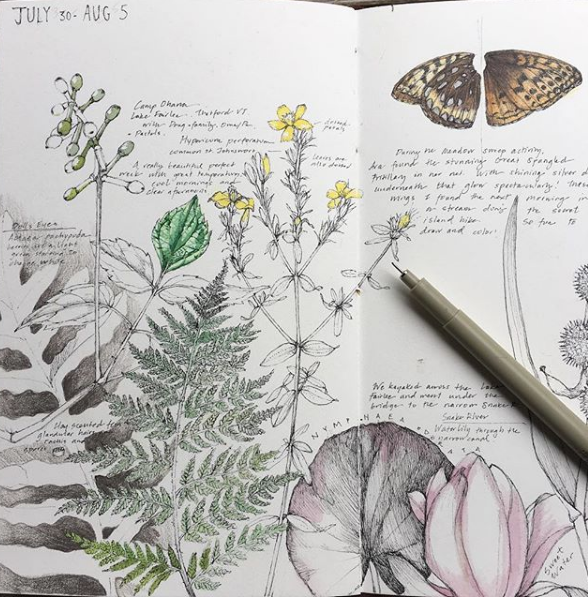
Journal page (image by stowelandtrust.org)
Some questions they come up with to help prompt you include:
“What do I see?” Some things to include are: size, shape and color, what it is doing, how it relates to other things, why it is so interesting to you.
“Do I see anything that surprises me?”
“How have I traveled to this spot?” This is good information for possible later visits, especially if you wish to do a series of related observations.
“What tools do I have?” This is good to remember for later visits and to assess the appropriateness of the observation. In most scientific observations, the methods and techniques used are critical to the validity of the observation.
“Who is with me on this expedition?” Researchers always include who was there. This helps for later consultation.
“What time of day is it?” In the natural sciences time of day is critical because so much in nature is diurnal (e.g., responds and changes as the day changes)
White birch tree with polypore fungus, ON (photo and rendition by Nina Munteanu)
Lynda Richardson at Virginia Wildlife talks about keeping a nature journal, which includes plein air painting and what goes into a field kit.
Page from Lynda Richardson’s nature journal (image by L. Richardson)
Page of Fiona Gillogly’s nature journal (image by F. Gillogly)
While recently browsing on the Internet, I ran across a very attractive yet simple nature blog. What made Judy Butler’s “Naturalist Journal: Down the Nature Trail” so appealing was her mixed use of regular text augmented with scanned handwritten pages containing color-pencil drawings and flower pressings. This charming “homespun” expression resembled a real three-dimensional journal.
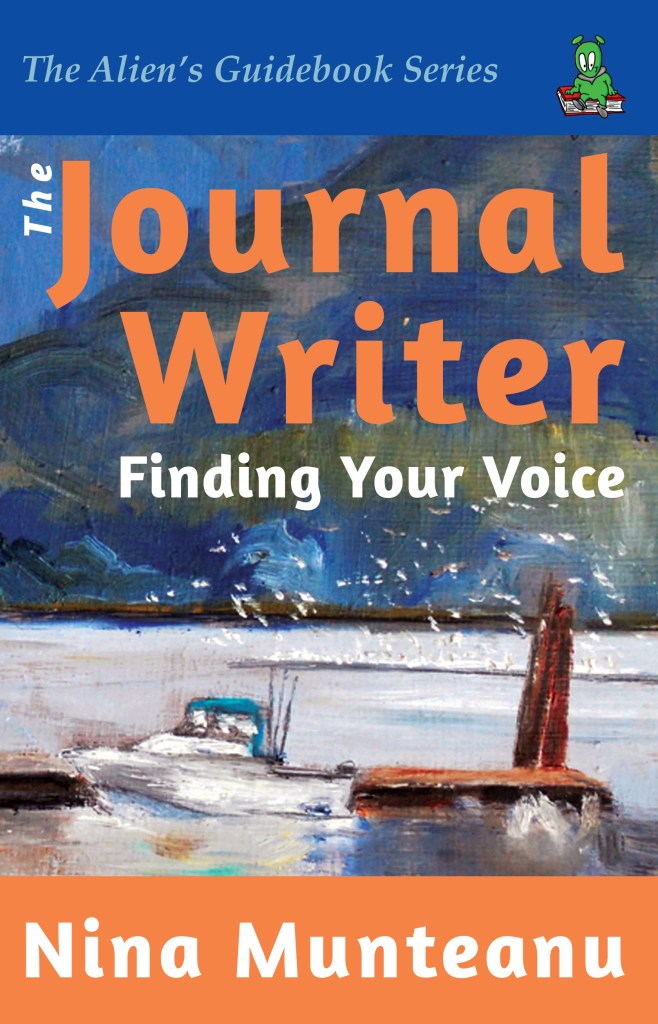
The Journal Writer is the second writing guide in the Alien Guidebook Series. This comprehensive guidebook will help you choose the best medium, style and platform for your expressive writing. The guide provides instruction on issues of safety, using the computer and electronic devices, social media and the internet.
“Engaging, accessible, and easily applicable…Brava, Nina, brava.”—David Merchant, Instructor, Louisianna Tech University
“Straight up, fact-filled, enriching, joyful and thorough…Nina is honest, she is human and she wants you to succeed.”—Cathi Urbonas, Halifax writer
Nina Munteanu is a Canadian ecologist / limnologist and novelist. She is co-editor of Europa SF and currently teaches writing courses at George Brown College and the University of Toronto. Visit www.ninamunteanu.ca for the latest on her books. Nina’s bilingual “La natura dell’acqua / The Way of Water” was published by Mincione Edizioni in Rome. Her non-fiction book “Water Is…” by Pixl Press(Vancouver) was selected by Margaret Atwood in the New York Times ‘Year in Reading’ and was chosen as the 2017 Summer Read by Water Canada. Her novel “A Diary in the Age of Water” was released by Inanna Publications (Toronto) in June 2020.
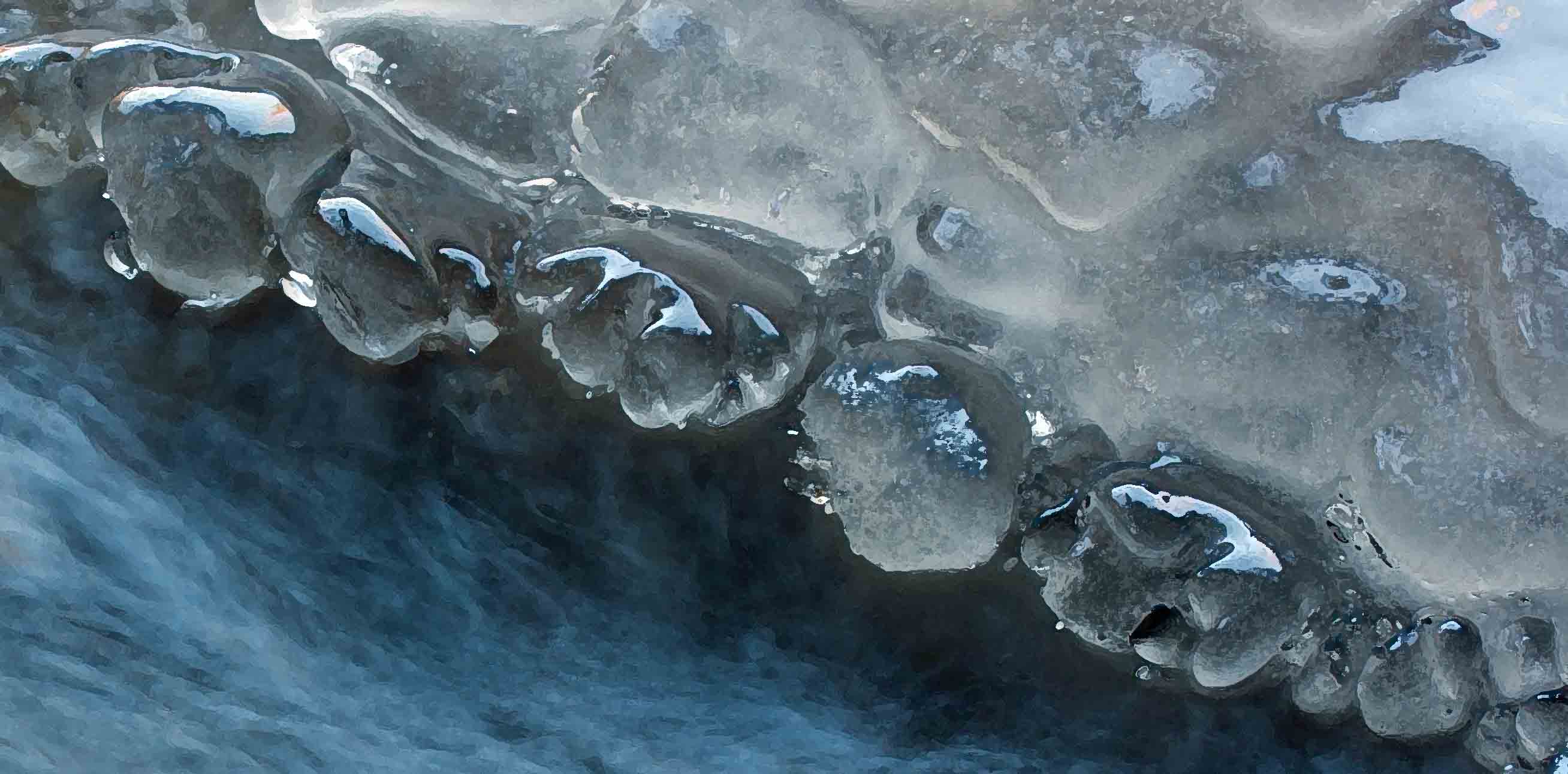
Ice ‘pearls’ forming in Jackson Creek, ON (photo and rendition by Nina Munteanu)
I’m a writer and aside from putting out the odd novel and short story, I teach writing for a living.
I teach online courses and tutor students at various writing centres at the University of Toronto on scientific and scholarly writing. I coach fiction writers of novels and short stories to publication. I help writers all over the world achieve clear, accurate, and compelling narrative, whether it’s fiction or non-fiction. I do this by focussing on the clarity and direction of narrative. The key to good narrative and good storytelling—whether it is a historical fantasy or a scholarly essay—is simplicity. Ernest Hemmingway knew that. His writing emulated simple and became profound.
The best writing can take something complex and express it simply. Just as with valid scientific theory (recall Einstein’s ‘simple’ and elegant theory of relativity, E=mc2), effective communication embraces complexity through simple expression and resonates with accuracy and power. Embracing complexity through simplicity is achieved through metaphor, key images and symbols that encompass an entire culture or thought.
If I were to write, “Jack’s office was a prison cell,” you’d have a good idea of what Jack’s office was like. In five simple words the concept and its emotional associations are clearly conveyed. This is because we all have a clear idea of what a prison cell is like. Yours may not be the same imagined prison cell as mine, but the metaphor works as effectively. It’s that simple.
Lately, I’ve taken the lesson of simplicity into my life decisions.
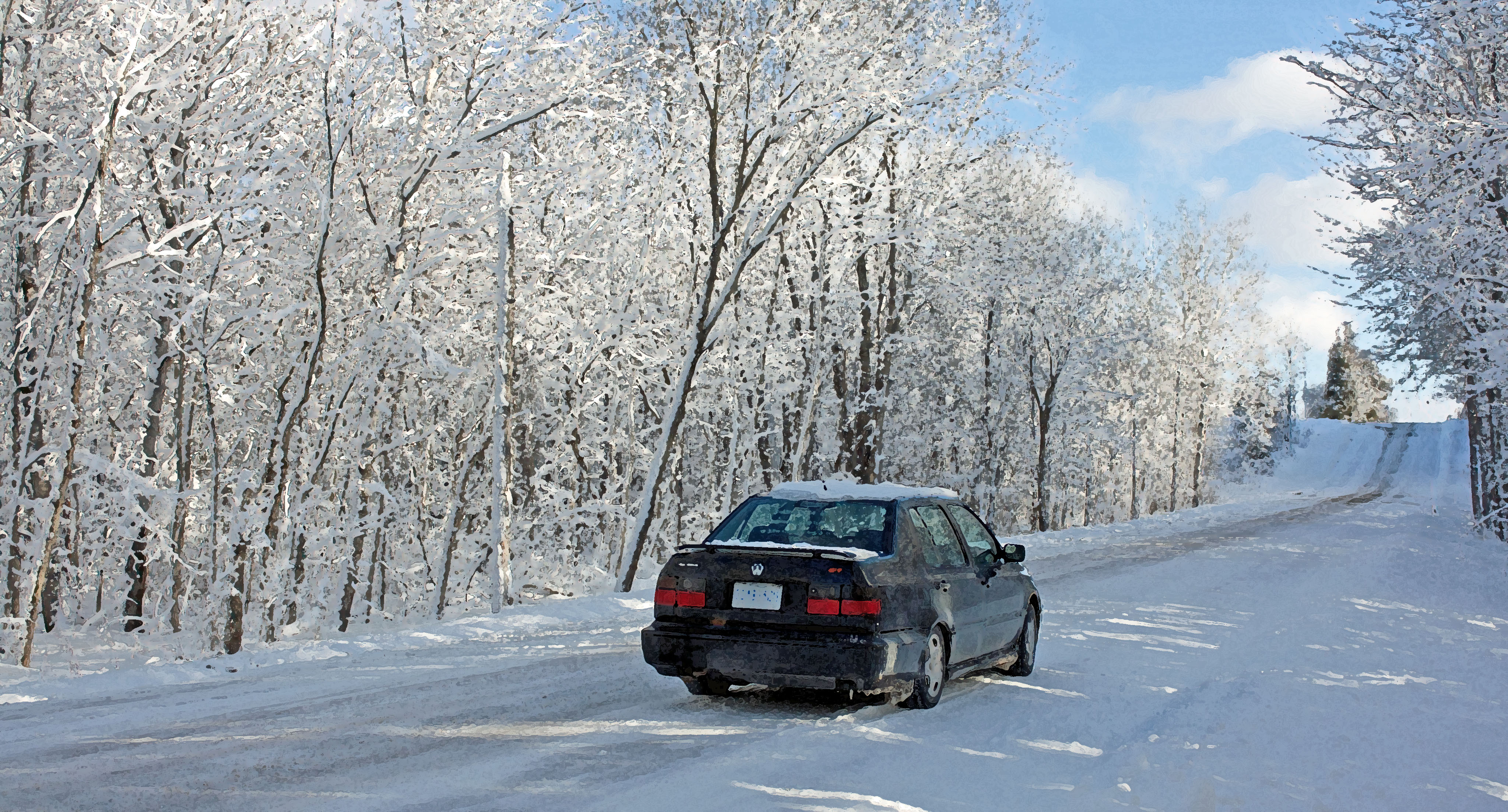
My car on a country road through a snow-covered forest, ON (photo and rendition by Nina Munteanu)
For the past ten years or so, I’ve become a bit of a nomad. After bringing up my family, I left my marriage nest in British Columbia, divested myself of virtually all my possessions (what I own fits in my car—a 1998 Jetta), and traveled across Canada from the west coast to the east coast and Nova Scotia. I lived in Lunenburg and Mahone Bay for several years, spent some time in Toronto, and am currently living in the Kawartha Region of Ontario. Before COVID-19, I travelled the world, through the United States, much of Europe, parts of Africa and Asia and Australia.
What I learned during my travels is that a person doesn’t need that much to live a full life. My health. A safe place to sleep. Food. Adventure for my curious mind. Purpose and meaning (something to live for): good people to love and share my adventures with and a way to feel that I am helping to make this a better world.
Living a simple life helps me find focus, meaning and joy.
In her article in YES! Magazine, Megan Sweas writes that “living simply can help us challenge society’s inequities, live in alignment with nature, and build community.” Sweas argues that a simple lifestyle is an ethical choice: “living simply so that others may simply live.” As the saying credited to Gandhi goes.
Vietnamese Zen Buddhist teacher and author of more than 100 books, Thich Nhat Hanh celebrates 94th birthday (Contributed by Don Farber)
Cultivating the Insight of Interbeing
Buddhist Zen master Thich Nhat Hanh coined the term “interbeing” to describe our interconnectedness. In a 2017 article entitled “The Insight of Interbeing,” Hanh described his experience:
“About thirty years ago I was looking for an English word to describe our deep interconnection with everything else. I liked the word “togetherness,” but I finally came up with the word interbeing. The verb “to be” can be misleading, because we cannot be by ourselves, alone. “To be” is always to “inter-be.” If we combine the prefix “inter” with the verb “to be,” we have a new verb, “inter-be.” To inter-be and the action of interbeing reflects reality more accurately. We inter-are with one another and with all life.
human bodies are ‘shared, rented, and occupied’ by countless other tiny organisms, without whom we couldn’t ‘move a muscle, drum a finger, or think a thought.’ Our body is a community, and the trillions of non-human cells in our body are even more numerous than the human cells. Without them, we could not be here in this moment. Without them, we wouldn’t be able to think, to feel, or to speak. There are, he says, no solitary beings. The whole planet is one giant, living, breathing cell, with all its working parts linked in symbiosis.”
Thich Nhat Hanh
Hanh drew the analogy of a piece of paper to make his point about interbeing:
“If you are a poet, you will see clearly that there is a cloud floating in this sheet of paper. Without a cloud, there will be no rain; without rain, the trees cannot grow; and without trees, we cannot make paper. The cloud is essential for the paper to exist. If the cloud is not here, the sheet of paper cannot be here either. So we can say that the cloud and the paper inter-are…If we look into this sheet of paper even more deeply, we can see the sunshine in it. If the sunshine is not there, the forest cannot grow. In fact, nothing can grow. Even we cannot grow without sunshine. And so, we know that the sunshine is also in this sheet of paper. The paper and the sunshine inter-are. And if we continue to look, we can see the logger who cut the tree and brought it to the mill to be transformed into paper. And we see the wheat. We know the logger cannot exist without his daily bread, and therefore the wheat that became his bread is also in this sheet of paper. And the logger’s father and mother are in it too.”
Thich Nhat Hanh
We inter-are. “Everything relies on everything else in the cosmos in order to manifest—whether a star, a cloud, a flower, a tree, or you and me,” said Hanh.
Hanh argued that this all starts with mindfulness. Mindfulness is rooted in Buddhist meditation. Practicing mindfulness helps us live a fuller and happier life; we become fully focused on the present moment, not absorbed in regrets, plans, worries or other thoughts. When we practice mindfulness we create more stillness which allows us to see more clearly what brings us happiness and what causes suffering. With this awareness, we can make positive choices in everyday life.
Those who practice mindfulness and contemplate interbeing seek “to protect life, practice generosity, love responsibly, speak lovingly, and listen deeply, as well as consume in a way that preserves peace, joy, and wellbeing in oneself, others, and the Earth,” said Hanh. He added that “understanding how their own consumption—of a burger, a glass of wine, Facebook, or gossip—causes harm is what spurs them to give up such ‘toxins’ and consume less.”
To live more simply is to live more lightly on this beautiful planet. And that’s a story worth reading…
The creek’s thalweg reveals itself as the creek ice melts, ON (photo and rendition by Nina Munteanu)
Nina Munteanu is a Canadian ecologist / limnologist and novelist. She is co-editor of Europa SF and currently teaches writing courses at George Brown College and the University of Toronto. Visit www.ninamunteanu.ca for the latest on her books. Nina’s bilingual “La natura dell’acqua / The Way of Water” was published by Mincione Edizioni in Rome. Her non-fiction book “Water Is…” by Pixl Press(Vancouver) was selected by Margaret Atwood in the New York Times ‘Year in Reading’ and was chosen as the 2017 Summer Read by Water Canada. Her novel “A Diary in the Age of Water” was released by Inanna Publications (Toronto) in June 2020.
Calgary author Simon Rose has published eighteen novels for children and young adults, eight guides for writers, more than a hundred nonfiction books, and many articles on a wide variety of topics. Simon has agreed to talk to me about his latest release, The Stone of the Seer, the first novel in the Stone of the Seer series.
Here’s my interview with Simon:
Nina:What’s the new series all about?
Simon: The Stone of the Seer is an exciting historical fantasy series of adventure novels for young adults, primarily set in the turbulent period of the English Civil War.
The Stone of the Seer, book one in the series, features the Vikings, Leonardo da Vinci, and the political turmoil of the 1640s. At Habingdon House, Lady Elizabeth Usborne, Kate, and Tom encounter a magical black stone, mysterious ancient manuscripts, and the incredible time viewing device known as the tempus inpectoris, all while under constant threat from the murderous witchfinder, Daniel Tombes.
The other novels in the series are Royal Blood and Revenge of the Witchfinder, which will be published in the coming months. There will be a box set including all three novels at some point in the future as well.
Nina:What’s the story behind the story?
Simon: The story, main characters, and some of the settings in The Stone of the Seer are fictional but are based on true events and the story features real historical characters, such as King Charles I. The English Civil War was a series of conflicts in England, Scotland, and Ireland in the 1640s and early 1650s. The war originated in the struggle between Charles I and Parliament, regarding how the country should be governed.
The king’s defeat in the civil war led to his trial and execution in January 1649. The monarchy was abolished and replaced first by the Commonwealth of England and then the Protectorate, before the monarchy was restored in 1660. However, the defeat of Charles I confirmed that an English monarch could not rule the country without the consent of Parliament, although this wasn’t legally established until the Glorious Revolution in 1688.
Nina:You must have done quite a lot of historical research for this book.
Simon: Yes, it’s a time period I’ve always been interested in, but it still involved considerable research. I’ve included a glossary at the end of each of the three novels in the series where you can learn more about the historical events, settings, and leading characters from the English Civil War, locations that are mentioned in the text, life in the seventeenth century, and details from other historical periods that are featured in the story. There’s also a page on my website all about the historical background behind the books, with links to online sources about the time period.
Nina:What are you currently working on?
Simon: I always have a current project or two and right now I’m writing another historical fantasy novel series set in World War II. I’m also working on sequels to the Flashback series of paranormal novels, which includes Flashback, Twisted Fate, and Parallel Destiny, which you can learn more about on my website at simon-rose.com. In addition, I’m working on screenplay adaptations of the Shadowzone series and have also completed a number of picture books for younger readers, which I hope will be published soon.
Nina:You also work with other authors, don’t you?
Simon: Yes, I do quite a lot of that these days. I provide coaching, editing, consulting, and mentoring services for writers of novels, short stories, fiction, nonfiction, biographies, inspirational books, and in many other genres. I also work as a writing instructor at the University of Calgary and have served as the Writer-in-Residence with the Canadian Authors Association. You can find details of some of the projects I’ve worked on, along with some references and recommendations, on my website.
Nina:Where can people buy The Stone of the Seer?
Simon: The novel can be purchased at most of the usual places, as follows:
Thanks Simon, for being my guest here today and the very best of luck with the Stone of the Seer series. I hope the first book sells thousands of copies in the coming weeks and months.
You can learn more about Simon and his work on his website at www.simon-rose.com, where you can also link to his social media sites and other locations online.
The Otonabee River glinting on a sunny winter day, ON (photo and rendition by Nina Munteanu)
Nina, the snow bear, enjoying a heavy snowfall in early winter, ON (photo by M. Cox)
I grew up in southern Quebec, where the first snow of the season often came from the sky in a thick passion. Huge flakes of unique beauty settled on my coat sleeves and within minutes I was covered in snow. I would stand enraptured and study each one as I could. Snow wraps everything in a blanket of soft acceptance. It creates a dazzling face on a dark Earth. It refuses to distinguish between artificial and natural. It covers everything—decorated house, shabby old car, willowy trees, manicured lawn—beneath its white mantle. It quiets the Earth.
Old barn after a fresh snow near Wolfville, NS (photo by Nina Munteanu)
Have you ever gone for an evening walk in the fresh crisp snow, boots crunching, snow glistening in the moonlight? Each step is its own symphony of textured sound. A kind of collaboration with the deep of the night and Nature’s own whisperings.
Heavy snowfall in a forest during early winter, ON (photo by Nina Munteanu)
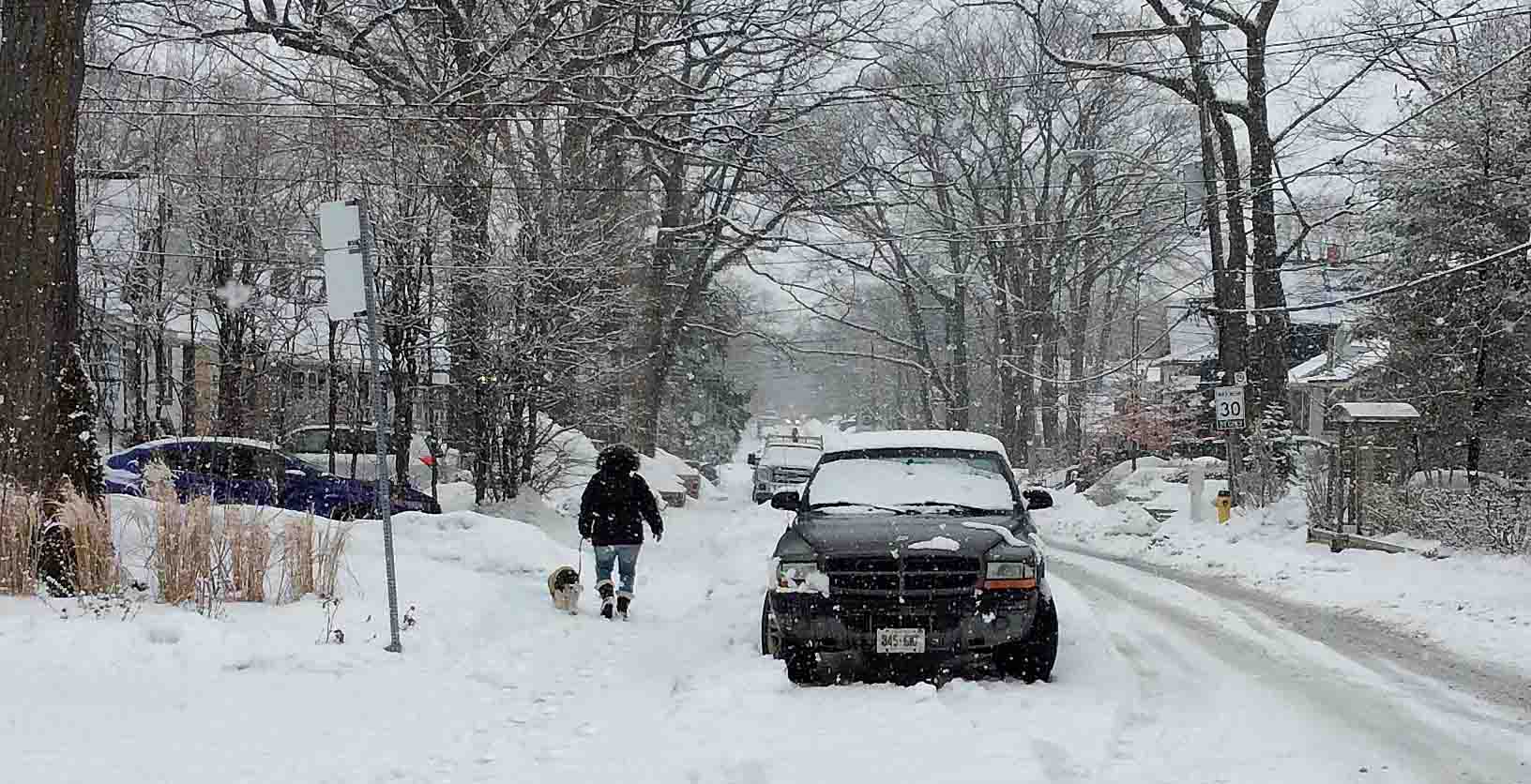
A heavy snow falls in the Beach in Toronto, ON (photo by Nina Munteanu)
Snow is a shape shifter, charging down in a fierce blizzard and as glittering hoarfrost that forms on cold, clear nights. Snow is a gypsy, conspiring with the clever wind to form mini-tornadoes and swirling on the cold pavement like misbehaving fairies. It drifts like a vagabond and piles up, cresting over the most impressive structure, creating phantoms out of icons. Some people, fearful of the chaos and confusion that snow brings, hide indoors out of the cold. Others embrace its many forms, punching holes through the snow crust to find the treasure of powder beneath or ploughing through its softness, leaving behind an ivory trail of adventure.
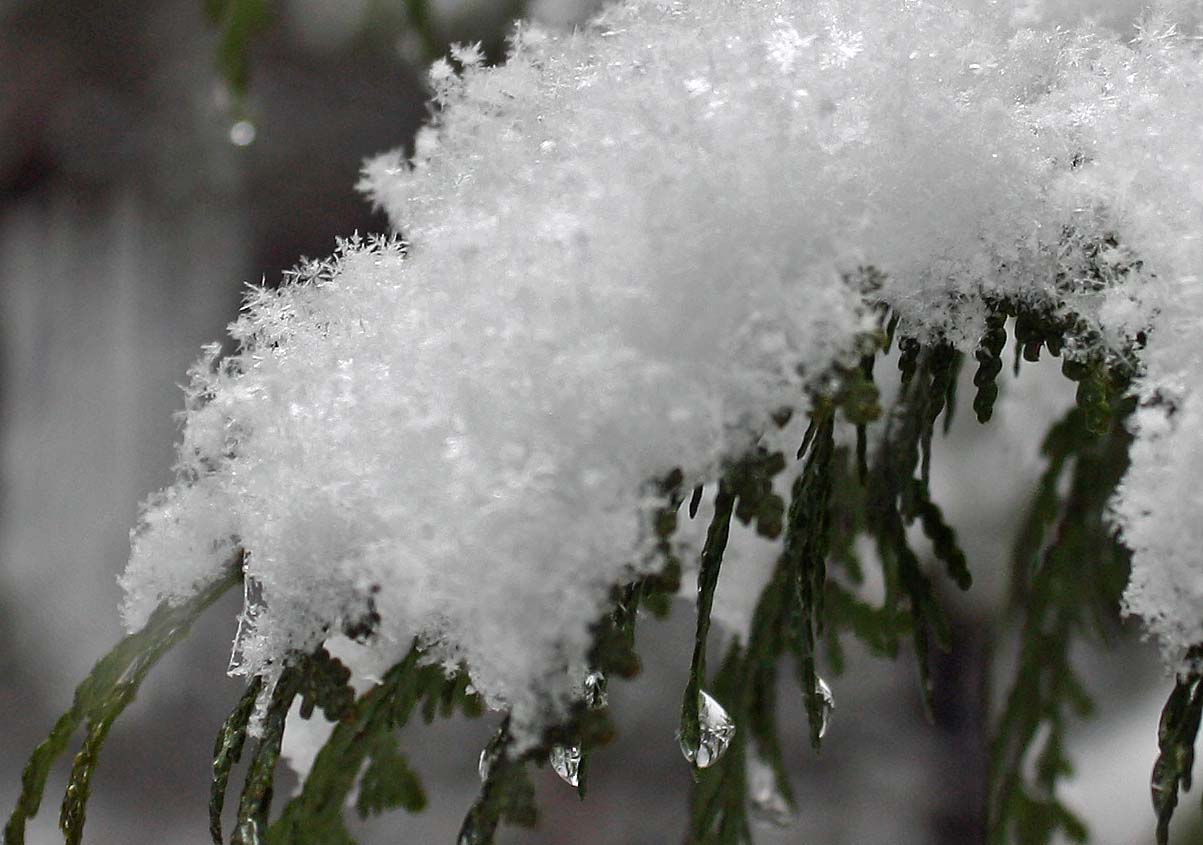
Snow crystals poised on the leaves of a white cedar, ON (photo by Nina Munteanu)
Snow is magic. It reveals as it cloaks. Animals leave their telltale tracks behind their silent sleuthing. No two snowflakes are alike. Yet every non-aggregated snowflake forms a six-fold radial symmetry, based on the hexagonal alignment of water molecules when they form ice. Tiny perfectly shaped ice-flowers drift down like world peace and settle in a gentle carpet of white. Oddly, a snowflake is really clear and colourless. It only looks white because the whole spectrum of light bounces off the crystal facets in diffuse reflection (i.e., at many angles). My son, who skies, extols “champagne powder”—very smooth and dry snow, ideal for gliding on. On powder days, after a fresh snowfall, mountain trees form glabrous Henry Moore-like sculptures. Skiers wind their way between the “snow ghosts,” leaving meandering double-helix tracks behind them.
Pump Peak, north view with snow ghosts, Mount Seymour, BC (photo by Kevin Klassen)
Skier shushing through powder among snow ghosts, Kaslo BC (photo by Kevin Klassen)
Snow ghosts at sunset, BC (photo by Kevin Klassen)
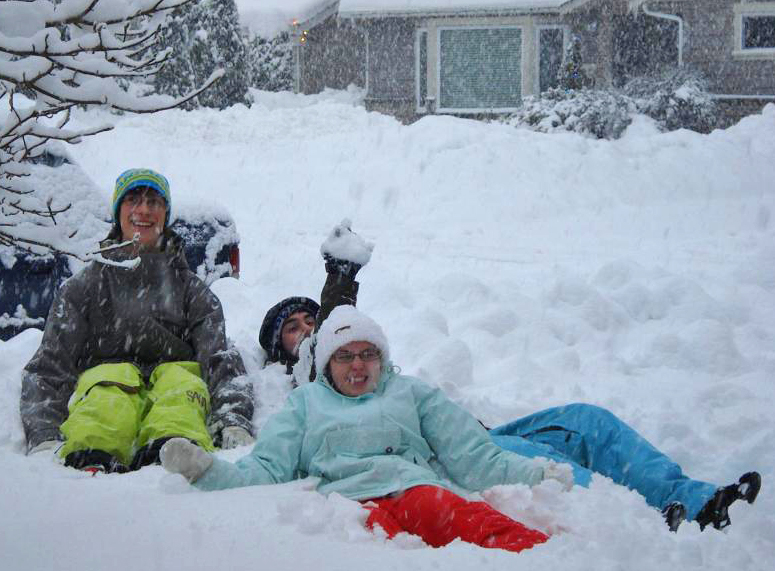
Snow is playful. It beckons you to stick out your tongue and taste the clouds. Snow is like an unruly child. Snow is the trickster. It stirs things up. Makes a mess. It is the herald of change, invigorating, fresh and wondrous. Cars skid in it and squeal with objection. Grumpy drivers honk their horns, impatient to get home; while others sigh in their angry wake. Brown slush flies in a chaotic fit behind a bus and splatters your new coat. Boys and girls of all ages venture outside, mischief glinting in their eyes, and throw snowballs. Great battles are fought in backyards where children build awesome forts and defend them with fierce determination.
The author’s son and friends playing in a snowstorm, BC (photo by Nina Munteanu)
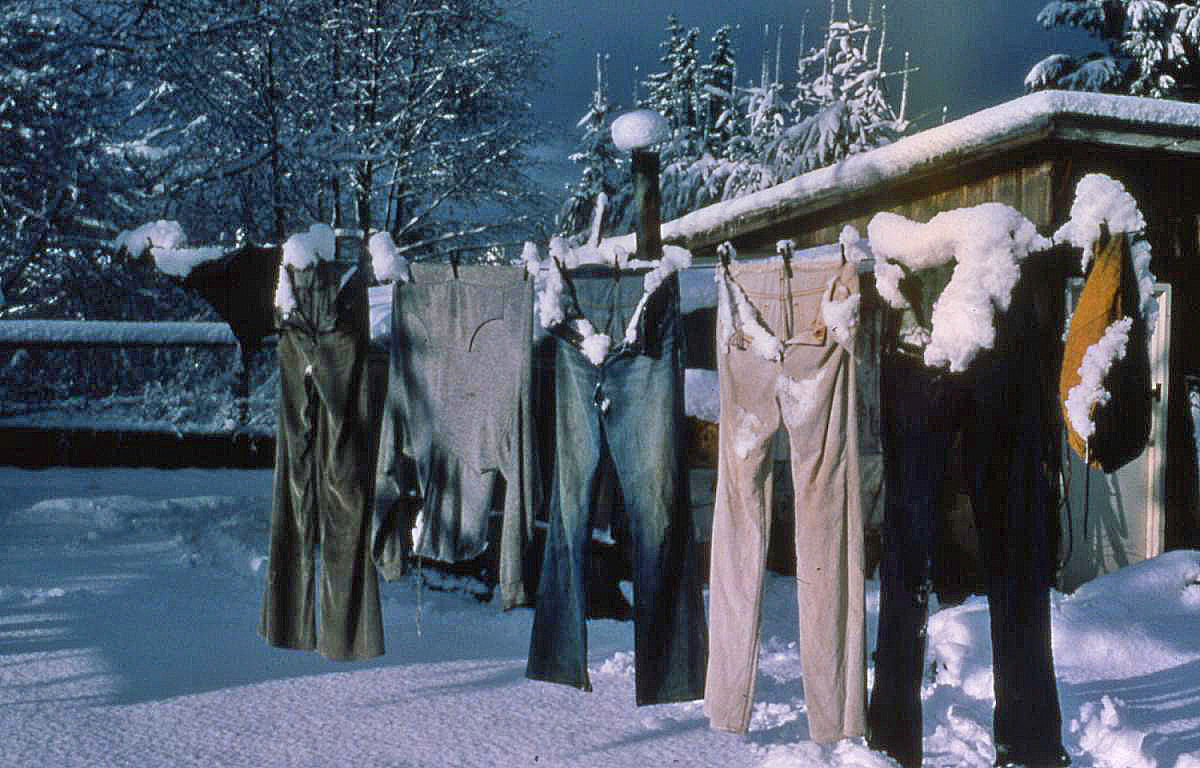
Laundry left out during a snowfall, BC (photo by Nina Munteanu)
In the end, snow—a solid form of water—remains implacable, untouched by our spurious activities. It lies beyond our tedious attempts to salt it, dirty it, move it or make it, turn it into slush, sublimate it or even desublimate it. Snow, like the water it is, cannot be ‘owned’ or kept. Ultimately, it will do its job to energize the earth, give life, then quietly transform, take its leave, and move on. Along with its various water cousins, it will move mountains particle by particle with a subtle hand; it will paint the world with beauty then return to its fold and rejoice; it will transcend time and space to share and teach and transform a world.
Skier exploring a high mountain bowl, Cloudburst Mountain, Squamish, BC (photo by Kevin Klassen)
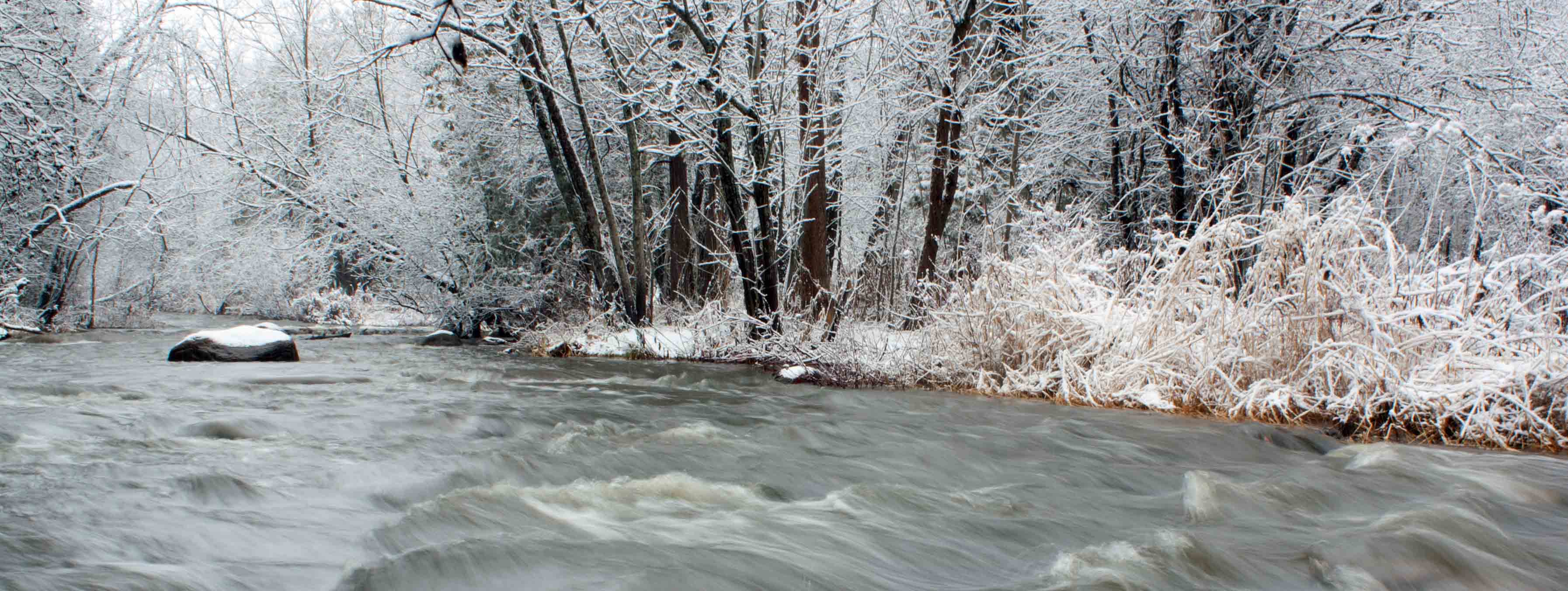
Jackson Creek flows through a forest after a fresh snowfall in early winter, ON (photo by Nina Munteanu)
Nina Munteanu is a Canadian ecologist / limnologist and novelist. She is co-editor of Europa SF and currently teaches writing courses at George Brown College and the University of Toronto. Visit www.ninamunteanu.ca for the latest on her books. Nina’s bilingual “La natura dell’acqua / The Way of Water” was published by Mincione Edizioni in Rome. Her non-fiction book “Water Is…” by Pixl Press(Vancouver) was selected by Margaret Atwood in the New York Times ‘Year in Reading’ and was chosen as the 2017 Summer Read by Water Canada. Her novel “A Diary in the Age of Water” was released by Inanna Publications (Toronto) in June 2020.


































 Nina Munteanu Writing Coach