Beech trees stand with bronzed leaves as the snow falls in the mixed forest of South Drumlin park, ON (photo and rendition by Nina Munteanu)
Yesterday, it started snowing near the end of my work shift, and I kept glancing out the window as it turned into a heavy thick snow, the kind I just adore. Whenever this happens, I long for werifesteria…
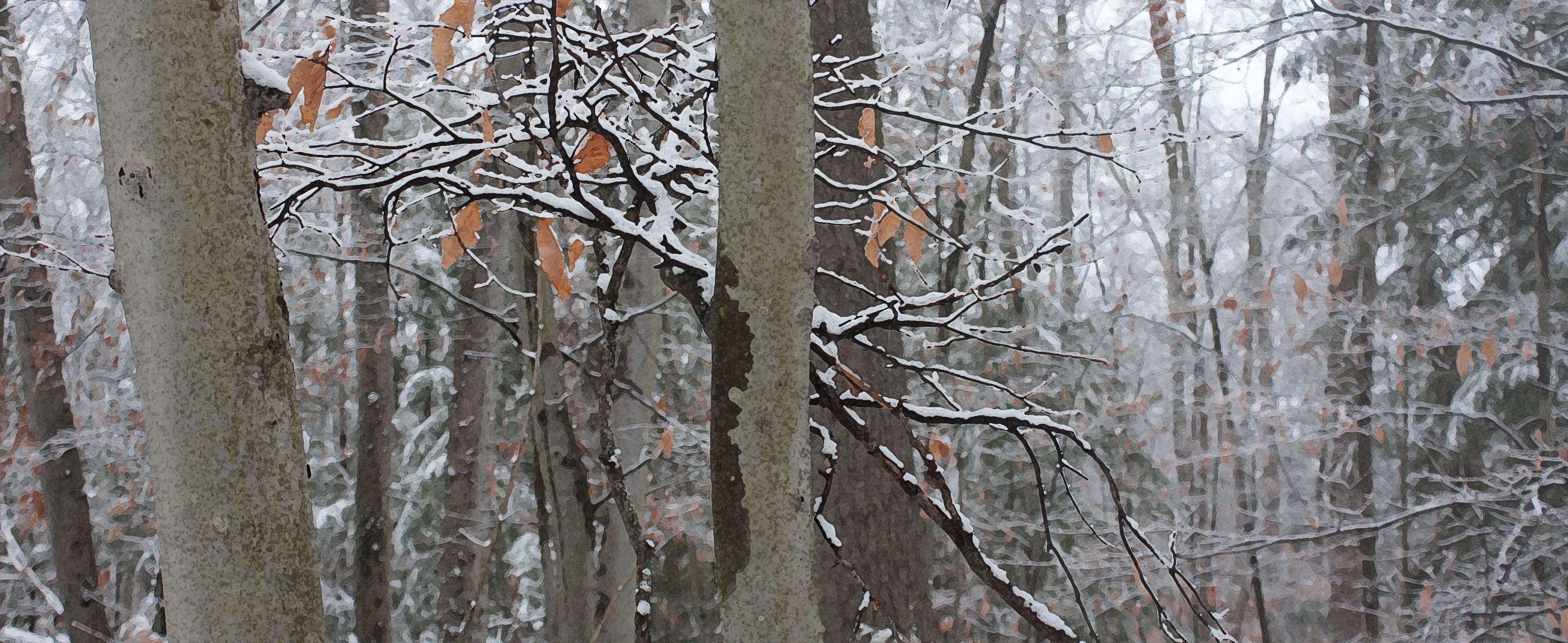
A pair of beech trees stand pale among hemlocks and poplar trees, South Drumlin park, ON (photo and rendition by Nina Munteanu)
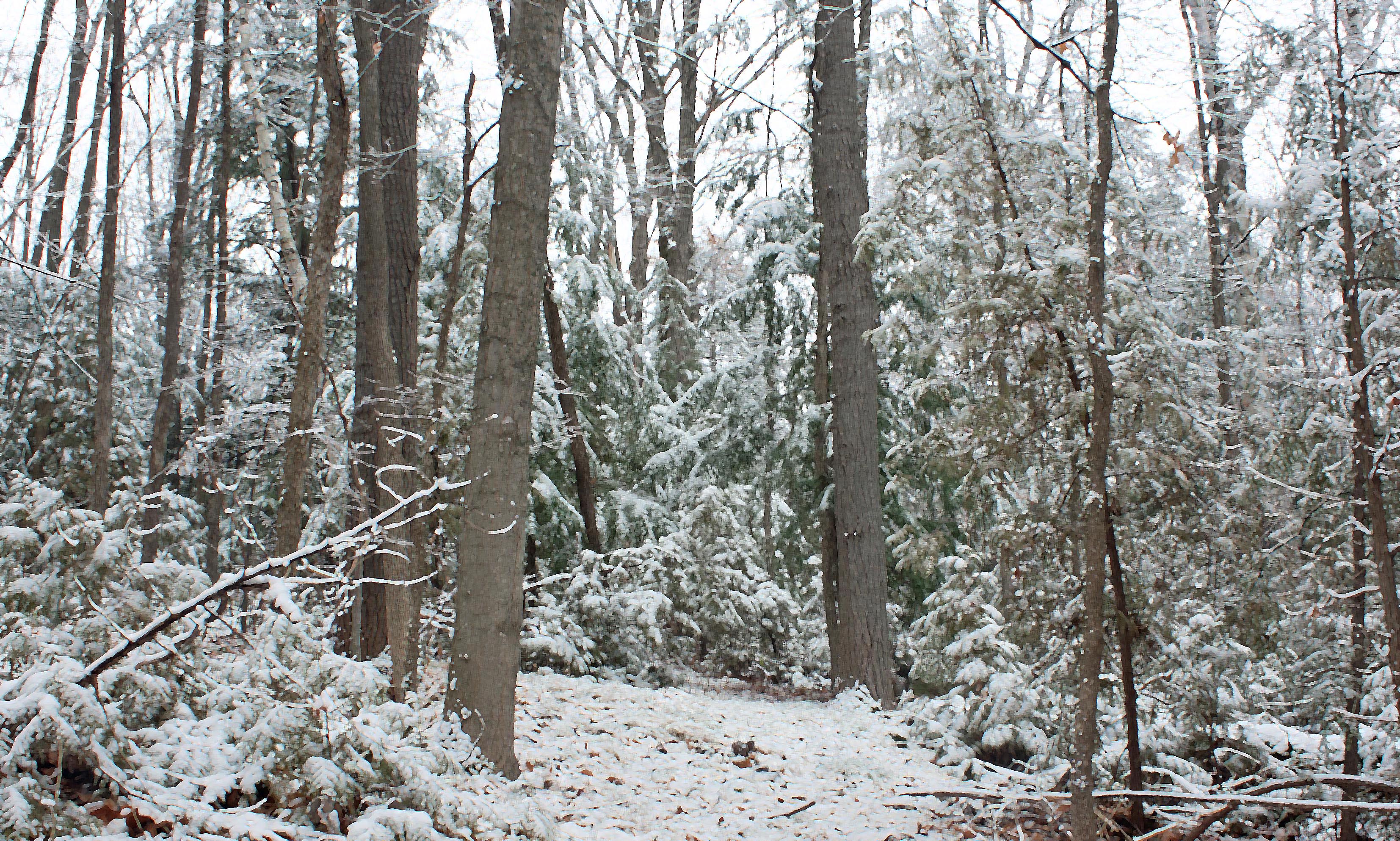
Beech-hemlock forest after a light snow in South Drumlin park, ON (photo and rendition by Nina Munteanu)
As soon as the shift was over, I snatched my gear and rushed off with my camera and tripod and a pack of blueberries to the beech-maple-hemlock forest nearby. The place is called South Drumlin Park, because the forest runs up and down a hogsback with wonderful trails throughout.
Marcescent beech trees greet me along a trail in South Drumlin park, ON (photo and rendition by Nina Munteanu)
I was the only person there. I walked and crunched through snow and frost-hardened leaf litter and I let myself get lost in the labyrinth of trails through the open winter forest. The pale beech trees, because they keep their now copper-coloured marcescent leaves, stood out amid the bare maples, oaks, poplars and birch trees.
Pale bronze beech leaves light up the dark hemlock forest, South Drumlin park (photo and rendition by Nina Munteanu)
I wandered there for hours, inhaling the peaceful freshness and the quiet hush of gentle snowing in the forest.
There were just a few rowdy red squirrels and one persistent bluejay, but all else lay quiet in the deep of the forest. I had found my magic and mystery … It felt sublime and my heart sang…
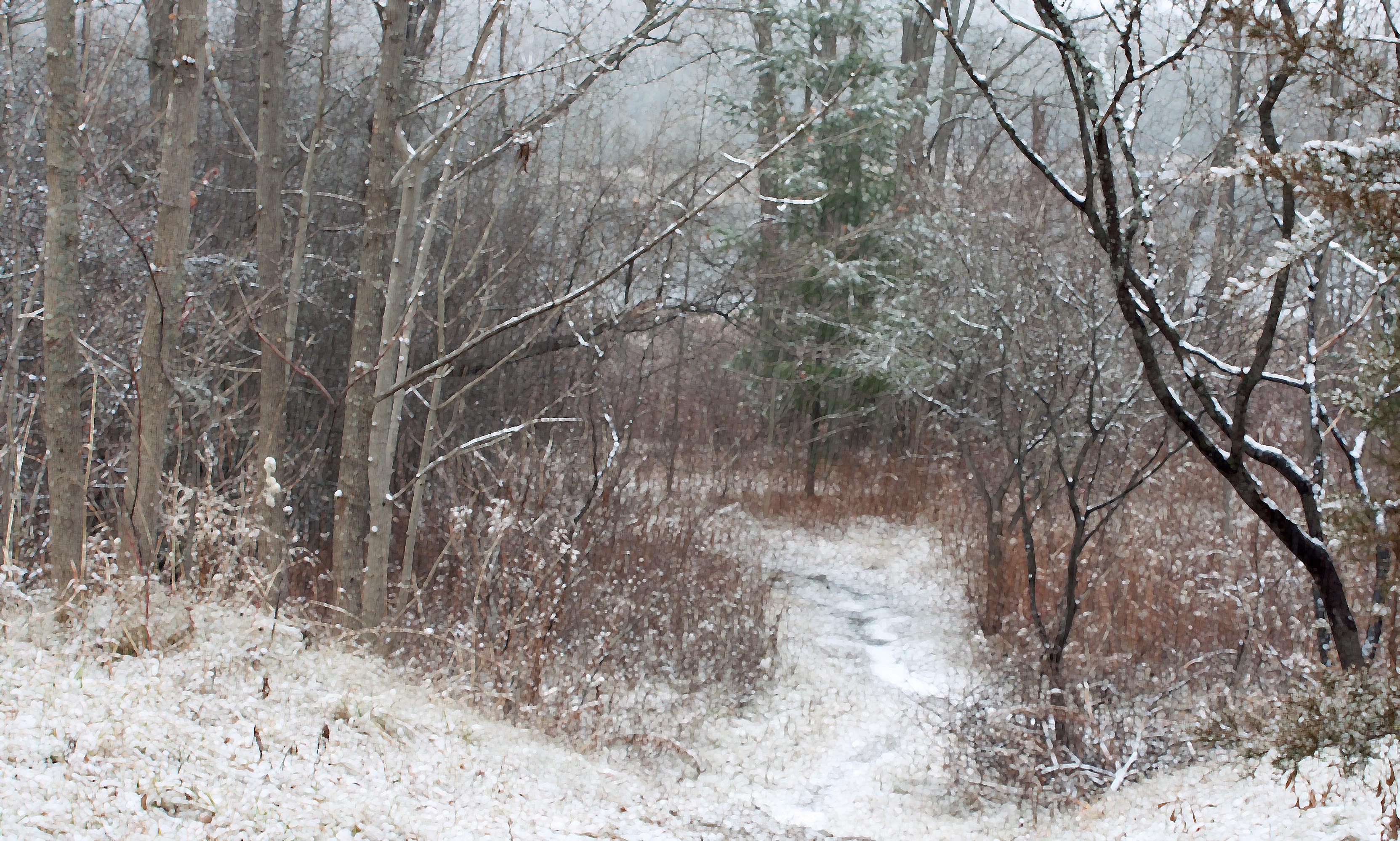
Trail through poplars, cedars and hemlocks toward the river, South Drumlin park, ON (photo and rendition by Nina Munteanu)
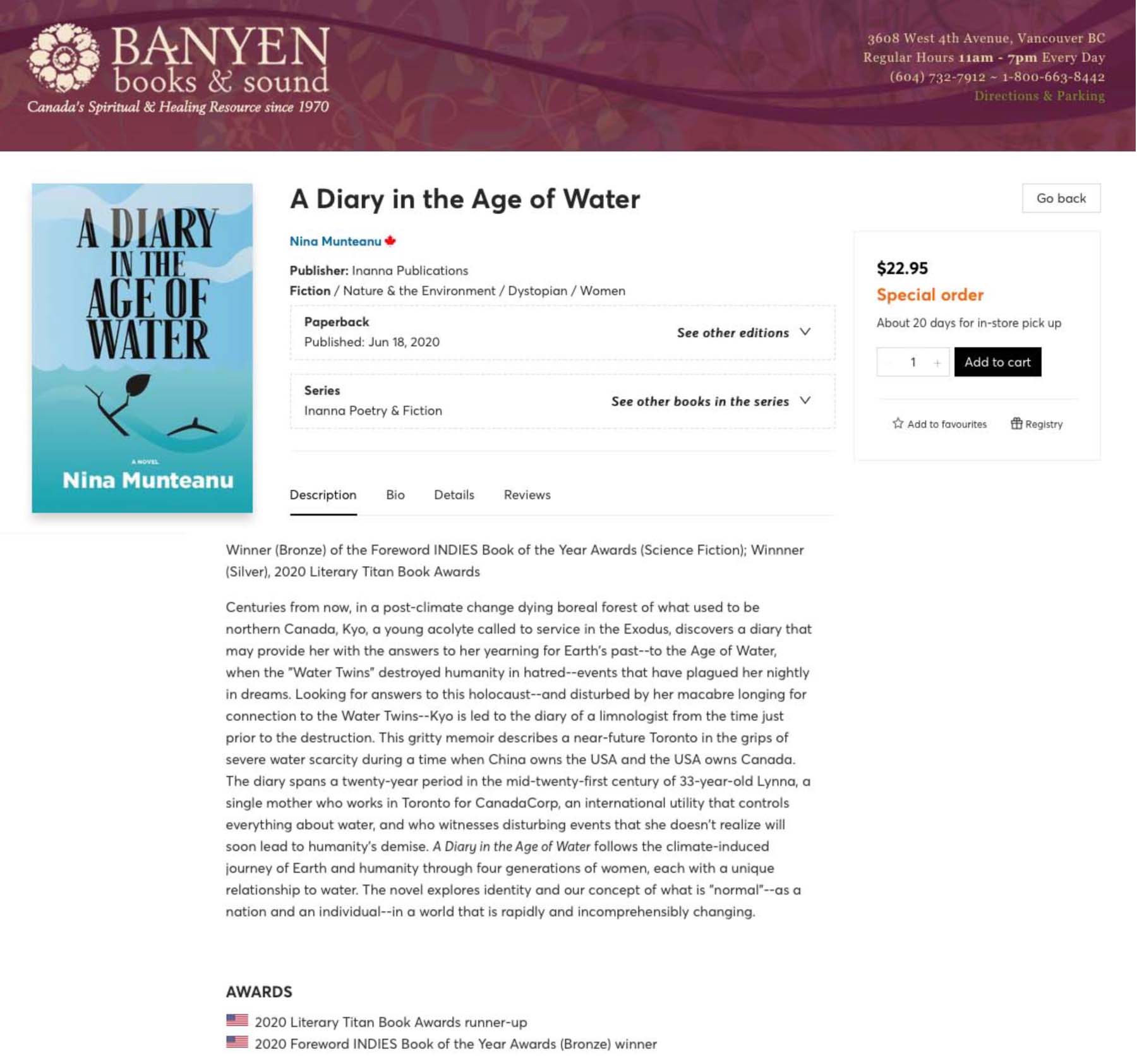
Nina Munteanu is a Canadian ecologist / limnologist and novelist. She is co-editor of Europa SF and currently teaches writing courses at George Brown College and the University of Toronto. Visit www.ninamunteanu.ca for the latest on her books. Nina’s bilingual “La natura dell’acqua / The Way of Water” was published by Mincione Edizioni in Rome. Her non-fiction book “Water Is…” by Pixl Press (Vancouver) was selected by Margaret Atwood in the New York Times ‘Year in Reading’ and was chosen as the 2017 Summer Read by Water Canada. Her novel “A Diary in the Age of Water” was released by Inanna Publications (Toronto) in June 2020.
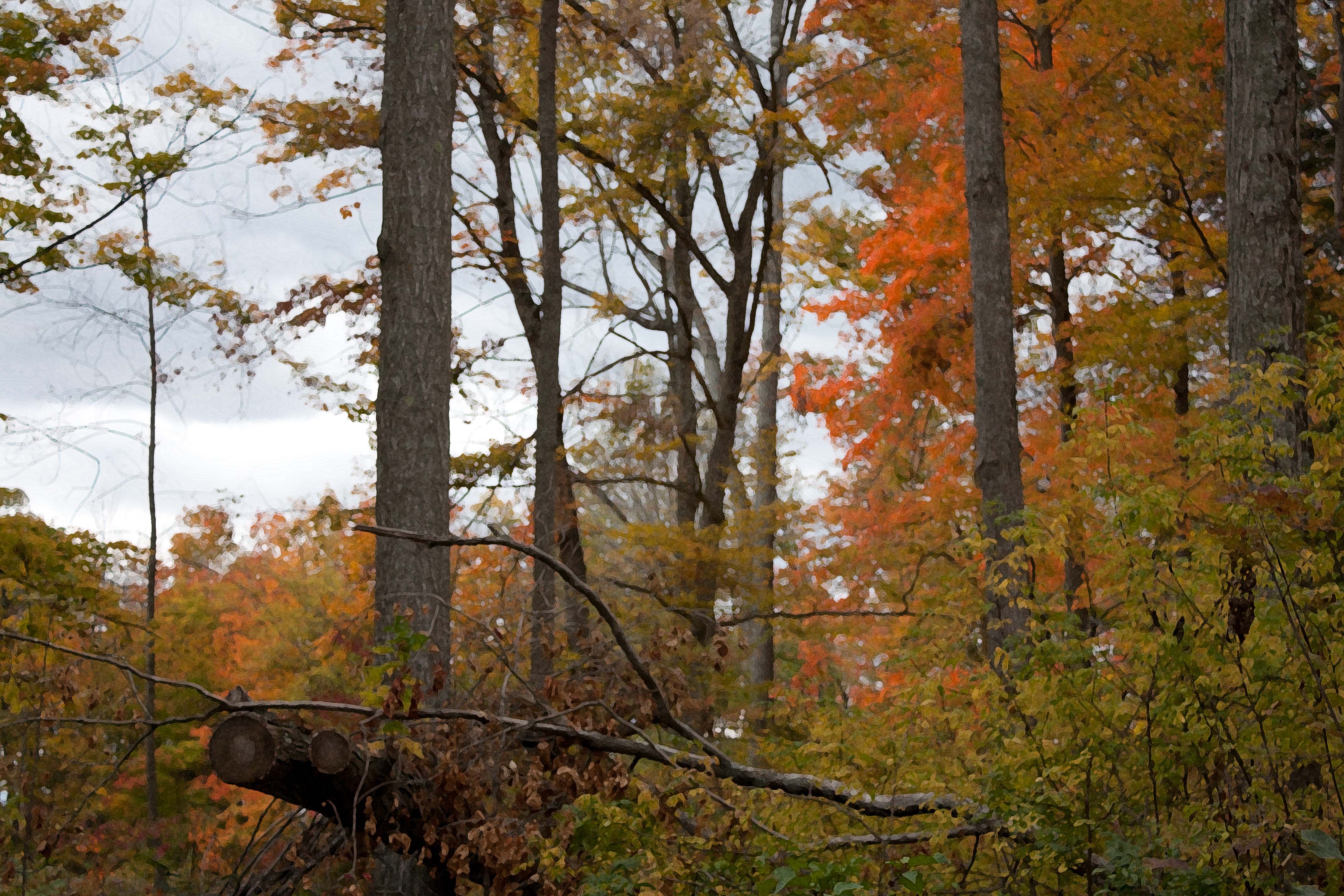
Fall colours of maple trees in the Mark S. Burnham Park, ON (photo and rendition by Nina Munteanu)
For the past few days, I’ve been wandering, entranced, in the various forests, swamps and marshes of the Kawarthas. I found myself inspired by the autumnal light and organic scent in the air.
They pulled me into the verge…
Poplar trees in the fall, ON (photo and rendition by Nina Munteanu)
It’s the time of “the verge,” when the seasons collide in the wake of the equinox and anticipate the unruly winds of change. A moment of stillness before the Earth shifts, relinquishes, and embraces.
In the hush of a great threshold, Nature holds its breath and a leaf settles in the arms of a cedar root…
Largetooth aspen sits on a cedar root in the pine forest of Warsaw Cave Park, ON (photo by Nina Munteanu)
Ancient pine, cedar and hemlocks in Jackson Creek forest, ON (photo and rendition by Nina Munteanu)
There I was, eyes and ears–all senses–wide, taking in Nature’s gifts of the verge. The rustling leaves in a cool wind. The musky smell of swamp water and the sweet rot of vegetation. The lazy gurgle of shallow creeks around smooth rocks. The halting shrill of a Blue Jay.
Jackson Creek in October, ON (photo and rendition by Nina Munteanu)
On one walk, a giant toad—the biggest I’d ever seen!—waddled across my path. I think it was an American toad, mottled and rough with warts. He looked rather grumpy and took his time, somehow confident—or not caring—that I could step on him and squish him easily. He was rather jiggly as he lumbered on. I did not take his picture; I don’t think he wanted me to, so I didn’t.
Fallen hemlock tree in Mark S. Burnham Park, ON (photo and rendition by Nina Munteanu)
Soon after, a small garter snake slithered across my path, less confident of my steps. It froze once it was safely out of my way. Good snake…
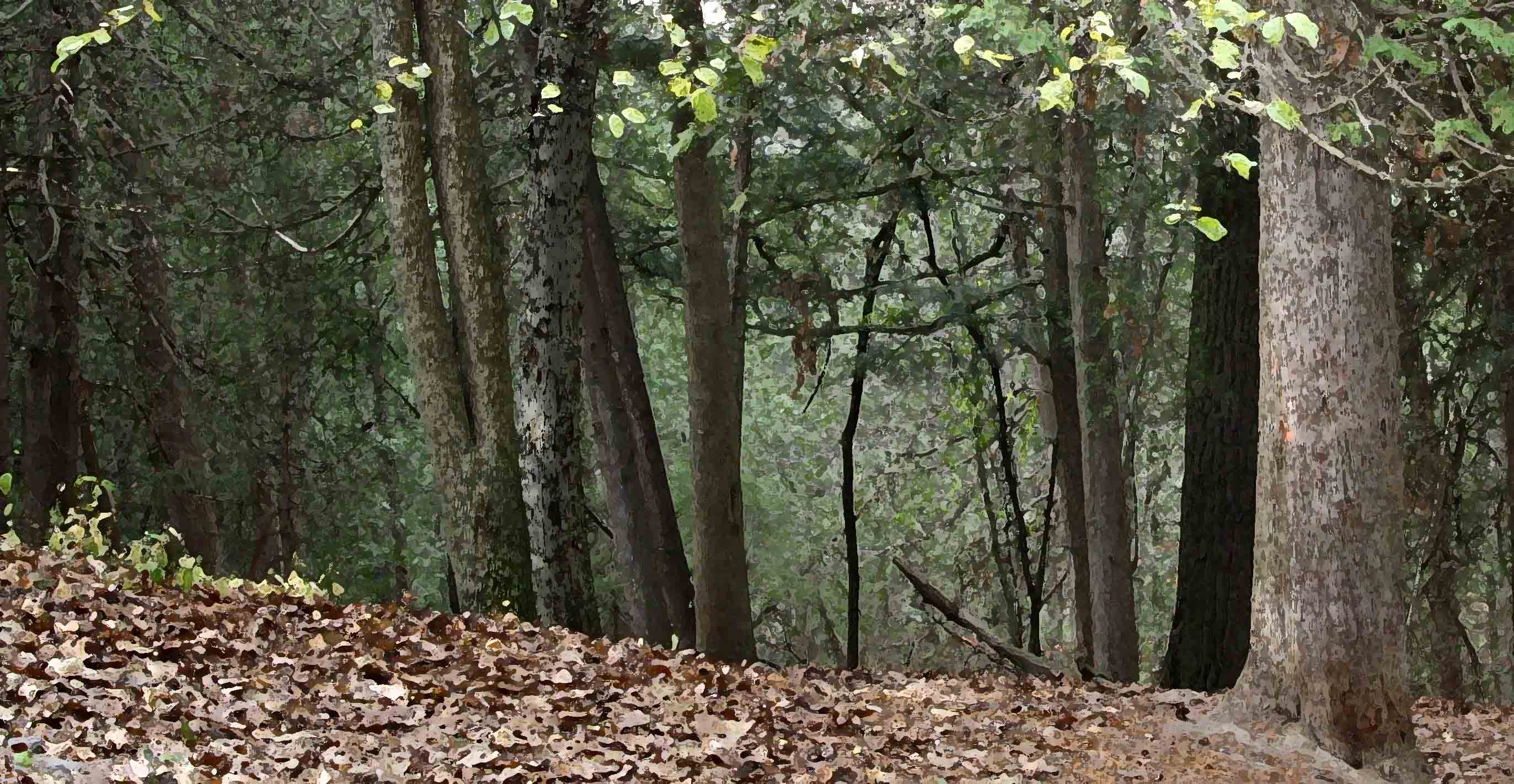
The forest was alive with the domestic chaos of wildlife busy with itself. Chipmunks chugged and squirrels scolded from the tree tops. Surely not at me! I climbed out of the lowland of old-growth hemlock-beech swamp forest to the top of a drumlin of maple-hop hornbeam-ash forest and then descended again into the dark hemlocks and pines.
Maple tree showing deep colour in the fall, ON (photo and rendition by Nina Munteanu)
Red and sugar maples and aspens flame in the fall by the Otonabee River near Trent University, ON (photo and rendition by Nina Munteanu)
The colours of sugar and red maple blazed in the canopy above, frothy clouds of bright orange, red, yellow and everything in-between under a deep blue sky. I wandered, camera in hand, and found treasures everywhere—from blue fungi to tiny bright red maple leaves freshly fallen.
Various mushrooms in the forests of Ontario (photos by Nina Munteanu)
I have a silly habit of picking up leaves and pressing them when I get home; my books are repositories of colourful prizes from years past.
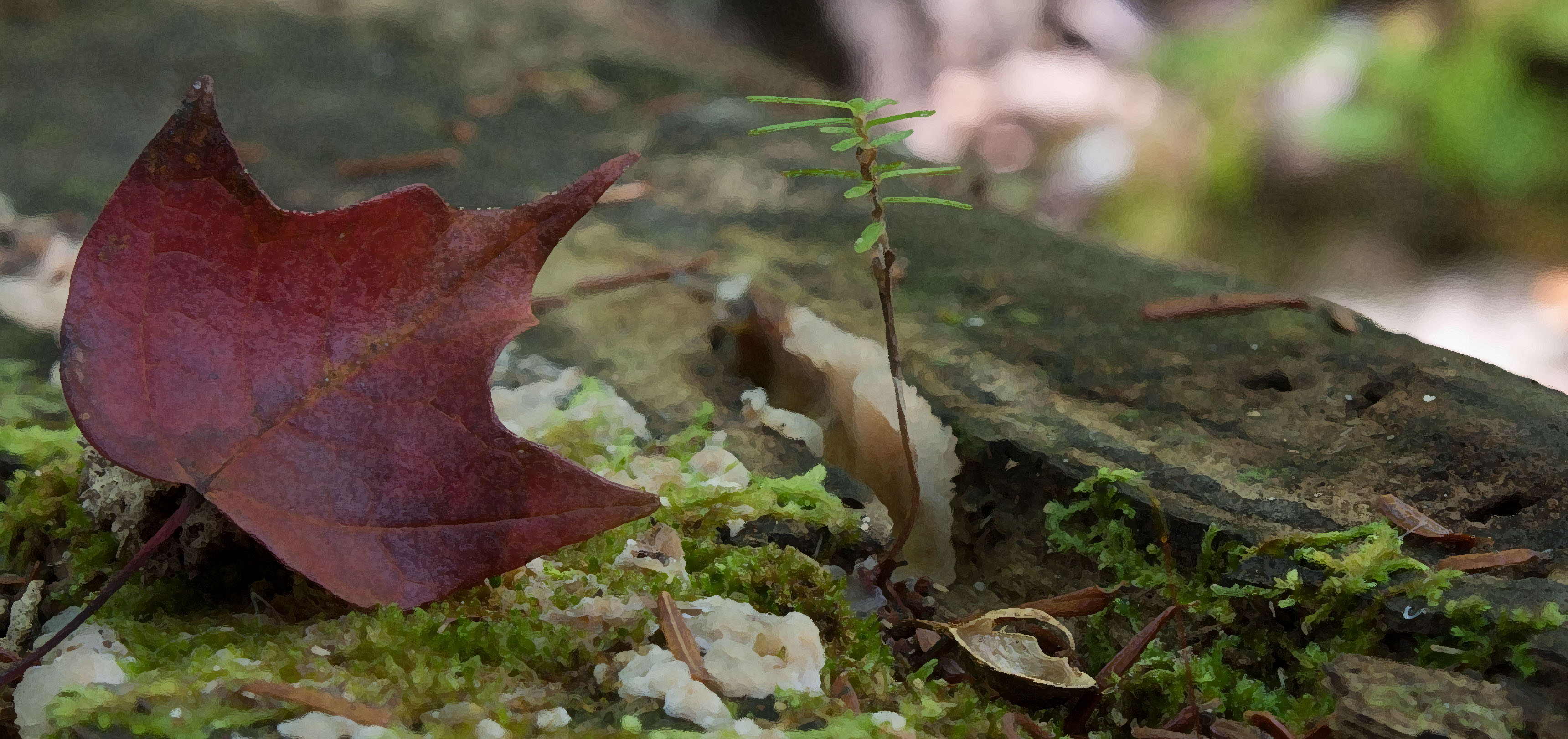
Small red maple leaf sits beside a hemlock sapling amid white fungi and moss on a nurse log in Mark S. Burnham forest, ON (photo and rendition by Nina Munteanu)
Marsh in Ontario in the fall (photo and rendition by Nina Munteanu)
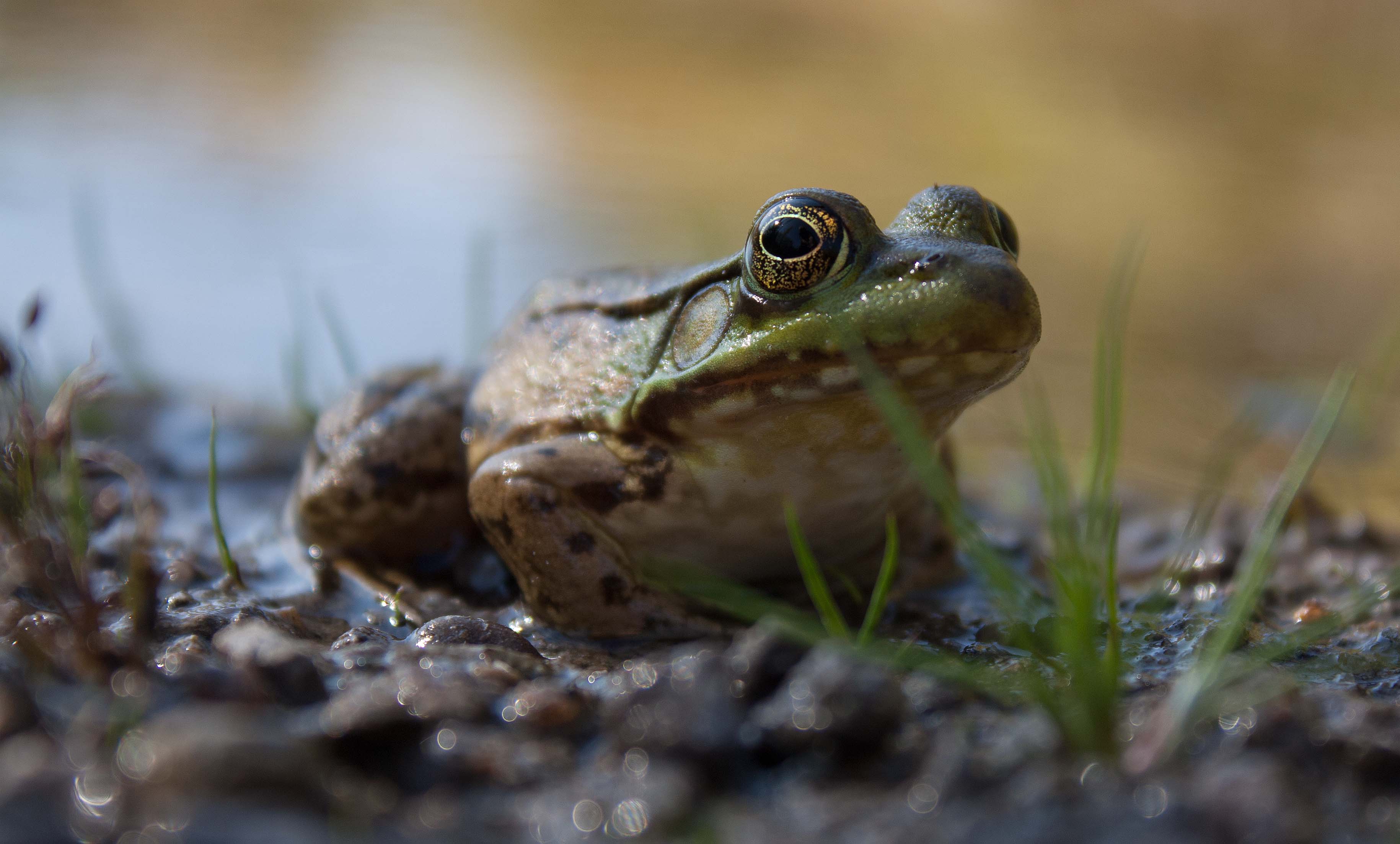
In the marsh, I encountered a green frog, sitting in the mud. It decided to pose for my camera. And I obligingly took its picture. My new best friend.
No, I did not take him home. I left him there, lollying in the mud, looking very content.
Green frog poses for the author’s camera
For all I know he’s still there, presiding over the autumn verge…
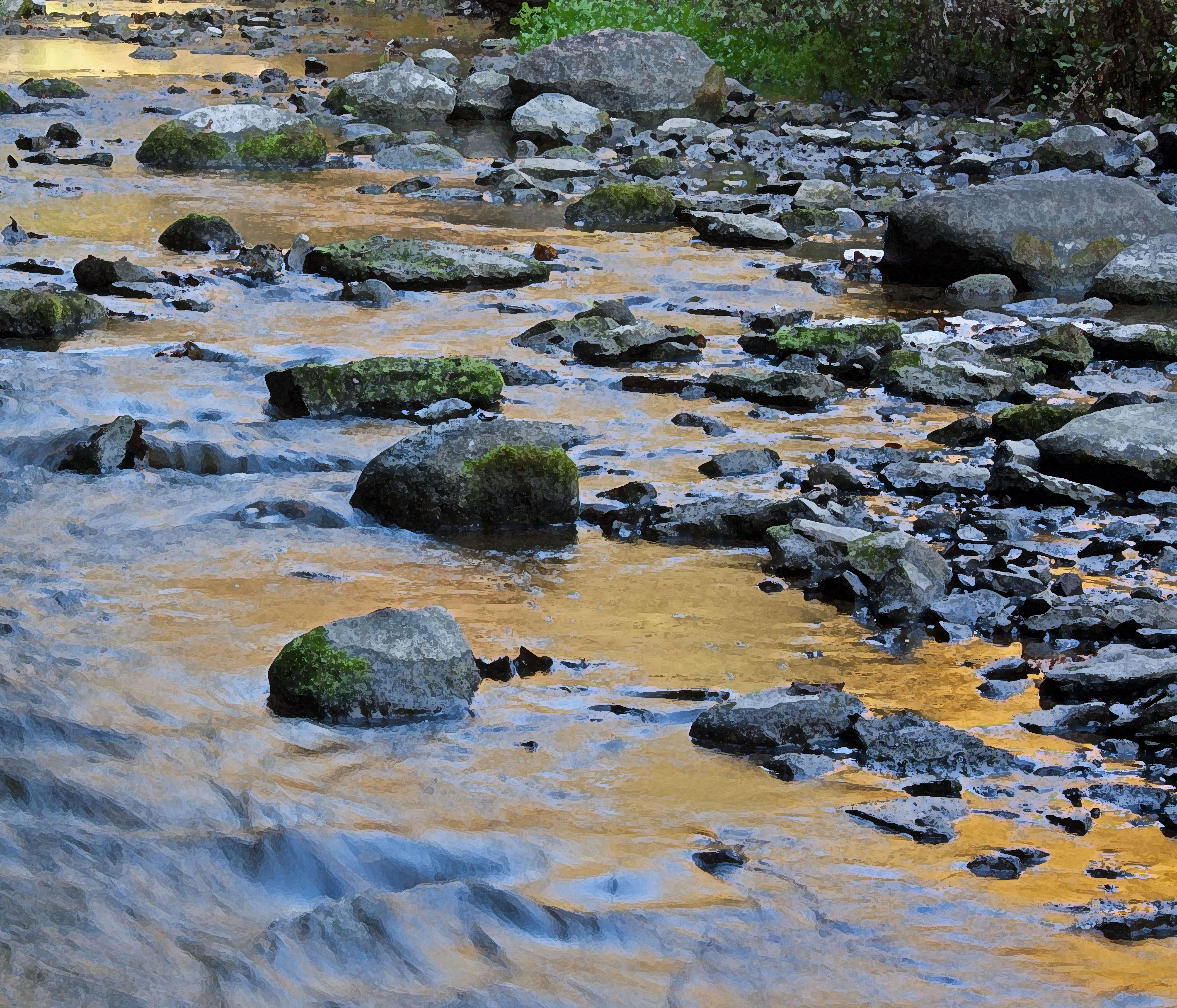
Jackson Creek reflects the gold hue of largetooth aspen in October, ON (photo by Nina Munteanu)
Nina Munteanu is a Canadian ecologist / limnologist and novelist. She is co-editor of Europa SF and currently teaches writing courses at George Brown College and the University of Toronto. Visit www.ninamunteanu.ca for the latest on her books. Nina’s bilingual “La natura dell’acqua / The Way of Water” was published by Mincione Edizioni in Rome. Her non-fiction book “Water Is…” by Pixl Press (Vancouver) was selected by Margaret Atwood in the New York Times ‘Year in Reading’ and was chosen as the 2017 Summer Read by Water Canada. Her novel “A Diary in the Age of Water” was released by Inanna Publications (Toronto) in June 2020.
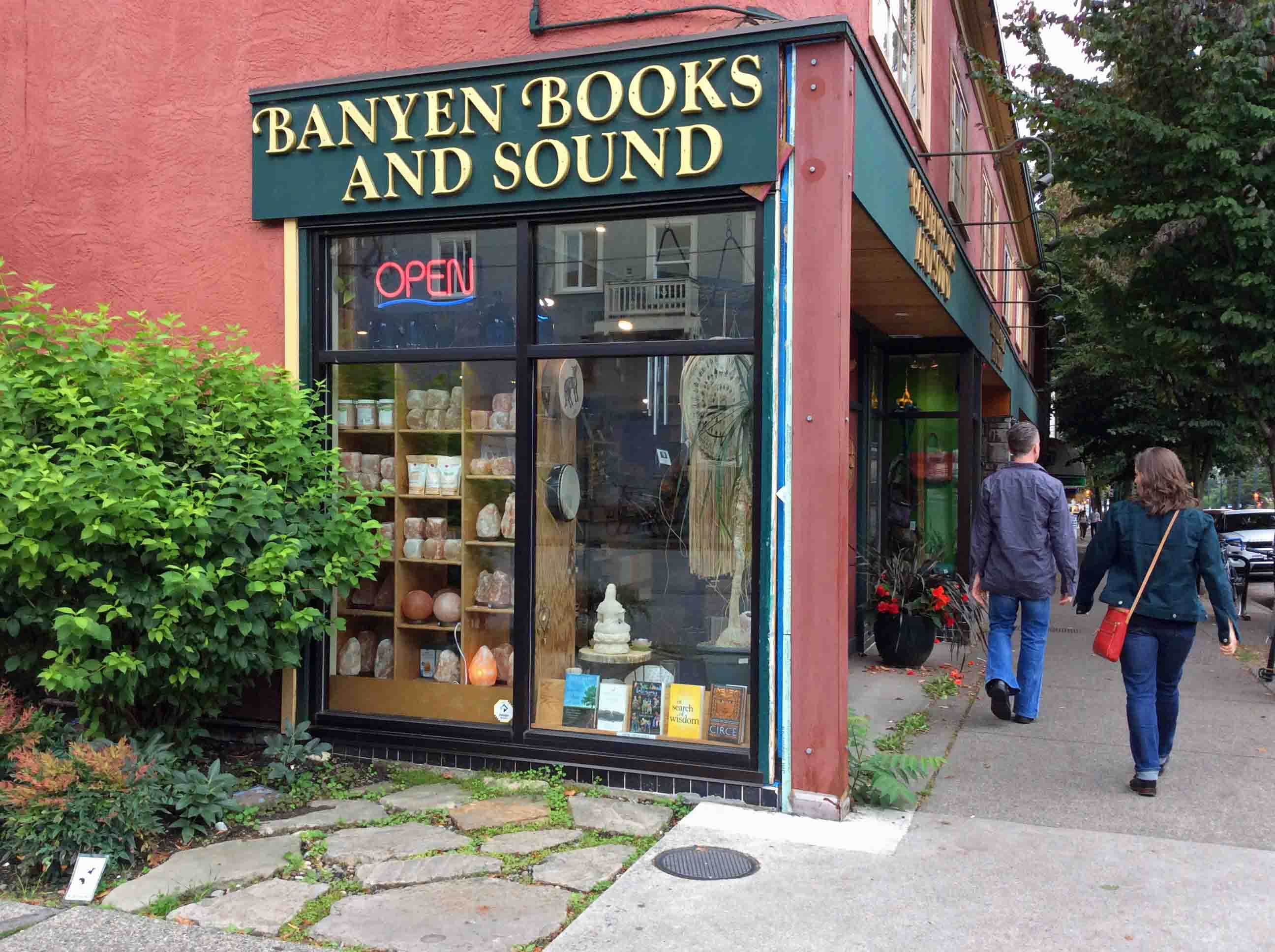
Banyen Books & Sound on corner of Dunbar and W 4th Avenue, Vancouver (photo by Nina Munteanu)
One of my favourite bookstores in Vancouver is Banyen Books & Sound on the southwest corner of W 4th Avenue and Dunbar. So, whenever I go back to my home town to visit family and friends, I stop there to linger amid the shelves of wonder and erudite adventure. Then I usually cross Dunbar to Aphrodite’s Organic Pie Shop for a delicious fresh pie—usually peach, if it is available. So good! Two things I love: books and pie!
Aphrodite’s Organic Pies, next door to Banyen’s, Vancouver (photos by Nina Munteanu)
Pacific Spirit Regional Park, Vancouver, BC (photo by Nina Munteanu)
During my recent visit this year to Vancouver, my friends and I had a fulfilling walk one morning through the big tree forest of Pacific Spirit Park near UBC. Margaret suggested we go to Aphrodite’s Organic Café for lunch, located across 4th Avenue from Banyen Books (the sister restaurant to the pie shop). After a delicious lunch, we wandered into Banyen, like desert nomads looking for water, and lost ourselves in a treasure of books, magazines, crystals, cards, singing bowls and other spiritual/healing items. Like a braided river, we dispersed according to our wayward interests.
Water Is… at Banyen Books, Vancouver (photos by Nina Munteanu)
Then friend Anne soon found me and pulled my sleeve. “Your book is here!” She led me to where my book Water Is… stood, face out, on the top shelf marked ‘Water: Life Force & Resource.’ In truth, I already knew through Pixl Press that the book was selling there. But here it was, showcased so nicely! It sat rather stately amid Emoto’s Secret Life of Water and Ryrie’s Healing Energies of Water.
Banyen customers find Water Is… and find a chair to take a look
One of the perks of Banyen Books are the comfortable seats for easy browsing. When I teasingly asked one of the clerks if they noticed people lingering for the day, they said, “yeah! They might leave for lunch then come back for the afternoon!” I can see why; Banyen is an entire world to discover. It is called Canada’s most comprehensive Body-Mind-Spirit bookstore, “offering a broad spectrum of resources from humanity’s spiritual, healing, and earth wisdom traditions…Our service is to offer life-giving nourishment for the body (resilient, vital), the mind (trained, open), and the soul (resonant, connected, in-formed). Think of us as your open source bookstore for the ‘University of Life’.”
“Banyen is an oasis, a crossroads, a meeting place…for East and West, the ‘old ways’ and current discoveries and syntheses.”
“The Golden Lotus Restaurant and Natural Food Store on Fourth Avenue at Bayswater was a hothouse for spiritual seekers, new vegetarians and spaced-out hippies grounding through good work. Banyen was born in a tiny book corner of the Golden Lotus. That lovely place was a connection to India, meditation and spiritual growth from 1967 to 1970. As its sun set, what was to become the Naam restaurant, Lifestream, Woodlands, Nature’s Path, and Banyen Books arose.”
Nina Munteanu is a Canadian ecologist / limnologist and novelist. She is co-editor of Europa SF and currently teaches writing courses at George Brown College and the University of Toronto. Visit www.ninamunteanu.ca for the latest on her books. Nina’s bilingual “La natura dell’acqua / The Way of Water” was published by Mincione Edizioni in Rome. Her non-fiction book “Water Is…” by Pixl Press (Vancouver) was selected by Margaret Atwood in the New York Times ‘Year in Reading’ and was chosen as the 2017 Summer Read by Water Canada. Her novel “A Diary in the Age of Water” was released by Inanna Publications (Toronto) in June 2020.
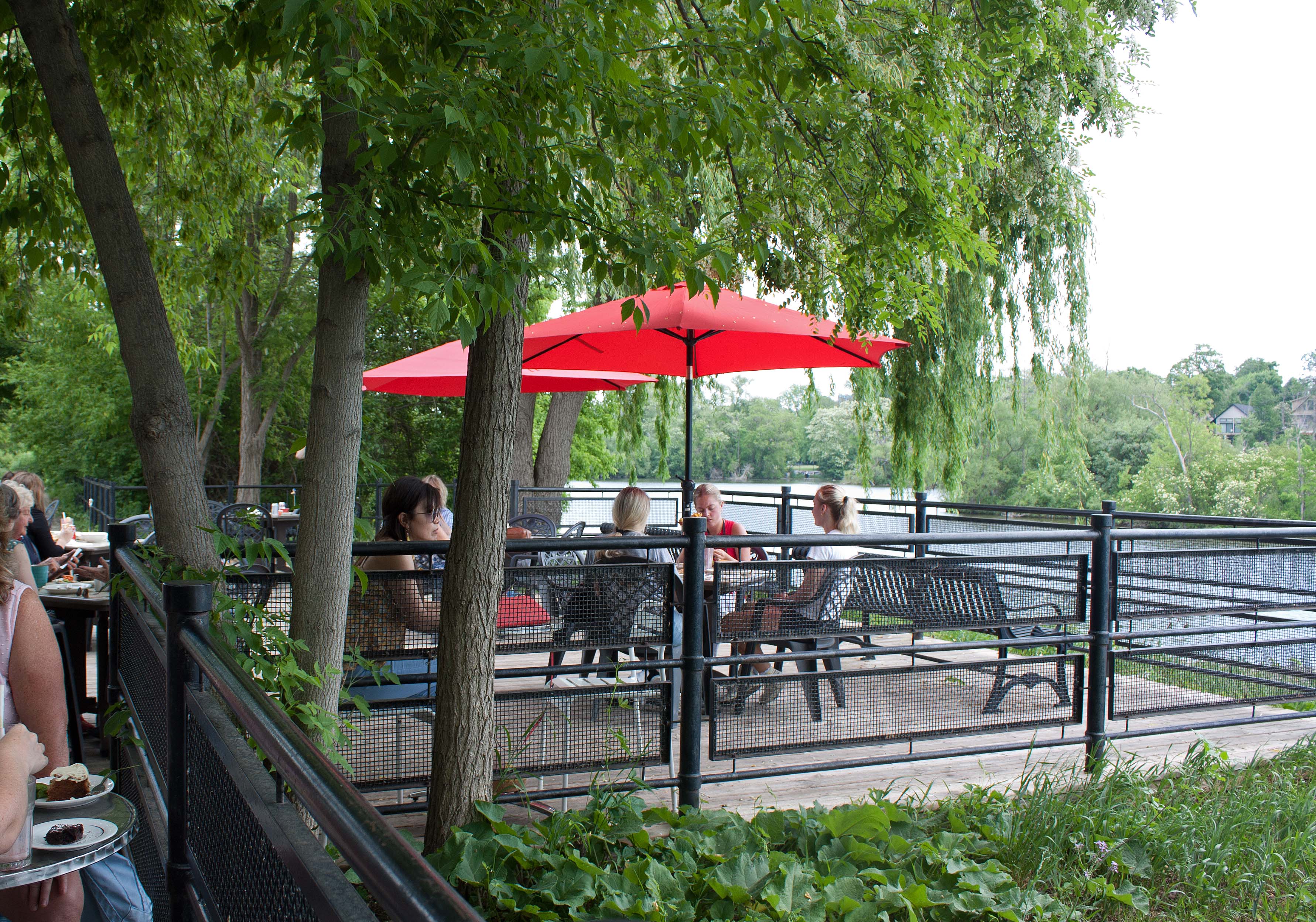
Cafe patio facing Otonabee River (photo by Nina Munteanu)
.
I’m a bit of a wanderer, an itinerant. A hobo, even. I house sat and pet sat for a decade. I travel light; I carry what I own in my Jetta. One of the things I look for when I first settle somewhere is a choice café and a place where I can walk—preferably in a forest by a river. The small unpretentious town of Peterborough, north of Toronto and entry way to the Kawarthas, has both. The Otonabee River flows through Peterborough, much of it protected by riparian woodland and marsh (it is Peterborough’s source of drinking water, after all). The place where I currently live allows me to walk daily—rain or shine or snow—through riparian forest along the Otonabee River.
And then there’s the café part…
.
Silver Bean Cafe and boat wharf on the Otonabee River in Millennium Park, ON (photo by Nina Munteanu)
Cafe entrance to King Street and ice cream booth (photo by Nina Munteanu)
.
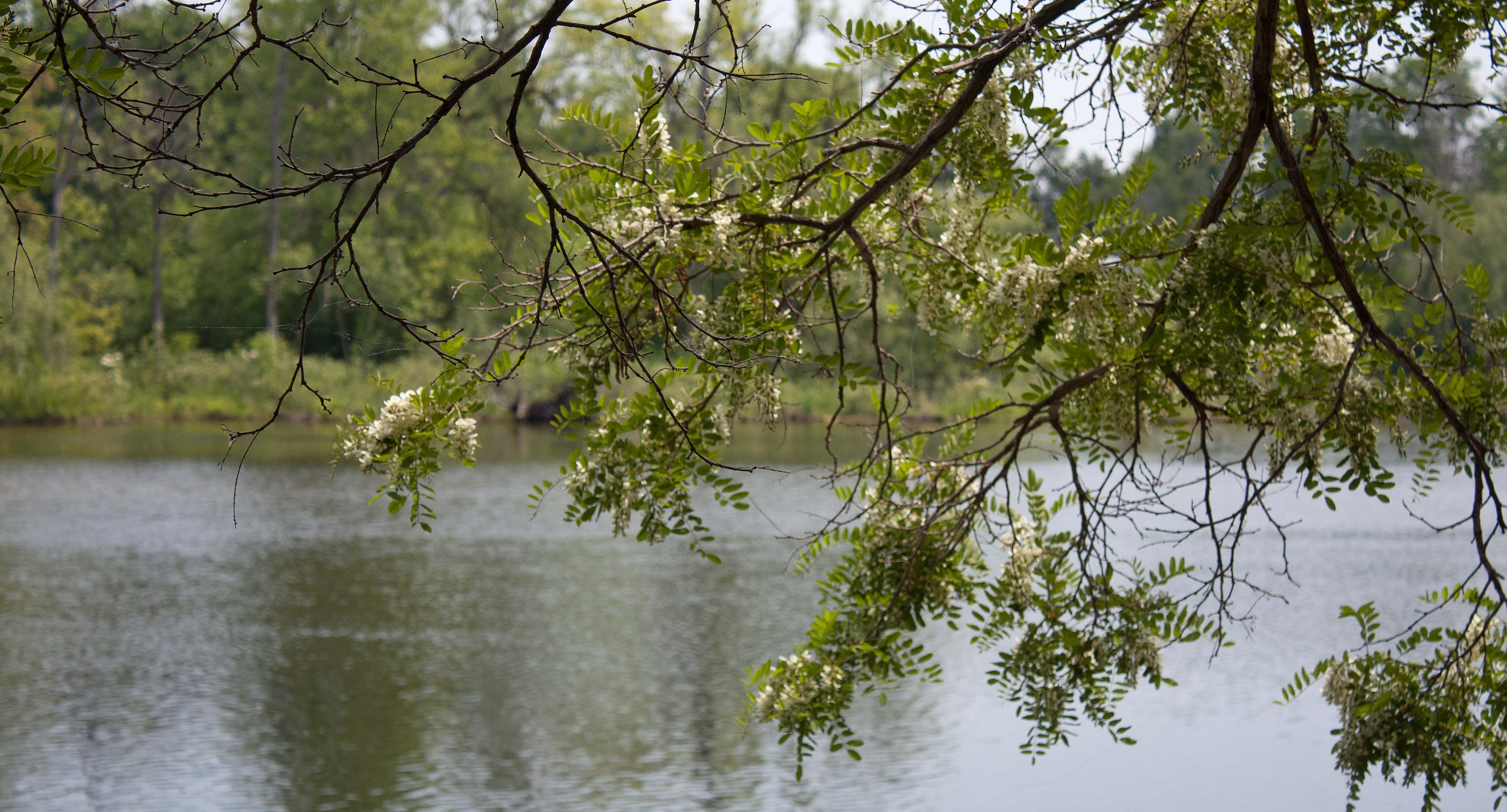
The Silver Bean Café fills that requirement wonderfully. It’s a café situated at a dead end of King Street within a linear riparian park (Millennium Park) on the banks of the river with a large side-park patio under a canopy of willows, black locust, and Manitoba maples. They know what they are too: they call themselves “your waterfront cottage in the city.” When I sit on the patio, enjoying my lunch under the dappled shade of a flowering black locust tree with a view of the river, I hear only birds and the desultory chatter of fellow patrons. And yet, the city is right there, next to this riparian park.
.
Stairs up to Silver Bean Cafe patio from boat wharf, beneath canopy of flowering black locust trees (photo by Nina Munteanu)
Riverside patio overlooking Otonabee River, ON (photo by Nina Munteanu)
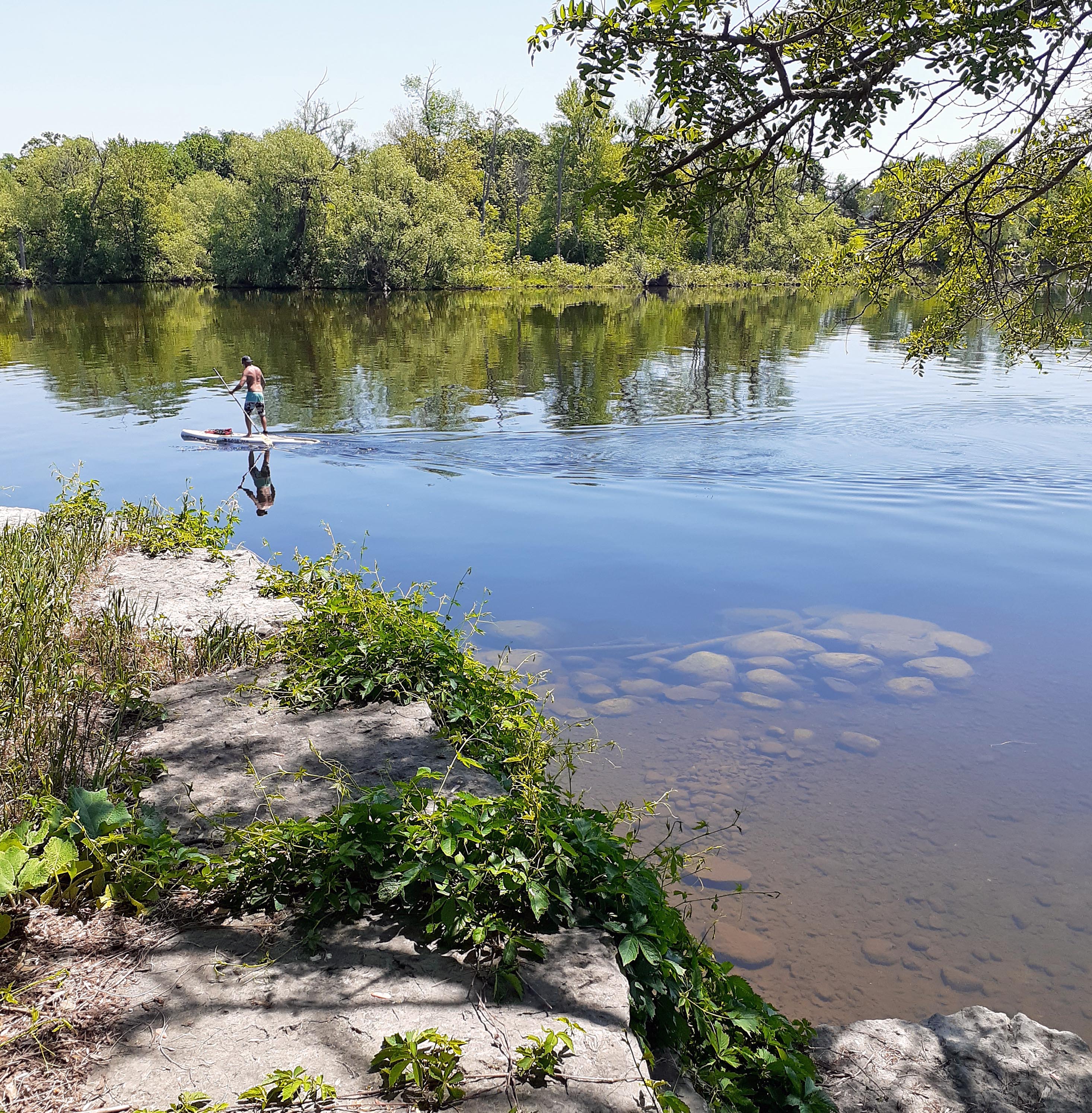
River boarder paddles by on Otonabee River, ON (photo by Nina Munteanu)
.
As I sit, eating my lunch and breathing in the ambrosia fragrance of black locust blooms, a young man paddles his canoe past the café. Soon after, a family of geese, adults flanking seven goslings, paddle leisurely by. Gulls cry out and gather on one of the small islands as a freight train lumbers over the old rail/footbridge downstream. A robin hops close to my table, looking for crumbs and I clumsily drop a seed from my multi-grain sandwich… Oops! Darn, I wanted that…
.
Family of geese paddle by cafe on the Otonabee River (photo by Nina Munteanu)
.
2023 is the Silver Bean’s 20th season, their website tells me. They opened in 2003 as a community café, serving light lunches with speciality sandwiches and salads, breakfasts, freshly baked scones, desserts and, of course, locally roasted coffee and espresso drinks. Oh! And their nook by the street-side serves at least thirty different flavours of my favourite Kawartha ice cream!
.
View of Silver Bean Cafe patio and boat rental wharf from park walk, ON (photo by Nina Munteanu)
.
One day, I was sitting on a stone step by the river on the park walkway, eating my peanut butter chocolate ice cream cone and watching a mother mallard and her chicks in the water. A well-dressed lady sat nearby with a take out coffee. Slipping off her shoes in the sun, she shared that she worked in the government building nearby and came here daily for her fix of sanity. I nodded sympathetically then smiled to myself. I felt the guilty pleasure of not being on ‘the clock.’ She left soon after. I stretched my legs in the sun, found my muse, and daydreamed about the next book I was going to write…
.
Black locust with fragrant flowers in spring, overlooking the Otonabee River, ON (photo by Nina Munteanu)
.
Nina Munteanu is an ecologist and internationally published author of award-nominated speculative novels, short stories and non-fiction. She is co-editor of Europa SF and currently teaches writing courses at George Brown College and the University of Toronto. Visit www.ninamunteanu.ca for the latest on her books. Nina’s recent book is the bilingual “La natura dell’acqua / The Way of Water” (Mincione Edizioni, Rome). Her latest “Water Is…” is currently an Amazon Bestseller and NY Times ‘year in reading’ choice of Margaret Atwood.
“There simply aren’t enough Canadians to protect our wilderness; but if there were enough of us, there’d be no wilderness left to protect.”
Lynna Dresden
“Strangely compelling.”
BURIED IN PRINT
“A Diary in the Age of Water, is simply and beautifully told, profoundly true; a novel that invites us to embrace the wisdom of ages. The story stirs its readers, teaches them about the importance of water, and leaves an imprint on the canvas of the literary and scientific world.”
LUCIA MONICA GOREA, author of Journey Through My Soul
Boys explore the shore of the Otonabee River, ON (photo and rendition by Nina Munteanu)
The Otonabee River under rosy haze from northeastern wildfires, ON (photo and rendition by Nina Munteanu)
It was pleasantly cool yesterday evening during my walk along the Otonabee River. Over the day, the smell of ‘campfire’ smoke from the raging northern wildfires intensified and the sun became an eerie copper disk in the peach-coloured sky. The river had gone still, as if hushed and waiting beneath the cloud of haze. Houses along the shore had become fluid watercolour paintings, colours and textures blending in a soft fabric of grey and green. As I set my gaze on a favourite cottage by the river, its reflection caught in the still waters, I thought the scene beautiful…
My heart then reminded me that this wasn’t a mist rising off the river but the yellow-brown dust descending from the corpses of millions of burnt trees, sent here by a cruel northeast wind.
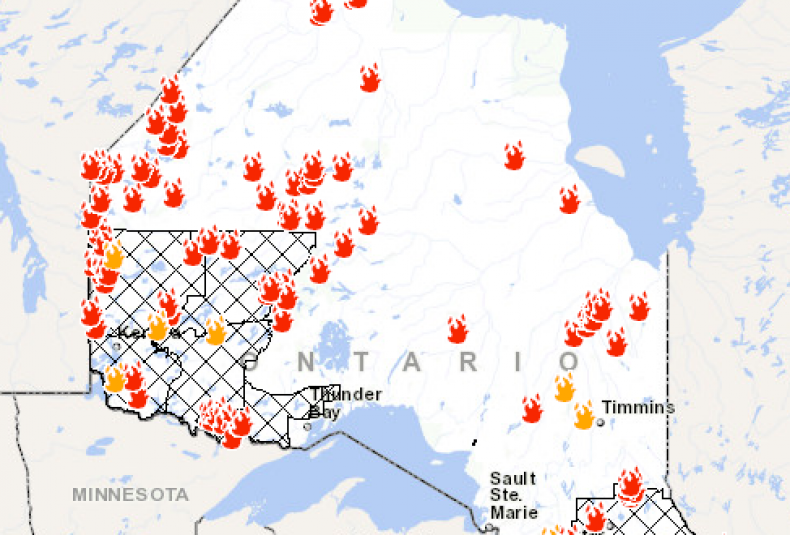
Map of Ontario wildfires June 5, 2023
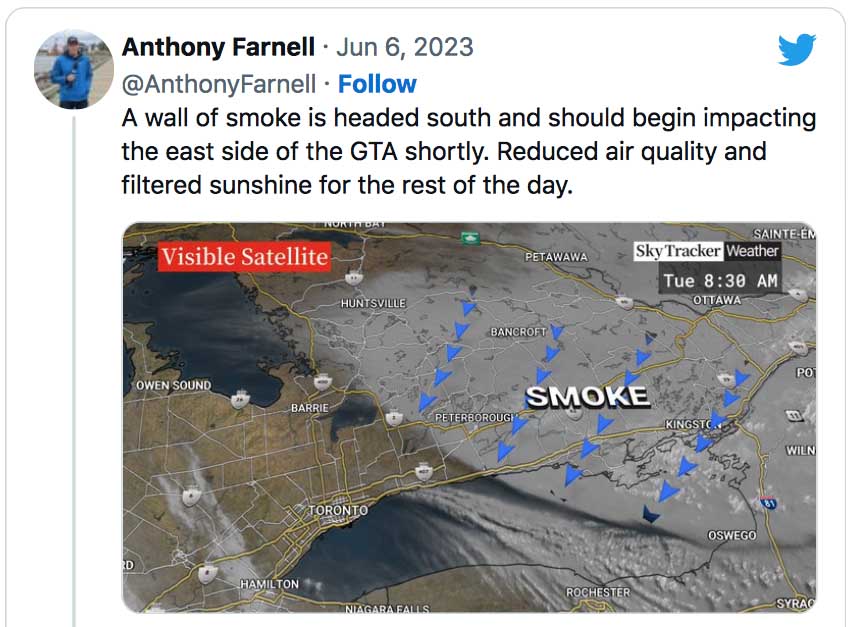
Today, the Ontario government reported heavy smoke conditions in the Northeast Region due to a large number of fires in eastern Ontario and Quebec—with fires worse than usual this year in Quebec. More than 160 fires are burning, most out of control, in Quebec. Smoke drift is travelling as far as just north of Timmins, down through Sudbury and past Parry Sound. Environment Canada issued Air quality warnings today for Peterborough, where I currently live.
Global News reported today that “relentless wildfires have devoured 3.3 million hectares of land across Canada so far this year—roughly 10 times the normal average for the season.” In the last 24 hours, 21 new fires were discovered across Ontario, amounting to 159 active fires provincially. According to Global News, “Searing hot, tinder-dry conditions, similar to what was seen in western Canada, has only worsened the situation in Ontario.” And Quebec.
Map of Quebec wildfires June 5, 2023
Sun setting over smoky Otonabee River, ON (photo by Nina Munteanu)
There is an old willow tree on the river bank by the path I walk daily. Its massive arms stretch out over the water and one arm leans low over the path so you must bend down to walk under it. The derecho last May had cracked the tree open. But the sturdy willow continues on, undaunted, as all Nature does, thrusting up suckers from its large limbs toward a future of many more willows. It’s a favourite tree of many a walker who like to sit on its generous arms and look out over the river. Each day I touch its bark and say hello.
Old willow on the path by the Otonabee River, the glow of smoke-sun on its generous arms (photo by Nina Munteanu)
New suckers burst out of the leaning willow limb (photo by Nina Munteanu)
I think of my old friend. How a fire would take it.
First its leaves would sizzle and take flight in a requiem dance. The trunk, a funnel of fire and smoke, would sway and groan then crack with a final death shout to the roaring hissing fire. Like flying kites, leaf corpses would join embers of curling bark and soar in a vortex of billowing coal black fury. The river would flow through a killing field, black stumps and burned debris flying with the vagaries of a mischievous wind. Covered in a film of thick and oily debris, the lonely river would grow dark and surly, smothering its own aquatic forest—the algae, benthic invertebrates and fish.
And I would weep…
Sun setting over hazy forest at mouth of Thompson Creek, ON (photo by Nina Munteanu)
Nina Munteanu is an ecologist and internationally published author of award-nominated speculative novels, short stories and non-fiction. She is co-editor of Europa SF and currently teaches writing courses at George Brown College and the University of Toronto. Visit www.ninamunteanu.ca for the latest on her books. Nina’s recent book is the bilingual “La natura dell’acqua / The Way of Water” (Mincione Edizioni, Rome). Her latest “Water Is…” is currently an Amazon Bestseller and NY Times ‘year in reading’ choice of Margaret Atwood.
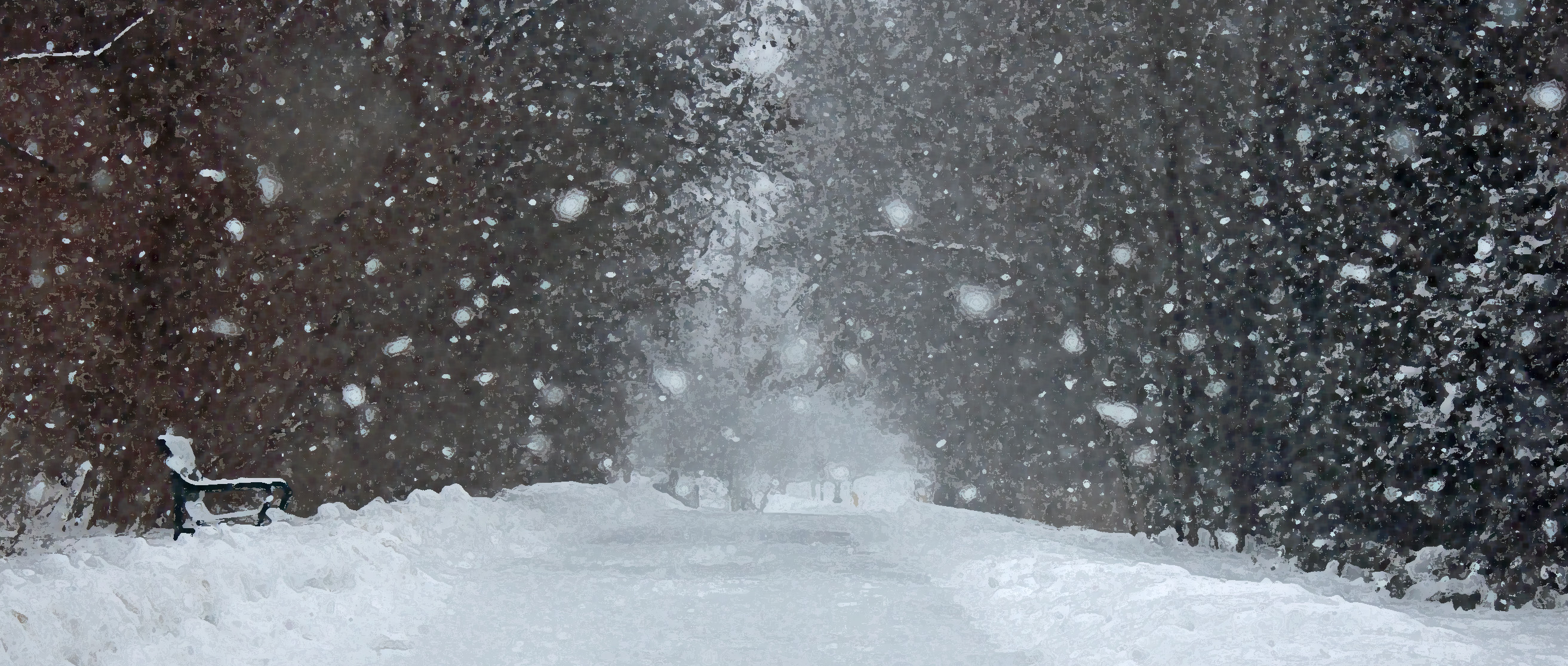
Heavy snowfall where I live in Ontario (photo by Nina Munteanu)
I currently live in Ontario, Canada, where the four seasons are still distinct and winter comes with signature cold temperature well below zero degrees Centigrade along with lots and lots of snow. I grew up in Quebec, where the snow often piled up higher than I stood tall. Temperatures often went into the minus zero teens and twenties with wind chills reaching minus thirty degrees. This called for the right equipment. Insulated coat or jacket, snow pants, wool toque and mittens and/or gloves that are also well insulated. And, of course, warm snow boots.
Nina on a walk during a snowstorm, ON (photo by Merridy Cox)
Country road in the Kawarthas, ON (photo and rendition by Nina Munteanu)
Nina’s car on ‘walkabout’ through Kawartha country after a fresh snowfall, ON (photo and rendition by Nina Munteanu)
Farm in the Kawarthas, ON (photo and rendition by Nina Munteanu)
Cows on a farm in the Kawarthas, ON (photo and rendition by Nina Munteanu)
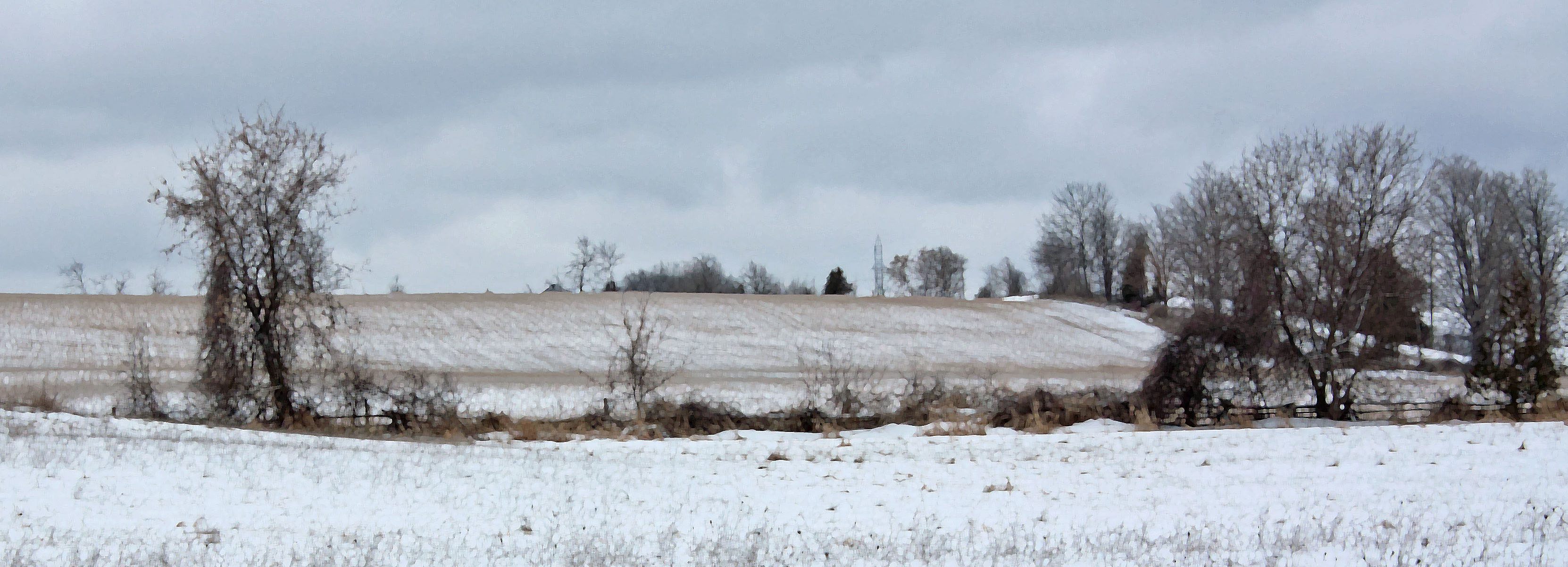
Country field in Kawarthas, ON (photo and rendition by Nina Munteanu)
School kids heading to class after a fresh snow, ON (photo by Nina Munteanu)
The Rotary Trail after a fresh snowfall, ON (photo and rendition by Nina Munteanu)
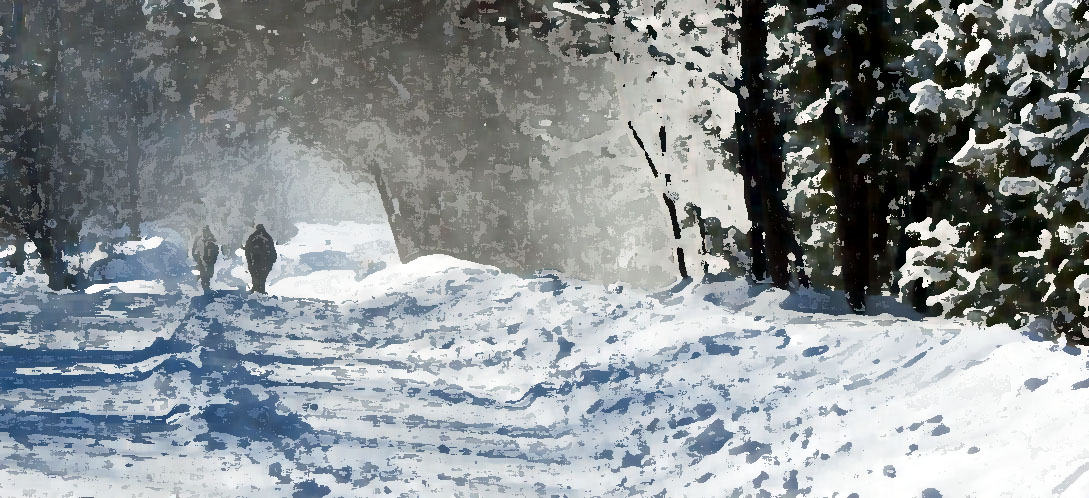
Heavy snow falls on a trail in the Kawarthas, ON (photo and rendition by Nina Munteanu)
Since moving to the West Coast then back east to Ontario, I’ve come to realize that I love winters. I love how snow covers everything, how it quiets the landscape and changes it in subtle ways. I love the frigid wind, how it bites the face with invigorating energy, reminding me that I am so alive. I love the sounds of winter, of walking on snow, crunching and squeaking, of the howl of the wind and the creaking and groaning of the trees, or the cracking and booming of the ice forming and reforming on the river.
Bridge over creek in Trent Nature Sanctuary during heavy snowfall, ON (photo and rendition by Nina Munteanu)
Jackson Creek after a fresh snowfall, ON (photo and rendition by Nina Munteanu)
Woman and her dog walk through cedar swamp forest after a fresh snowfall, ON (photo and rendition by Nina Munteanu)
Riparian forest clothed in fresh snow, ON (photo and rendition by Nina Munteanu)
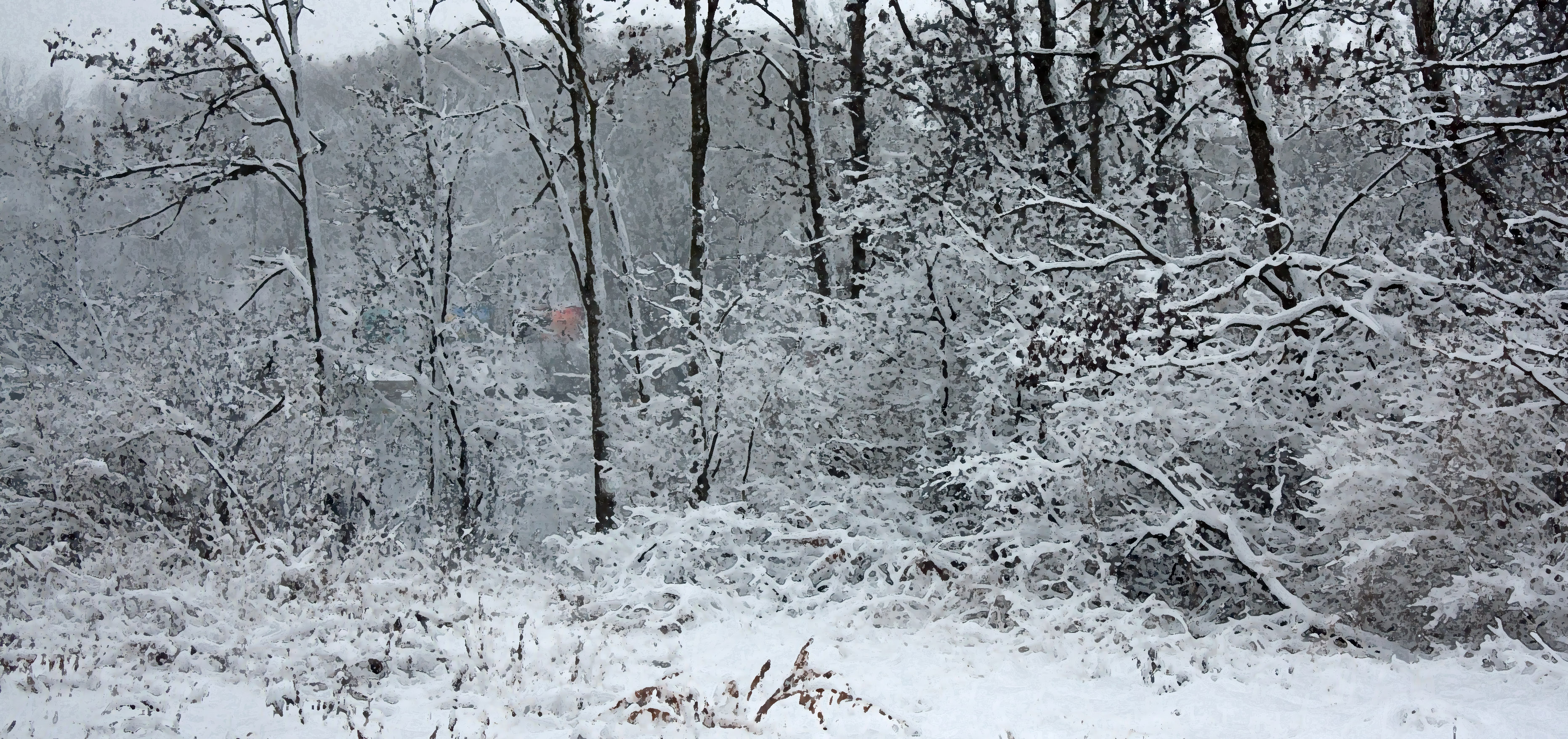
Riparian forest after a fresh snowfall, ON (photo and rendition by Nina Munteanu)
I am currently finishing my fiction book Thalweg, which takes place throughout Canada, but predominantly in northern British Columbia and the arctic of the Northwest Territories. My main character, a Gwich’in scientist, explores the land during a time of climate change, and much of it involves the expansive vast snowfields of northern Canada in which she describes the look, smell, feel, and sounds of snow. She thinks with great fondness of home in the Arctic where snow prominently features and, bringing in all her senses, of course, includes sound:
There are many different kinds of snow, and any native of the north can recognize them. We can not only tell something of the quality of weather from it, but also its history. Without having experienced the day or history of the place, we will know simply from walking through it. For instance, on a minus twenty-degree Centigrade day, when the cold bites your face and your breath coils out of your mouth like steam, old snow shines under a raking sun like an ice sheet. As though clear plastic was stretched over it. Sometimes, a hoar frost will form on the glassy thin layer, adding more glitter. Walking through it creates a symphony of crunch, pop and skittle sounds as each step breaks through the thin brittle layer into soft snow underneath. The scattering flat shards tingle like glass across the glistening ice-snow sheet.
Fresh snow that has fallen on a frigid night of minus fifteen degrees in a drier climate is fluffy, individual snowflakes glinting like jewels in the sun, and emits a high-pitched squeak and crunch as your boots press down on it. The colder the temperature, the higher the squeak. I just made that up. I’m not sure if it’s true. But considering the relationship of harmonics with temperature, it’s plausible.
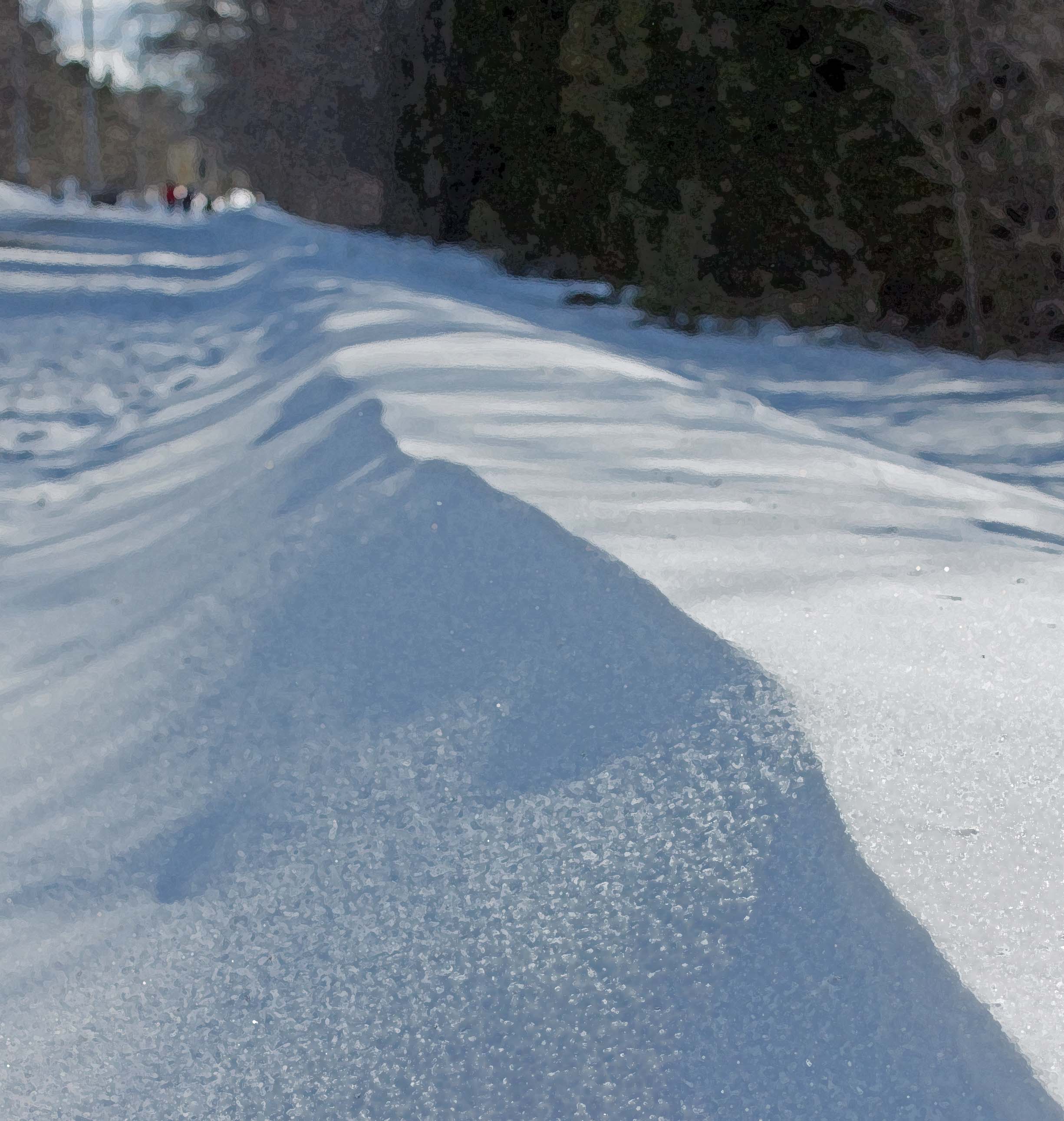
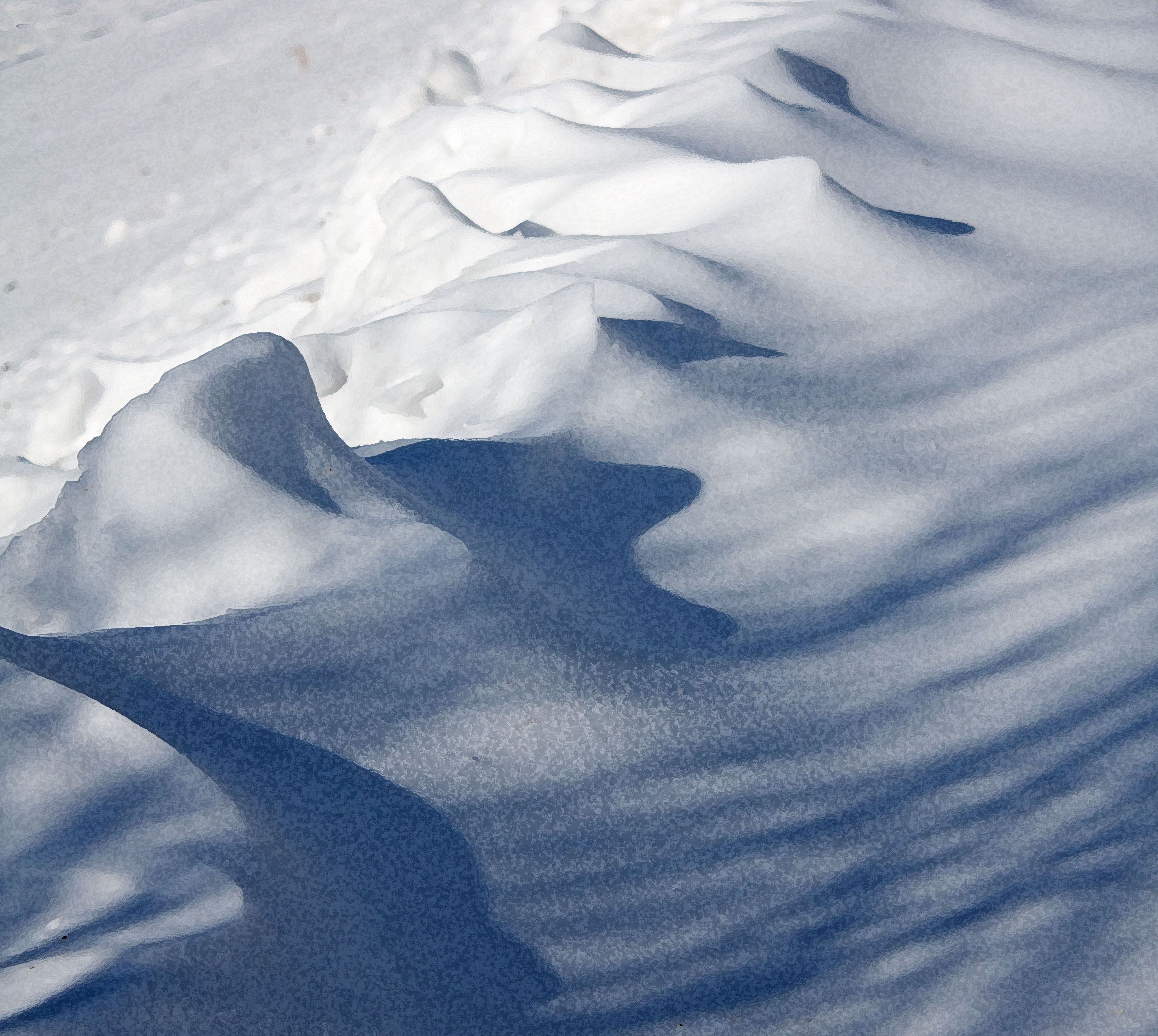
Squeaky snow is the snow of my home up north, where it arrives in a thick passion in October with the winter darkness, and where a constant minus 16°C to minus 30°C pervades until spring, six months later. The snow resembles powdered sugar, glittering like millions of tiny mica flakes under the moonlight of an arctic winter night. It covers everything, the ground, the trees and tiniest vegetation with a white blanket of snow. And when the wind teases the trees, they rain glitter-dust. In places where the north wind freely drifts across open landscape, sastrugi form; frozen wavelets, mini-barchans and dune chains that resemble the wave ripples of a sandy white beach. In some vast open areas, the wind will sculpt a frozen sea of irregular ridges and grooves up to a metre high. Mary’s friend Jem from Igloolik calls these snowdrifts qimugruk, whose distinctive shapes become permanent features of the snowscape, with tips always pointing west-northwest. Igloolik hunters use these uqalurait to set their bearings when travelling across the expansive tundra, particularly during poor visibility from storms or darkness.
Tracks through a small path by the river, ON (photo and rendition by Nina Munteanu)
Snow drift on a trail by the river, ON (photo and rendition by Nina Munteanu)
One of the sensitivity readers for Thalweg, anthropologist and Gwich’in scholar Ingrid Kritsch, related to me an interesting account during attempts to open up to oil and gas development the Arctic National Wildlife Refuge–a critical area where the Porcupine Caribou herd calve. “To many Americans, it was just a big, white, barren expanse of unused lands,” said Ingrid. “She recalled a Senator speaking for development on these lands. The Senator held up a blank sheet of white paper and claimed ‘this is what the area looks like!’
The vast snowfields look nothing like that…
Snow drifts in Ontario (photo and rendition by Nina Munteanu)
…Now, don’t forget to play in the snow…
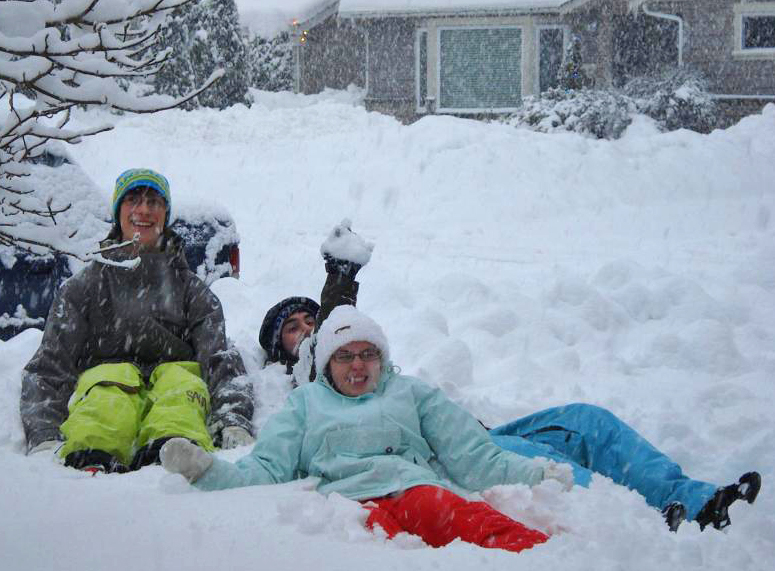
Author’s son and friends play in fresh snow on Christmas in BC (photo by Nina Munteanu)
Nina Munteanu reads a book with her cup of tea in +8 degree C, ON (photo by Merridy Cox)
Nina Munteanu is a Canadian ecologist / limnologist and novelist. She is co-editor of Europa SF and currently teaches writing courses at George Brown College and the University of Toronto. Visit www.ninamunteanu.ca for the latest on her books. Nina’s bilingual “La natura dell’acqua / The Way of Water” was published by Mincione Edizioni in Rome. Her non-fiction book “Water Is…” by Pixl Press(Vancouver) was selected by Margaret Atwood in the New York Times‘Year in Reading’ and was chosen as the 2017 Summer Read by Water Canada. Her novel “A Diary in the Age of Water” was released by Inanna Publications (Toronto) in June 2020.
Rotary Trail in Peterborough during a foggy day, ON (photo and rendition by Nina Munteanu)
A few days ago, I woke up in the morning to a dense fog outside. I hastily dressed, grabbed a clementine, put on my boots and coat and raced outside into the gentle morning. The air was fresh. A calm stillness had settled over everything, from ghostly forest to dripping branches by the path to people who appeared and disappeared in the mist.
Rotary Trail path to the bridge across the Otonabee River, ON (photo by Nina Munteanu)
As I strolled along the trail and forest paths, camera in hand, I realized that I needn’t have rushed; the fog didn’t burn away and dissipate beneath a strong sun. It remained foggy the entire day.
Path through winter forest on a foggy morning, ON (photo by Nina Munteanu)
Thompson Creek marsh in the fog, ON (photo by Nina Munteanu)
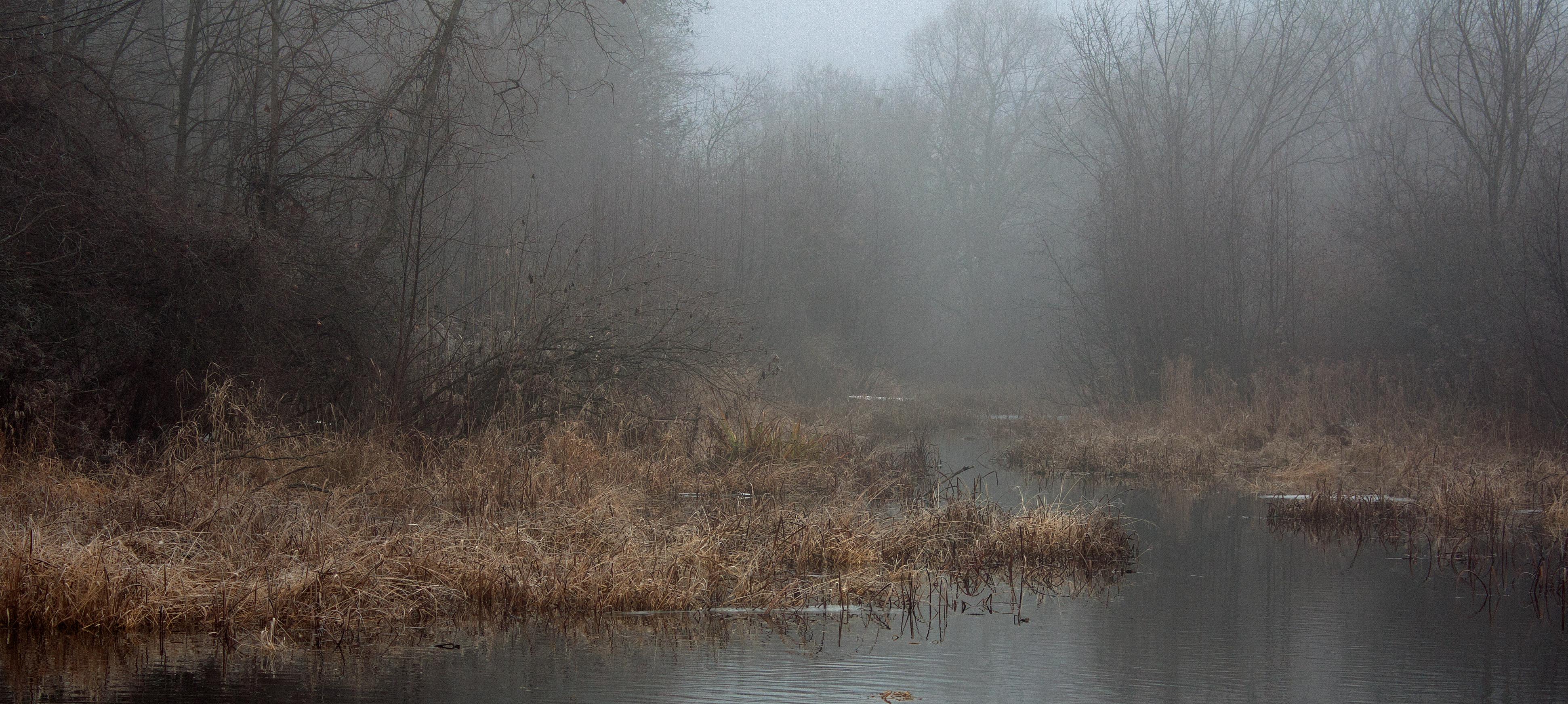
Otonabee marsh in the fog, ON (photo and rendition by Nina Munteanu)
Dogwood shrubs add colour to the marsh as ice forms, ON (photo and rendition by Nina Munteanu)
At Thompson Creek marsh, crimson dogwood shrubs and gnarly trees greeted me with arms stretched through the fog. The damp air, fragrant with the stirring of Winter, caressed my cheeks. I felt like I’d entered a Camille Pissarro painting…
Alders, willows and other trees, amid ruddy dogwoods, line Thompson Creek marsh behind, ON (photo and rendition by Nina Munteanu)
Road to Lakefield along Otonabee River in the fog, ON (photo and rendition by Nina Munteanu)
During my drive along the river, the calm stillness of the day settled over me with muted beauty. Nature’s shapes peered through the mist like quantum entangled apparitions, coalescing to the nearness of my gaze then vanishing again on my parting.
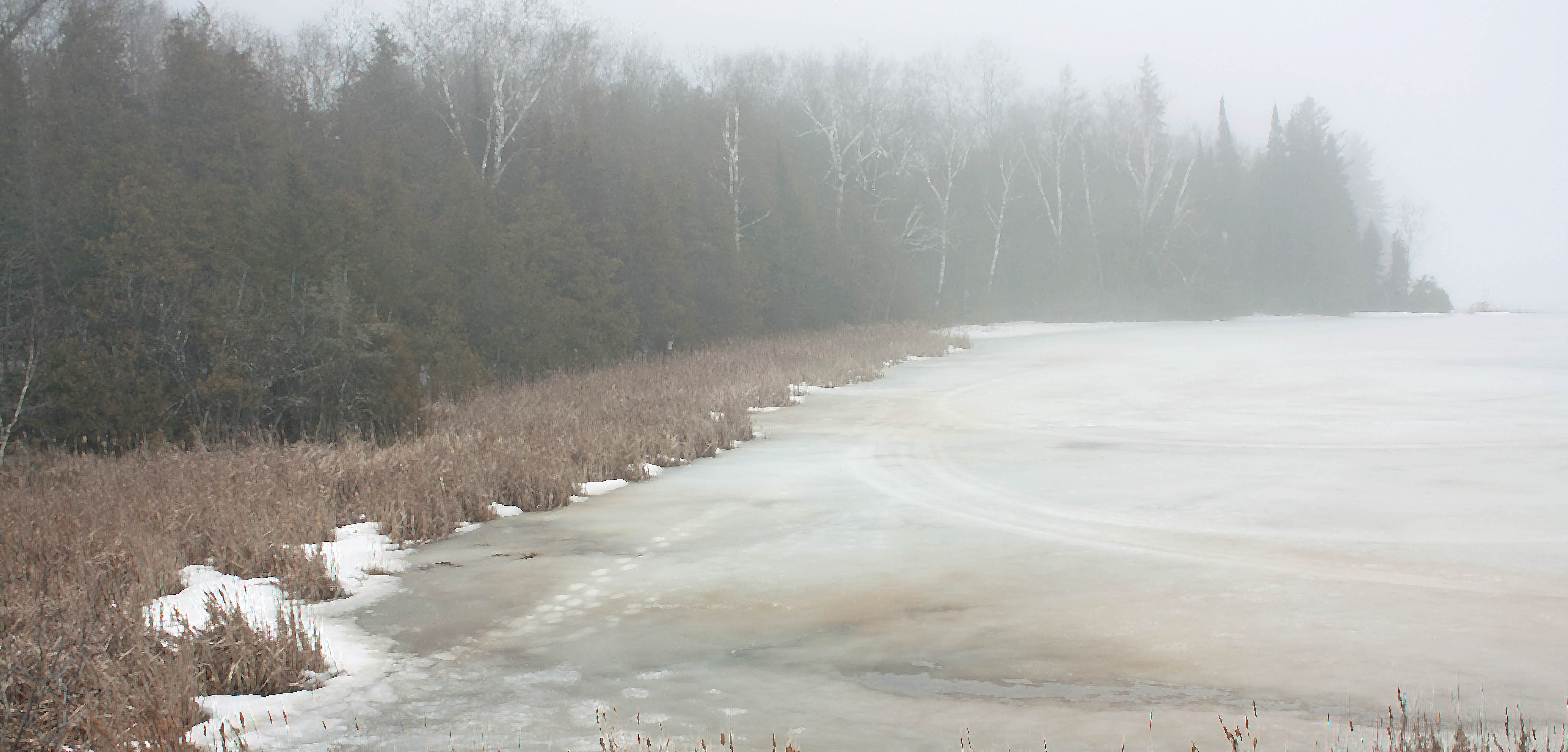
Shore of ice-strewn Otonabee River off Lakefield Road, ON (photo and rendition by Nina Munteanu)
1906 building on shore of Otonabee River during a foggy day, ON (photo and rendition by Nina Munteanu)
Small island in Otonabee River on road to Lakefield, ON (photo and rendition by Nina Munteanu)
I drove along country roads that vanished in the mist. As I plied through the fog, phantom trees loomed, quietly announcing themselves on the side of the road as their shapes assembled into something solid.
I imagined I was catching the breath of heaven…
Country dirt road in the Kawarthas on a foggy day, ON (photo by Nina Munteanu)
Tree ghosts in a farmer’s field in Kawartha country, ON (photo by Nina Munteanu)
Snow melt stream and marsh on the side of a country road on a foggy day, ON (photo and rendition by Nina Munteanu)
The fog is a shape-shifter. Sometimes a brooding beast, obscuring all in its indiscriminate path. Other times an impish rogue, a pale coquette, winking and teasing as it both reveals and hides, like a good mystery novel…
Fog over the Otonabee River, ON (photo and rendition by Nina Munteanu)
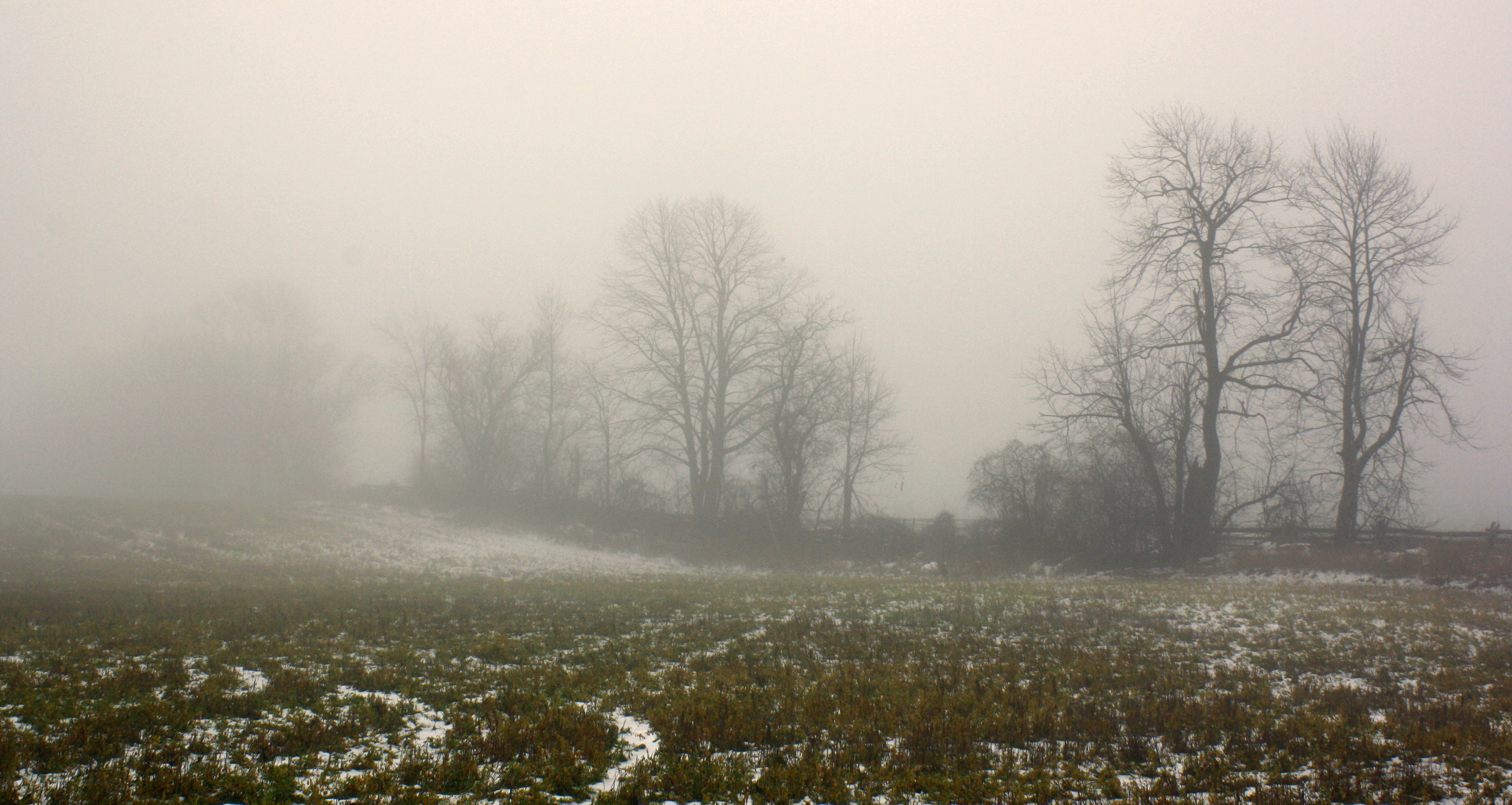
Thompson Creek marsh in a winter mist, ON (photo by Nina Munteanu)
Nina Munteanu is a Canadian ecologist / limnologist and novelist. She is co-editor of Europa SF and currently teaches writing courses at George Brown College and the University of Toronto. Visit www.ninamunteanu.ca for the latest on her books. Nina’s bilingual “La natura dell’acqua / The Way of Water” was published by Mincione Edizioni in Rome. Her non-fiction book “Water Is…” by Pixl Press(Vancouver) was selected by Margaret Atwood in the New York Times‘Year in Reading’ and was chosen as the 2017 Summer Read by Water Canada. Her novel “A Diary in the Age of Water” was released by Inanna Publications (Toronto) in June 2020.
Willow, goddess of Purring Cat Meditation (photo by Nina Munteanu)
Her name is Willow, and she helps me centre my being…
Willow is a diminutive 18-year old Russian blue cat, who I looked after for some friends in Mississauga. When I first met Willow, she responded with reticence–like all smart discerning cats. She appeared so delicate, I was scared to pick her up. I soon realized that this was a fallacy. That not only could I pick her up but that she loved to be held. I just needed to learn how.
As soon as I did, we became best friends. And it all came together with the Purring Cat Meditation.
“Time to feed me, Nina!” says Willow (photo by Nina Munteanu)
It starts out with her finding me “doing nothing terribly important” like typing on the computer, or something. A soft but decisive tap of the paw on my leg and I have to smile at her intense look up at me with those guileless emerald eyes. I abandon my work–how can I ignore such a plea?– and pick her up. After all, I know what she wants…And so starts our journey toward “nirvana”… the meditative state that will centre our beings and ultimately save the world.
I wander the house with her. We check out each room and make our silent observations. We end up in the bedroom upstairs, where she normally sleeps (except when she’s decided to join me on my bed to sit on me and purr in my face in the middle of the night).
Willow playfully teasing (photo by Nina Munteanu)
In her sanctuary, we drift to the window that faces the back yard, now cloaked in the fresh drifts of winter snow. The window is slightly open and a crisp breeze braces us with the deep scent of winter. I breathe in the fragrance of fallen leaves, mist and bark…
Willow settles into a feather-light pose in the crook of my arms and I hardly feel her. More like she and I have joined to become one. We are both purring …
We remain in Cat-Purr-Meditation for …
I have no idea. It feels like moments. Infinity. It encompasses and defines an entire world. We’ve just created something. Just by being.
“Time to pick me up, Nina!” says Willow (photo by Nina Munteanu
Cats–well, most animal companions–are incredibly centring and can teach us a lot about the art of simply being.
And meditating…
Whenever I run across a bout of writer’s block or need to stoke my muse, instead of trying harder, I stop and reach out for my cat-friend.
And practice Purring-Cat Meditation…
First snow on the Otonabee River, Peterborough, ON (photo and rendition by Nina Munteanu)
Nina Munteanu is a Canadian ecologist / limnologist and novelist. She is co-editor of Europa SF and currently teaches writing courses at George Brown College and the University of Toronto. Visit www.ninamunteanu.ca for the latest on her books. Nina’s bilingual “La natura dell’acqua / The Way of Water” was published by Mincione Edizioni in Rome. Her non-fiction book “Water Is…” by Pixl Press(Vancouver) was selected by Margaret Atwood in the New York Times ‘Year in Reading’ and was chosen as the 2017 Summer Read by Water Canada. Her novel “A Diary in the Age of Water” was released by Inanna Publications (Toronto) in June 2020.
First snow in Kawarthas, ON (photo by Nina Munteanu)
I move around a lot these days. It helps me to appreciate some of the most simple things in life and reminds me of what I love most about Christmas: how it focuses my heart and reconnects me. I don’t mean just with relatives and friends either, although the season certainly does that. I’m talking about my soul and the universe itself. Before I became an itinerant, Christmas bustled with my responsibilities as primary caregiver, social coordinator and hostess of major parties.
After I’d said goodbye to our visiting friends and done the dishes and tidied the house; after my husband and son had gone to bed, I sat in the dark living room lit only with the Christmas Tree lights and the flickering candle on my writing desk, and listened to soft Christmas music, primed to write…
My cat Sammy watching the world (photo by Nina Munteanu)
My male cat, smelling fresh from outside, found his rightful place on my lap and settled there, pinning me down with love. And there, as I breathed in the scent of wax and fir and cat I found myself again.
Christmas is, more than anything, a time of embracing paradox. It is an opportunity to still oneself amid the bustle; to find joy in duty; to give of one’s precious time when others have none, to embrace selflessness when surrounded by promoted selfishness, and to be genuine in a commercial and dishonest world. If one were to look beyond the rhetoric and imposed tradition, the Christmas season represents a time of focus, a time to reflect on one’s genuine nature and altruistic destiny. A time to reconnect with the harmony and balance in our lives.
First snow on path into the forest, ON (photo by Nina Munteanu)
A time to sit with our cat, pinned with love, and write our next novel.
Merry Christmas!
Heavy snow day in Scots Pine forest, ON (photo and rendition by Nina Munteanu)
NINA MUNTEANU is a Canadian ecologist / limnologist and novelist. She is co-editor of Europa SF and currently teaches writing courses at George Brown College and the University of Toronto. Visit www.ninamunteanu.ca for the latest on her books. Nina’s bilingual “La natura dell’acqua / The Way of Water” was published by Mincione Edizioni in Rome. Her non-fiction book “Water Is…” by Pixl Press(Vancouver) was selected by Margaret Atwood in the New York Times ‘Year in Reading’ and was chosen as the 2017 Summer Read by Water Canada. Her novel “A Diary in the Age of Water” was released by Inanna Publications (Toronto) in June 2020.

































 Nina Munteanu Writing Coach