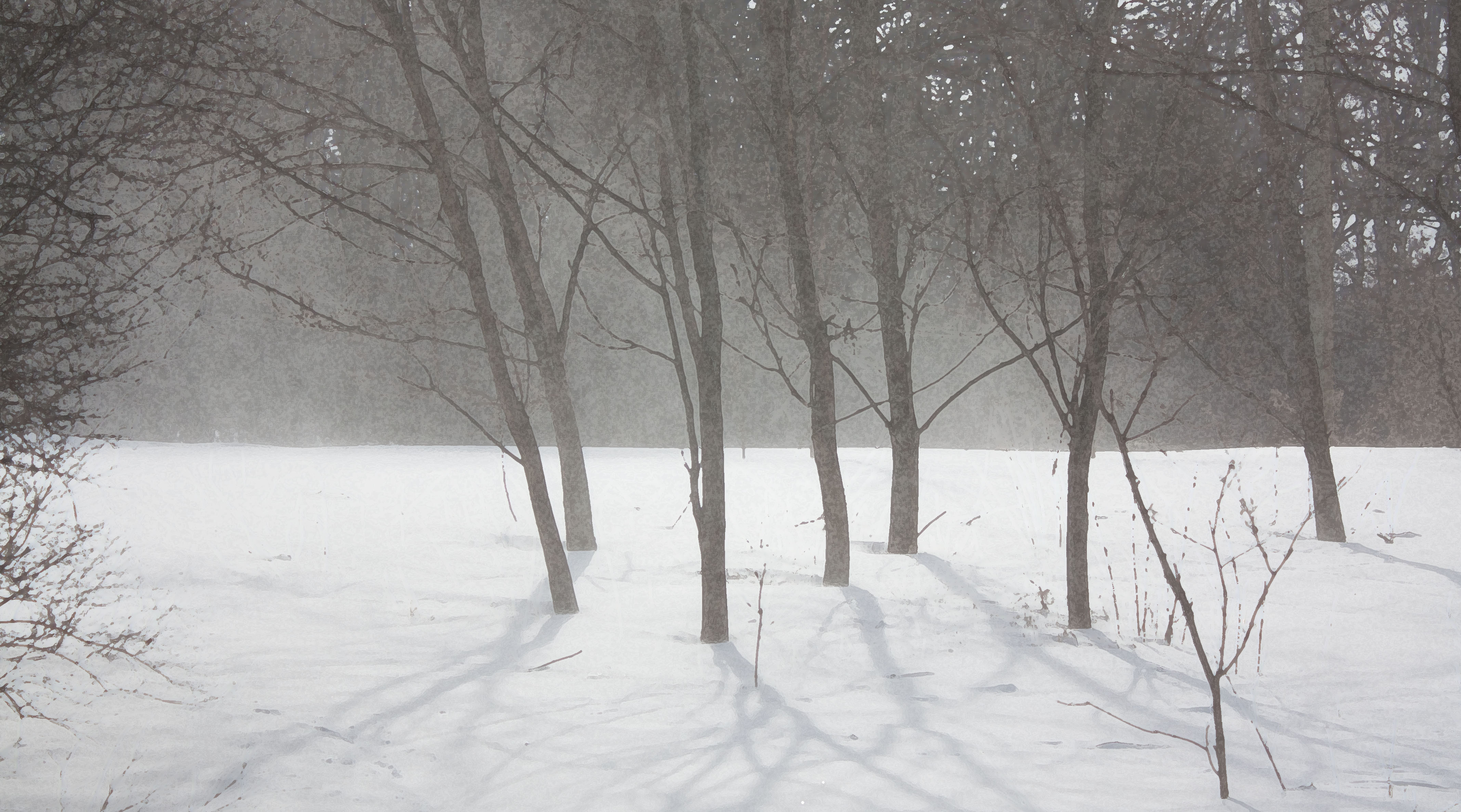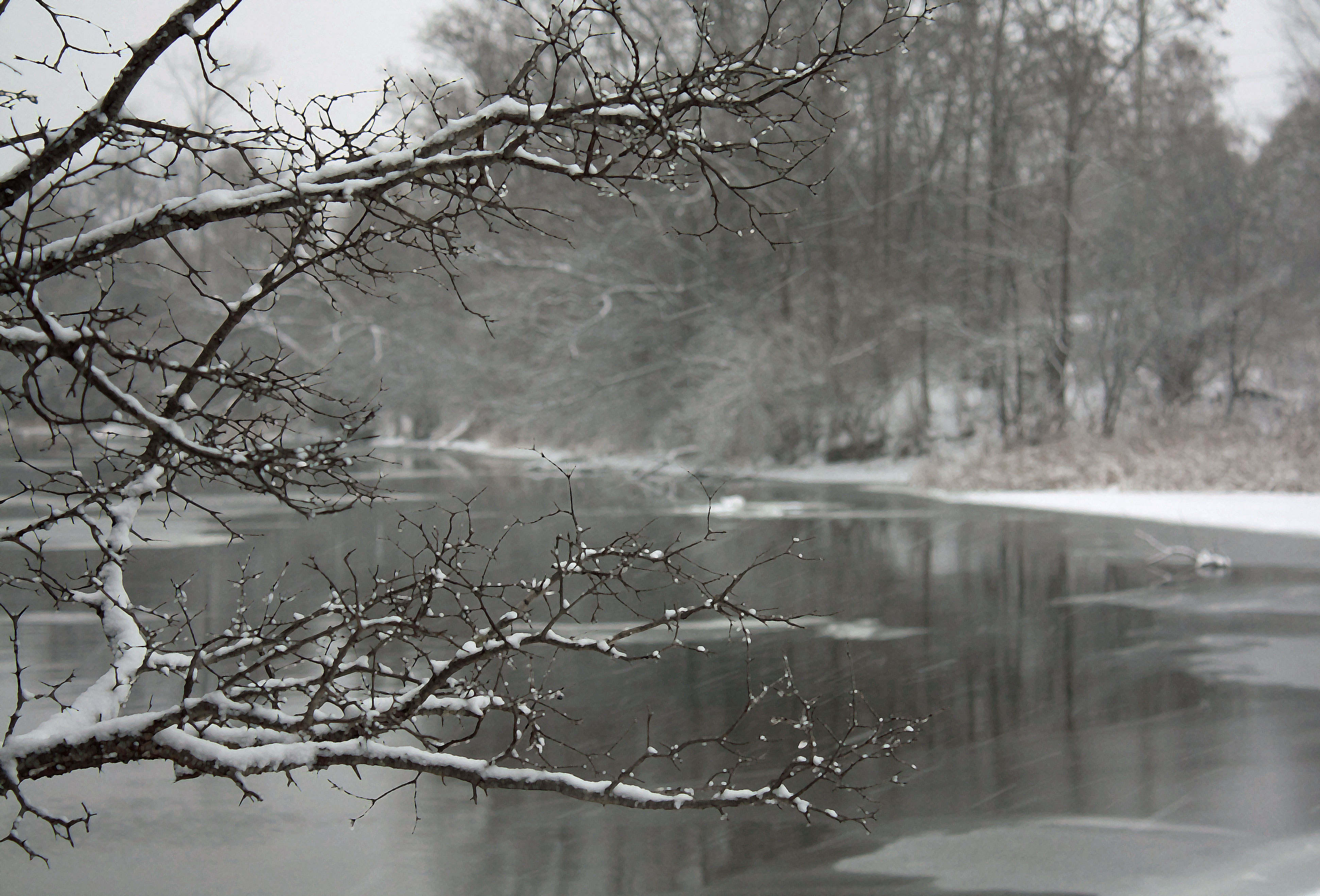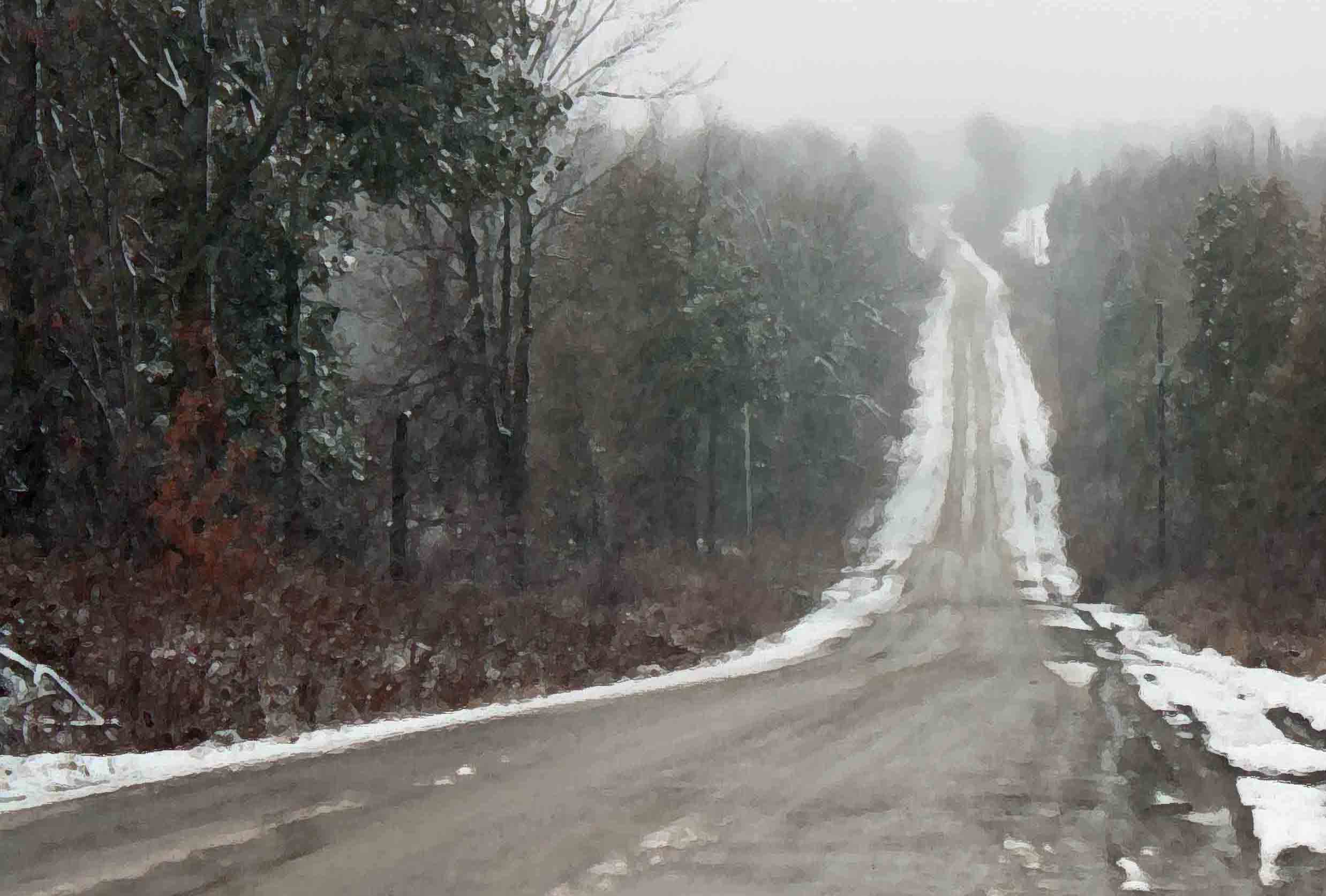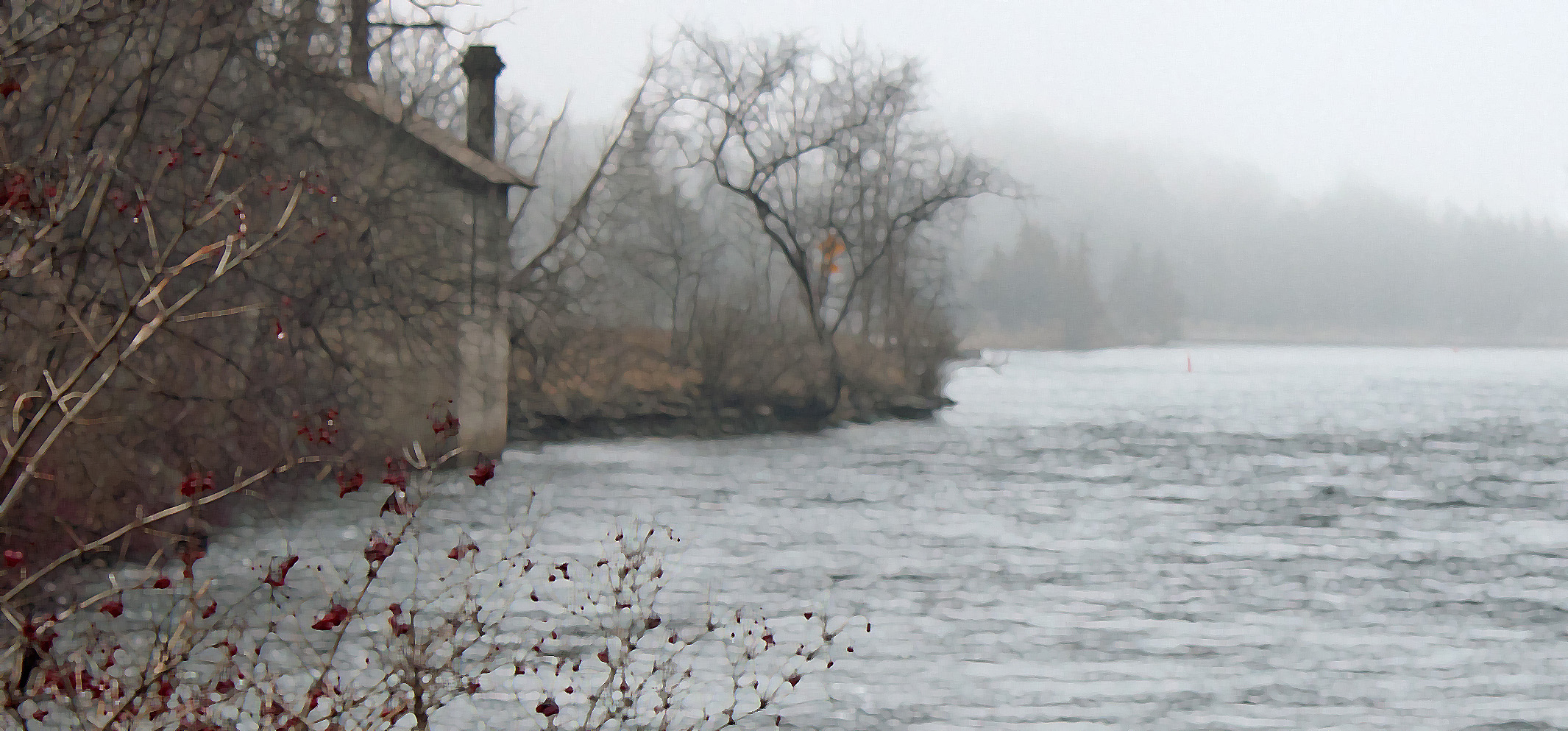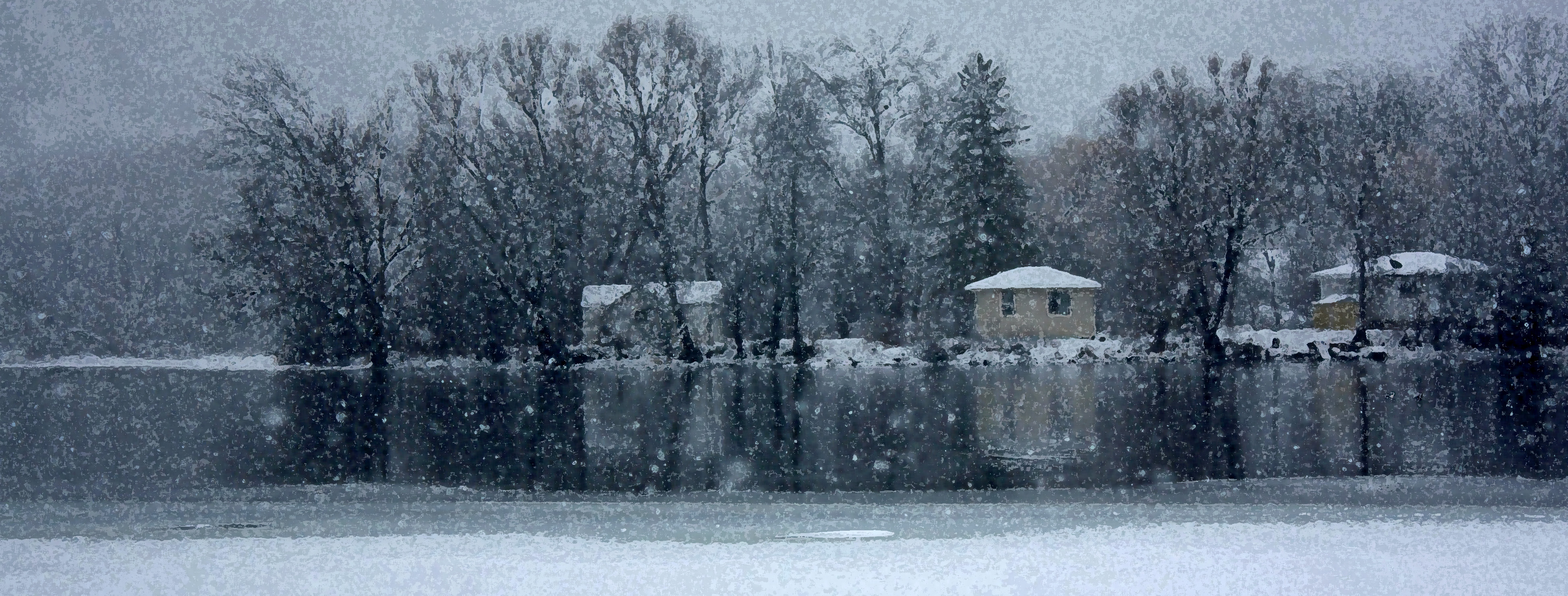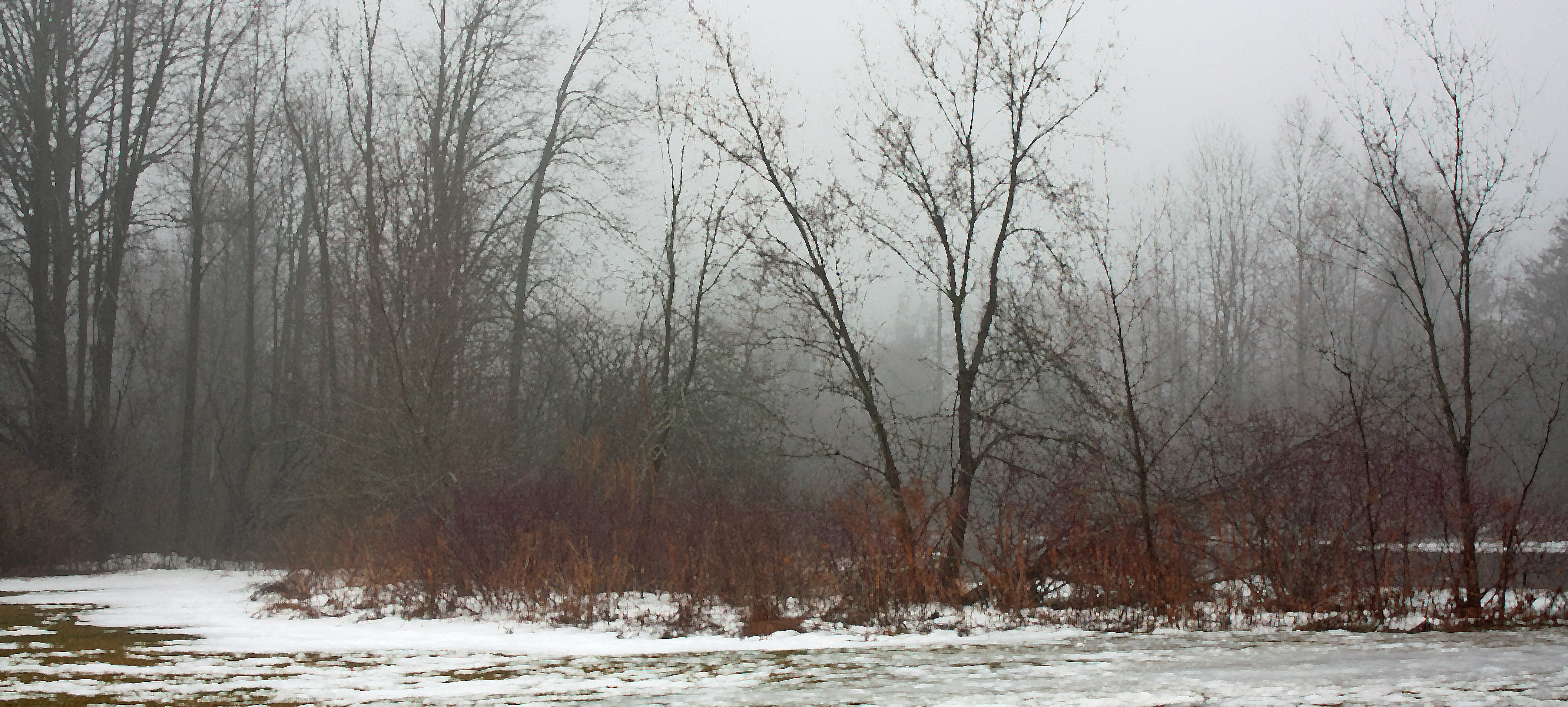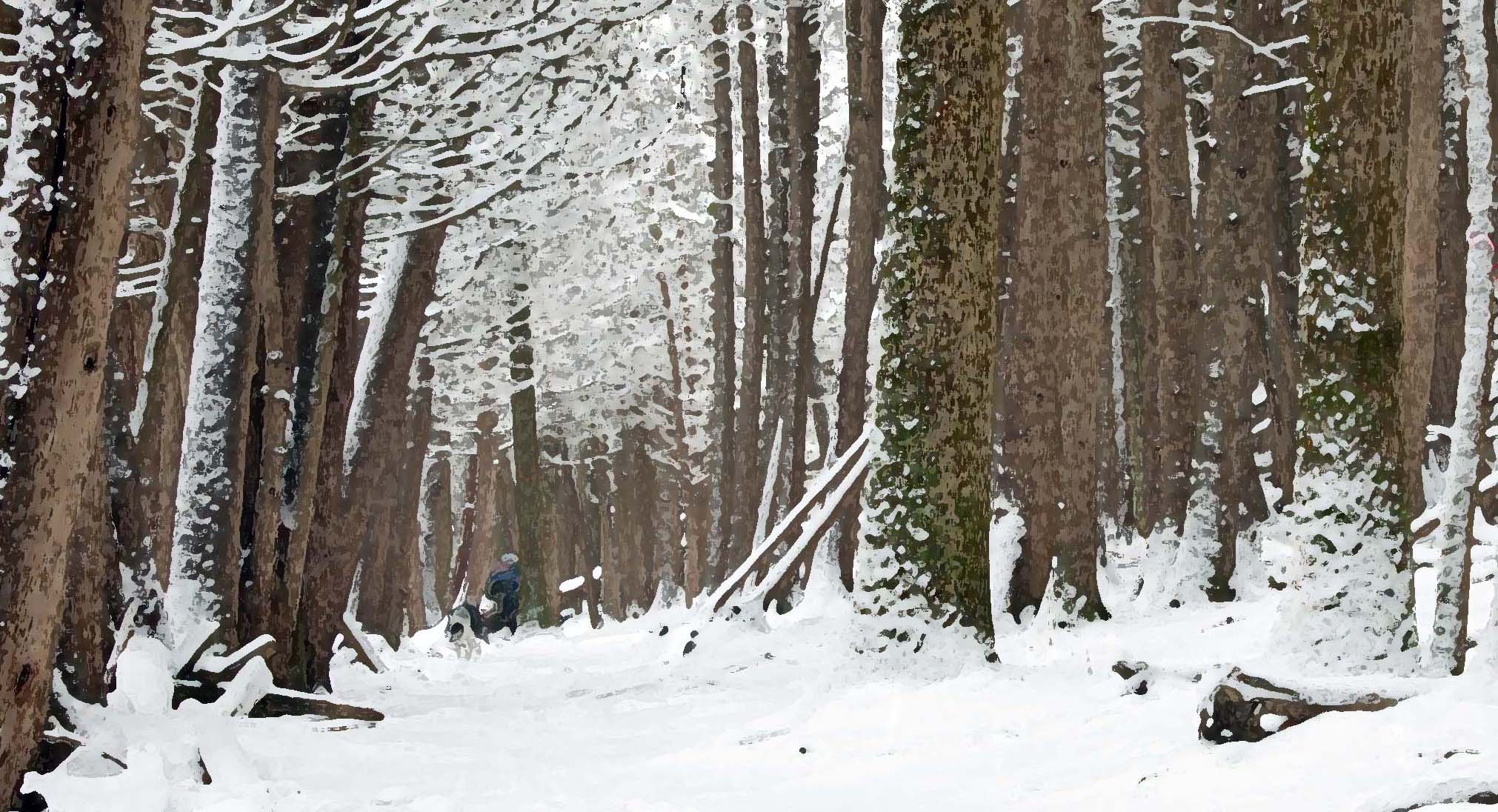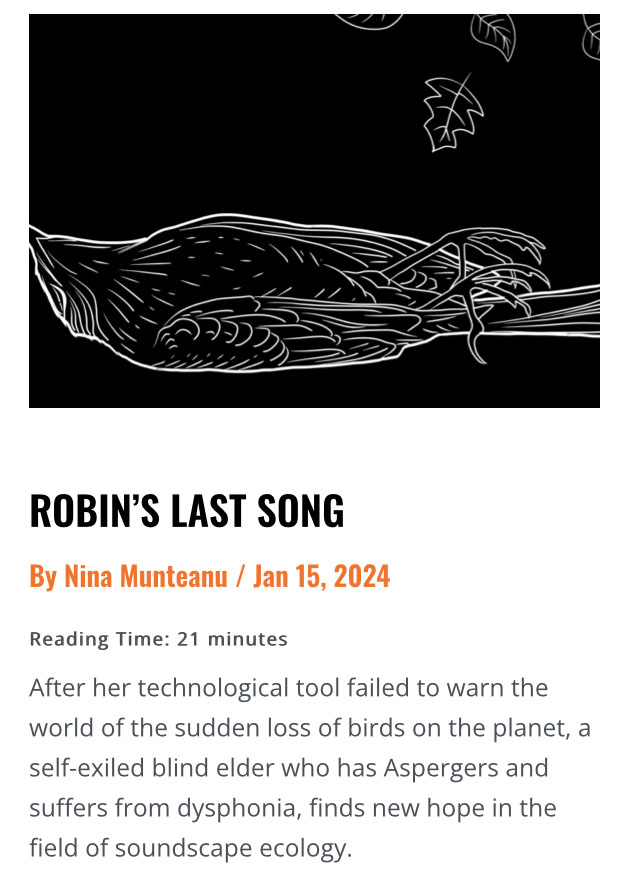
I rock on the cedar swing on my veranda and hear the wind rustling through the gaunt forest. An abandoned nest, the forest sighs in low ponderous notes. It sighs of a gentler time. A time when birds filled it with song. A time when large and small creatures — unconcerned with the distant thrum and roar of diggers and logging trucks — roamed the thick second-growth forest. The discord was still too far away to bother the wildlife. But their killer lurked far closer in deadly silence. And it caught the birds in the bliss of ignorance. The human-made scourge came like a thief in the night and quietly strangled all the birds in the name of progress.
excerpt from “Robin’s Last Song” by Nina Munteanu
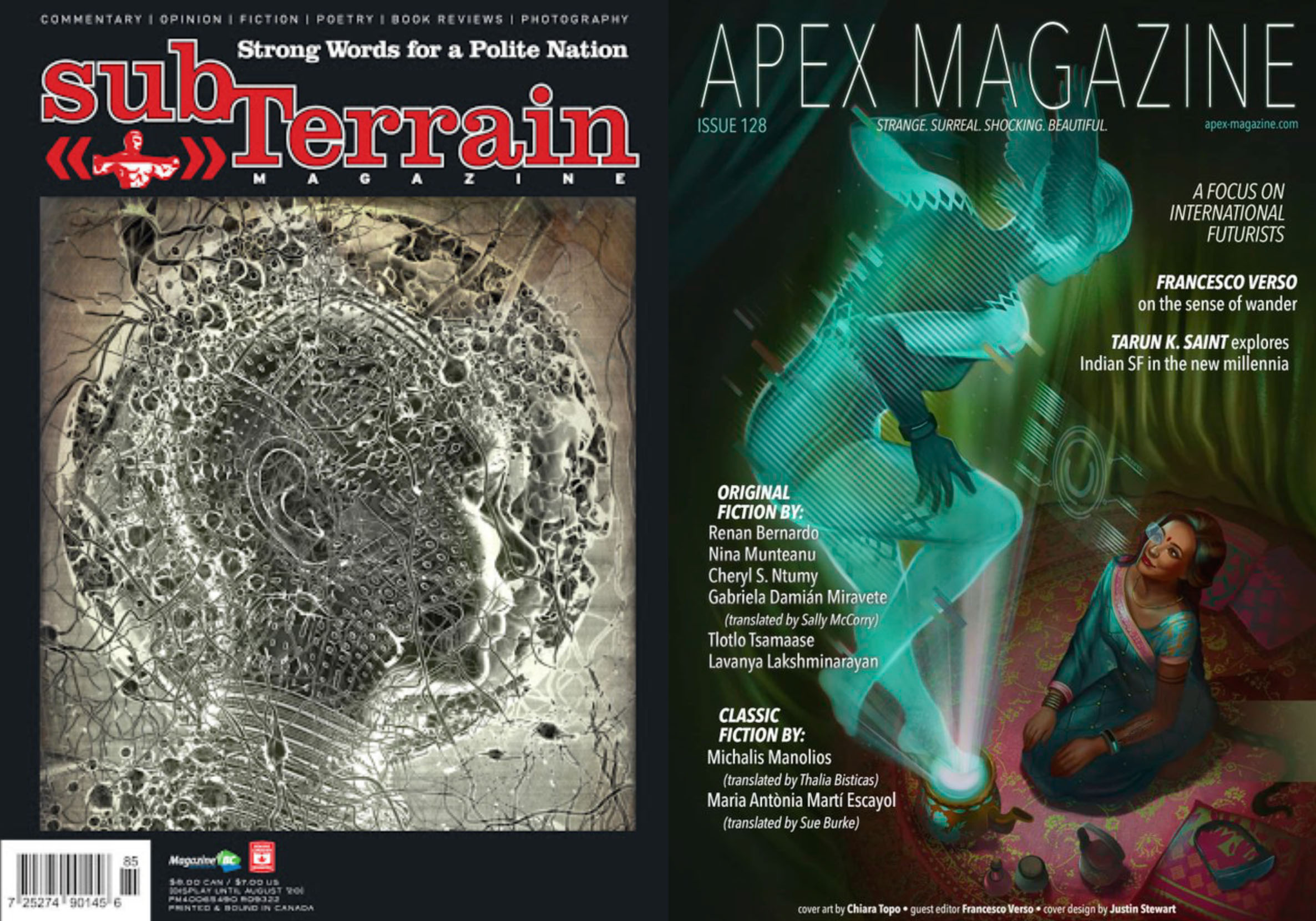
My short story Robin’s Last Song was republished recently in the superlative online magazine Metastellar. The story was first published in 2021 in Issue 128 of Apex Magazine and an earlier version of the story called Out of the Silence appeared in the literary magazine subTerrain Magazine Issue 85 in 2020.
Left, “subTerrain” Issue 85 carries “Out of the Silence”; right, “Apex Magazine” issue 128 carries “Robin’s Last Song”
I raced up the stairs to the auditorium then quieted my breath and listened at the door, heart thumping like a bird trying to escape. Professor Gopnik was ten minutes into his lecture; I could hear his commanding voice: “… estimates that the entire number of birds have been reduced by a third in five decades—I mean common birds like the robins, sparrows, warblers, and even starlings…”
He was talking about Rosenberg’s paper in Science. The study shocked the scientific community; but I had already observed the decline of the house sparrow around my aunt and uncle’s house near the Old Mill. And the robin—my namesake, whose song heralded spring for me—had grown quiet.
I imagined Gopnik waving the journal at the class in his typical showman style. He had a habit of wandering the stage like an evangelist, fixing each student with intense blue eyes as if challenging them to believe. I thought him an over-confident condescending prig. But for someone who looked as young as the students he was teaching, Gopnik was brilliant. And what he was doing was so important. I wanted so badly to work under him as a grad student. But he terrified me.
Excerpt from “Robin’s Last Song” by Nina Munteanu
The Story Behind the Story
It all began with my discovery of an emerging bioacoustic tool, soundscape ecology, that measures biodiversity and ecosystem functionality. I’d just read the disturbing 2019 Science article by Rosenberg and team who determined that our slow violence of habitat degradation and toxic pollution has reduced the world’s bird population by a third in just five decades. I was devastated; I could not imagine a world without the comforting sound of birds. What would it be like if all the birds disappeared?
Map and chart of bird decline since 1970
Already primed with research into genetic engineering for the sequel to my 2020 eco-novel,A Diary in the Age of Water, my muse (often delightfully unruly) played with notions of the potential implication of gene hacking in ecological calamity and how this might touch on our precious birds: when nature “is forced out of her natural state and squeezed and moulded;” her secrets “reveal themselves more readily under the vexations of art than when they go their own way.”
Robin’s Last Song is a realizable work of fiction in which science and technology are both instigators of disaster and purveyors of salvation. Today, gene-editing, proteomics, and DNA origami—to name just a few—promise many things from increased longevity in humans to giant disease-resistant crops. Will synthetic biology control and redesign Nature to suit hubris or serve evolution? What is our moral imperative and who are the casualties? As Francis Bacon expressed in Novum Organum, science does not make that decision. We do.
I also recently sat down with Rebecca E. Treasure of Apex Magazine for a conversation about story, ecology, and the future. Here’s how it begins:
Apex Magazine: The Way of Water in Little Blue Marble is such a powerful piece touching on water scarcity and friendship, a dry future and the potential for technology to overtake natural ecology. Robin’s Last Song explores extinction, human fallibility, friendship, and again, that conflict between technology and nature. Do you think we’re heading toward the kind of dystopia shown in these stories?…
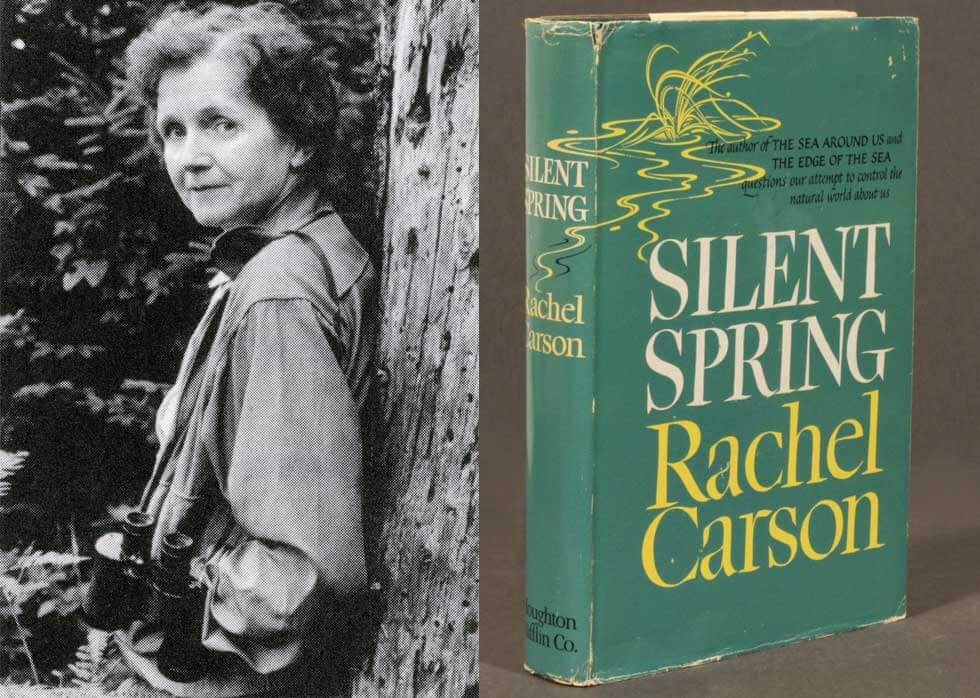
“Over increasingly large areas of the United States, spring now comes unheralded by the return of the birds. The early mornings are strangely silent where once they were filled with the beauty of bird song”
Rachel Carson, Silent Spring
Discarded robin’s egg in the forest in spring, ON (photo by Nina Munteanu)
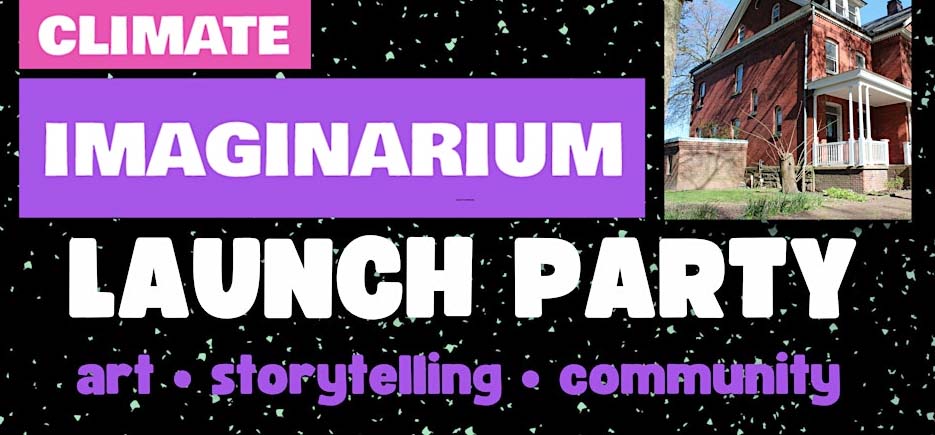
p.s. May9: I just learned that Robin’s Last Song was selected by the NYC Climate Writers Collective as part of an exhibition in the Climate Imaginarium on Governors island. The exhibition, starting May 18, will run throughout the summer of 2024.
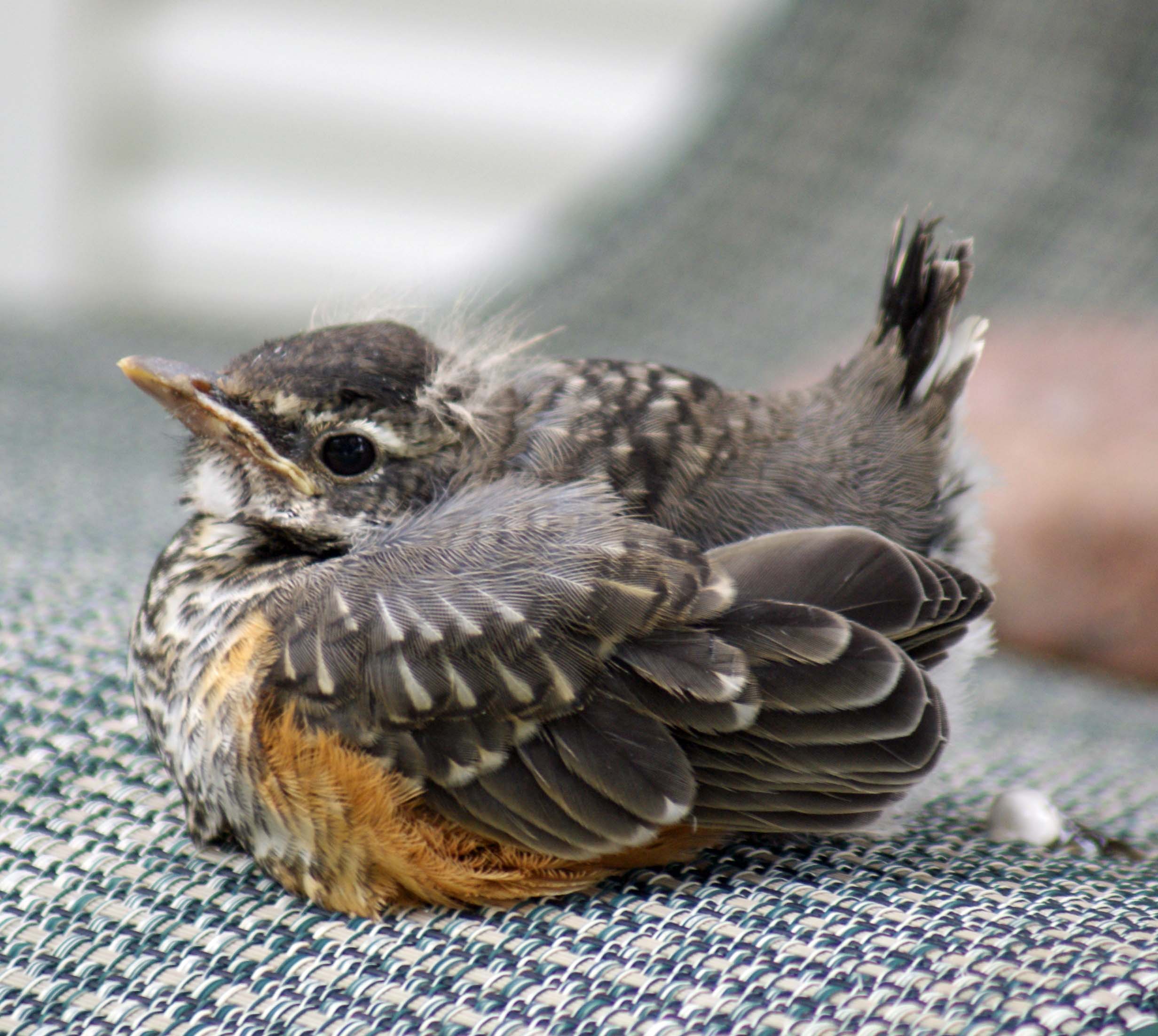
Fledgling robin rests on a patio chair in spring, ON (photo by Merridy Cox)
Nina Munteanu is a Canadian ecologist / limnologist and novelist. She is co-editor of Europa SF and currently teaches writing courses at George Brown College and the University of Toronto. Visit www.ninamunteanu.ca for the latest on her books. Nina’s bilingual “La natura dell’acqua / The Way of Water” was published by Mincione Edizioni in Rome. Her non-fiction book “Water Is…” by Pixl Press (Vancouver) was selected by Margaret Atwood in the New York Times ‘Year in Reading’ and was chosen as the 2017 Summer Read by Water Canada. Her novel “A Diary in the Age of Water” was released by Inanna Publications (Toronto) in June 2020.
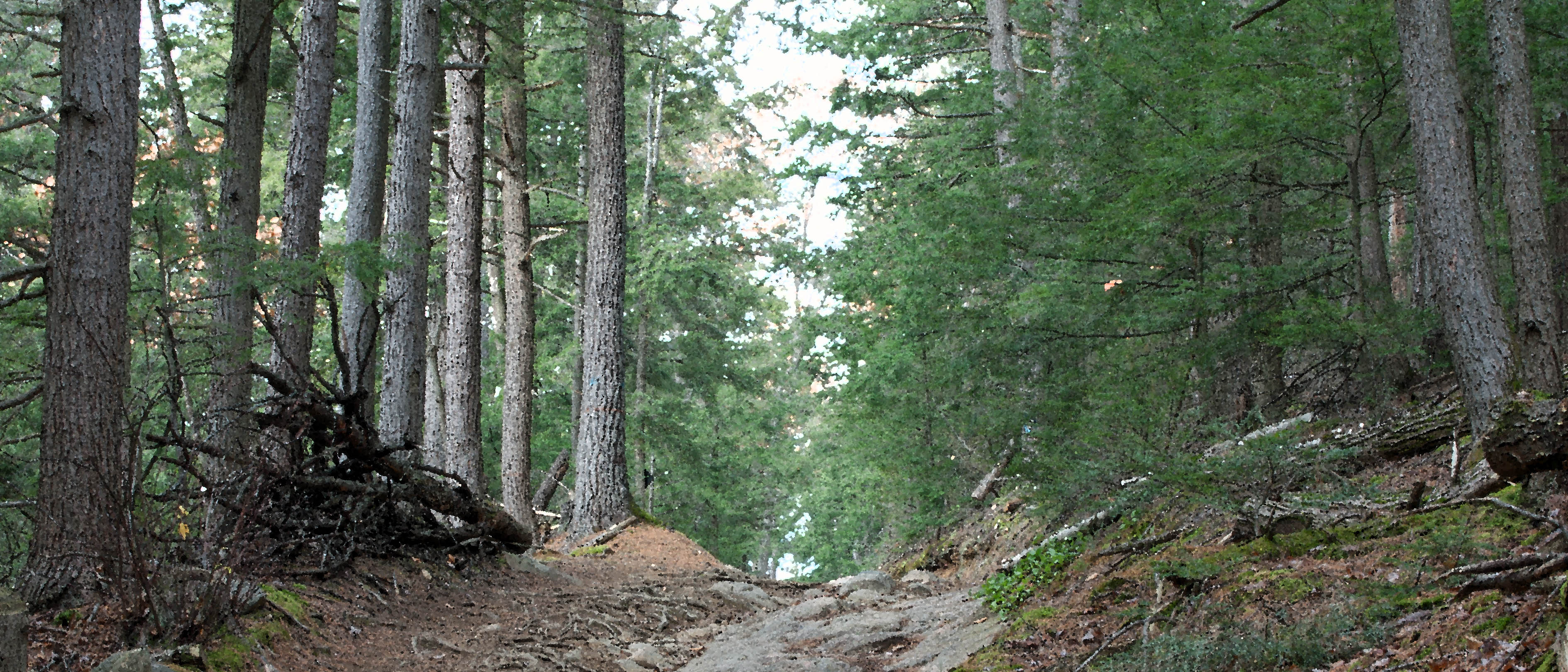
Rocky trail through ancient eastern hemlock forest, Catchacoma Park, ON (photo and rendition by Nina Munteanu)
I look forward to my daily walks. I find that walking helps me centre myself. Depending on the time I have, some walks last half an hour to an hour. Others walks will stretch from three hours to a day long. These aren’t city-walks.
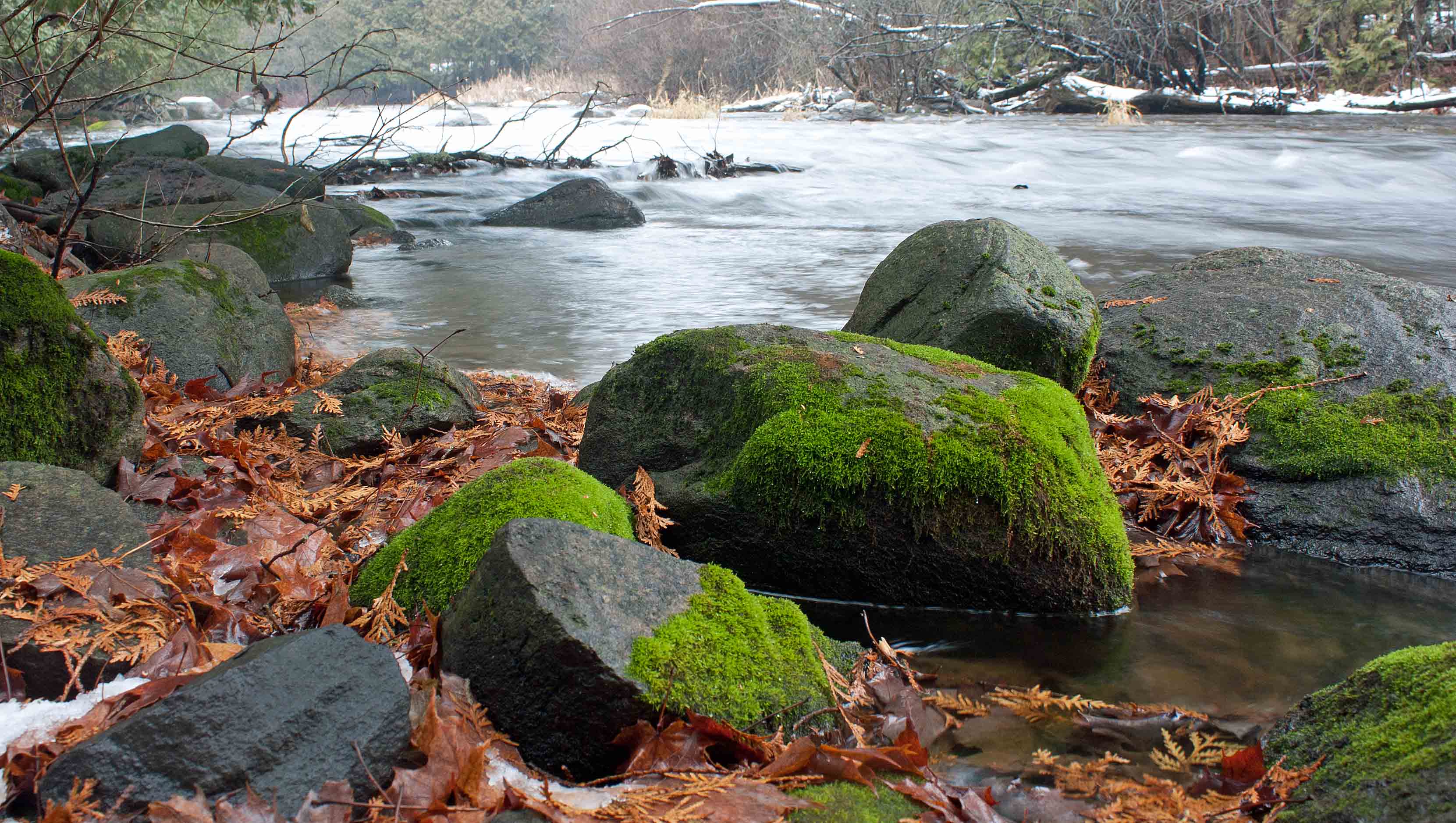
Stream swells in a spring rain in Trent Nature Sanctuary, ON (photo and rendition by Nina Munteanu)
My favourite place to walk is in the forest, by a river.
Perhaps it is the solitude… or the negative ions, the fresh pungent scents of damp loam, moss and trees. The humbling magnificence of these stately trees. The fishy bog smell of algae. Or the unknown treasures hiding in plain sight for me to discover… Whatever the combination, I find it most pleasing. And freeing.
It is also here, wandering in the forest, that my creativity flourishes as I find expression through the joy of discovery.
Old-growth forest surrounding Pierce Lake, BC (photo by Kevin Klassen)
The first step is to lose myself…
That’s the fun part: not knowing what’s beyond that hillside or down that ravine on the shores of the creek I barely see or around that bend in the root-gnarled trail among the swamp cedars. Like a moth to light, I’m drawn to the unknown. Ever the explorer.
Old-growth cedar forest in Jackson Creek forest, ON (photo and rendition by Nina Munteanu)
Gnarly cedar roots cross a path through morning fog in a swamp cedar forest, ON (photo by Nina Munteanu)
It is often here, as I walk along uneven trails or maneuver through undergrowth, up hills or down stream banks to explore and record with my camera, that I do my best thinking… Well, best in that it does not feel like thinking; more like simply ‘being.’ As my body responds to Nature’s sensual treasures, my ingenuous mind ‘walks away’ from restrictions of consciousness and roams in a kind of euphoric state of simple joy. Freed from thinking to feel and sense.
No need for a destination. The journey is my destination…
Gnarly roots of an old yellow birch snake across the old-growth cedar forest, ON (photo by Nina Munteanu)
Moss-covered boulder erratic (Nina’s Boulder) in old-growth cedar forest of Jackson Creek park, ON (photo by Nina Munteanu)
Walking in a forest unclutters my mind. The forest is simple in its natural complexity. Its beauty combs out the tangles of human encumbrance and grounds me in the simplicity of natural life.
Cookout in old-growth rainforest at Mamquam River near Squamish, BC (photo by Kevin Klassen)
I go prepared. Depending on the kind of walk, I’ll bring my clementine to snack on or a hearty lunch and fruit snacks that I carry in my backpack, along with a notebook and first aid kit. And, of course, I bring my camera. When I stop for lunch or snack, I choose my location thoughtfully, sometimes a place to sit, but mostly with a view of something worth studying. Lunch or snack stops are particularly alluring with unexpected experience.
Moss-covered rocks scatter along the banks of Jackson Creek, ON (photo by Nina Munteanu)
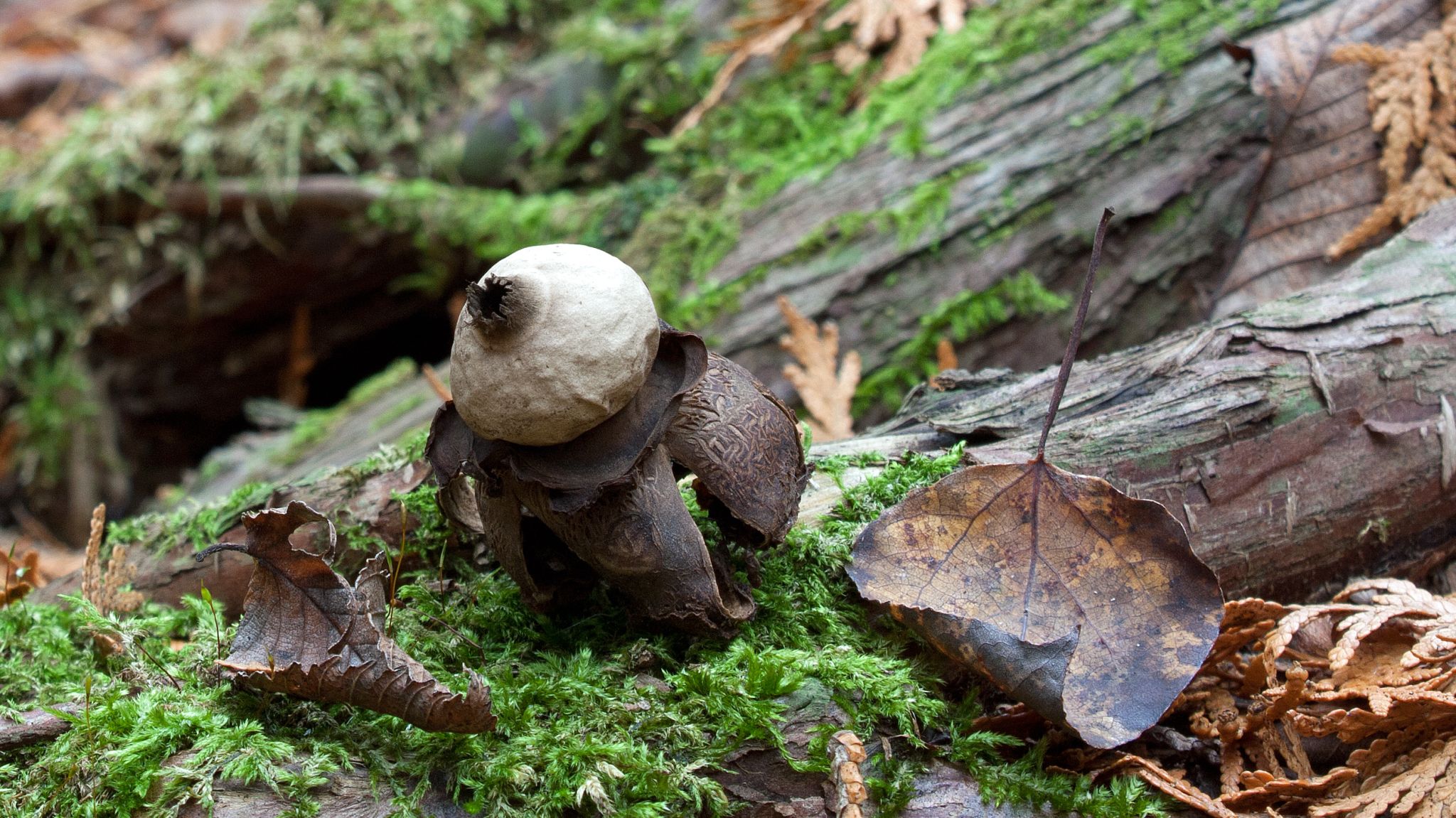
It is then, when I’ve stopped walking and have become quiet, when nature closes around me like a soft blanket and often gifts me with a precious sight or sound. A nearby red squirrel eating a nut. A bird flitting from berry to berry in a viburnum shrub. Oft times, I will be rewarded with the sight of a mushroom right at my feet or next to where I sit. That is often followed by the sight of many more.
As though the one had to be first seen to reveal the many.
Various mushrooms in Ontario forests (photos by Nina Munteanu)
Now lost, I open myself to possibility…
Like the propagules of Virginia creeper, my senses reach out to find the unexpected. I’m looking to be surprised. To discover something new that will draw me outside myself.
Various flowers and trees in southern Ontario (photos by Nina Munteanu)
The river trickles in the background as I step through dappled light and inhale the organic scents of the forest. The forest and the river help me re-align and focus—without trying. That’s the magic of it. It’s in the not trying.
Marcescent beech leaves drape over old road through swamp forest, ON (photo and rendition by Nina Munteanu)
I take my camera (and tripod) with me on most walks for those moments that I can never anticipate: like the time a deer stepped gracefully out from behind a tree not three metres from me in a moss-covered red pine forest. I was in the process of setting up my camera on its tripod to capture the trail through the pines when the deer moved gracefully into my sight. Startled, we both froze and stared at one another for a moment made eternity. The deer then sprang away and loped through the trees, disappearing within seconds. I stood, hands fixed on my camera shutter button, and smiled. I had not taken a picture. But I now basked in that frozen moment of fascination between two curious animals, a deer and a human.
I didn’t need a picture; I already had my prize, the enduring memory of that moment.
Pine trees loom tall at the location where I met the deer in Petroglyph National Park, ON (photo and rendition by Nina Munteanu)
In the April 2014 issue of the Journal of Experimental Pshychology: Learning, Memory and Cognition, Stanford researchers Marily Oppezzo and Daniel L. Schwartz demonstrated that walking boosts creative inspiration. Using the Guildford’s Alternative Uses Test they showed that the act of walking significantly increased creativity for 81% of the participants. Oppezzo and Schwartz were able to demonstrate that the creative ideas generated while walking were not irrelevant or far-fetched, but innovative and practical.
Moss-covered ancient hemlock in the Catchacoma old-growth forest, ON (photo by Nina Munteanu)
It begins with changes to our chemistry. In the September 3 2014 issue of TheNew Yorker, journalist Ferris Jabr describes why walking opens the mind to creativity:
“When we go for a walk, the heart pumps faster, circulating more blood and oxygen not just to the muscles but to all the organs—including the brain. Many experiments have shown that after or during exercise, even very mild exertion, people perform better on tests of memory and attention. Walking on a regular basis also promotes new connections between brain cells, staves off the usual withering of brain tissue that comes with age, increases the volume of the hippocampus [a brain region crucial to relational memory and contextual learning], and elevates levels of molecules that both stimulate the growth of new neurons and transmit messages between them.”
Beech tree with marcescent leaves in a mixed forest, ON (photo by Nina Munteanu)
So, I walk and I create in my mind and my heart as I prepare to write my next novel…
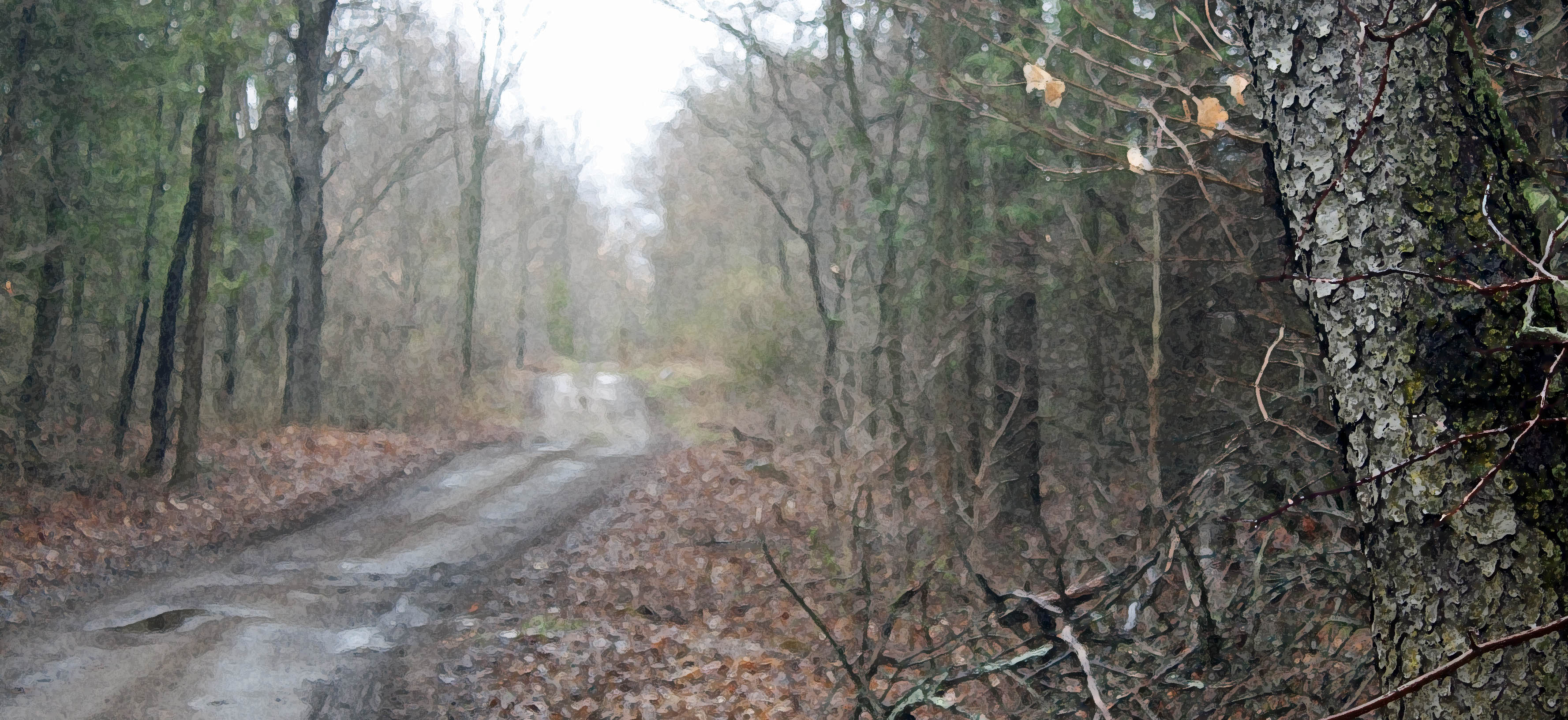
Payne Line road in the mists of an early morning rain, ON (photo and rendition by Nina Munteanu)
Nina Munteanu is a Canadian ecologist / limnologist and novelist. She is co-editor of Europa SF and currently teaches writing courses at George Brown College and the University of Toronto. Visit www.ninamunteanu.ca for the latest on her books. Nina’s bilingual “La natura dell’acqua / The Way of Water” was published by Mincione Edizioni in Rome. Her non-fiction book “Water Is…” by Pixl Press (Vancouver) was selected by Margaret Atwood in the New York Times ‘Year in Reading’ and was chosen as the 2017 Summer Read by Water Canada. Her novel “A Diary in the Age of Water” was released by Inanna Publications (Toronto) in June 2020.
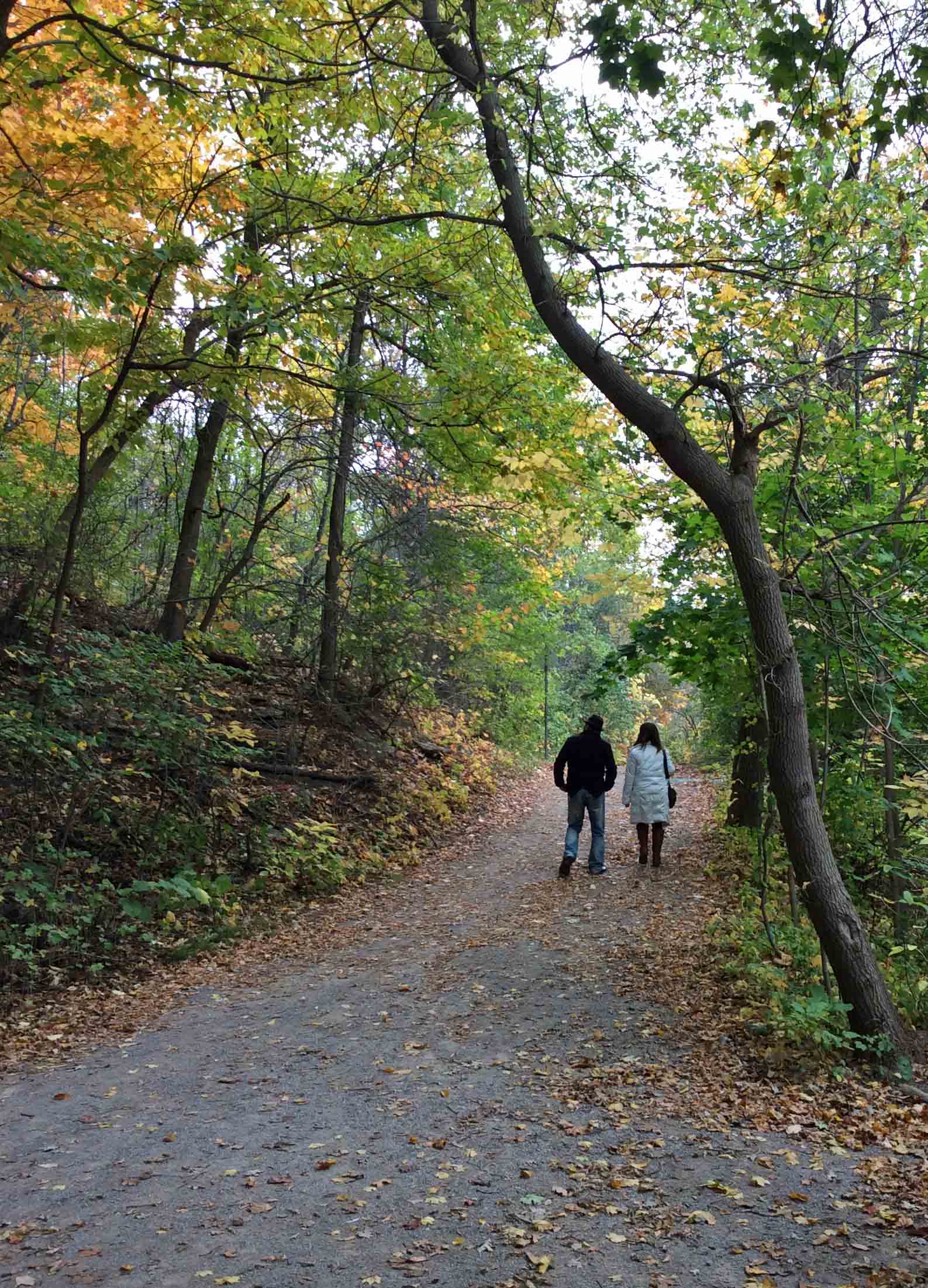
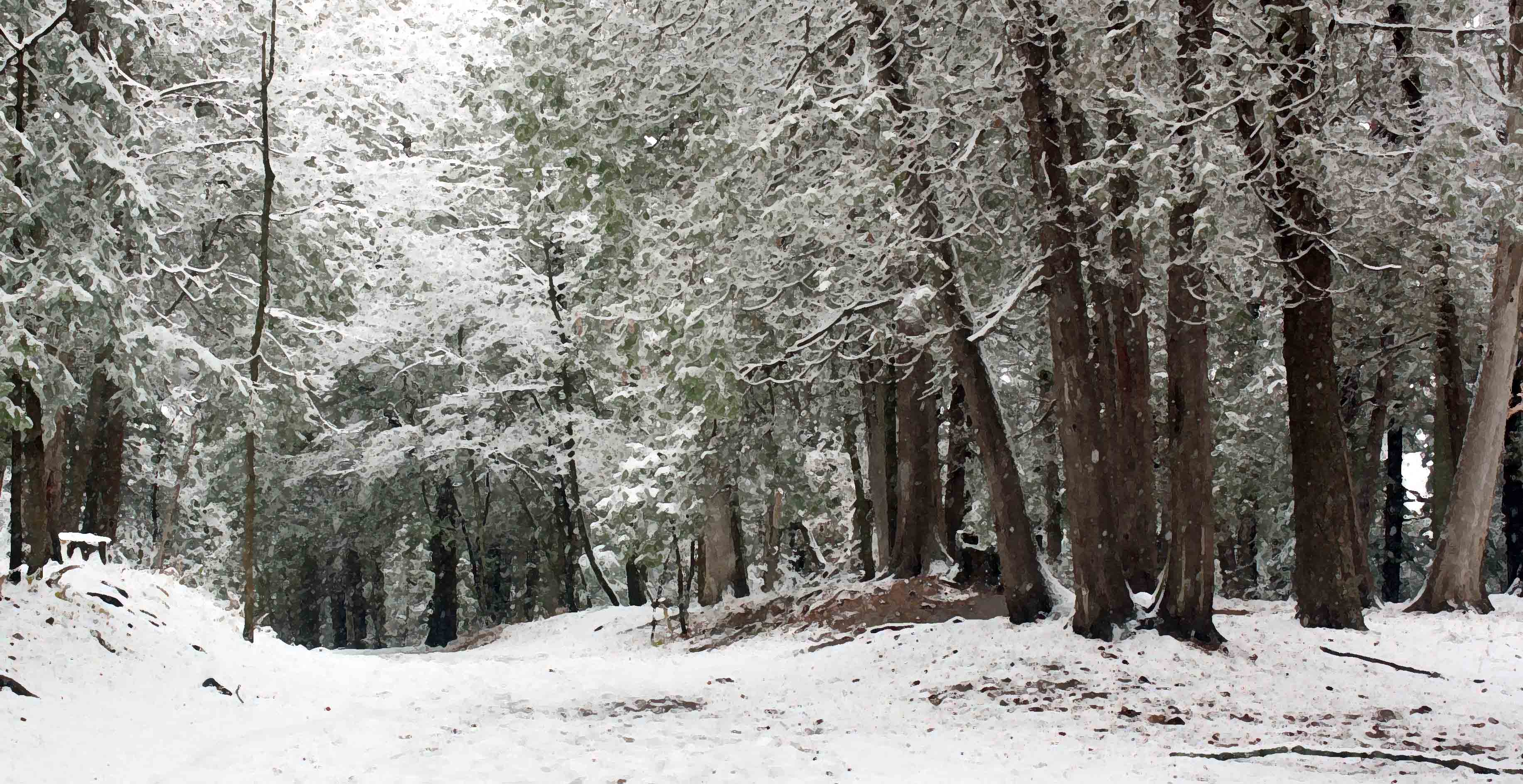
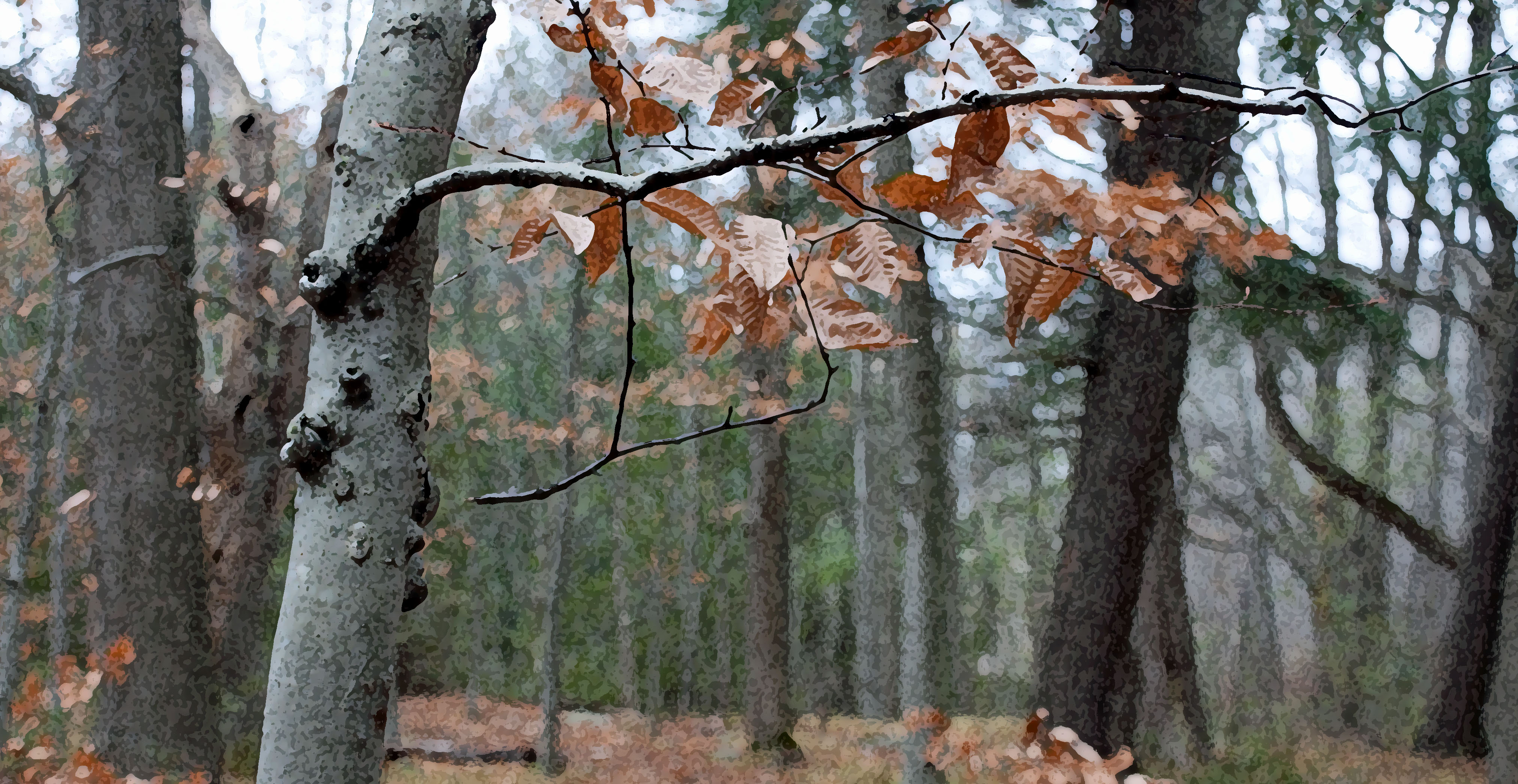
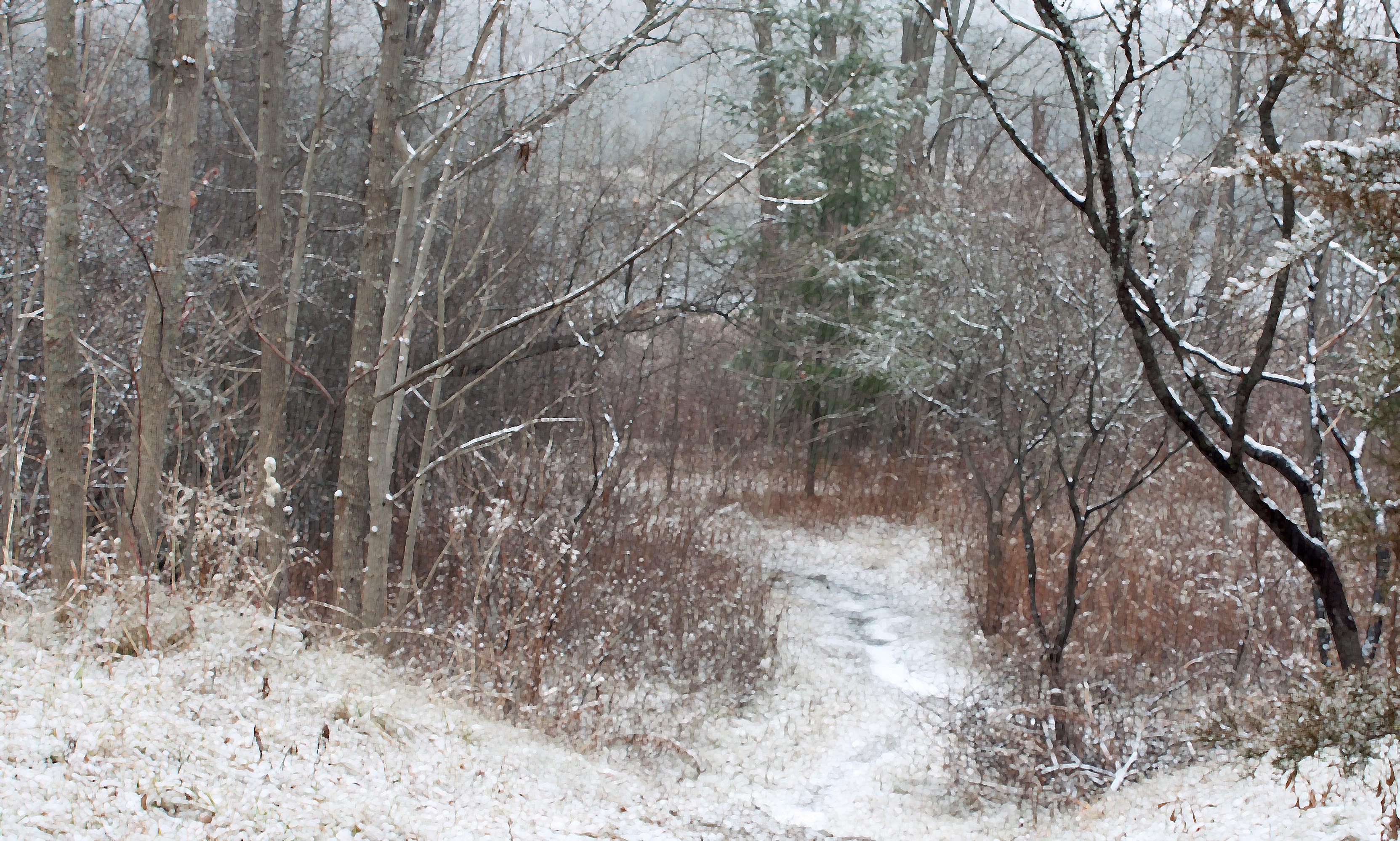
Beech trees stand with bronzed leaves as the snow falls in the mixed forest of South Drumlin park, ON (photo and rendition by Nina Munteanu)
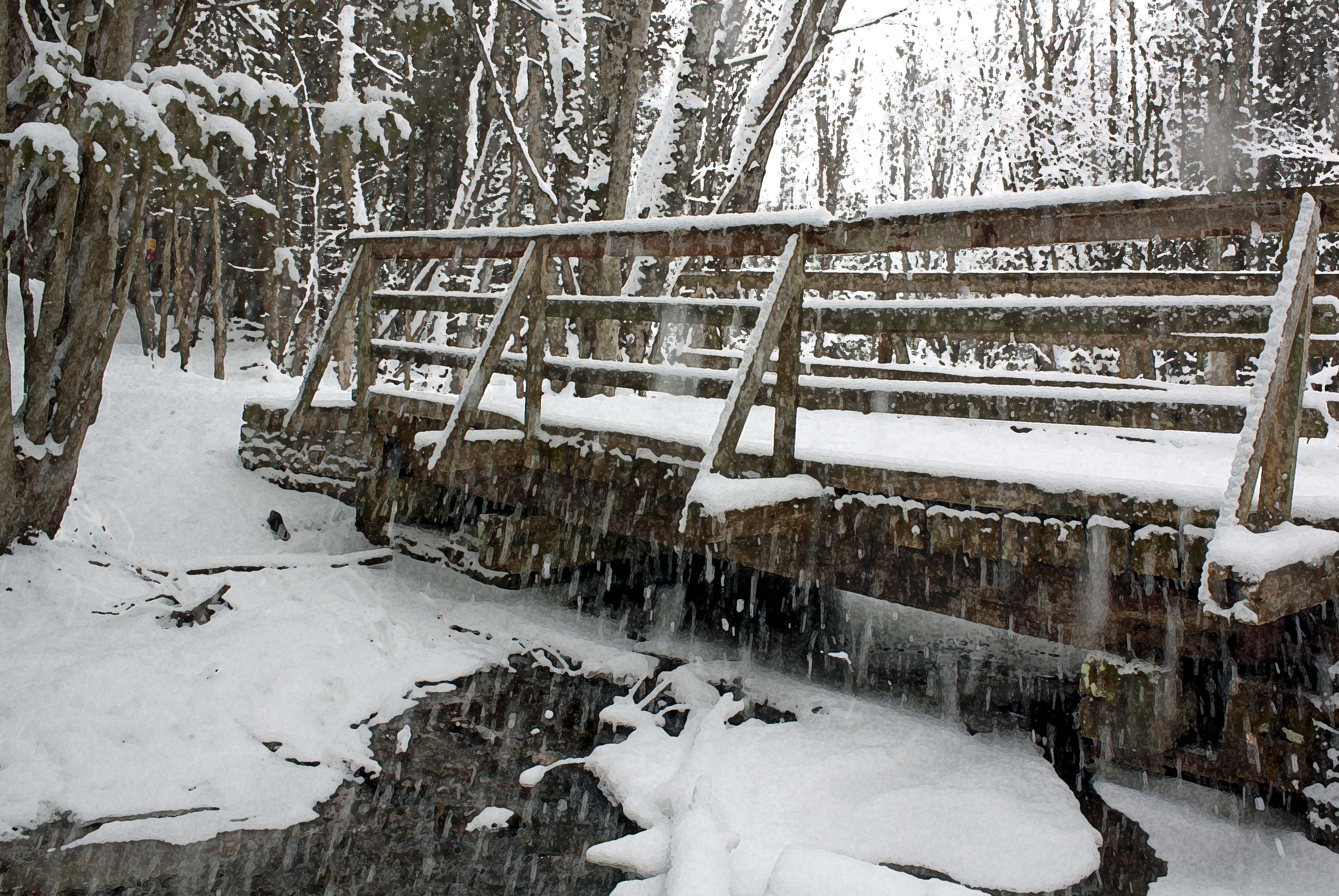
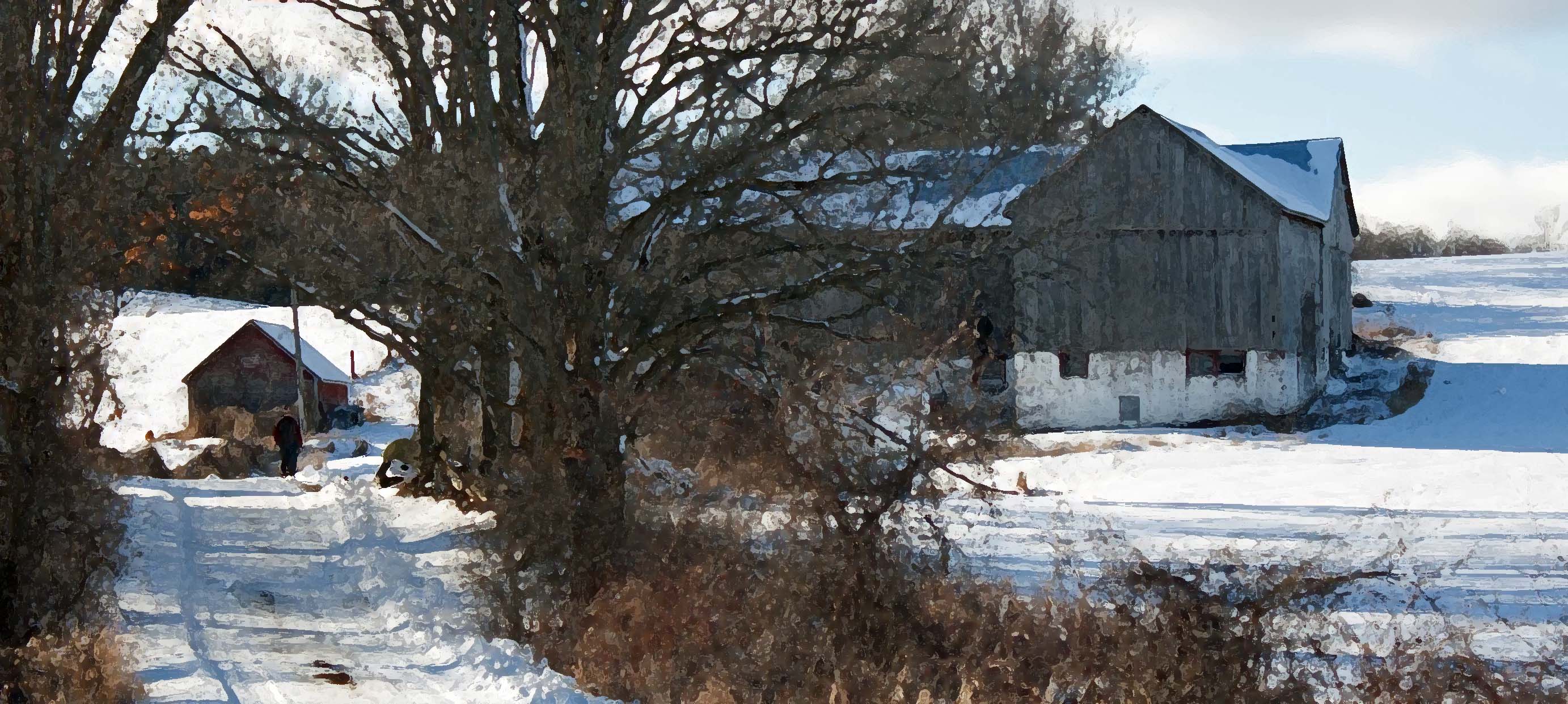
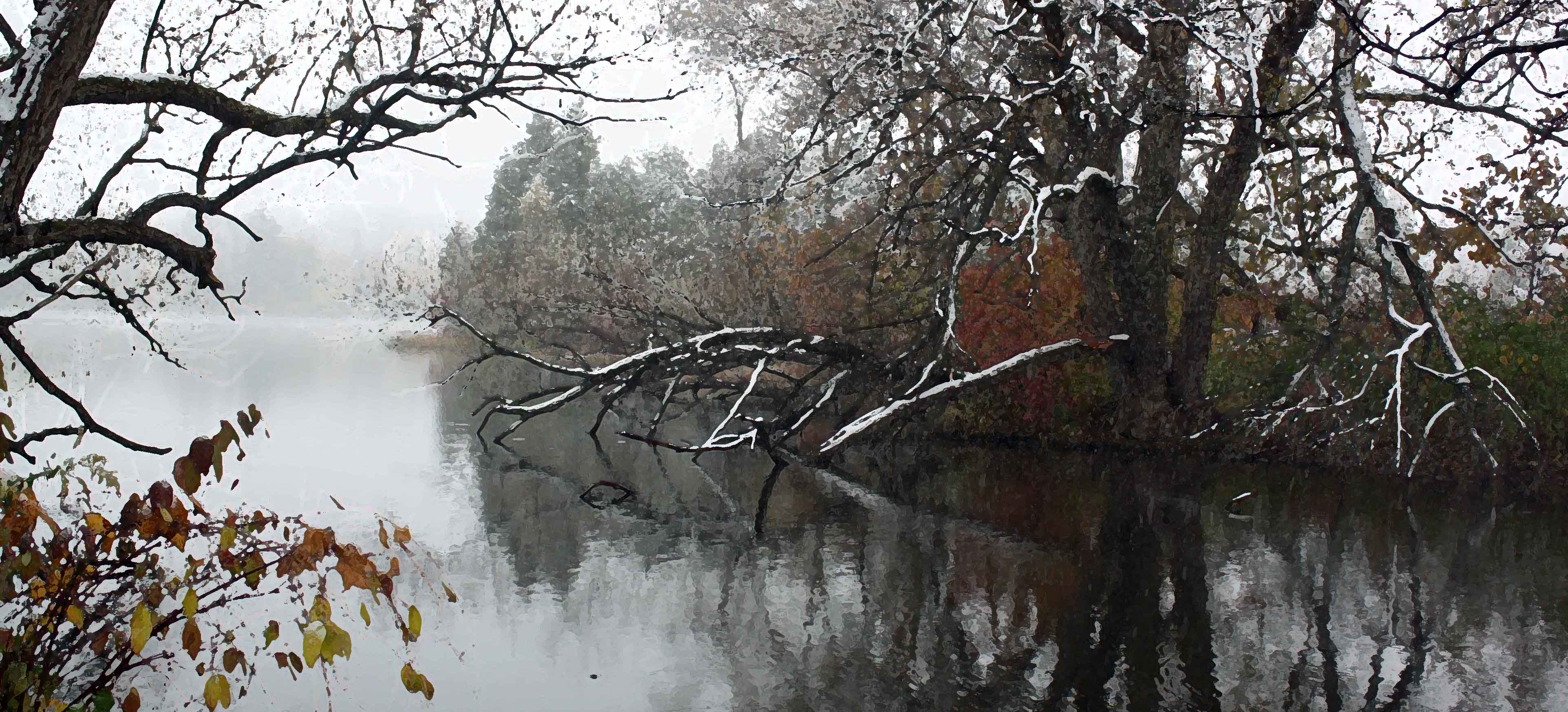
Yesterday, it started snowing near the end of my work shift, and I kept glancing out the window as it turned into a heavy thick snow, the kind I just adore. Whenever this happens, I long for werifesteria…
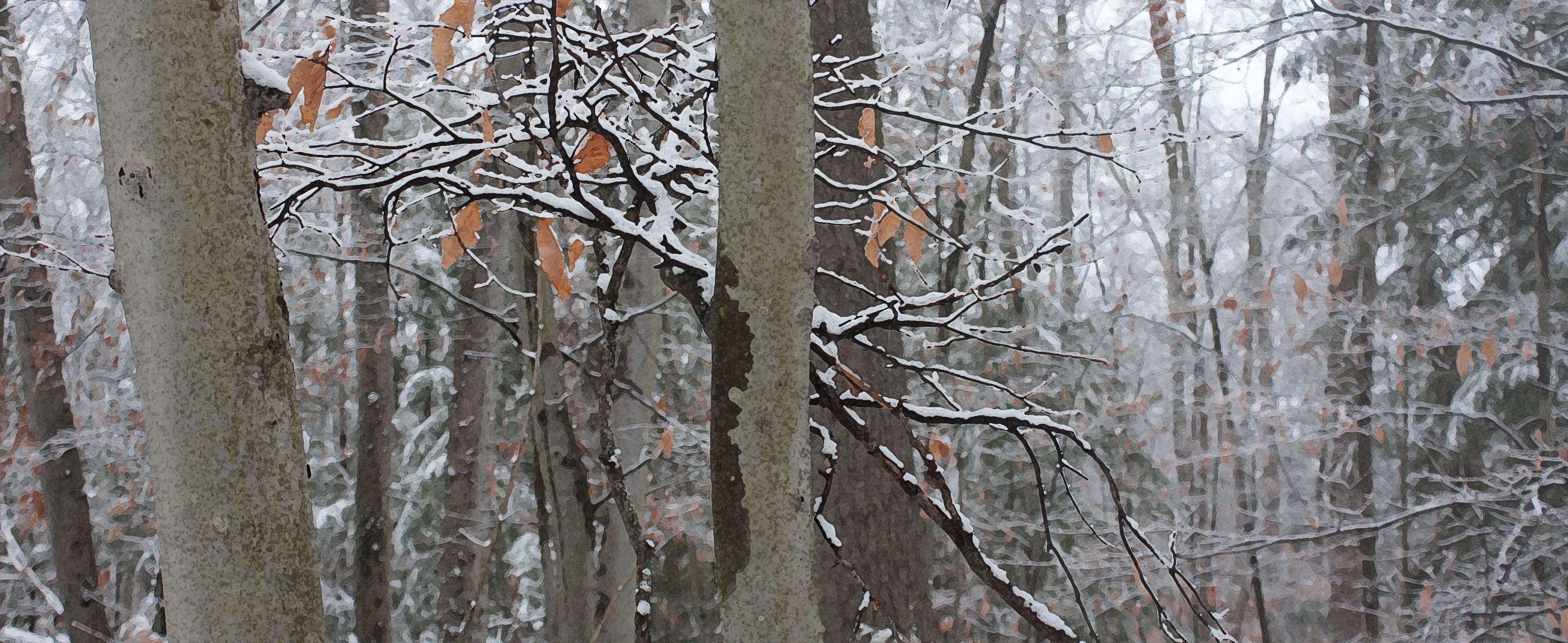
A pair of beech trees stand pale among hemlocks and poplar trees, South Drumlin park, ON (photo and rendition by Nina Munteanu)
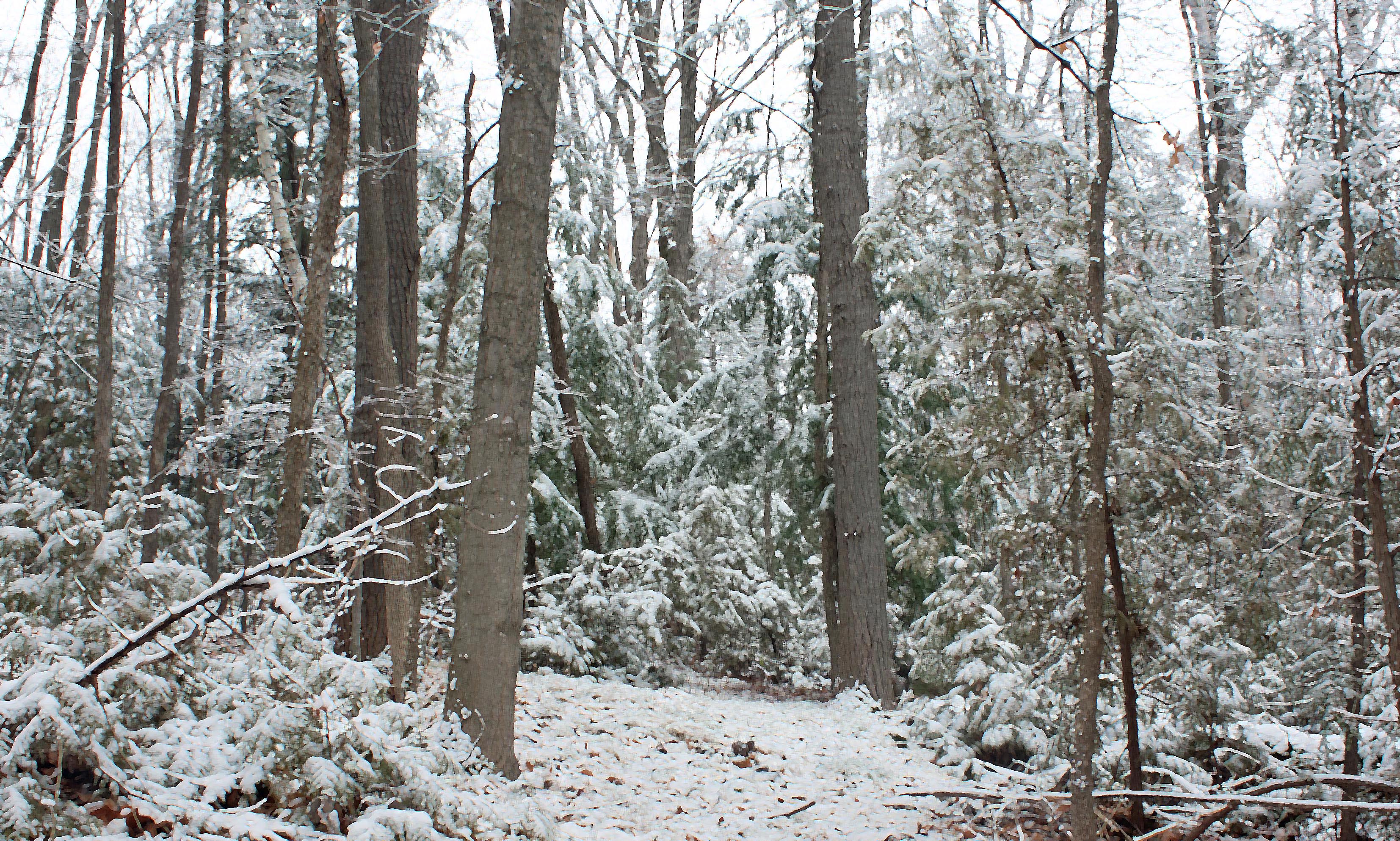
Beech-hemlock forest after a light snow in South Drumlin park, ON (photo and rendition by Nina Munteanu)
As soon as the shift was over, I snatched my gear and rushed off with my camera and tripod and a pack of blueberries to the beech-maple-hemlock forest nearby. The place is called South Drumlin Park, because the forest runs up and down a hogsback with wonderful trails throughout.
Marcescent beech trees greet me along a trail in South Drumlin park, ON (photo and rendition by Nina Munteanu)
I was the only person there. I walked and crunched through snow and frost-hardened leaf litter and I let myself get lost in the labyrinth of trails through the open winter forest. The pale beech trees, because they keep their now copper-coloured marcescent leaves, stood out amid the bare maples, oaks, poplars and birch trees.
Pale bronze beech leaves light up the dark hemlock forest, South Drumlin park (photo and rendition by Nina Munteanu)
I wandered there for hours, inhaling the peaceful freshness and the quiet hush of gentle snowing in the forest.
There were just a few rowdy red squirrels and one persistent bluejay, but all else lay quiet in the deep of the forest. I had found my magic and mystery … It felt sublime and my heart sang…
Trail through poplars, cedars and hemlocks toward the river, South Drumlin park, ON (photo and rendition by Nina Munteanu)
Nina Munteanu is a Canadian ecologist / limnologist and novelist. She is co-editor of Europa SF and currently teaches writing courses at George Brown College and the University of Toronto. Visit www.ninamunteanu.ca for the latest on her books. Nina’s bilingual “La natura dell’acqua / The Way of Water” was published by Mincione Edizioni in Rome. Her non-fiction book “Water Is…” by Pixl Press (Vancouver) was selected by Margaret Atwood in the New York Times ‘Year in Reading’ and was chosen as the 2017 Summer Read by Water Canada. Her novel “A Diary in the Age of Water” was released by Inanna Publications (Toronto) in June 2020.
McGill University, view from main gate on Rue Sherbrooke (photo by Nina Munteanu)
I’ve just returned from Montreal, where I was invited to participate in a two-day conference hosted by McGill University’s Bieler School of Environment at Esplanade Tranquil. Named after Kim Stanley Robinson’s eco-fiction novel New York 2140, the conference brought together a diverse assemblage of scientists, academic researchers, urban planners, speculative fiction writers, artists, and students in a small setting dedicated to encourage cross-pollination of ideas and visions through panels and workshops. I sat on a panel and a roundtable with other writers, urban planners, engineers, scientists and activists to discuss futures through science and story. Much of the event focused on the literary genre called Hopepunk—a sub-genre of Speculative Fiction devoted to optimistic themes of scientific transformation, discovery and empathy. Resulting dialogue explored forms of communication, expression, and ways not just to deal with growing solastalgia, eco-grief, and environmental anxiety but to move forward through action and hope.
Breakout groups in Seeds of Good Anthropocenes Workshop (photo by Nina Munteanu)
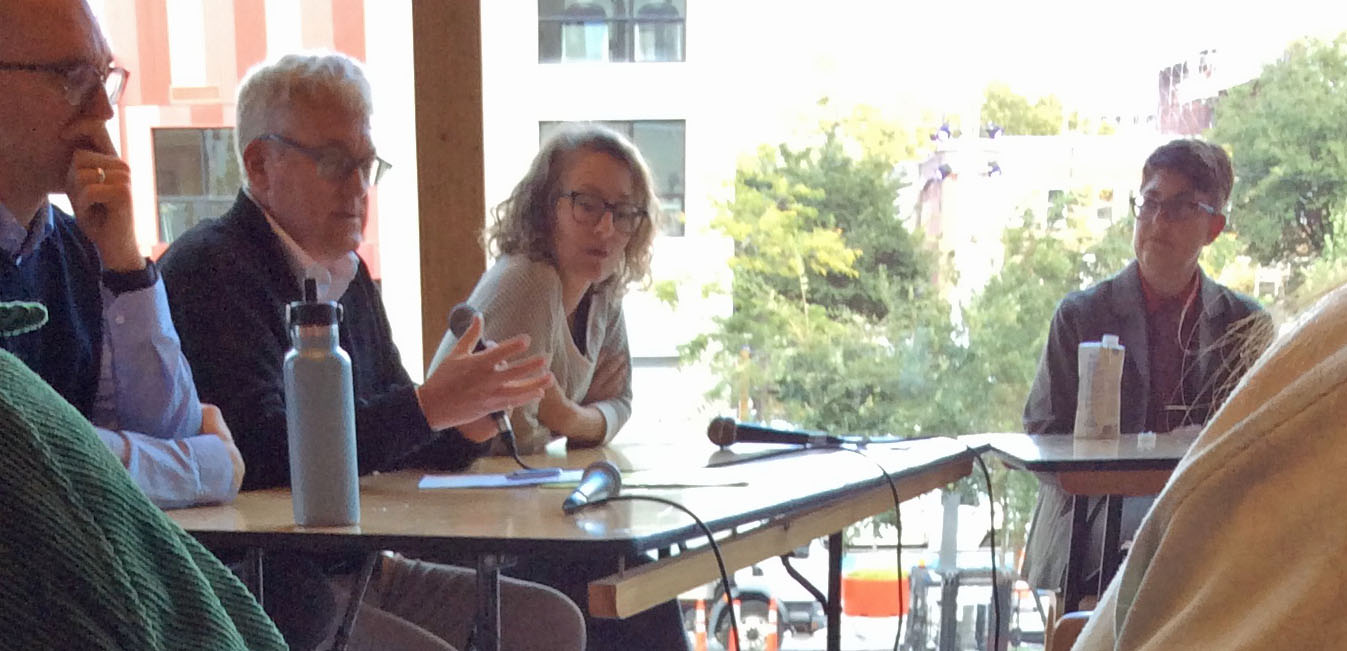
McGill faculty in Panel on ‘Turning Research into Hopeful Stories’ (photo by Nina Munteanu)
In the Thursday morning writer’s panel, in which we explored the role of science knowledge and hope in story, I shared the writing process I underwent with my latest published novel A Diary in the Age of Water, which I categorize as a hopeful dystopia (‘Hopeful dystopias’ are much more than an apparent oxymoron; they are in some fundamental way, the spearhead of the future—and ironically often a celebration of human spirit by shining a light through the darkness of disaster):
The main character in A Diary in the Age of Water was a limnologist like me who kept a journal (the diary referenced in the title of the book). This part of the story took place in the near-future when the water crisis and associated climate change phenomena had become calamitous. Being a scientist with so much intimate knowledge of the crisis, the diarist became cynical and lost her faith in humanity. I recall my own journey into despair as I did the research needed to convey the character’s knowledge and situation. I found myself creating a new character (the diarist’s daughter) much in the way a drowning swimmer takes hold of a life-saver, to pull me out of the darkness I’d tumbled into. The daughter’s hopeful nature and faith in humanity pulled both me and the reader out of the darkness. The cynical nature of the diarist came from a sense of being overwhelmed by the largeness of the crisis and froze her with feelings of powerlessness. The diarist’s daughter rose like an underground spring from the darkness by focusing on a single light: her friend and lover who pointed to a way forward. As Greta so aptly said once, “action leads to hope” and hope leads to action. Despite the dire circumstances in the novel, I think of A Diary in the Age of Water as a story of resilience. And ultimately of hope.
I came to the conference as a writer, scientist, mother, and environmental activist. What I discovered was an incredible solidarity with a group so diverse in culture, disciplines, expression and language—and yet so singularly united. It was heartwarming. Hopeful. And necessary. This conference ultimately felt like a lifeline to a world of possibilities.
Organizers brought in a wide variety of talent, skill, and interest and challenged everyone through well-run workshops to think, feel, discover, discuss, collaborate and express. Workshops, panels, and multimedia art incited co-participation with all attendees in imaginative and fun ways. On-site lunches and drinks helped keep everyone together and provided further space for interaction and discussion.
Student-led break out group discussing ways to transform eco-emotions into hope (photo by Nina Munteanu)
At every turn, I made contacts across disciplines and interests and had stimulating and meaningful conversations. I discovered many hopeful ‘stories’ of Montreal and elsewhere on hopeful visions and endeavors. These included “Seeds of good Anthropocenes” (small ground-rooted projects and initiatives aimed at shaping a future that is just, prosperous, and sustainable); turning scientific research into hopeful stories; and world building as resistance. I talked with artistic creators, students doing masters in Hopepunk literature and co-panelists on all manner of subjects from urban encampments, greening and rewilding Montreal, to how Rachel Carson’s Silent Spring informed a main character in Liu Cixin’s novel The Three Body Problem.
Creating visual art via MAPP (photo by Nina Munteanu)
Marc-Olivier Lamothe stands next to a MAPP projection (photo by Nina Munteanu)
Conversations often led to an acknowledgement of art as an effective means of expression and creative therapy in the context of the climate crisis. I met creatives such as Marc-Olivier Lamothe and his colleagues at MAPP and had the chance to experiment first hand with his creative tools. I had wonderful discussions with storytelling visual artist Alina Gutierrez Mejia of Visual Versa, whose evolving mural of each day’s events was truly mesmerizing to watch—and rather revealing.
Alina Gutierrez Mejia creates a visual representation of the day’s conference (photo by Nina Munteanu)
In future, I’ll post more on these and other creatives I encountered at the conference.
Program for Montreal 2140
THURSDAY morning began with an introduction by BDE Director Frédéric Fabry.
This was followed by a panel entitled Hopeful Stories Across Science and Fiction, in which I participated, along with fellow writers Su J. Sokol (author of Zee), Alyx Dellamonica (author of Gamechanger), Rich Larson (author of Annex and Ymir), Genevieve Blouin (author of Le mouroir des anges) and Andrea Renaud Simard (author of Les Tisseurs). The panel was moderated by McGill geographer Renee Sieber and McGill urban planner Lisa Bornstein.
After lunch, a panel entitled Faculty Workshop: Turning Research into Hopeful Stories was moderated by McGill researcher Kevin Manaugh and Annalee Newitz (journalist and author of Four Lost Cities). McGill researchers included: Caroline Wagner (bioengineering), Hillary Kaell (anthropology and religious studies); Jim Nicell (civil engineering); Sébastien Jodoin (law); and Michael Hendricks (biology).
McGill students who lead the workshop on Hope and the Future stand with one of the conference organizers Daniel Lukes (photo by Nina Munteanu)
The faculty panel was followed by the Student Workshop, Hope and the Future, led by McGill students Tom Nakasako, Rachel Barker, Tatum Hillier, and Lydia Lepki.
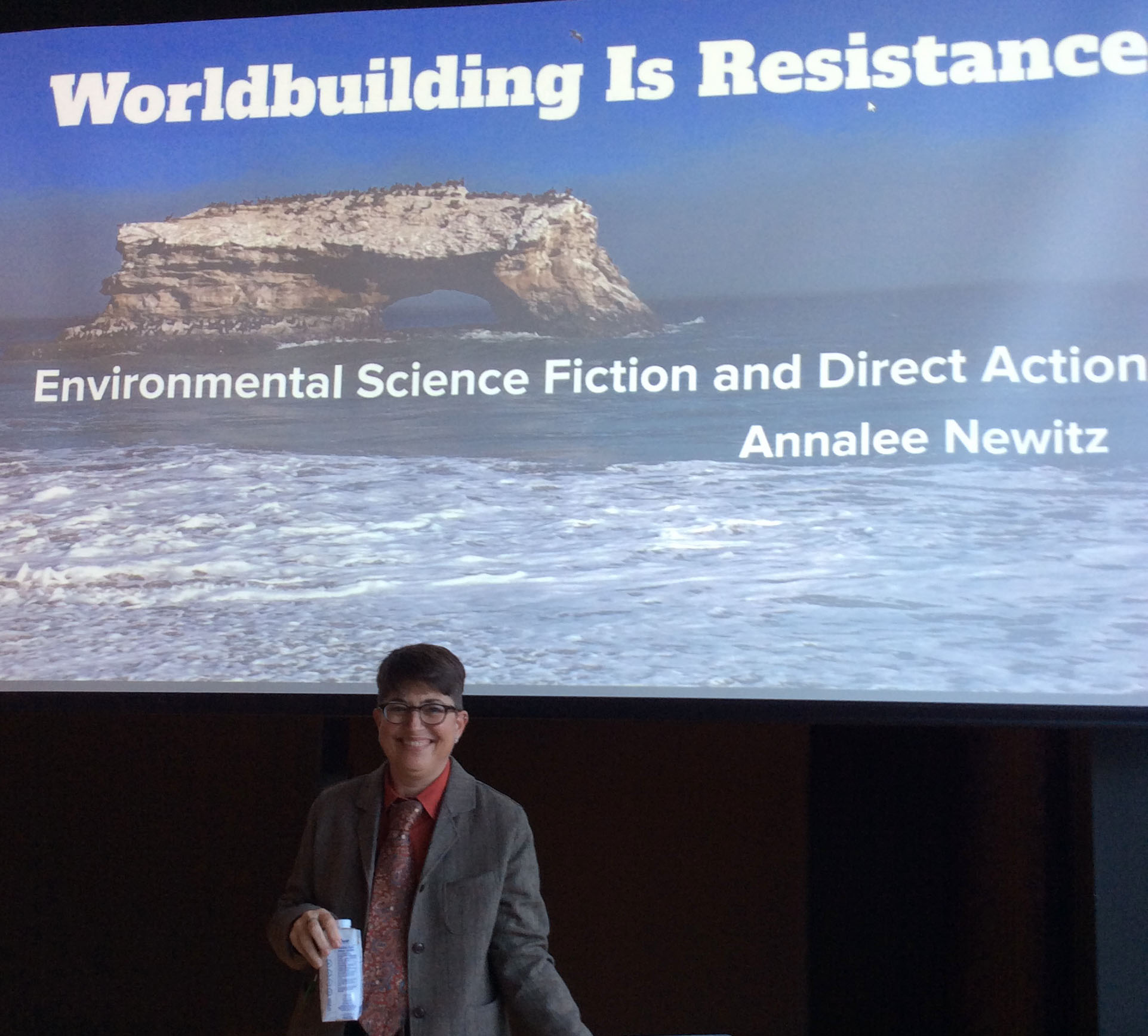
Annalee Newitz gives her keynote (photo by Nina Munteanu)
Annalee Newitz closed the day with their keynote presentation Worldbuilding Is Resistance that explored the dystopia binary of environmental science fiction. A theme to which the next keynote by Kim Stanley Robinson would touch on as well.
Elson Galang presenting Seeds workshop (photo by Nina Munteanu)
FRIDAY morning started with Elson Galang and Elena Bennett (McGill University), who led the Seeds of Good Anthropocenes Workshop, which introduced the concept of seeds programs then further explored through breakout discussion groups they moderated.
This was followed by faculty-led Teaching and Learning for Hopeful Futures Workshop, in which McGill instructors from varied disciplines (including education, political science, environment, urban planning and planetary sciences) discussed translating science into hopeful narratives.
pre-meet on Zoom of participants of the Roundtable
I then participated in a roundtable of authors, scholars, researchers and planners entitled Telling the Story of the Future, moderated by Chris Barrington-Leigh (McGill BSE/Health and Social Policy). The roundtable included fellow authors Alyx Dellamonica and Su J. Sokol. Other participants of the roundtable included Stephanie Posthumus (languages, literatures, cultures at McGill), Jayne Engle (public policy at McGill) Richard Sheamur (urban planning at McGill), and limnologist Irene Gregory-Eaves (biology at McGill).
BDE Director Frédéric Fabry introduces the conference (photo by Nina Munteanu)
The final keynote was given by Kim Stanley Robinson (author of New York 2140 and The Ministry of the Future).
Storyboard of the first day of the conference by Visual Versa (photo by Nina Munteanu)
Nina Munteanu is a Canadian ecologist / limnologist and novelist. She is co-editor of Europa SF and currently teaches writing courses at George Brown College and the University of Toronto. Visit www.ninamunteanu.ca for the latest on her books. Nina’s bilingual “La natura dell’acqua / The Way of Water” was published by Mincione Edizioni in Rome. Her non-fiction book “Water Is…” by Pixl Press (Vancouver) was selected by Margaret Atwood in the New York Times ‘Year in Reading’ and was chosen as the 2017 Summer Read by Water Canada. Her novel “A Diary in the Age of Water” was released by Inanna Publications (Toronto) in June 2020.
Maude Barlow, author of Boiling Point, Chairman of the Council of Canadians
Like a car, every novel has its point of ignition: a spark that sets it in motion. This occurs when a premise or idea comes together with an incendiary moment of clarity or a thematic question. Mine—though I didn’t know it at the time—happened in a church on the Summer of 2016.
I was in a United Church on Bloor Street, in Toronto’s Annex, watching a talk given by Maude Barlow on water justice. The radical talk was based on her recent book Boiling Point, a comprehensive exploration of Canada’s water crisis—a crisis that most Canadians weren’t—and still aren’t—aware. Canada is steward to a fifth of the world’s fresh water, after all. It is a water-rich country. Of the dozen largest inland lakes in the world, Canada holds eight of them. So, why water crisis? Barlow explains. And you should read Boiling Point, particularly if you’re Canadian. It will open your eyes to the politics of water and how multinational corporations—like Nestlé—are already grabbing and funneling water away from Canadians and into the global profit machine.
I sat close to the front of the Church sanctuary to best see her. But I soon noticed that many people had elected to sit in the gallery above. I found myself focusing on a young mother and her little girl. The girl had some paper and crayons and was busy with that as the enthusiastic mother listened to Maude deliver dire facts about corporate water high-jacking and government complicity.
I saw a story there.
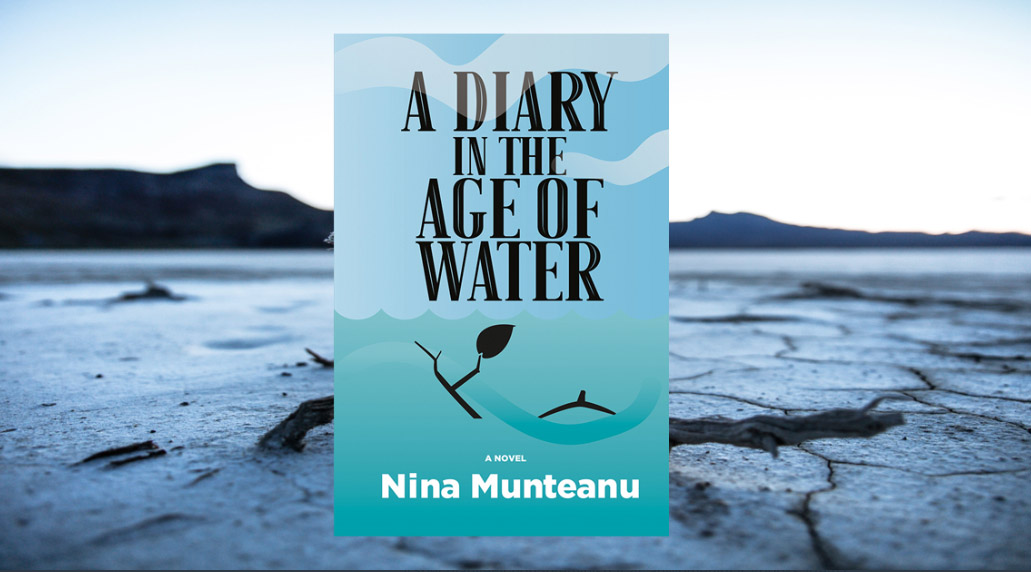
What mother would take her pre-school child to a socio-political talk on water? I would later reflect that memory of the mother and her little girl through my characters Una and her little daughter Lynna, the diarist in my novel A Diary in the Age of Water (eventually published in 2020 with Inanna Publications).
Fresh water flows down the barrel of a hand-operated water pump.
My novel really began with a short story I was invited to write in 2015 by editors of Future Fiction and Mincione Edizioni about water and politics in Canada; the premise of this story would later find it’s way into the larger novel. I had long been thinking of potential ironies in Canada’s water-rich heritage. The premise I wanted to explore was the irony of people in a water-rich nation experiencing water scarcity: living under a government-imposed daily water quota of 5 litres as water bottling and utility companies took it all. I named the story “The Way of Water.” It was about a young woman (Hilda) in near-future Toronto who has run out of water credits for the public wTap; by this time houses no longer have potable water and their water taps have been cemented shut; the only way to get water is through the public wTaps—at great cost. She is in a line of people; she’s two metres from water—and dying of thirst.
“The Way of Water” captures a vision that explores the nuances of corporate and government corruption and deceit together with global resource warfare. In this near-future, Canada is mined of all its water by thirsty Chinese and US multinationals—leaving nothing for the Canadians. Rain has not fallen on Canadian soil in years due to advances in geoengineering and weather manipulation that prevent rain clouds from going anywhere north of the Canada-US border. If you’re wondering if this is possible, it’s already happening in China and surrounding countries.
The story first appeared in 2015 in Future Fiction, edited by Francesco Verso, and in 2016 as a bilingual (English and Italian) book and essay published by Mincione Edizioni in Rome. The story has so far been reprinted seven times in magazines and anthologies, including “Cli-Fi: Canadian Tales of Climate Change Anthology” (Exile Editions, Bruce Meyer, ed), in 2017, “Future Fiction: New Dimensions in International Science Fiction” (Francesco Verso & Bill Campbell, eds; Future Fiction / Rosarium Publishing, Rome and Greenbelt, MD) in 2018; and in Little Blue Marble Magazine (Katrina Archer, ed) in January, 2019 and in their ‘Best of’ anthology. It was then published in 2022 in Metastellar Magazine and later in their ‘Best of’ anthology. “The Way of Water” received generous praise from review sites and the press worldwide.
After the success of this short story, I realized that I needed to tell the larger story—how did the world—Canada—get to where Hilda was? Her mysterious mother, the limnologist Lynna who was taken away by the RCMP in 2063, clamored for more attention. I remembered that four-year old girl and her mother in the gallery at Maude Barlow’s talk on water politics. And I thought of my characters: young Lynna and her mother Una. How does a daughter of an activist mother behave and think? How best to express her voice? I had earlier written a short story that was a mix of correspondence (emails) and third person narrative (“The Arc of Time” in Natural Selection, later reprinted in Metastellar Magazine), which I felt captured the voices of the characters well. I realized that a diary by Lynna would be an ideal way for her to express her unique worldview and cynicism—yet allow her vulnerable humanity to reveal itself through this unique relationship with her diary. The remaining characters and their narratives emerged easily from there: Una, her activist mother; Daniel, her conspiracy theorist colleague (and her conscience); Orvil, the water baron (and lover she betrayed); and Hilda, her “wayward” supposedly mind-challenged daughter—who appears in the short story that takes place later.
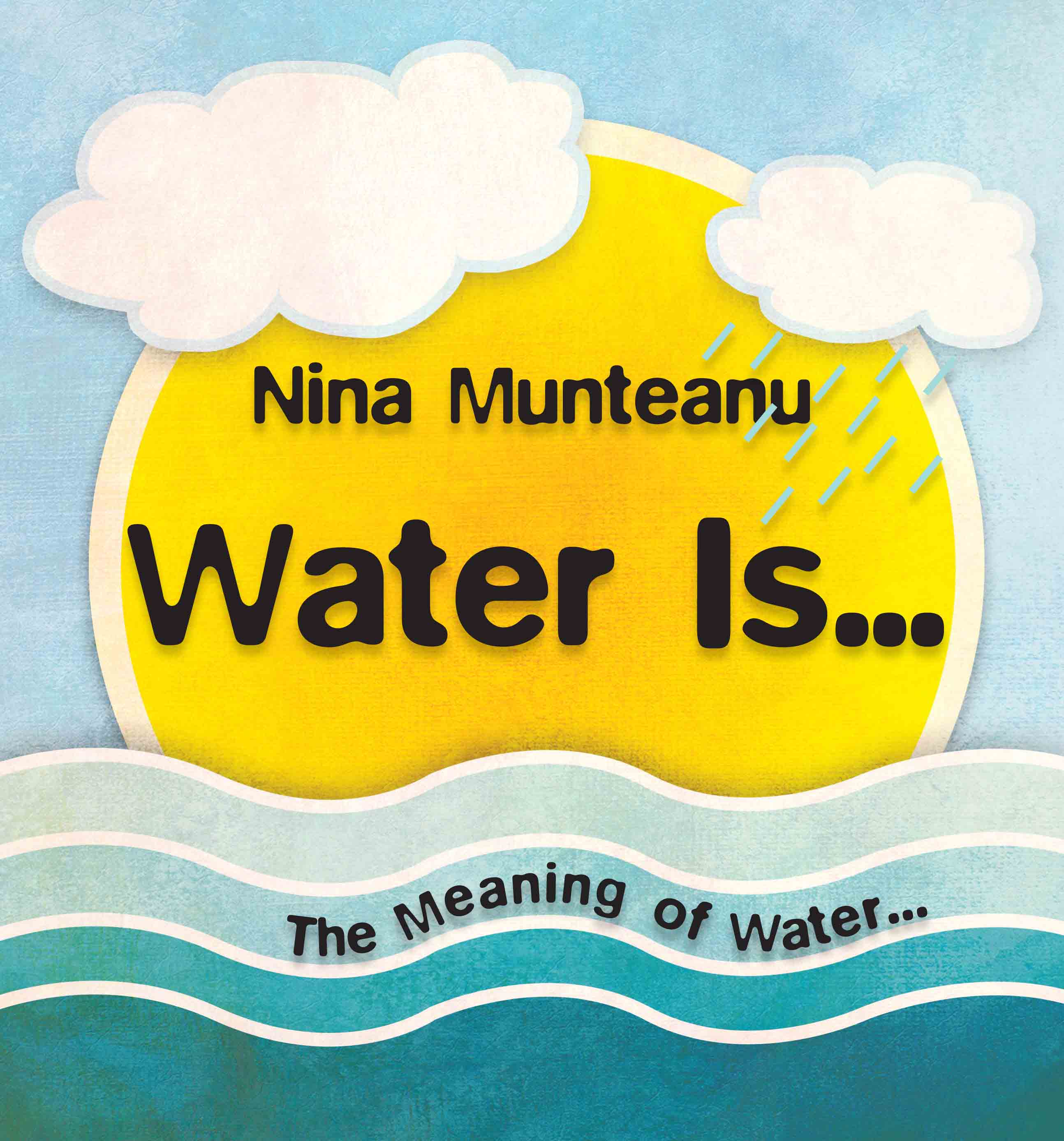
I had a lot of material; I had already been researching water issues and climate change in my activism as a science writer and reporter. In 2016, Pixl Press had published “Water Is… The Meaning of Water”,essentially a biography of water, written from the perspective of mother, environmentalist and scientist. I had practiced as a limnologist for over twenty-five years and could mine my various personal experiences in the field, lab and office with genuine realism. I chose Wetzel’s Limnology (the classic text book I used in my introductory limnology course) for quotes to each of Lynna’s entries; this added an opportunity to provide additional metaphor and irony through Lynna’s scientific voice. I placed the child Lynna (who was born in 2012) into actual events in Toronto, where I currently live. This pushed the story further into the area of documentary and blurred the lines between fiction and non-fiction to achieve a gritty and textured reality. Lynna also taught limnology at the University of Toronto, where I currently teach.
Just as Water Is… served as a watershed for all my relevant experiences as mother, environmentalist and scientist, A Diary in the Age of Water would galvanize many of my personal experiences, doubts, challenges and victories into compelling story. Although parts of the story wrote themselves, the entire book was not easy to write. There were times when I had to walk away from the book to gain some perspective—and optimism—before continuing. When I found myself drowning in Lynna’s voice, I invoked Hilda to guide me to shore. I found a balance that worked and compelled. Ultimately this opened to some of the best internal conflict and tension I have experienced in my writing.
Like water itself, A Diary in the Age of Water expresses through many vessels and in many perspectives, spanning hundreds of years—and four generations of women—with a context wider than human life. Through its characters, A Diary in the Age of Waterexplores the big question of humanity’s deadlock with planetary wellness and whether one is worth saving at the expense of the other. One of the characters asks Lynna the hard question: “If you had the chance to save the planet [stop the mass extinctions, deforestation and pollution ravaging the planet], but it was at the expense of humanity, would you do it?”
Water is, in fact, a character in the book—sometimes subtle and revealed in subtext, other times horrific and roaring with a clamorous voice. Water plays both metaphoric and literal roles in this allegorical tale of humanity’s final journey from home. The story explores identity and our concept of what is “normal”—as a nation and an individual—in a world that is rapidly and incomprehensibly changing—and in which each of us plays a vital role simply by doing or not doing.
A Diary in the Age of Water promises to leave you adjusting your frame of reference to see the world, yourself—and water—in a different way.
Illustration on Liisbeth article (photo collage by PK Mutch and Dreamstime
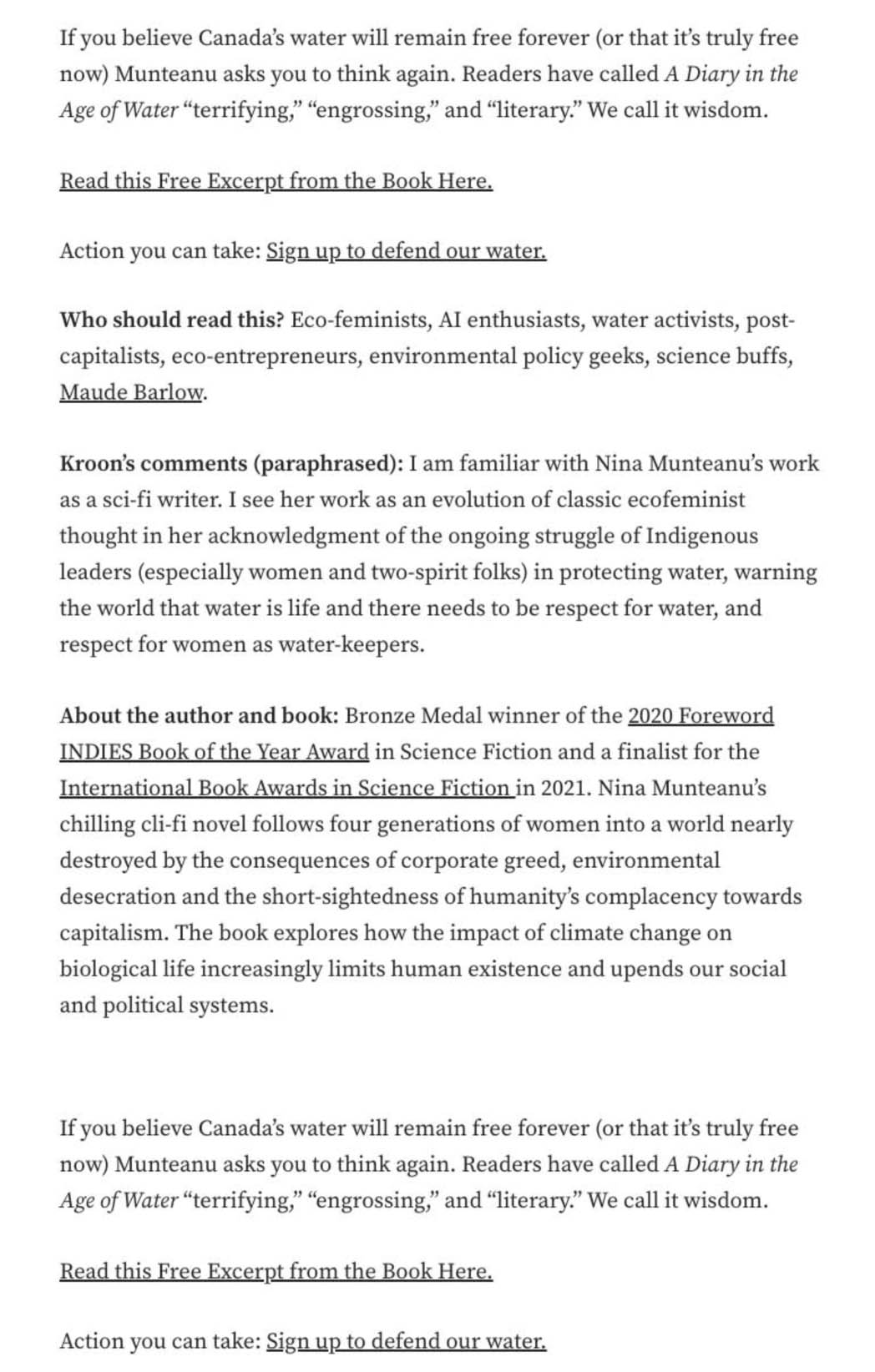
This is what PK Mutch of Liisbeth and Ariel Kroon (PhD graduate of English Literature at the University of Alberta and co-editor at Solarpunk Magazine) say about A Diary in the Age of Water, published by Inanna Publications in 2020:
The novel has received wonderful praise and prizes, including the Literary Titan Award, the Foreword Indies Award and finalist in the International Book Awards. I wonder if Maude Barlow has read it?… Maybe I (or someone) should get her a copy, huh?…
Maude Barlow with ‘Save our River’ sign
Maude Barlow is a Canadian activist and author of Blue Gold, Boiling Point and several other books on water justice. She chairs the board of Washington-based Food and Water Watch and Ottawa-based Blue Planet Project. Maude co-founded the Council of Canadians and chaired its board for over three decades.
Nina Munteanu is a Canadian ecologist / limnologist and novelist. She is co-editor of Europa SF and currently teaches writing courses at George Brown College and the University of Toronto. Visit www.ninamunteanu.ca for the latest on her books. Nina’s bilingual “La natura dell’acqua / The Way of Water” was published by Mincione Edizioni in Rome. Her non-fiction book “Water Is…” by Pixl Press (Vancouver) was selected by Margaret Atwood in the New York Times ‘Year in Reading’ and was chosen as the 2017 Summer Read by Water Canada. Her novel “A Diary in the Age of Water” was released by Inanna Publications (Toronto) in June 2020.
Fall colours of maple trees in the Mark S. Burnham Park, ON (photo and rendition by Nina Munteanu)
For the past few days, I’ve been wandering, entranced, in the various forests, swamps and marshes of the Kawarthas. I found myself inspired by the autumnal light and organic scent in the air.
They pulled me into the verge…
Poplar trees in the fall, ON (photo and rendition by Nina Munteanu)
It’s the time of “the verge,” when the seasons collide in the wake of the equinox and anticipate the unruly winds of change. A moment of stillness before the Earth shifts, relinquishes, and embraces.
In the hush of a great threshold, Nature holds its breath and a leaf settles in the arms of a cedar root…
Largetooth aspen sits on a cedar root in the pine forest of Warsaw Cave Park, ON (photo by Nina Munteanu)
Ancient pine, cedar and hemlocks in Jackson Creek forest, ON (photo and rendition by Nina Munteanu)
There I was, eyes and ears–all senses–wide, taking in Nature’s gifts of the verge. The rustling leaves in a cool wind. The musky smell of swamp water and the sweet rot of vegetation. The lazy gurgle of shallow creeks around smooth rocks. The halting shrill of a Blue Jay.
Jackson Creek in October, ON (photo and rendition by Nina Munteanu)
On one walk, a giant toad—the biggest I’d ever seen!—waddled across my path. I think it was an American toad, mottled and rough with warts. He looked rather grumpy and took his time, somehow confident—or not caring—that I could step on him and squish him easily. He was rather jiggly as he lumbered on. I did not take his picture; I don’t think he wanted me to, so I didn’t.
Fallen hemlock tree in Mark S. Burnham Park, ON (photo and rendition by Nina Munteanu)
Soon after, a small garter snake slithered across my path, less confident of my steps. It froze once it was safely out of my way. Good snake…
The forest was alive with the domestic chaos of wildlife busy with itself. Chipmunks chugged and squirrels scolded from the tree tops. Surely not at me! I climbed out of the lowland of old-growth hemlock-beech swamp forest to the top of a drumlin of maple-hop hornbeam-ash forest and then descended again into the dark hemlocks and pines.
Maple tree showing deep colour in the fall, ON (photo and rendition by Nina Munteanu)
Red and sugar maples and aspens flame in the fall by the Otonabee River near Trent University, ON (photo and rendition by Nina Munteanu)
The colours of sugar and red maple blazed in the canopy above, frothy clouds of bright orange, red, yellow and everything in-between under a deep blue sky. I wandered, camera in hand, and found treasures everywhere—from blue fungi to tiny bright red maple leaves freshly fallen.
Various mushrooms in the forests of Ontario (photos by Nina Munteanu)
I have a silly habit of picking up leaves and pressing them when I get home; my books are repositories of colourful prizes from years past.
Small red maple leaf sits beside a hemlock sapling amid white fungi and moss on a nurse log in Mark S. Burnham forest, ON (photo and rendition by Nina Munteanu)
Marsh in Ontario in the fall (photo and rendition by Nina Munteanu)
In the marsh, I encountered a green frog, sitting in the mud. It decided to pose for my camera. And I obligingly took its picture. My new best friend.
No, I did not take him home. I left him there, lollying in the mud, looking very content.
Green frog poses for the author’s camera
For all I know he’s still there, presiding over the autumn verge…
Jackson Creek reflects the gold hue of largetooth aspen in October, ON (photo by Nina Munteanu)
Nina Munteanu is a Canadian ecologist / limnologist and novelist. She is co-editor of Europa SF and currently teaches writing courses at George Brown College and the University of Toronto. Visit www.ninamunteanu.ca for the latest on her books. Nina’s bilingual “La natura dell’acqua / The Way of Water” was published by Mincione Edizioni in Rome. Her non-fiction book “Water Is…” by Pixl Press (Vancouver) was selected by Margaret Atwood in the New York Times ‘Year in Reading’ and was chosen as the 2017 Summer Read by Water Canada. Her novel “A Diary in the Age of Water” was released by Inanna Publications (Toronto) in June 2020.
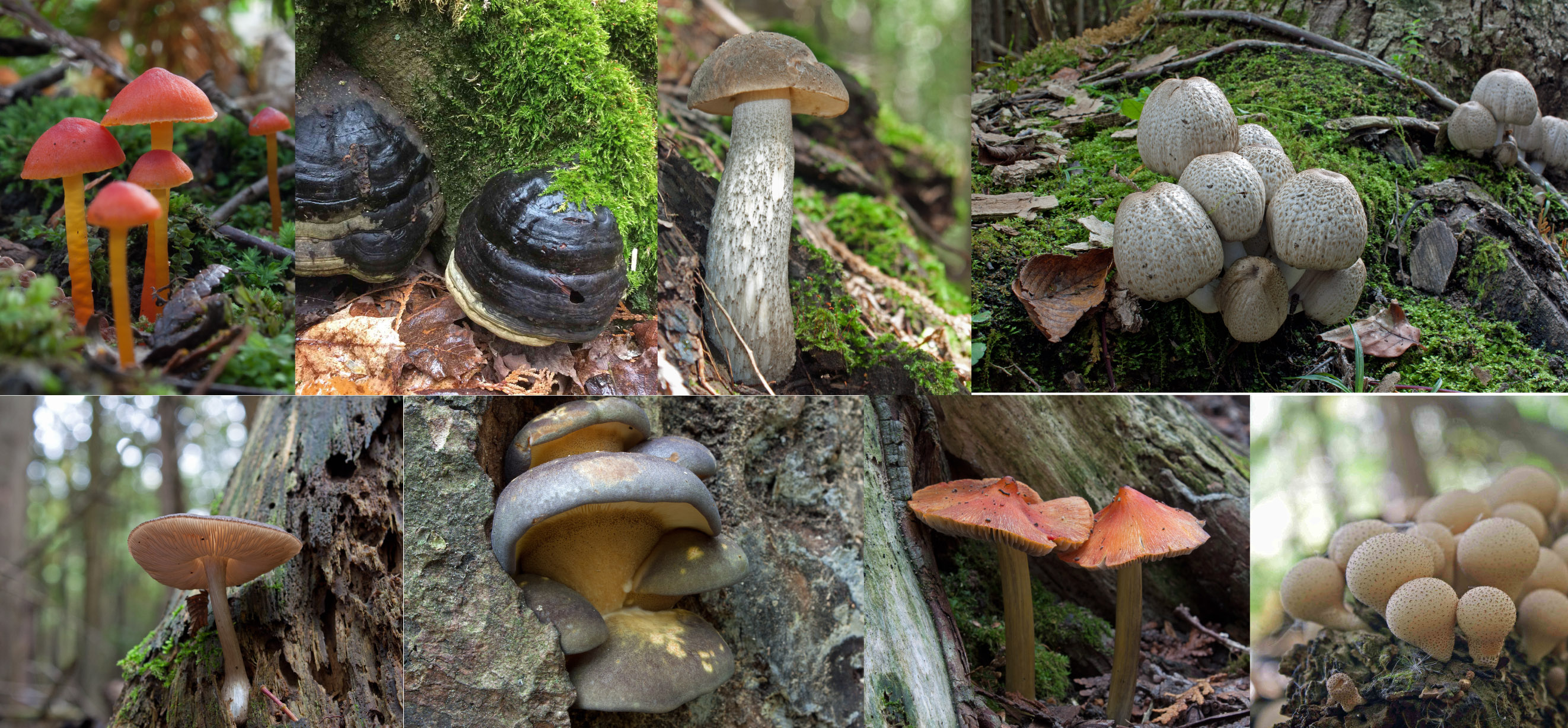
She imagines its coolness gliding down her throat. Wet with a lingering aftertaste of fish and mud. She imagines its deep voice resonating through her in primal notes; echoes from when the dinosaurs quenched their throats in the Triassic swamps.
Water is a shape shifter.
It changes yet stays the same, shifting its face with the climate. It wanders the earth like a gypsy, stealing from where it is needed and giving whimsically where it isn’t wanted.
Dizzy and shivering in the blistering heat, Hilda shuffles forward with the snaking line of people in the dusty square in front of University College where her mother used to teach. The sun beats down, crawling on her skin like an insect. She’s been standing for an hour in the queue for the public water tap.
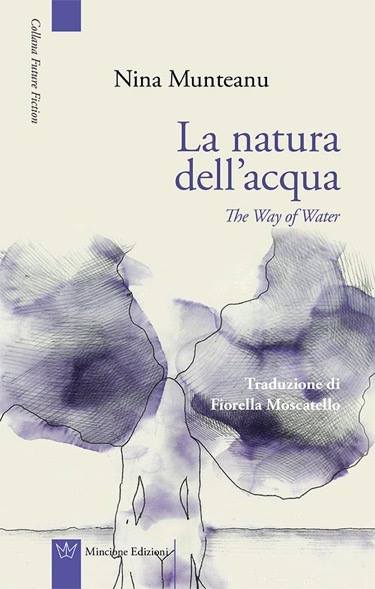
The Way of Water was first published as a bilingual print book by Mincione Edizioni(Rome) in Italian (La natura dell’acqua, translated by Fiorella Moscatello), and English along with a recounting of what inspired it: The Story of Water (La storia dell’acqua) in 2016. The Way of Water has been reprinted several times, in magazines and anthologies, since its first appearance in 2016.
It all started with an invitation by my publisher in Rome in 2015 to write about water and politics in Canada. I had long been thinking of potential ironies in Canada’s water-rich heritage. The premise I wanted to explore was the irony of people in a water-rich nation experiencing water scarcity: living under a government-imposed daily water quota of 5 litres as water bottling and utility companies took it all.
I named the story “The Way of Water” (“La natura dell’acqua”), about a young woman (Hilda) in near-future Toronto who has run out of water credits for the public wTap; by this time houses no longer have potable water and their water taps have been cemented shut (as was done in Detroit in 2014); the only way to get water is through the public wTaps—at great cost. She’s standing two metres from water—in a line of people waiting to use the tap—and dying of thirst.
“The Way of Water” captures a vision that explores the nuances of corporate and government corruption and deceit together with global resource warfare. In this near-future, Canada is mined of all its water by thirsty Chinese and US multinationals—leaving nothing for the Canadians. Rain has not fallen on Canadian soil in years due to advances in geoengineering and weather manipulation that prevent rain clouds from going anywhere north of the Canada-US border. If you’re wondering if this is possible, it’s already happening in China and surrounding countries.
The Way of Water, in turn, inspired my recent dystopian novel A Diary in the Age of Water, which explores the lives of four generations of women and their relationship to water during a time of severe water restriction and calamitous climate change.
Publications (excluding online pubs) that featured The Way of Water
“The Way of Water evokes a sense of awareness about issues of access to water and about the dangers of imbalances in that access.”
Derek Newman-Stille, Speculating Canada
“In a short story in which every word has its weight, Nina Munteanu manages to describe a dystopia with ecological, political, social and economic elements and Hilda’s reactions to her situation with a great emotional intensituy. To avoid thirst, Hilda ends up embracing an extreme idea, a last hope linked to water. The Way of Water is a story of the kind you hope is science fiction but you fear is not.”
Massimo Luciani
Nina Munteanu is a Canadian ecologist / limnologist and novelist. She is co-editor of Europa SF and currently teaches writing courses at George Brown College and the University of Toronto. Visit www.ninamunteanu.ca for the latest on her books. Nina’s bilingual “La natura dell’acqua / The Way of Water” was published by Mincione Edizioni in Rome. Her non-fiction book “Water Is…” by Pixl Press (Vancouver) was selected by Margaret Atwood in the New York Times ‘Year in Reading’ and was chosen as the 2017 Summer Read by Water Canada. Her novel “A Diary in the Age of Water” was released by Inanna Publications (Toronto) in June 2020.
Critical reception for Christopher Nolan’s science fiction blockbuster movie Interstellar was widely mixed. Reviews ranged from being dazzled and awestruck to thinking it utterly ridiculous and silly. Much of the range in opinion had in fact to do with the hard science: hard science that Nolan insisted he get right by hiring theoretical physicist Kip Thorne to best approximate what a black hole and a wormhole will look like and behave. Science so good that it generated a discovery worthy of reporting in a scientific journal (see below). The forums and chats that debated the last half-hour of the movie and its significance were entertaining, if not informative. Interstellar also generated a spate of vitriolic, accusing the film as propaganda for American colonialism (see a few examples below).
I first watched it in an IMAX theatre (the only way to see such an epic—it was filmed using 70mm Imax film, after all), which helped achieve its grandness. Since I was five, I’ve always wanted to be an astronaut. And I’ve always been a sucker for good space adventure—especially well-researched, realistic depictions defined by a good story. And that is exactly what Interstellar is. And so much more…
The ship enters the wormhole
I’ll admit openly that this film swept me up like a giant wave. I sat humbled yet exalted as I journeyed to some magnificent alien worlds: deep space; a powerful spherical wormhole; vast shallow waters between mile-high waves of a tidally locked planet; skimming beneath ice-clouds of a barren ice-planet; and falling—literally—into a black hole. All to the recursive echoes of a mesmerizing score by Hans Zimmer. While I was openly moved during the film, its aftertaste caught me unawares and impressed me the most about Nolan’s talent for subtle paradox. I realized that the journey—and deep space—felt inexplicably vast and intimate at the same time.
the Black Hole, Gargantua
The research by Thorne and Nolan’s visual team generated a scientific discovery. To accurately portray a black hole in the film, Thorne produced a new set of equations to guide the special effects team’s rendering software. Black holes apparently spin at nearly the speed of light, dragging bits of the universe along with it. Based on the notion that it was once a star that collapsed into a singularity, the hole forms a glowing ring that orbits around a spheroidal maelstrom of light, which curves over the top and under the bottom simultaneously. The team then discovered that “warping space around the black hole also warps the accretion disk,” explained Paul Franklin, senior supervisor of Double Negative (the visual experts). “So, rather than looking like Saturn’s rings around a black sphere, the light creates this extraordinary halo.” Thorne confirmed that they had correctly modeled a phenomenon inherent in the math he’d supplied and intends to publish several articles in scientific journals, based on these findings.
Canadian science fiction author Robert J. Sawyer defines good science fiction as: the literature of change; it’s about something “large” (world-important), arises from a scientific premise; and is generally pro-science. Interstellar achieves all of these criteria, particularly the latter.
Murph overseas the burning of blighted wheat
The movie begins in the near-future on a post-climate change Earth, plagued by dust storms and failing crops in a society reverted to parochial superstition. Cooper (Mathew McConaughey), once a NASA pilot and now a farmer, laments: “We used to look up at the sky and wonder at our place in the stars, now we just look down and worry about our place in the dirt.”
In a scene reminiscent of present day schools removing cursive writing from the curriculum or the controversy of teaching evolution (e.g., in favor of creationism), Cooper’s daughter’s teacher, Ms. Kelly, informs him at a parent-teacher meeting that the history textbooks have been rewritten to make known the “truth” about the moon landing: “I believe [the moon landing] was a brilliant piece of propaganda,” attests Ms. Kelly, “that the Soviets bankrupted themselves pouring resources into rockets and other useless machines…And if we don’t want to repeat the excess and wastefulness of the 20th Century, then we need to teach our kids about this planet, not tales of leaving it.”
The Cooper farmhouse after a dust storm
The danger of turning away from scientific exploration—particularly space exploration—in times of great social and economic insecurity is a theme that runs deep in the film. Not only are scientists and engineers portrayed as whole individuals, both smart and compassionate, but they are also marginalized in a future world looking more to blame than to fix. “We didn’t run out of planes and television sets,” the principal of the school tells Cooper. “We ran out of food.”
When a gravitational anomaly leads Cooper and his daughter Murph (Mackenzie Foy) to a secret NASA base in the middle of nowhere, an old colleague, Professor Brand (Michael Caine), recruits him to pilot the interstellar Endeavor, NASA’s “Noah’s Ark”, into the far reaches of outer space to repopulate the human race. NASA has turned covert due to public pressure against “irrelevant or politically unfeasible” spending. After showing Cooper how their last corn crops will eventually fail like the okra and wheat before them, Brand answers Cooper’s question of, “So, how do you plan on saving the world?” with: “We’re not meant to save the world…We’re meant to leave it.” Cooper rejoins: “I’ve got kids.” To which Brand answers: “Then go save them.”
The crew arrive on the first planet
Unbeknownst to us—and to Cooper, who leaves his precious children behind on Earth for what turns into a one-way mission—the intention is to literally leave the rest of humanity behind. You see, Cooper’s ship—headed toward one of three potentially habitable worlds beyond a wormhole near Saturn—contains the seeds of humanity and other life that the four astronauts aboard are meant to distribute and nurture. Cooper and Brand’s daughter, Amelia (Anne Hathaway), one of the other three astronauts onboard, both believe that the real ark sits back on Earth in the form of a huge spaceship—awaiting Brand’s solution to the gravity issue. Brand knows, but keeps to himself, that the solution is insolvable and sends his intrepid crew off, knowing that Cooper will never see his young son and daughter again.
While Nolan admits to some iconic comparisons with Kubrick’s 2001; A Space Odyssey, Interstellar actually shares much more with the film Contact (in which Kip Thorne and McConoughey also participated). Contact also centered on a ground-breaking scientist daughter who misses her lost father. Mark Kermode, in a Guardian review also saw the relationship:
Murph solves the problem of gravity
“In both movies, it is these daughters who detect the first stirrings of an “alien” encounter: Ellie Arroway (Jodie Foster) identifying recurrent sequences in the white noise of interstellar radiation in Contact; Murph (very affectingly played in her younger years by Mackenzie Foy) spying Morse code in poltergeist disturbances in Interstellar. From such discoveries are missions launched, voyaging across time and space at the apparent instruction of a superior intelligence offering cryptic hands across the universe. Intergalactic portals are breached, timescales bifurcated, science and faith reconciled. Crucially, for all their astro-maths exposition, the constant in both stories is neither time, space, nor gravity, but love. More than once I was reminded of Contact’s Ellie striking the outer limits of the universe and breathlessly declaring: ‘They should have sent a poet.’”
The crew investigate the first planet they reach after passing through the wormhole
Interstellar received widely mixed reviews, described as anything from sublime to ridiculous. Its American-centric presentation generated some criticism (e.g., NASA acting alone without any international help; all American actors; American flags erected on settled colonies). Some even vilified the film as “a dangerous fantasy of US colonialism”. Journalist Abraham Riesman raises valid issues to do with human-centric expansionism in Interstellar:
“Coop and his coterie make one assumption that the movie never questions: Humanity (which, for all we ever see, is white, English-speaking America with a couple of black friends and one British guy) deserves to go to the stars and will suffocate if it’s confined to its current environs. That logic was, of course, one of the main justifications for most imperial expansions since the dawn of the 1800s. No one stops to ask whether this civilization (which, in the movie, appears to have murdered its home planet through human-caused climate change, though, for some reason nobody talks about that) needs to make some fundamental changes in its approach to social construction and resource use. Indeed, when we see the bright new future on Cooper Station, it’s all baseball and manicured lawns. Perhaps more important, no one questions whether human expansion will kill off the new planets’ current residents. Sure, we’re told that the planets are uninhabited … but uninhabited by what? Carbon-based humanoid life forms? What if we immediately kill off whatever fragile ecosystems we find once we take off our helmets and exhale our Earthly germs? Of course, I’m reading too much into a movie that isn’t even implying any of the messages I’m inferring, but that’s the problem right there: No one’s even asking the questions, and for humans, that kind of attitude usually leads to bad answers.”
What saves Interstellar from skidding into 20th Century pseudo-jingoistic expansionism with undertones of patriarchal rationalism, is its subversive theme. And because of it, the movie transcends into artistic commentary.
I speak of love.
Love embodied by two of the main characters—both women: Cooper’s daughter, Murph, and his shipmate, Amelia Brand. Love that is irrational. Love that is unscientific. Love that is inexplicable. And love that is all powerful. Inviolate. Eternal. And, I believe, our salvation.
Murph Cooper
Aspects of “imperialist expansionism” and “patriarchal rationalism” interplay through Cooper, who embodies both in his “cowboy” science. It is love that propels his evolution to transcend them. In Cooper, we see the constant tension between rationality of science and the “irrational” faith of love. Related to this, Cooper must continually choose between the personal and the whole in defining his humanity and ultimately his hard choices. First with his daughter and her “ghost”, then with Amelia Brand in their mission to another galaxy.
Amelia Brand
After a botched mission, Amelia appears to abandon the very tenets of hard science to ask the defining question: “Maybe we’ve spent too long trying to figure all this out with theory. Love is the one thing that transcends time and space.” She describes love as a cosmic force, a kind of empathic drive that provides the very basis for humanity’s survival: a link to our wholeness as living beings within a breathing multi-dimensional universe. When Cooper challenges Amelia’s unscientific notions, she responds with, “Love isn’t something we invented. It’s observable, powerful … Maybe it’s evidence, some artifact of higher dimensions that we can’t consciously perceive.” Repeating, almost word for word, what Cooper said to his father about choosing his interstellar mission, Amelia admits, “yes, the tiniest possibility [of seeing Wolf again] excites me. But that doesn’t mean I’m wrong.” To which Cooper answers just as his father did: “Honestly…it might.”
Amelia nails it when she, in turn, challenges Cooper: if the second choice turns out bad, they will have enough fuel to do only one of two things: go on to the third planet in hopes of distributing the seeds of humanity OR go back home to his children and the end of the world. Which will he choose? It’s interesting what he does end up choosing: he chooses love. Love drives him to do impossible feats, like dock his shuttle with a damaged and recklessly spinning Endeavor:
CASE: That’s impossible
COOPER: No, it’s necessary
Love for Murph drives Cooper into the black hole … and out of it. Love directs him to that precise quantum moment where his love for Murph transcends into love for all humanity: to save the world. This is the secret. The secret Mann in his intellectualized definition of what it means to be human could not touch. The window for connection to the whole is through a single tiny grasp of it. The glimpse into Eternity is through the lens of Love. I am reminded of a quote in David Mitchell’s Cloud Atlas: “What is any ocean but a multitude of drops?” In Spielberg’s Schindler’s List, Itzhak Stern quotes the Talmud: “Whoever saves one life, saves the world entire.”
So what is love, then? Is it gravity? Does it communicate through the God particle in the fractal fabric of the Higgs field? What other phenomenon grows from nothing? What other phenomenon is not lessened but in fact grows by giving it away? What other phenomenon provides the very weight and structure—the meaning—of our existence? What other phenomenon is like a whisper in a crowded room, yet creates the most beautiful symphony? Is it that simple?
If gravity is a plane of existence, a fifth dimension that can exist across space-time, is a black hole simply a doorway? Like death? Is love the fuel of evolution, lifting us up into a higher state?
Catholic theologian Peter Kreeft shares: “…Gravity is love on a material level. In fact, [gravity] has two movements: one is towards union, back to the center, the big bang, the past by gravity. And the other is to give itself out to all other beings, out into the future, the expanding universe, by energy and by entropy, which is energy giving itself out to the empty places.”
What struck me the most about Interstellar was how it simultaneously evoked my breathless awe in the vast universe’s existentialist grandeur with a personal connection and incredible intimacy. Interstellar was soul-nourishing, dream-engaging; and its recursive themes called of “home”.
Definitions:
Wormhole: Officially known as an Einstein-Rosen Bridge, a wormhole is a hypothetical topological feature of spacetime that would fundamentally be a shortcut through spacetime.
God Particle: Also known as the Higgs boson or Higgs particle, the God particle is believed to be the subatomic particle that gives everything mass. Without it, nothing would have weight or even structure. The Higg boson is an elementary particle with no spin, electric charge or colour charge. It is considered the smallest possible quantum excitation of the Higgs field that unlike the more familiar electromagnetic field cannot be “turned off”; instead it takes a non-zero constant value almost everywhere.
Higgs Field: In two papers published in 1964, Peter Higgs posited that particles obtain mass by interacting with a mysterious invisible energy force field that permeates the universe: the Higgs field. It is the stuff of stars, planets, trees, buildings and animals. Without mass, electrons, protons and neutrons wouldn’t stick together to make atoms; atoms wouldn’t make molecules and molecules wouldn’t make us. The presence of the Higgs field explains why some fundamental particles have mass while the symmetries (laws of nature) controlling their interactions should require them to be massless, and why the weak force has a much shorter range than the electromagnetic force.
Nina Munteanu is a Canadian ecologist / limnologist and novelist. She is co-editor of Europa SF and currently teaches writing courses at George Brown College and the University of Toronto. Visit www.ninamunteanu.ca for the latest on her books. Nina’s bilingual “La natura dell’acqua / The Way of Water” was published by Mincione Edizioni in Rome. Her non-fiction book “Water Is…” by Pixl Press (Vancouver) was selected by Margaret Atwood in the New York Times ‘Year in Reading’ and was chosen as the 2017 Summer Read by Water Canada. Her novel “A Diary in the Age of Water” was released by Inanna Publications (Toronto) in June 2020.
Cafe patio facing Otonabee River (photo by Nina Munteanu)
.
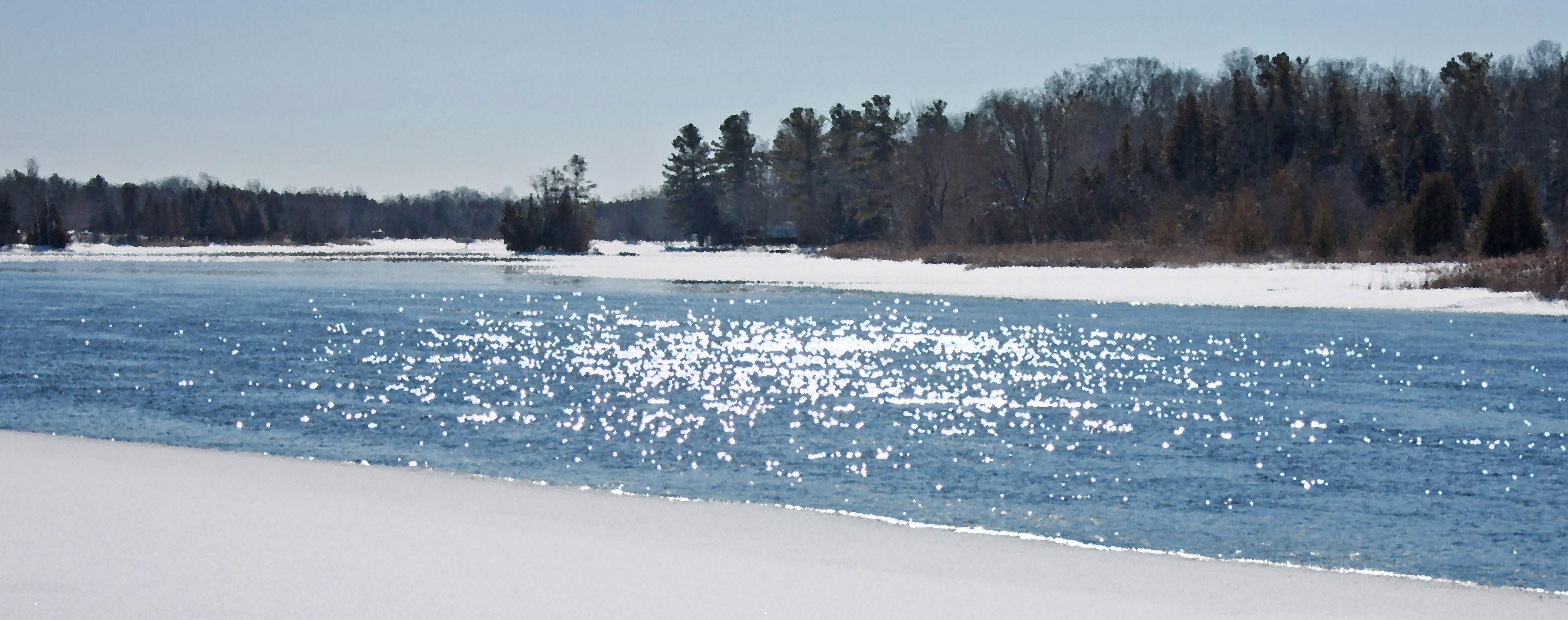
I’m a bit of a wanderer, an itinerant. A hobo, even. I house sat and pet sat for a decade. I travel light; I carry what I own in my Jetta. One of the things I look for when I first settle somewhere is a choice café and a place where I can walk—preferably in a forest by a river. The small unpretentious town of Peterborough, north of Toronto and entry way to the Kawarthas, has both. The Otonabee River flows through Peterborough, much of it protected by riparian woodland and marsh (it is Peterborough’s source of drinking water, after all). The place where I currently live allows me to walk daily—rain or shine or snow—through riparian forest along the Otonabee River.
And then there’s the café part…
.
Silver Bean Cafe and boat wharf on the Otonabee River in Millennium Park, ON (photo by Nina Munteanu)
Cafe entrance to King Street and ice cream booth (photo by Nina Munteanu)
.
The Silver Bean Café fills that requirement wonderfully. It’s a café situated at a dead end of King Street within a linear riparian park (Millennium Park) on the banks of the river with a large side-park patio under a canopy of willows, black locust, and Manitoba maples. They know what they are too: they call themselves “your waterfront cottage in the city.” When I sit on the patio, enjoying my lunch under the dappled shade of a flowering black locust tree with a view of the river, I hear only birds and the desultory chatter of fellow patrons. And yet, the city is right there, next to this riparian park.
.
Stairs up to Silver Bean Cafe patio from boat wharf, beneath canopy of flowering black locust trees (photo by Nina Munteanu)
Riverside patio overlooking Otonabee River, ON (photo by Nina Munteanu)
River boarder paddles by on Otonabee River, ON (photo by Nina Munteanu)
.
As I sit, eating my lunch and breathing in the ambrosia fragrance of black locust blooms, a young man paddles his canoe past the café. Soon after, a family of geese, adults flanking seven goslings, paddle leisurely by. Gulls cry out and gather on one of the small islands as a freight train lumbers over the old rail/footbridge downstream. A robin hops close to my table, looking for crumbs and I clumsily drop a seed from my multi-grain sandwich… Oops! Darn, I wanted that…
.
Family of geese paddle by cafe on the Otonabee River (photo by Nina Munteanu)
.
2023 is the Silver Bean’s 20th season, their website tells me. They opened in 2003 as a community café, serving light lunches with speciality sandwiches and salads, breakfasts, freshly baked scones, desserts and, of course, locally roasted coffee and espresso drinks. Oh! And their nook by the street-side serves at least thirty different flavours of my favourite Kawartha ice cream!
.
View of Silver Bean Cafe patio and boat rental wharf from park walk, ON (photo by Nina Munteanu)
.
One day, I was sitting on a stone step by the river on the park walkway, eating my peanut butter chocolate ice cream cone and watching a mother mallard and her chicks in the water. A well-dressed lady sat nearby with a take out coffee. Slipping off her shoes in the sun, she shared that she worked in the government building nearby and came here daily for her fix of sanity. I nodded sympathetically then smiled to myself. I felt the guilty pleasure of not being on ‘the clock.’ She left soon after. I stretched my legs in the sun, found my muse, and daydreamed about the next book I was going to write…
.
Black locust with fragrant flowers in spring, overlooking the Otonabee River, ON (photo by Nina Munteanu)
.
Nina Munteanu is an ecologist and internationally published author of award-nominated speculative novels, short stories and non-fiction. She is co-editor of Europa SF and currently teaches writing courses at George Brown College and the University of Toronto. Visit www.ninamunteanu.ca for the latest on her books. Nina’s recent book is the bilingual “La natura dell’acqua / The Way of Water” (Mincione Edizioni, Rome). Her latest “Water Is…” is currently an Amazon Bestseller and NY Times ‘year in reading’ choice of Margaret Atwood.
“There are women with voices and brains and power and intelligence that have been waiting for this moment.”—Director Jennifer Phang
Advantageous is a low budget indie film by Jennifer Phang that explores a near-future world—a kind of “pre-dystopia”, according to Katharine Trendacosta of io9—where jobs have become heavily automated and opportunities for education are cutthroat. Women have been generally forced out of the workplace and onto the streets: the logic being that they will be less violent while living on the street than men.
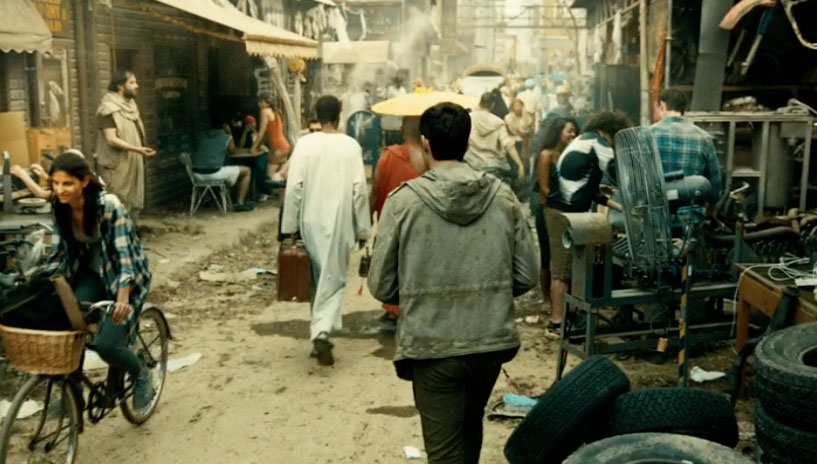
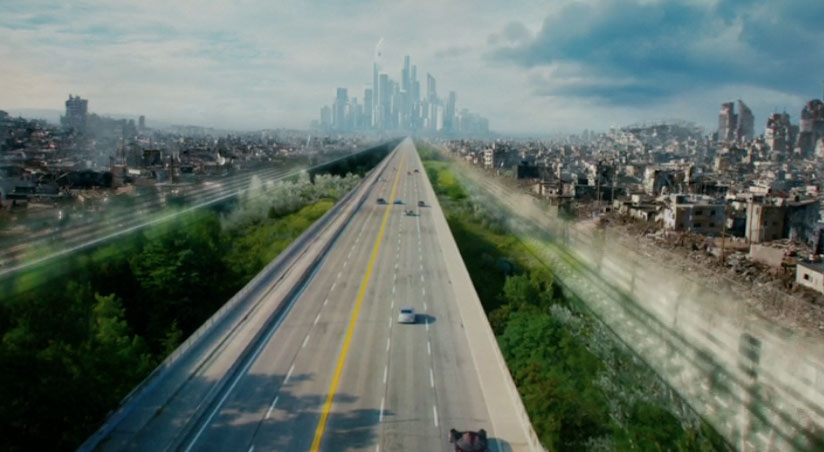
While the world vaguely resembles a vibrant City with flying ships and some bizarrely futuristic architecture (including a high rise that functions as a giant water feature), a sense of unease permeates most scenes, punctuated by occasional terrorist explosions and snippets of disturbing news reports. Artificial intelligence has supplanted most people in middle management, “The people you do see are either impoverished and disenfranchised or are hidden in the upper floors, the protected places,” says director Jennifer Phang. Unemployment is close to 50% and there are no public schools. The only options for a young girl—if she is not to end up on the streets, either as a beggar or prostitute—is to attend a highly selective free magnet school or a very expensive private school.
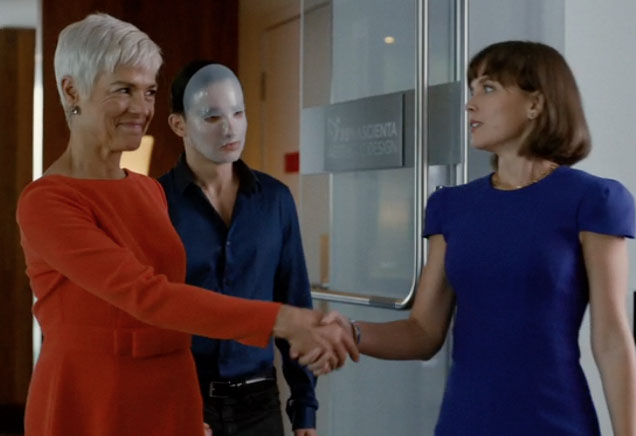
Gwen Koh (Jacgueline Kim) is the spokeswoman of the Center for Advanced Health and Living, a wellness corporation that offers health and beauty treatments to an elite who can afford it. When the Center informs her that she looks too old, Gwen—desperate to secure her bright daughter’s expensive education—submits to the experimental treatment she was initially hired to promote. Jules hadn’t made it into the free magnet school, leaving Gwen to come up with extensive funds to get her into a private school. The corporation has subtly backed Gwen into a corner by reminding her that her generation doesn’t have the skills to compete—all of education currently being STEM-based—and they fully understand that she is too old and too unconnected to do anything other than offer herself up to their new procedure to secure her position and a future for her daughter Jules. Constantly walking the edge of privilege, Gwen struggles to make the elite-connections necessary to place Jules. “Gwen is too old, too female, and too unconnected to do anything other than offer herself up as a sacrifice,” writes Trendacosta.
Gwen and here daughter Jules share a moment
The true nature of her sacrifice is not understood at first; it unravels slowly, like an internal wound, until we learn that the procedure—putting her memories into a younger person’s body—means that Gwen’s “mother-connection” awareness with her daughter will be lost when her original body dies in the procedure. This is particularly significant, given their close and loving relationship, which is evocatively conveyed throughout the film.
Advantageous “is riveting, emotionally gripping, and offers up a vision of the future that is disturbingly easy to picture, even as some of the technologies it imagines seem out of reach,” says Ariel Schwartz of Business Insider Magazine. While the trope of mind-upload into a younger, prettier body has been around for while in standard SF, how Phang presents it, in the muted notes and pace of “everyday” and “mundane” events, brings a kind of realism to it that both invigorates and chills. Like watching a building explode in person rather than on TV. The immediacy and reality of it is visceral. Phang does this through sparing use of sound, language and colour. And all presented in a pace that does not rush, but lingers and reflects. Long moments of quiet punctuate scenes of significance, giving us the chance to examine, resonate and reflect in “real-time” with the character. These, in themselves, provide some of the most poignant footage of the film as we are given the time to descend into deeper reflection. Each plays out, short vignettes of life that string together like pearls on a necklace. Life moments. Unflinchingly and confidently performed at the pace of life.
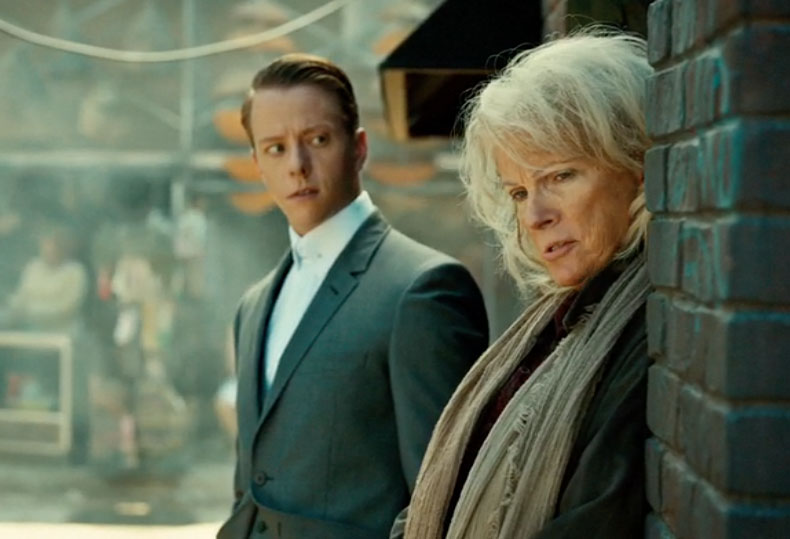
In one of many quietly powerful scenes, Gwen stumbles upon a street woman, huddled in a small grassy alcove under an old blanket. When Gwen asks her if she is okay, the woman instead responds, “Are you okay?” This is a natural response for a woman; we think of others, of their welfare. We carry the “mother” archetype within us, everywhere we go, no matter what befalls us. This natural sense of compassion and altruism runs through our blood.
And, yes, it makes us a different kind of hero.
Gwen’s heroics are not accompanied by percussive violence or gut-wrenching action; they are silent choices that percolate from deep within. They are choices that ultimately bleed into great consequence.
Gwen and Jules read something together
“The plot suggests a standard ‘body swap’ sci-fi storyline,” says Danielle Riendeau of Polygon. “But Advantageous is much more about motherhood, the sacrifices women make for their children, and to a large extent, the difficulties of being a non-white woman in an increasingly intolerant society. The writing, directing and performances are so strong that they elevate the film far beyond a simple twist on a classic trope. Advantageous is a potent, heartbreaking meditation on parental love and the sacrifices women make for their families. It has a lot to say, and it does so with clear-eyed, fearless intensity.”
Trendacosta writes, “People are going to judge Advantageous by the things it lacks. There are no battles, no mustache-twirling villains, and not even any giant science fiction spectacle sets. People are also going to judge it for what it has. There are some intense discussions of classism, racism, ageism, sexism, and elitism. But don’t judge this movie for either of those things—instead, it’s worth appreciating for all the things it does so incredibly well.”
What Advantageous does so incredibly well is portray a near-future vision worth pondering and discussing.
Nina Munteanu is a Canadian ecologist / limnologist and novelist. She is co-editor of Europa SF and currently teaches writing courses at George Brown College and the University of Toronto. Visit www.ninamunteanu.ca for the latest on her books. Nina’s bilingual “La natura dell’acqua / The Way of Water” was published by Mincione Edizioni in Rome. Her non-fiction book “Water Is…” by Pixl Press (Vancouver) was selected by Margaret Atwood in the New York Times ‘Year in Reading’ and was chosen as the 2017 Summer Read by Water Canada. Her novel “A Diary in the Age of Water” was released by Inanna Publications (Toronto) in June 2020.