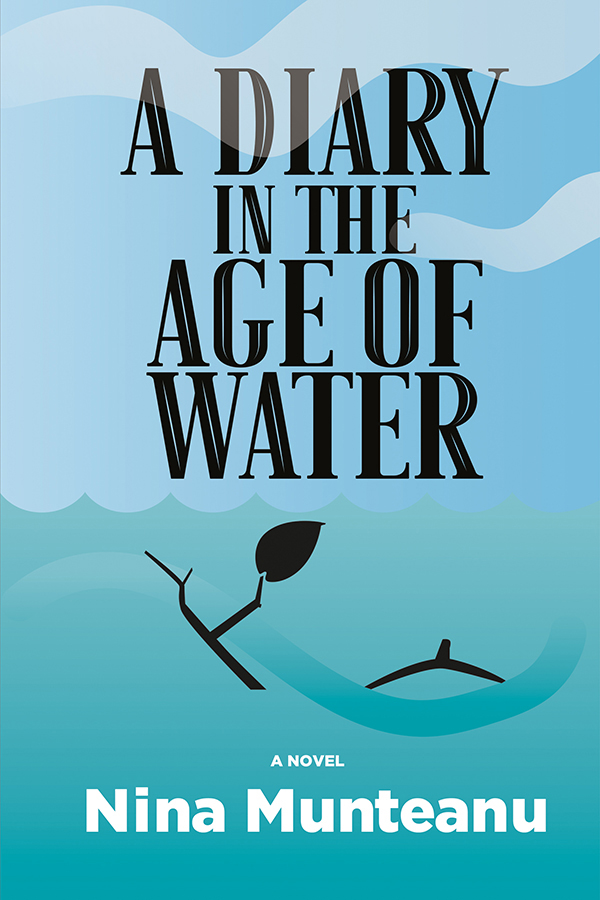
In the Spring issue of Ecology & Action, Mary Woodbury, author and publisher of Dragonfly.eco, lists some of her favourite Eco-Fiction that Inspires Action. Among them is Nina Munteanu’s eco-novel “A Diary in the Age of Water.”
“Fiction exploring humanity’s impacts on nature is becoming more popular. It has the distinct ability to creatively engage and appeal to readers’ emotions. In fact, it can stir environmental action. A survey I took last year showed that 88% of its participants were inspired to act after reading ecological fiction.
Principled by real science and exalting our planet’s beauty, these stories are works of art. They live within classic modes of fiction exploring the human condition, but also integrate the wild. They can be referred to as “rewilded stories.” The following Canadian titles are some of my favourites in this genre.”
MARY WOODBURY
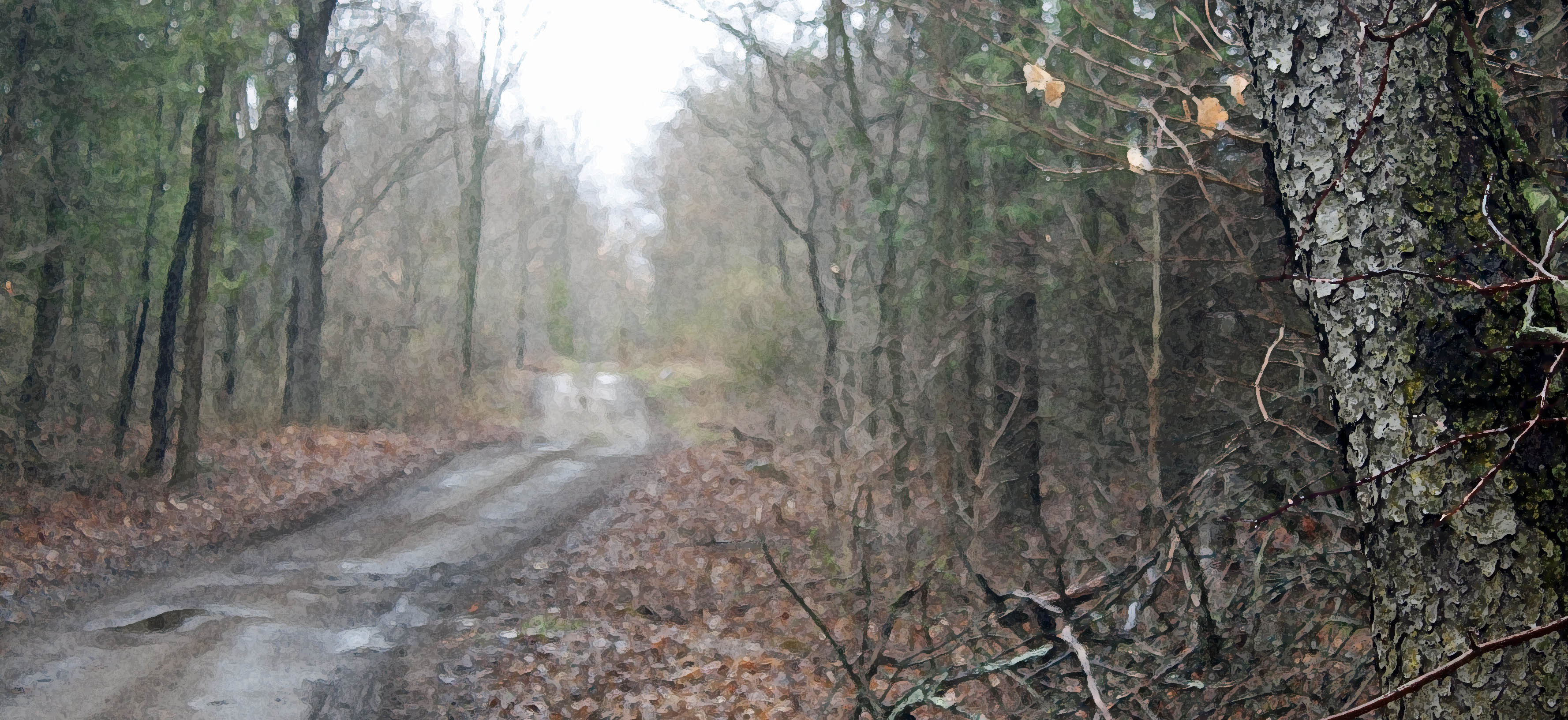
Dirt road to Long Lake in a misty light rain in early spring, ON (photo and dry brush rendition by Nina Munteanu)
Nina Munteanu is a Canadian ecologist / limnologist and novelist. She is co-editor of Europa SF and currently teaches writing courses at George Brown College and the University of Toronto. Visit www.ninamunteanu.ca for the latest on her books. Nina’s bilingual “La natura dell’acqua / The Way of Water” was published by Mincione Edizioni in Rome. Her non-fiction book “Water Is…” by Pixl Press(Vancouver) was selected by Margaret Atwood in the New York Times‘Year in Reading’ and was chosen as the 2017 Summer Read by Water Canada. Her novel “A Diary in the Age of Water” was released by Inanna Publications (Toronto) in June 2020.
The TVO and National Film Board of Canada film Borealis by Kevin McMahon opens with ‘tree song’ and Diana Beresford Kroeger’s voice: “The design of Nature is music. If you listen to the trees, you will hear their song. And some people actually hear an individual song for certain species.”
Early in the film, you see Edmund Metatawabin, a Fort Albany First Nation writer, walking ghost-like in the forest. His voice tells us that when the trees look at us, we would just be like “these little things flitting by.” This simple comment underscores the difference that time plays to a tree that may live to a thousand years in contrast to a human who—if they are lucky—may live to a hundred. Says Metatawabin:
“We have a certain relationship with the trees, their living essence. The tree has been here for a long time, standing in the same spot but watching…They’re our older relations. We’re very happy and secure that they’re there, still standing watching over us. Some of us have heard them sing.”
Edmund Metatawabin
Boreal forest after a natural fire (Borealis)
In a frank interview with Madeline Lines of POV Magazine about the making of Borealis, filmmaker Kevin McMahon talked about how the rugged beauty of the boreal forest belies a fragility poised on a precarious balance with humanity.
The film discusses some of the major relationships and mechanisms of this complex and unique ecosystem through the voices of scientists and naturalists who study and know the forest: botanists, population and aquatic ecologists, atmospheric scientists, forest entomologists and researchers and guides.
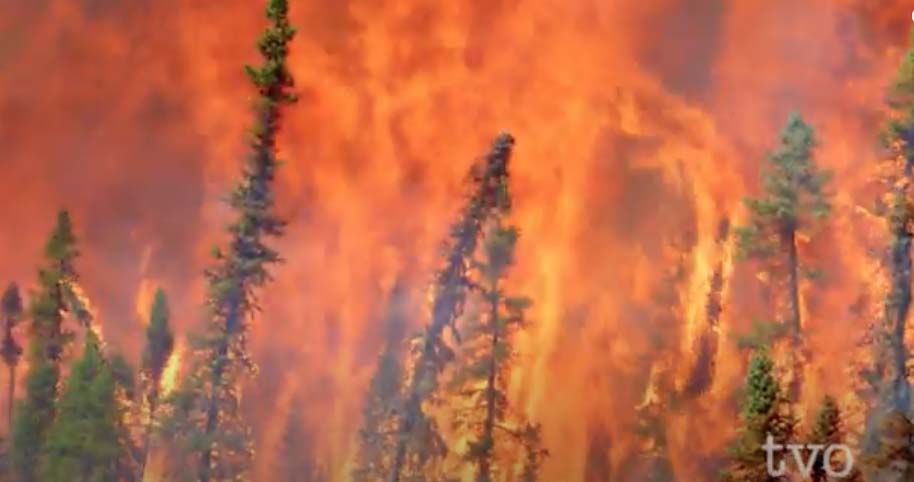
“The story of the boreal forest [is that] basically … it goes up, burns itself down and like a phoenix, goes up again,” says McMahon. “There’s a complexity—the trees influence the animals, the animals influence the trees, so a community grows up over at least two centuries, usually, and sometimes three, or four.”
Natural fire cycles through the boreal forest every hundred years to renew it (Borealis)
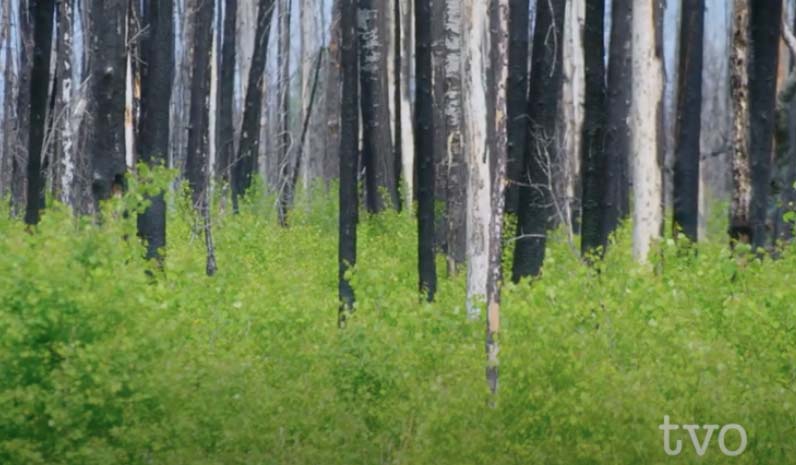
One of the narrators tells us that the boreal forest has “survived and thrived in this regime of semi-regular stand-renewing fire.” This natural cycle of creative destruction is common in most ecosystems where destruction engenders rebirth and renewal by a community of species well-adapted to these cyclical changes. Botanist Diana Beresford-Kroeger adds, “the jack pine cones will only open on fire. The resin needs to be melted off the cone and then they shed their seeds.” The cones of tall spruce trees aggregate at the top of the tree, where the fire provides enough heat to open them but not burn them. White birch saplings sprout—phoenix-like—from the burnt tree base and roots. Aspen roots also send up thousands of suckers to become new clone trees of a renewed forest. The dead trees provide substrate for mosses, lichens and fungi that bring in moisture and decompose the logs into nutrients used by the living forest.
Aspen clone saplings cover the forest floor after a fire (Borealis)
The movie showcases some of the most vivid details of tree function, including the microscopic view of opening and closing stomata (pores on a leaf). Stomata take in CO2 and release oxygen during photosynthesis. They also release water vapour as part of transpiration and other chemicals such as metabolic aerosols.
Stomata on the underside of leaf release aerosols, carbon dioxide and water (Borealis)
The devastation of climate change strongly features in the film as does our own mismanagement of the forests. A particularly telling scene was shot in the Yukon by Joshua See where squirrels have co-evolved with spruce trees in a relationship they’ve developed over 1000 years. The squirrels have timed their reproduction with the spruce production of cones and release of seeds; but climate change has knocked the trees out of sync with the squirrels, which is threatening the survival of the squirrel.
Red squirrel eating spruce seeds from cone (Borealis)
“I think that’s probably the first time any human being has seen such a vivid example of the rhythms of nature being thrown out of sync by climate change. And the funny thing is, if you listen to the climate change debate, as I obviously do fairly closely, that is something that has not really sunk in with the general public,” said McMahon. “People know about storms, and because of Australia and California they’re starting to learn about the impact it has on fires. But the reality that the rhythms of the world are all screwed up has not really sunk in, and Borealis has two really powerful examples of this. One is what happens to the squirrels, and the other is what’s happening to the trees, with what’s happening with the pine beetles.”
Aerial shot of river and boreal forest (Borealis)
Fern fiddleheads in boreal forest (Borealis)
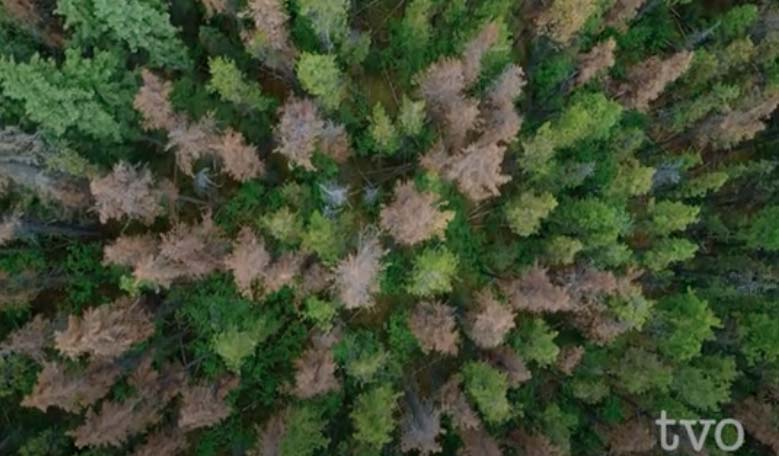
McMahon then adds soberly, “That last big dramatic drone shot [in the film] where you see that, basically, the boreal forest is dying – that’s Jasper National Park. This iconic forest that Canadians have sort of hung their identity on – you know, the snow-capped pine trees, and whatever – that forest is dying. It’s in a death spiral.”
McMahon admits: “I didn’t know when I started this project 10 years ago about the state of the forest. I was intending to make a film about how the forest worked. I did not realize until I started really talking to scientists that it is dying…The boreal forest is dying, and we are doing a super shitty job of taking care of it.”
This resonated particularly with me; I’d just published my latest eco-novel A Diary in the Age of Water with Inanna Publications. The novel—about four generations of women and their unique relationship with water—begins with a blue being in the unknown future as she runs through a dying forest of the north, the last boreal forest in the world…
Clearcut logging the boreal forest (Borealis)
Pest-ridden boreal forest (Borealis)
McMahon adds a sober note about Canadian awareness:
“I think that in Canada – and this has been a theme of mine for decades – we pat ourselves on the back for being fresh faced boy scout-types, and we have this sense of ourselves as being green because we have so much green. The best thing about my career is I’ve been able to travel so much around this country. And it is a huge, huge country, and we do have just incredible, astonishing wilderness here–and we are wrecking it. We’re wrecking it in an extremely heedless, pointless, stupid kind of way. So I want that to sink in with people.
All those people at the end of the film that talk about the fact that the forest is collapsing, and we’re going to end up with a shrubland, and the forest emits more carbon than it sequesters–those are all Canadian government scientists. They’re not environmentalists. There’s no environmentalist voice in this film, in fact. I didn’t go to Greenpeace or any of those kinds of people, I went only to people who have a direct, material day-to-day interaction with the forest. Those people at the end of the film are on your payroll, and their job is to figure out what’s going. That’s what they’ve figured out, and I don’t think hardly anybody in this country knows that.”
Kevin McMahon
But McMahon remains hopeful. He cites Ursula Franklin, a scientist and peace activist who said, “Despair is a luxury we cannot afford.” McMahon responds with, “That’s the model that I live by really, because if I didn’t have hope I wouldn’t bother making these films, I’d just retire.”
Tree planter Isabella plants spruce and pine in a clearcut (Borealis)
Near the end of the film, tree planter Isabella reminds us that, “We have the ability to make whatever it is that we imagine, so let’s just start imagining a new path, let’s start imagining a new way. We are so tied to this experience and whatever happens to that forest is going to be a reflection of what happens to us.”
The film ends with the powerful wisdom of indigenous writer Edmund Metatawabin:
“We are here to make sure that the world, that the species, that humanity continues. The trees are the support, guidance, encouragement, and faith that things are just the way they’re supposed to be. That’s support from something that’s inanimate it looks like; but you’re getting it because it’s connected to the ground and its aiming for the sky. It’s a conduit between the earth and the sun. To see the tree as a living light … When you see that light you’ve gotten a gift; you’re going to be very humbled.”
Edmund Metatawabin
Nina Munteanu is a Canadian ecologist / limnologist and novelist. She is co-editor of Europa SF and currently teaches writing courses at George Brown College and the University of Toronto. Visit www.ninamunteanu.ca for the latest on her books. Nina’s bilingual “La natura dell’acqua / The Way of Water” was published by Mincione Edizioni in Rome. Her non-fiction book “Water Is…” by Pixl Press(Vancouver) was selected by Margaret Atwood in the New York Times ‘Year in Reading’ and was chosen as the 2017 Summer Read by Water Canada. Her novel “A Diary in the Age of Water” was released by Inanna Publications (Toronto) in June 2020.
You walk toward English Bay to the nearest Hydrogenase Hub, where you are meeting with your team to discuss the presentation.
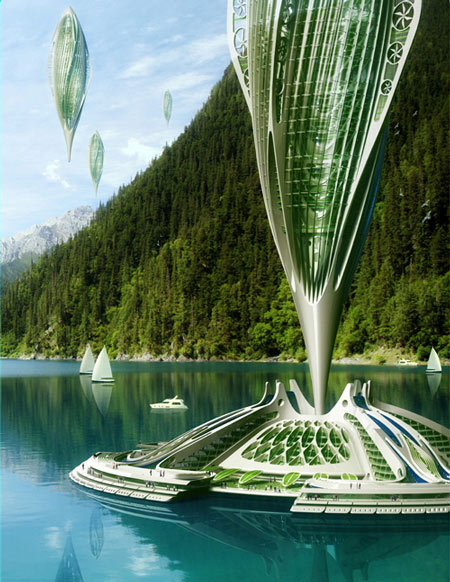
The hub is a floating algal farm. The farm and the elongated seed-shaped airship docked at its centre both produce biofuel—essentially hydrogen—from the microorganism Chlamydomonas reinhardtii. Your mom, a former environmental consultant and algal scientist—now she writes science fiction—explained to you that this unicellular organism has both plant and animal properties; it carries out photosynthesis but is also heterotrophic (able to use organic carbon to grow) and will in the absence of oxygen produce gaseous hydrogen and metabolites such as formate and ethanol through hydrogenase enzymes. Chlamydomonas reinhardtii was first discovered as a clean source of hydrogen back in 1939 by German scientist Hans Gaffron at the University of Chicago (ironically the same year Germany invaded Poland). Gaffron called it “photosynthetic hydrogen production by algae”; and today it is a process that produces electricity and biofuel with zero emissions.
The algae farm recycles CO2for the bio-hydrogen airship you will be boarding after your meeting in the hub. You enter the airy station, whose honeycomb circular design resembles a stylized lily pad and glance up through the high nano-glass ceiling toward the elongated seed-shaped transport rising ten stories above you. The sun glances off the diaphanous double helix frame that resembles a freshwater spirogyra. The hub you’re standing in is a floating algae farm with solar cells on top and hydro-turbines below to capture tidal energy. The algae farm recycles CO2 for the bio-hydrogen airship you will be boarding after your meeting in the hub. You enter the airy station, whose honeycomb circular design resembles a stylized lily pad and glance up through the high nano-glass ceiling toward the elongated seed-shaped transport rising ten stories above you.
The sun glances off the diaphanous double helix frame that resembles a freshwater spirogyra. The hub you’re standing in is a floating algae farm with solar cells on top and hydro-turbines below to capture tidal energy.
The concept is the “subversive architecture” of Belgian architect Vincent Callebaut and inspired by the principles of biomimicry, coined by Janine Benyus in 2002 in her book “Biomimicry: Innovation Inspired by Nature”. Callebaut conceived Hydrogenase in 2010 as a 100% self-sufficient and zero-emission transport system using algae. He claimed that a hectare of seaweeds could produce 120 times more biofuel than a hectare of colza, soya or sunflower without consuming land needed for crops or forests. He called Hydrogenase a true miniature biochemical power station. Able to absorb CO2 as the main nutrient through photosynthesis the algae, under anaerobic conditions, produce hydrogen in vitro or in bioreactors.
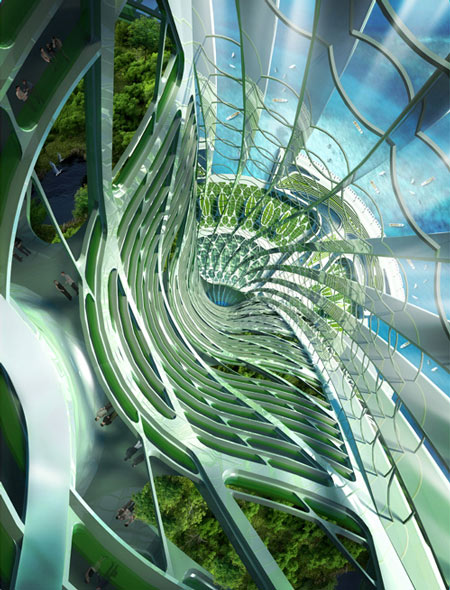
You swipe your PAL over the ticket booth sensor and the optional ticket-brochure pops out. You take it and read the specs between glances at the tall vessel loading in the dock of the hub. It’s really like a vertical dirigible, you think, studying the seed-shaped airship with self-cleaning “intelligent” nanostructured glass—inspired by the lotus leaf that doesn’t get wet. The semi-rigid unpressurised airship stretches vertically around an arborescent spine that twists like chloroplast ribbons 400 meters high and 180 meters in diameter.
You read that each Hydrogenase airship is covered with flexible inflatable photovoltaic cells and twenty wind turbines to maneuver and collect energy. The interior spaces provide room for housing, offices, scientific laboratories, and entertainment, and a series of vegetable gardens that provide a source of food while recycling waste.
You read that this self-sufficient organic transport flies about 2000 meters high at about 175 km/hr (twice the speed of a conventional ship). Given its ease in negotiating airspace and its ability to land and take off from virtually any location, the Hydrogenase is used by many groups in various capacities. Your friend Michael who teaches at the University of Victoria uses one as a mobile research station in his studies along the coast of northern British Columbia.
The vessel is made of “intelligent layers” and “self-separable ceramics”. Its bionic coating draws inspiration from sharkskin that is self-cleaning and flow-efficient.
Hydrogenase concept with algal farm pods and air ships
You head down the spiral staircase to the third subsea level toward the meeting room you booked earlier on your PAL. The view is spectacular from here through the nano-glass panes. Rays of shimmering light stream through a gently swaying forest of kelp. You glimpse the sun-glinted flickering of hundreds of anchovies as they school through the kelp. This floating farm is an organic purifying station of four carbon wells where the algae recycle the carbonated waste brought by the airships and, in turn, feed the airship with biohydrogen. It’s the new “gas station”, you reflect with a smile.
After your meeting with staff, you and three others of your team board the airship and settle in one of the skyview chambers. The journey is relaxing, like the BC Ferry used to be, but without the pungent smell and pollution of conventional motorized sea vessels. It’s a quiet and relaxing trip with a spectacular view of the Gulf Islands. Your team strategizes your presentation over a light lunch and Matcha lattes.
Vincent Callebaut’s Hydrogenase
The PA system sounds and a woman’s voice informs you that the ship will be making an emergency landing on Saturna Island to rescue two hikers injured at East Point. This will only add twenty minutes to the trip, the woman assures you. You don’t mind and recall the disclaimer at the bottom of the ticket. Given the ability of this airship to take off and accurately land virtually anywhere, all Hydrogenases are by law mandated to be on standby for rescue missions in rough terrain.
You pull out the ticket and read again: The Hydrogenase is affiliated with the International Red Cross and BC Coastguard. The Hydrogenase must by law respond to any distress call at sea or rough terrain associated with coastal waters. Because of this service, we cannot guarantee a timely schedule.
You recall how Hydrogenases were deployed in the last hurricane disaster off the coast of Florida last year, saving countless people trapped in the flooding that accompanied the storm. The International Red Cross uses them as flying hospitals.
Bernard frets over the time delay. He is concerned about the lack of preparation and set up time once you get into Victoria. You assuage him gently. The best preparation is sincerity, you tell him. The landscape architect Thomas Woltz, whose work you highly respect, saw himself as someone who embraces the complexity of modern life while seeking meaning and narrative in both natural and human-made environments.
“We’re storytellers,” you tell Andre. Invoking metaphor through design. “They know we’re coming and they know we’re helping someone; they’ll wait for our story. And it’s all about harmony.”
The lines of Henry David Thoreau come to you: Man’s life must be of equal simplicity and sincerity with nature, and his actions harmonize with her grandeur and beauty.
Then you point your PAL at the ServiceBot and order three more lattes. You lean back in your bamboo fabric chair and cross your legs over the leg rest.
It’s a brave new world.
Pine forest in Jackson Creek Park, ON (photo and dry brush rendition by Nina Munteanu)
Nina Munteanu is a Canadian ecologist / limnologist and novelist. She is co-editor of Europa SF and currently teaches writing courses at George Brown College and the University of Toronto. Visit www.ninamunteanu.ca for the latest on her books. Nina’s bilingual “La natura dell’acqua / The Way of Water” was published by Mincione Edizioni in Rome. Her non-fiction book “Water Is…” by Pixl Press(Vancouver) was selected by Margaret Atwood in the New York Times‘Year in Reading’ and was chosen as the 2017 Summer Read by Water Canada. Her novel “A Diary in the Age of Water” was released by Inanna Publications (Toronto) in June 2020.
Stream runs through cedar poplar forest in the rain, Trent Nature Sanctuary, ON (photo and dry brush rendition by Nina Munteanu)
Oh! great mysterium: Great forested sanctuary into the heart of being Oh! to walk pensive, in solitude into the center Of a cedar forest, worlds all russet and green, Branch and bough, rain swept landscapes The high treetops, far whisper and echo… The great winds in high flight high above… Songs to pierce the sullen skies, Melodies of joy and of a deepest longing…
Cedars and poplars in a morning mist, Trent Nature Sanctuary, ON (photo by Nina Munteanu)
Songs of immortality, worlds full aflame, Mystic cathedrals and dawn memory, Haze and gray day, silver sky, silver cloud Rain downfall and mist… Leaf, branch and bough, the wind and the rain The bending and wind tossed land
Mist hangs over Trent Canal, Trent Forest Sanctuary, ON (photo by Nina Munteanu)
The spring scents, spring grasses and nearby stream; Rivulet and rhapsodic song, The holy silences, the rain, fall, hiss and far echo… Cedar forest cathedrals, branches overspread, Red winged blackbird, soaring alone high above, High into the receiving dome of haze and sky Free swoop and whispering forest airs
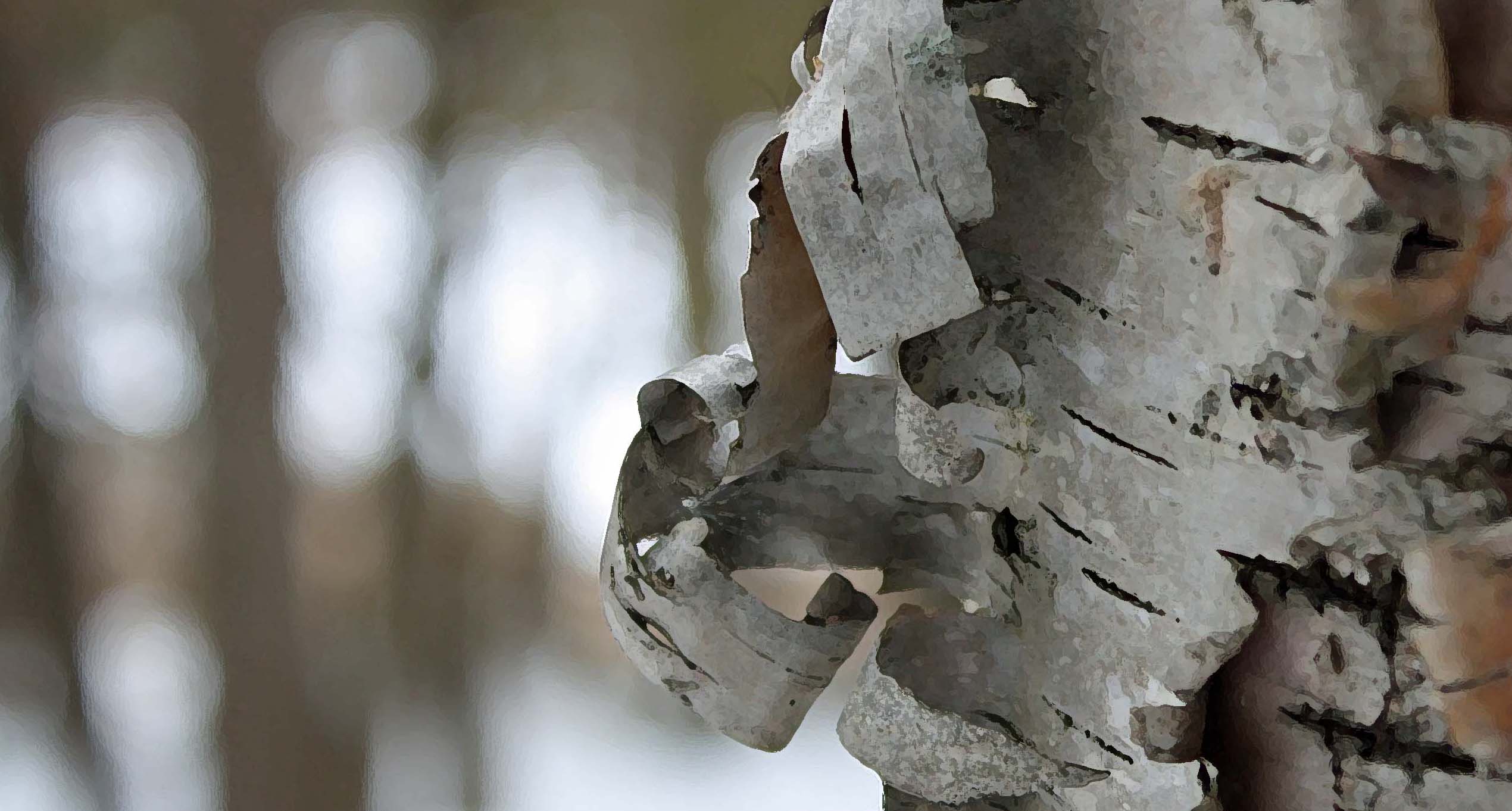
White birch in Trent Nature Sanctuary, ON (photo and dry brush rendition by Nina Munteanu)
The far meditation: Sacred journey into a holy wilderness: Forested worlds beyond time…
Cedar root among ferns and moss in a light mist, Trent Nature Sanctuary (photo by Nina Munteanu)
Forested worlds of an existential beauty, Great moss silences, tree root and bough… Great worlds of hope and the tenebrous shadow Of a rain swept day… Holy encounters: the great mysterium Sacred worlds beyond still time…
BEV GORBET
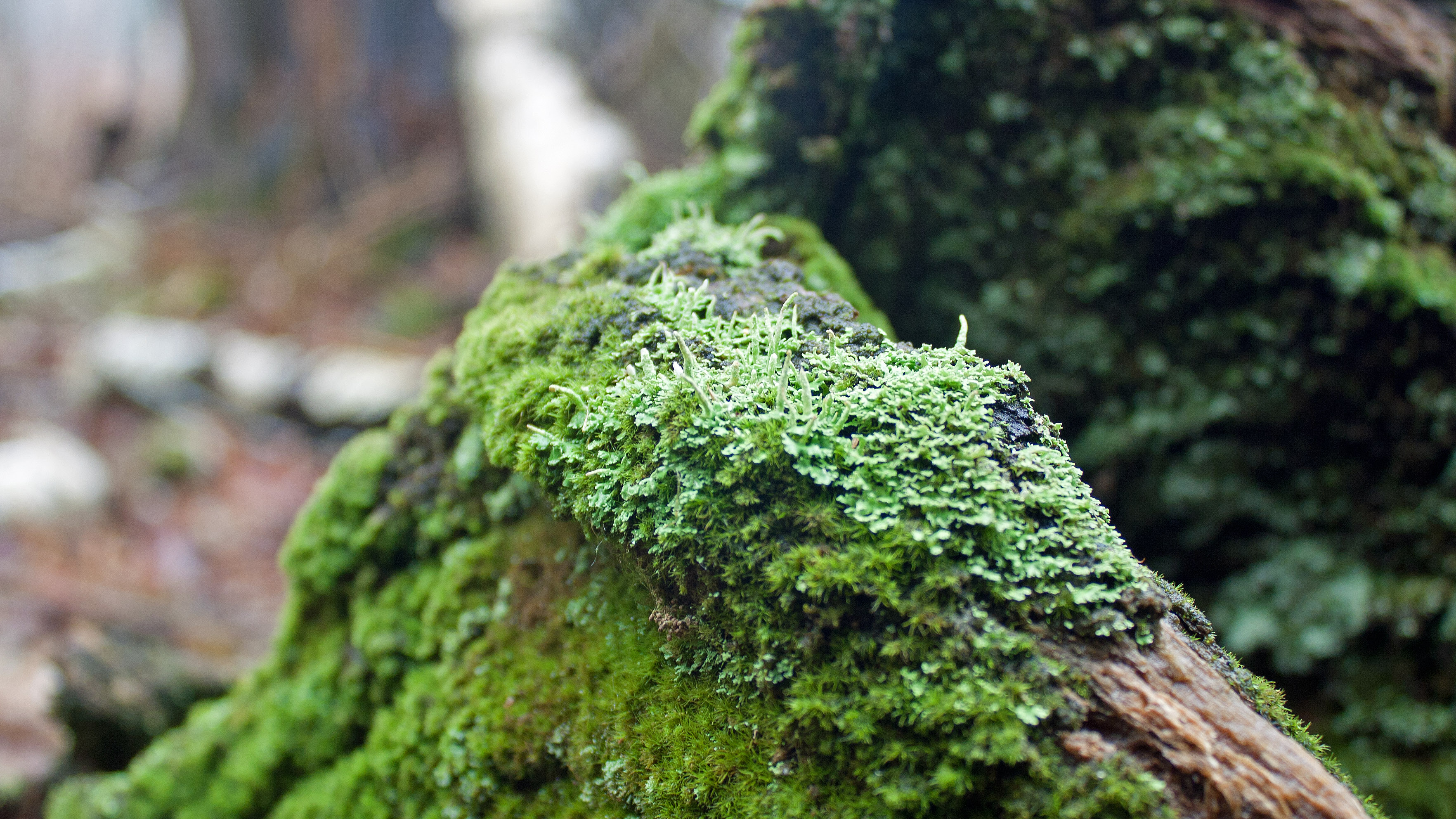
Moss and lichen cover an old cedar log, Trent Nature Sanctuary, ON (photo by Nina Munteanu)
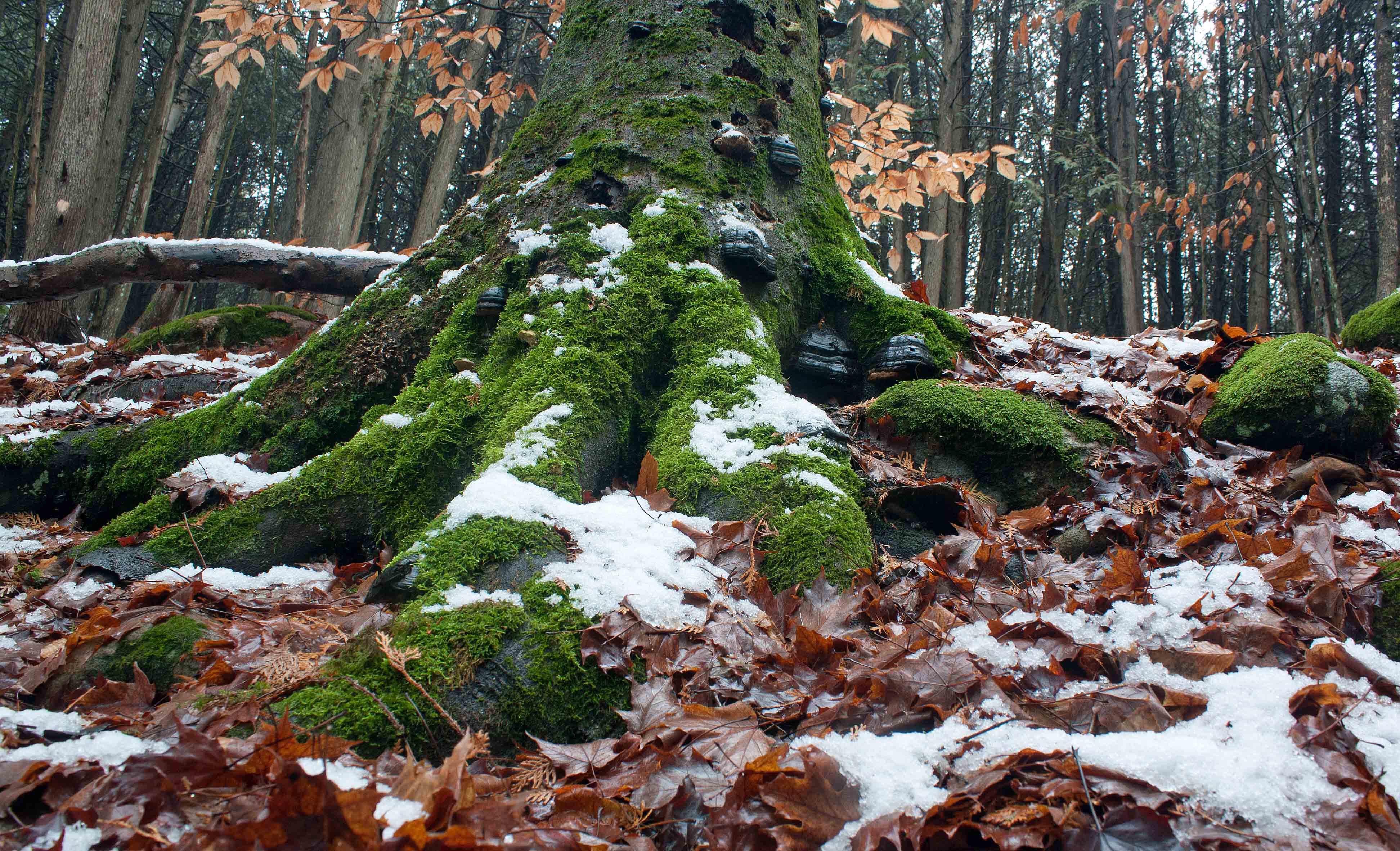
Tinder polypore fungus on white birch, Trent Nature Sanctuary, ON (photo and dry brush rendition by Nina Munteanu)
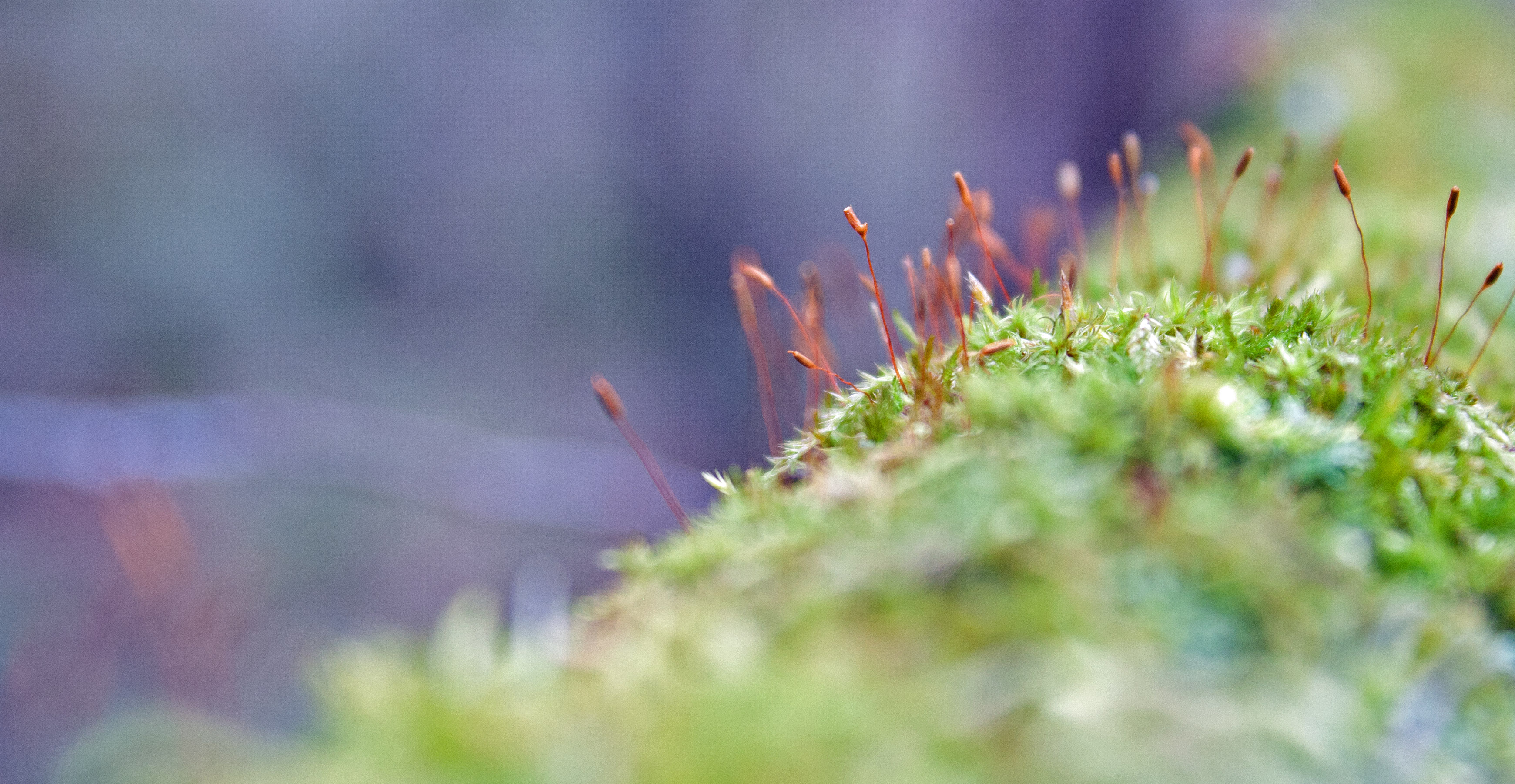
Moss on a log in Trent Nature Sanctuary, ON (photo by Nina Munteanu)
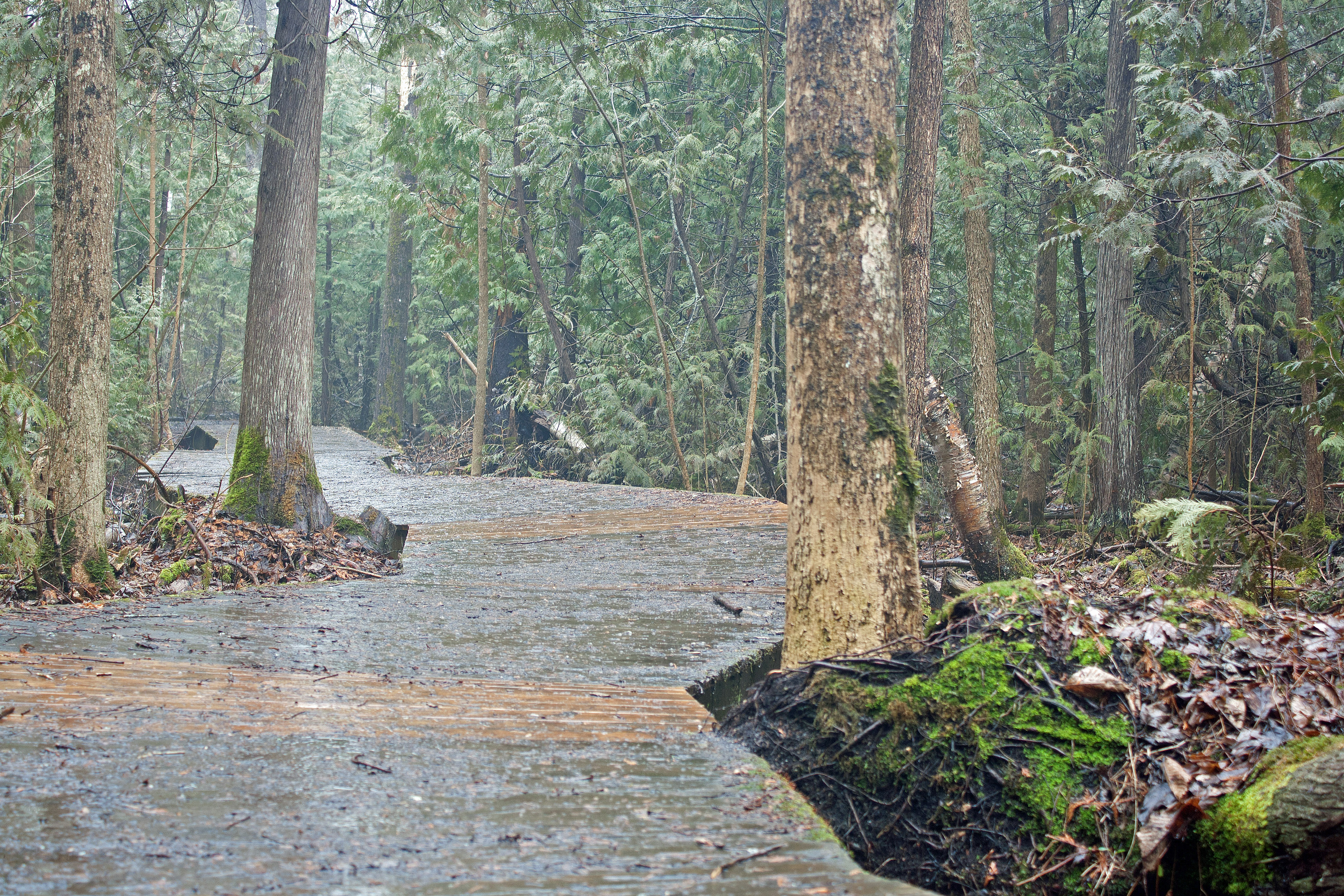
Cedar boardwalk in a misty rain, Trent Nature Sanctuary, ON (photo by Nina Munteanu)
Nina Munteanu is a Canadian ecologist / limnologist and novelist. She is co-editor of Europa SF and currently teaches writing courses at George Brown College and the University of Toronto. Visit www.ninamunteanu.ca for the latest on her books. Nina’s bilingual “La natura dell’acqua / The Way of Water” was published by Mincione Edizioni in Rome. Her non-fiction book “Water Is…” by Pixl Press(Vancouver) was selected by Margaret Atwood in the New York Times‘Year in Reading’ and was chosen as the 2017 Summer Read by Water Canada. Her novel “A Diary in the Age of Water” was released by Inanna Publications (Toronto) in June 2020.
I appeared recently on the Sustainably Geeky Podcast Episode 33 “Making a Splash” to talk with host Jennifer Hetzel about all things to do with water, from physics and chemistry to geography and politics. We discussed what a limnologist does (like zoom around lakes in a jet boat and collect water samples, among other things).
Here is their blurb about the episode:
“Water you waiting for? This month we talk with limnologist and cli-fi author Nina Munteanu about the water cycle and how human activity affects it. Nina discusses the importance of water in all its forms, and its affect on global warming.”
Click below to listen:
Jackson Creek in early winter high flow, ON (photo and dry brush rendering by Nina Munteanu)
Nina Munteanu is a Canadian ecologist / limnologist and novelist. She is co-editor of Europa SF and currently teaches writing courses at George Brown College and the University of Toronto. Visit www.ninamunteanu.ca for the latest on her books. Nina’s bilingual “La natura dell’acqua / The Way of Water” was published by Mincione Edizioni in Rome. Her non-fiction book “Water Is…” by Pixl Press(Vancouver) was selected by Margaret Atwood in the New York Times‘Year in Reading’ and was chosen as the 2017 Summer Read by Water Canada. Her novel “A Diary in the Age of Water” was released by Inanna Publications (Toronto) in June 2020.
In my recent eco-novel A Diary in the Age of Water the limnologist Lynna makes the following entry in her diary in 2057:
Last night after supper, Hilde and I went for a walk along Shaw to Christie Pits, where I used to play as a kid. She wanted to show me the magnificent aurora borealis that had been streaming dramatically for the past several weeks. When I was a kid, auroras this far south were unheard of. Now they are common. The night sky was clear, and we enjoyed the fresh spring air as we ambled down Shaw Street. We parked ourselves on the damp grass among other spectators of the colourful night sky and watched the dancing light show.
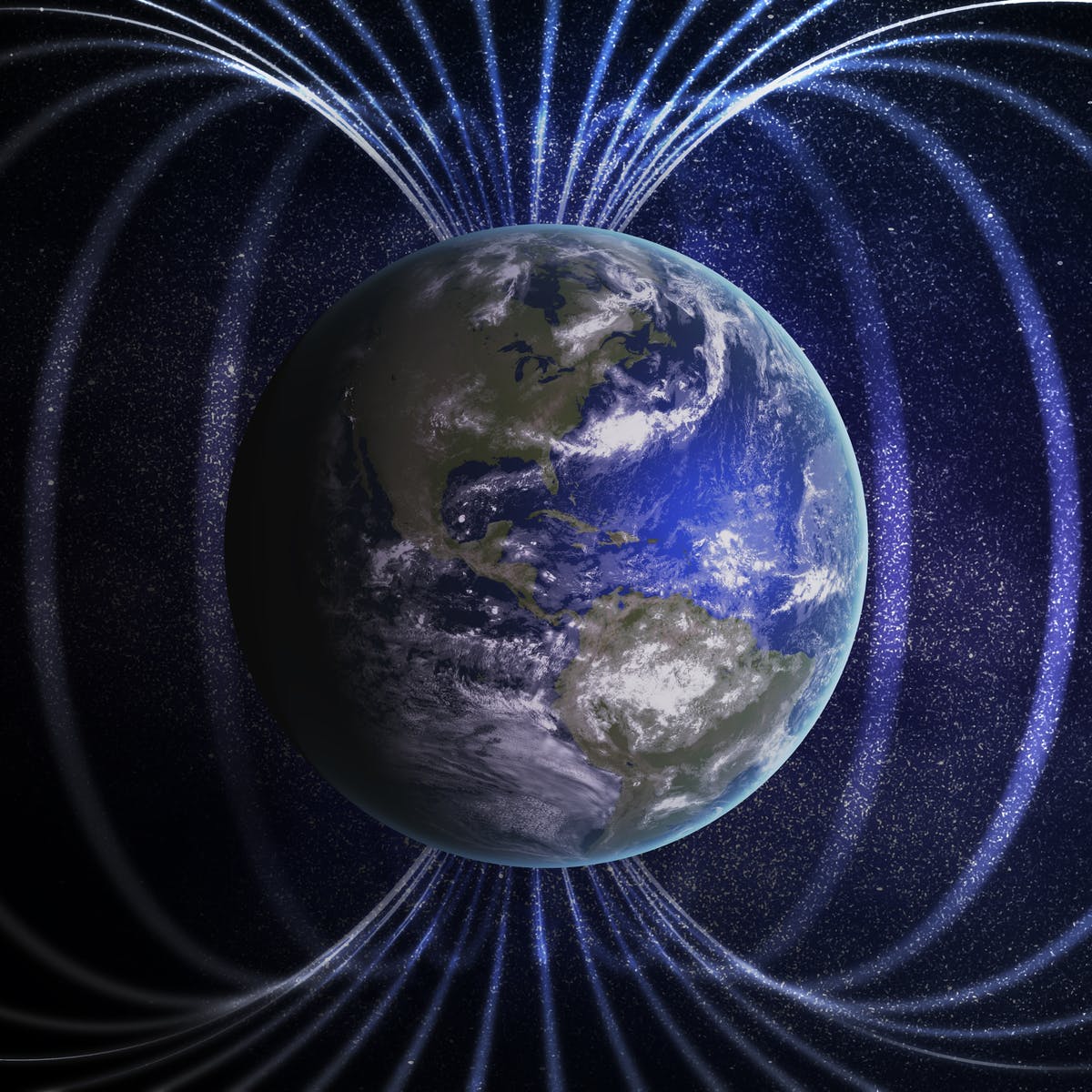
It was mesmerizing: ribbons of mostly green and pink light rippled as if tugged by a mischievous wind. They danced with a kind of life that brought me back to my childhood. Northern lights happen when the magnetic field of our planet is disturbed by the solar wind. As the particles slide along the contours of the Earth’s magnetosphere, they glow as they lose their energy. The particles energize the air molecules enough to make them glow in various colours, depending on the composition of the gases.
Earth’s magnetic field is generated and maintained by an ocean of superheated, swirling metal around a solid iron core. These act like a dynamo to create electrical currents, which, in turn, create our magnetic field. But our magnetic field is weakening, and a flip is imminent. In the past two hundred years, the field has weakened by fifteen percent. That’s why we’re seeing these auroras in Toronto. A weaker field creates more auroras. They’ve become common here, particularly during the winter and spring months. Nasa predicts that the field could be gone in five hundred years or less and then take another two hundred years to rebuild.
The field will first become more complex and might show more than two magnetic poles—playing havoc with our navigation systems and God knows what else—until it is entirely gone. Then it will presumably build and align in the opposite direction. When the magnetic field goes, so will our shield against radiation. First, the ozone layer—our shield against ultraviolet rays—will be stripped away, and then the atmosphere may lose other key elements and grow thinner. Will we end up like Mars 4.2 billion years ago, when severe solar storms stole its very atmosphere and evaporated all its water?
Mars once had a strong magnetic field like Earth. But then Mars cooled and its conducting geodynamo stopped rotating. In the absence of the protective field, the solar wind surged in and excited the ions in the upper Martian atmosphere to an escape velocity. The solar wind just swept the air away. The surface pressure of the Martian atmosphere dwindled from one thousand millibars to six millibars. Mars lost about the same atmosphere that Earth has today.
Mars is our destiny; it’s just a question of when. We’re all batteries, running dry. I considered this probable fate for Earth as we watched the exquisite example of our changing magnetic field. But I didn’t share it with Hilde, who watched with her mouth open in rapt wonder. If she’s lucky, she will experience no more of this progression than these amazing auroras. The weakening magnetic field and the associated loss of protection and atmosphere won’t happen for a while. I hope. —A Diary in the Age of Water
Earth’s magnetic field
In a 2019 article in New Atlas, David Szondy tells us that “North isn’t quite where it was after the Earth’s north geomagnetic pole made an unexpected sprint across arctic Canada.” Apparently the magnetic pole is moving faster than predicted. The shift is caused by a push/pull between two patches of magnetic field—one under Canada and another under Siberia. The Canadian one appears to be weakening…
Every few hundred thousand years our magnetic field reverses—with the magnetic north switching places with the magnetic south. The last major geomagnetic reversal occurred 780,000 years ago. Between the full geomagnetic reversals—which can last up to 10,000 years—shorter disruptions occur. These are called geomagnetic excursions and are short-lived, involving temporary changes to the magnetic field that last from a few hundred to a few thousand years. The most recent recorded geomagnetic excursion is called the Laschamps Excursion some 42,000 years ago.
“The Laschamps Excursion was the last time the magnetic poles flipped,” explains Chris Turney, one of the lead scientists of a study reported in Science. “They swapped places for about 800 years before changing their minds and swapping back again.”
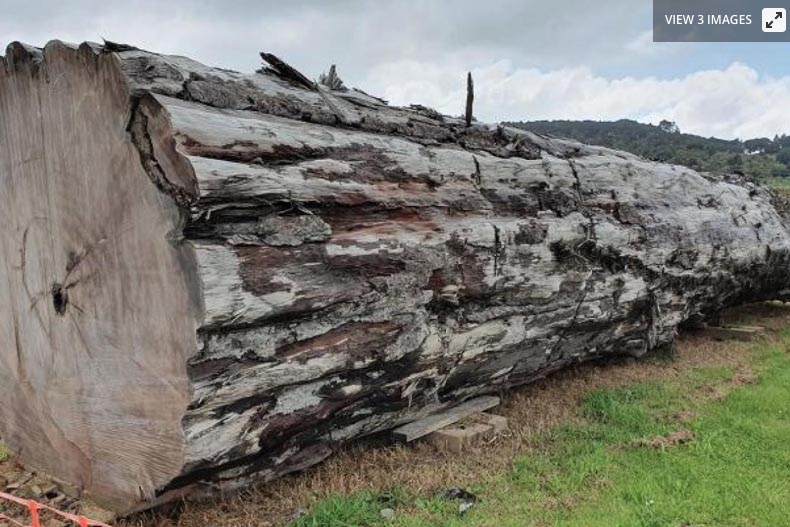
Although scientists have known about these magnetic pole events, they have not clearly understood their impacts on life and the environment. A study published in the journal Science reported on a recent discovery in New Zealand of an ancient kauri tree, that not only confirmed the time of the magnetic collapse, but shed some light on the dramatic period of environmental change, particularly in the time leading up to the few hundred years the Earth’s magnetic field was reversed. These included a depleted ozone layer, higher levels of ultraviolet radiation, and increased atmospheric ionization, all coalescing about 42,000 years ago in the Laschamps Excursion. “Early humans around the world would have seen amazing auroras, shimmering veils and sheets across the sky,” says Alan Cooper, one of the lead scientists. “It must have seemed like the end of days.”
Ancient Kauri tree unearthed in New Zealand (image by New Atlas)
The researchers also speculated that the magnetic field disruption led to an influx of cave art, driven by the need to seek shelter from the increase in ultraviolet rays—particularly during solar flares. The researchers also suggested that the event prompted the extinction of several megafauna in Australia and the end for Neanderthals—whose extinction occurred around 42,000 years ago.
Cooper points to the current movements of the north magnetic pole across the Northern Hemisphere as a potential warning sign of an impending event.
“This speed – alongside the weakening of Earth’s magnetic field by around nine per cent in the past 170 years – could indicate an upcoming reversal,” says Cooper. “If a similar event happened today, the consequences would be huge for modern society. Incoming cosmic radiation would destroy our electric power grids and satellite networks.”
Alan Cooper
Terraforming Mars (images by NASA)
Making Mars Inhabitable By Re-establishing its Magnetic Field
“Our quest on Mars has been to ‘follow the water’ in our search for life in the universe, and now we have convincing science that validates what we’ve long suspected,” said NASA’s John Grunsfeld.”This is a significant development, as it appears to confirm that water – albeit briny – is flowing today on the surface of Mars.”
That was step one. Mars was once just like Earth, with a thick atmosphere and lots of water.
In a 2017 article in Science Alert, Peter Dockrill reported that “NASA wants to launch a giant magnetic field to make Mars habitable.” This bold plan was to give Mars its atmosphere back and make it habitable for future generations of human colonists consists of launching a giant magnetic shield into space to protect Mars from solar winds. With the shield in place, scientists argued that we could restore the atmosphere and terraform the Martian environment so that liquid water flows on the surface again. Mars once had a thick atmosphere like Earth currently has.
In 2018 NASA concluded: “Our results suggest that there is not enough CO2 (carbon dioxide) remaining on Mars to provide significant greenhouse warming were the gas to be put into the atmosphere; in addition, most of the CO2 gas is not accessible and could not be readily mobilized. As a result, terraforming Mars is not possible using present-day technology.”
Then in 2019, Harvard scientists proposed a way around the problem of insufficient CO2 for greenhouse warming. They proposed that by “covering certain areas of the Martian surface with a thin layer of silica aerogel, namely areas with large amounts of water ice, enough sunlight will come through for warming and combine with natural heating processes beneath the surface to create a potentially habitable environment.”
The study demonstrated through experiments and modelling that under Martian environmental conditions, a 2–3 cm-thick layer of silica aerogel would simultaneously transmit sufficient visible light for photosynthesis, block hazardous ultraviolet radiation and raise temperatures underneath it permanently to above the melting point of water, without the need for any internal heat source.
“Once temperatures were adequate, the gases released from the ice in the lakes and regolith (soil) would build up to form a pressurized atmosphere under the aerogel layer. If successful up to that point, microbes and plant life could theoretically survive. “Placing silica aerogel shields over sufficiently ice-rich regions of the Martian surface could therefore allow photosynthetic life to survive there with minimal subsequent intervention,” the scientists suggested. This photosynthetic life would go on to produce oxygen for pickier Earth dwellers to utilize,” reports Dacia J. Ferris of Teslarati.
p.s. I’m sure I’m not the only one who sees the irony of this situation: Mars has insufficient CO2to warm its atmosphere, when Earth suffers from an excess of this greenhouse-warming gas. While going to Mars is one of my dreams (quite unrealizable for me; but I’m allowed to dream, no?), I still harbor an unsettling feeling that comes with the uncertainty about our prowess and respect in this endeavor. We haven’t exactly been successful in controlling our own runaway global warming or other degradation of our living ecosystems. Read Ray Bradbury’s Martian Chronicles to get my meaning.
“Watch those disposable coffee cups!”
Nina Munteanu is a Canadian ecologist / limnologist and novelist. She is co-editor of Europa SF and currently teaches writing courses at George Brown College and the University of Toronto. Visit www.ninamunteanu.ca for the latest on her books. Nina’s bilingual “La natura dell’acqua / The Way of Water” was published by Mincione Edizioni in Rome. Her non-fiction book “Water Is…” by Pixl Press(Vancouver) was selected by Margaret Atwood in the New York Times‘Year in Reading’ and was chosen as the 2017 Summer Read by Water Canada. Her novel “A Diary in the Age of Water” was released by Inanna Publications (Toronto) in June 2020.
“Every story is a story of water,” says Mojave American poet Natalie Diaz.
In her article on Diaz, Maria Popova reiterates, “we ourselves are a story of water—biologically and culturally, in our most elemental materiality and our mightiest metaphors.”
There is a reason that women are recognized worldwide as water keepers. Women are intimately connected with flowing water; everything about us is flowing: from our menstrual and birthing waters to the waters of our nurturing milk and the tears we shed for our lost ones. We flow with life and it flows out of us.
The water walk with Grandmother Josephine along Lake Ontario in 2019 (photo by Nina Munteanu)
So, when Lake Erie became a person with rights in February 2019, this landmark designation came with both triumph and some irony to womankind and water keepers around the world.
Based on that quote, it would seem that only men did the trammelling (given that women are not included or the more correct term would be “human”). It was only a hundred years ago, in 1920, that the 19thAmendment granted women legal personhood in the United States; and in that amendment Native American women were not included—until years after. In her poem Lake-loop, Mojave poet Natalie Diaz explored “how that nesting doll of exclusions breaks open into the living reality of this Earth”:
“Part of the San Andreas fault runs along the Mojave Desert. We see and feel the fault, it has always been a part of Mojave stories and geography. We have always existed with it–in rift–part land. We are land’s action, maybe. I am always wondering and wandering around what it means to be part of this condition, in shift. What it means to embrace discontinuity, to need it and even to need to cause it in order to be–depression but also moving energy. The necessary fracturing of what is broken. The idea of being made anything or nothing in this country–“to be ruined before becoming”–the idea that this country tried to give us no space to exist, yet we made that space, and make it still–in stress, in friction, glide and flow, slip and heave. We are tectonic, and ready.”
NATALIE DIAZ
The Earth is indeed shifting. As are we. If we are to survive, that is. This will come with a connection with Earth’s natural rhythms. We haven’t been doing that very well, particularly under an “othering” capitalist, exploitive, hubristic dogma. It’s time to ride the swells and turbulence of a Nature evolving. And co-evolve; or get left behind. We can learn much from the stories of our Indigenous relatives. We can learn much from the stories of our non-human relatives too.
That’s what climate change is: a new story. And that story is all about water.
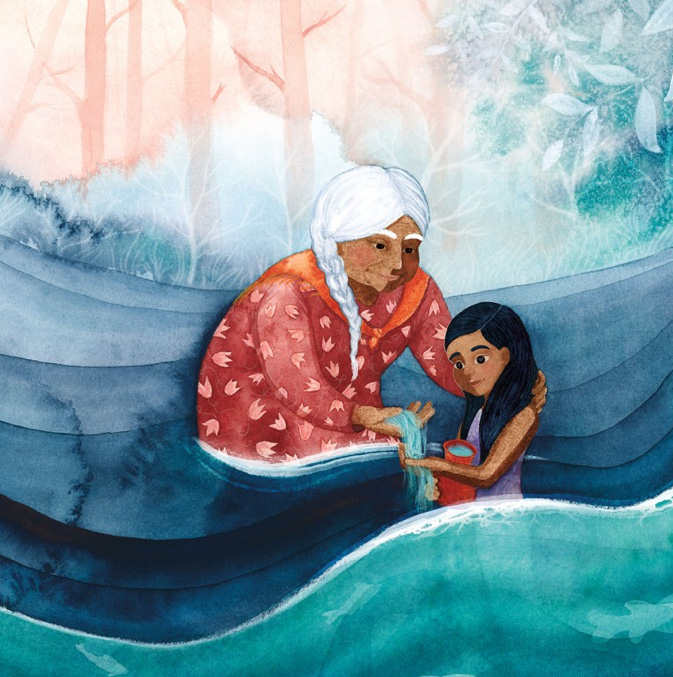
Grandmother with young water keeper (illustration by Michaela Goade)
For this World Water Day, I share with you a wonderful story of water keepers and the water we keep safe. Author Carole Lindstrom, member of the Turtle Mountain Band of Ojibwe, and artist Michaela Goade, member of the Central Council of the Tlingit Haida Tribe of Alaska. have produced “We Are Water Protectors”, a lyrical illustrated celebration of cultural heritage and the courage to stand up for nature.
“Yours is a grave and sobering responsibility, but it is also a shining opportunity. You go out into a world where [human]kind is challenged, as it has never been challenged before, to prove its maturity and its mastery–not of nature but of itself. Therein lies our hope and our destiny.”
RACHEL CARSON
Today is World Water Day…
I exhort you to do something for water today. Plant a tree (they love water and water loves them). Clean up a local stream or lakeshore. Write a letter to a government official about protecting your watershed. Research something about water and share with someone. Share your watermark on the WatermarkProject.ca site. Buy We Are Water Protectors and share it with someone or give it away. Or buy Silent Spring and share it with someone who hasn’t read it yet.
Keep it flowing…
Nina Munteanu is a Canadian ecologist / limnologist and novelist. She is co-editor of Europa SF and currently teaches writing courses at George Brown College and the University of Toronto. Visit www.ninamunteanu.ca for the latest on her books. Nina’s bilingual “La natura dell’acqua / The Way of Water” was published by Mincione Edizioni in Rome. Her non-fiction book “Water Is…” by Pixl Press(Vancouver) was selected by Margaret Atwood in the New York Times‘Year in Reading’ and was chosen as the 2017 Summer Read by Water Canada. Her novel “A Diary in the Age of Water” was released by Inanna Publications (Toronto) in June 2020.
Cedar forest and extensive roots amid glacial erratics flank Jackson Creek on the right, ON (photo by Nina Munteanu)
.
It was a cold November day, after a light snow, as I wandered the Jackson Creek old-growth forest. Centuries-old cedar, pine and hemlock towered above me, giving off the fresh scent of forest. The trees creaked and cracked, swaying in a mischievous wind. I left the main path and descended the leaf-strewn slope toward the river. My boots pressed through a frosty crust into the spongy ground of dead leaves and organic soil. I stopped and breathed in the fresh coolness of the air. A damp mist huddled among the trees, adding wisps of mystery to the ancient forest. It was as though I’d entered an enchanted forest in some fanciful fairy tale.
Cedar forest on slope of Jackson Creek Park in early winter, ON (photo by Nina Munteanu)
.
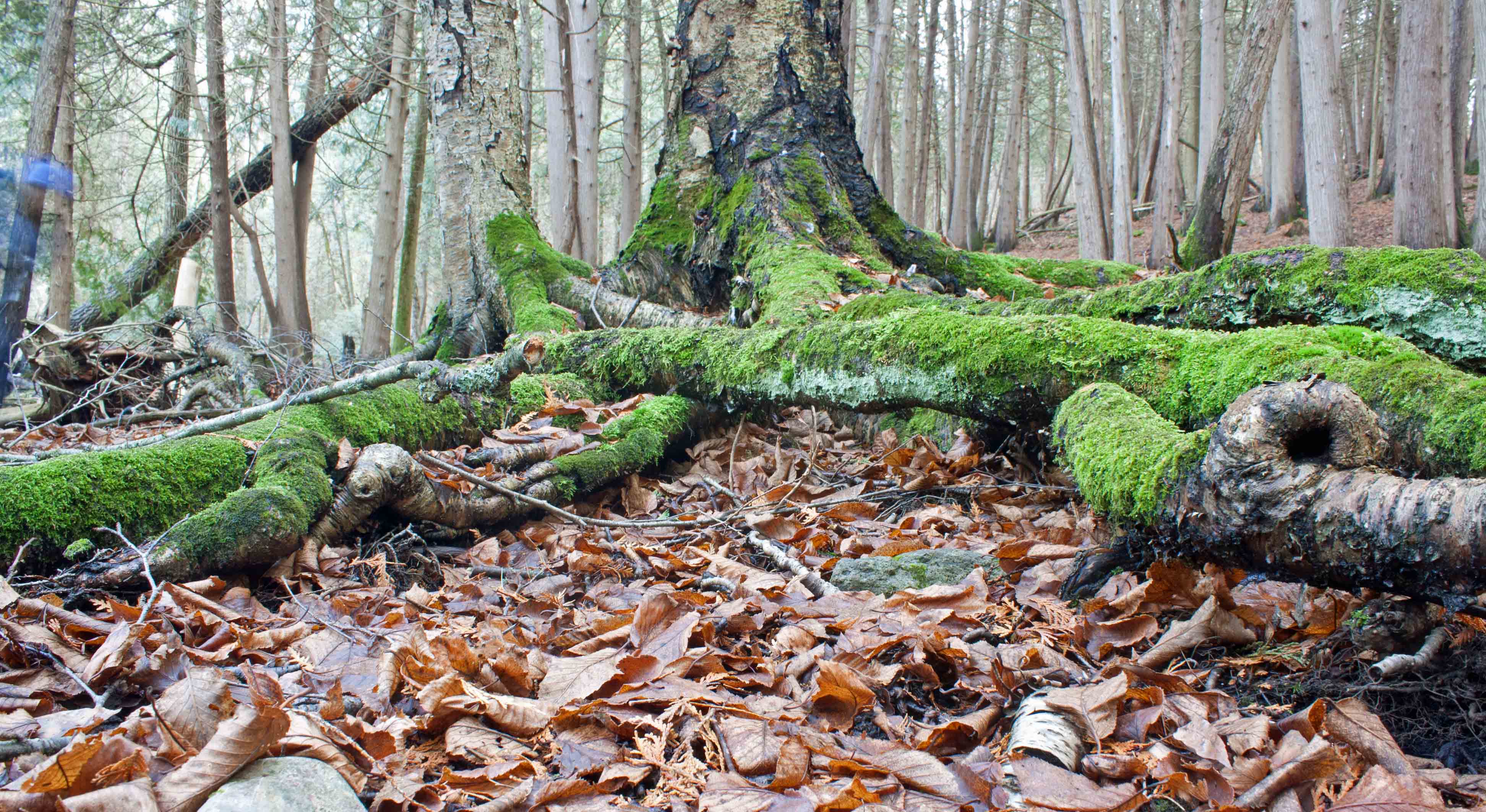
Not far from the river, I approached an old yellow birch tree, large trunk rising as tall as some of the cedars and pines around it. Golden flakes of bark curled and formed craggy patterns around the girth of the old tree. Radiating out from the tree, moss-covered roots snaked out like tangled ropes in a profusion of brilliant green. This was fairy country, I suddenly thought.
I dropped to my knees, crouching down, and set up my tripod and camera to capture this magical tree from the perspective of the forest floor. Head almost touching the ground, I inhaled the scent of loam and decaying leaves. The fresh pungency of cedar, pine, and humid moss hung in the air. Nearby, the river chortled and bubbled in a content symphony of motion. A curious red squirrel parked itself on a log nearby to watch me. It didn’t scold me like they normally did when I entered the forest; like it understood… It then occurred to me, as I set up my equipment under the squirrel’s careful stare, that I was in the presence of an enchantment. Like I was peering into a secret dance of feral celebration. But being there and appreciating it, I had now become part of it; I was Alice going down the rabbit hole into a true wonderland…
It was then that I glimpsed it as I carefully took my timed pictures. A blur of blue. What had I witnessed? A motion? A colour? Then it was gone. But in that moment, I’d felt the spark of an elation that comes with a glimpse into a secret world.
Old yellow birch tree and moss-covered roots with approaching blue sprite from left (photo by Nina Munteanu)
.
When I returned home to look at the images I saw that my camera had captured a wispy blue entity that flowed into its view and peered around the old birch at me with a kind of curious though mischievous grin.
Had I just captured a blue sprite? Something was unmistakably there!
Forest sprite peers around a yellow birch tree, Jackson Creek Park, ON (photo by Nina Munteanu)
.
I read up on sprites. According to European lore, a sprite is a supernatural entity. They are often depicted as fairy-like creatures or as an ethereal entity. The word sprite comes from the Latin spiritus (“spirit”), via the French esprit.
Given that the sprite I’d observed was blue and we were close to the river, I wondered if it was not a forest or wood sprite, but a water sprite. According to alchemist Paracelsus, the term ‘water sprite’ is used for any elemental spirit associated with water. They can breathe water or air and sometimes can fly. They also possess the power of hydrokinesis, which is the ability to create and manipulate water at will. Also known as ‘water nymphs’ and naiads (or nyads), these divine entities tend to be fixed in one place. Slavic mythology calls them vilas. Sprites are not corporeal beings (like selkies, mermaids and sirens) given that they are not purely physical; they are more like local deities than animals. This explained the wispy nature of the being I’d seen peering at me from the tree.
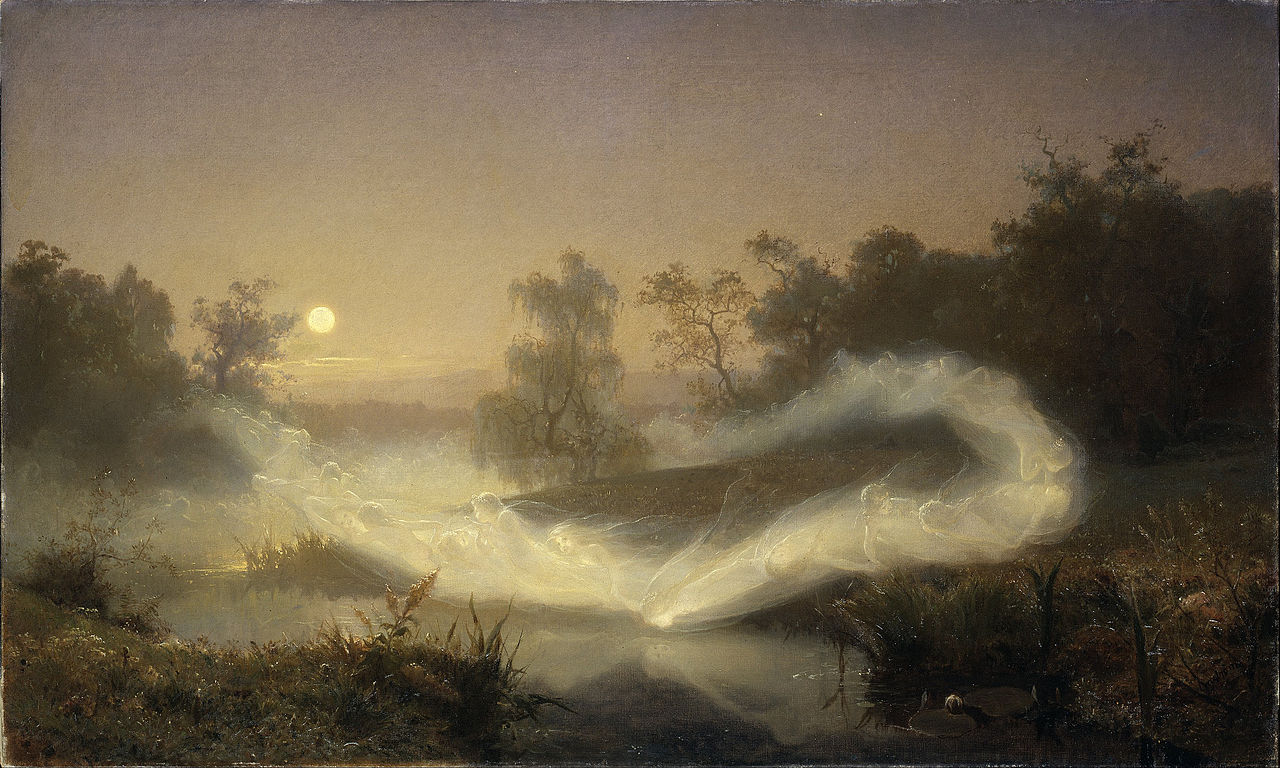
“Dancing Fairies” by August Malmström
.
After consulting with several friends—some who purported to know much more about sprites than I did—I concluded that this sprite was, in fact, a forest sprite and it was blue because it was near the water. Friend Merridy suggested that “forest sprites, normally green, may turn blue if a nearby brook calls to them.” She added that “water sprites can be distinguished by their chatty nature. They rarely go beyond the banks of a river or brook. Forest sprites are mostly silent.” Which this one certainly was. Friend Craig then pondered, “Are digital sprites in our world or in an electro-magnetic world? Or something else?” He was referring to them showing up on my camera without me even noticing they were there. When I told him I would return in search of them he observed, “if you’re looking for them that might be when they hide. Or maybe not. Any type of sprite is probably good, mischievous or friendly.” Thanks, Craig! That was helpful…
Glacial erratic boulders in Jackson Creek, ON (photo by Nina Munteanu)
Century-old beech tree, decaying and moss-covered in early winter, Jackson Creek Park, ON (photo by Nina Munteanu)
Ancient cedar tree stands next to an ice sheet on the path beside Jackson Creek, ON (photo by Nina Munteanu)
.
I visited the forest many times after but saw no sign of any sprites. Perhaps Craig was right; they were hiding from me.
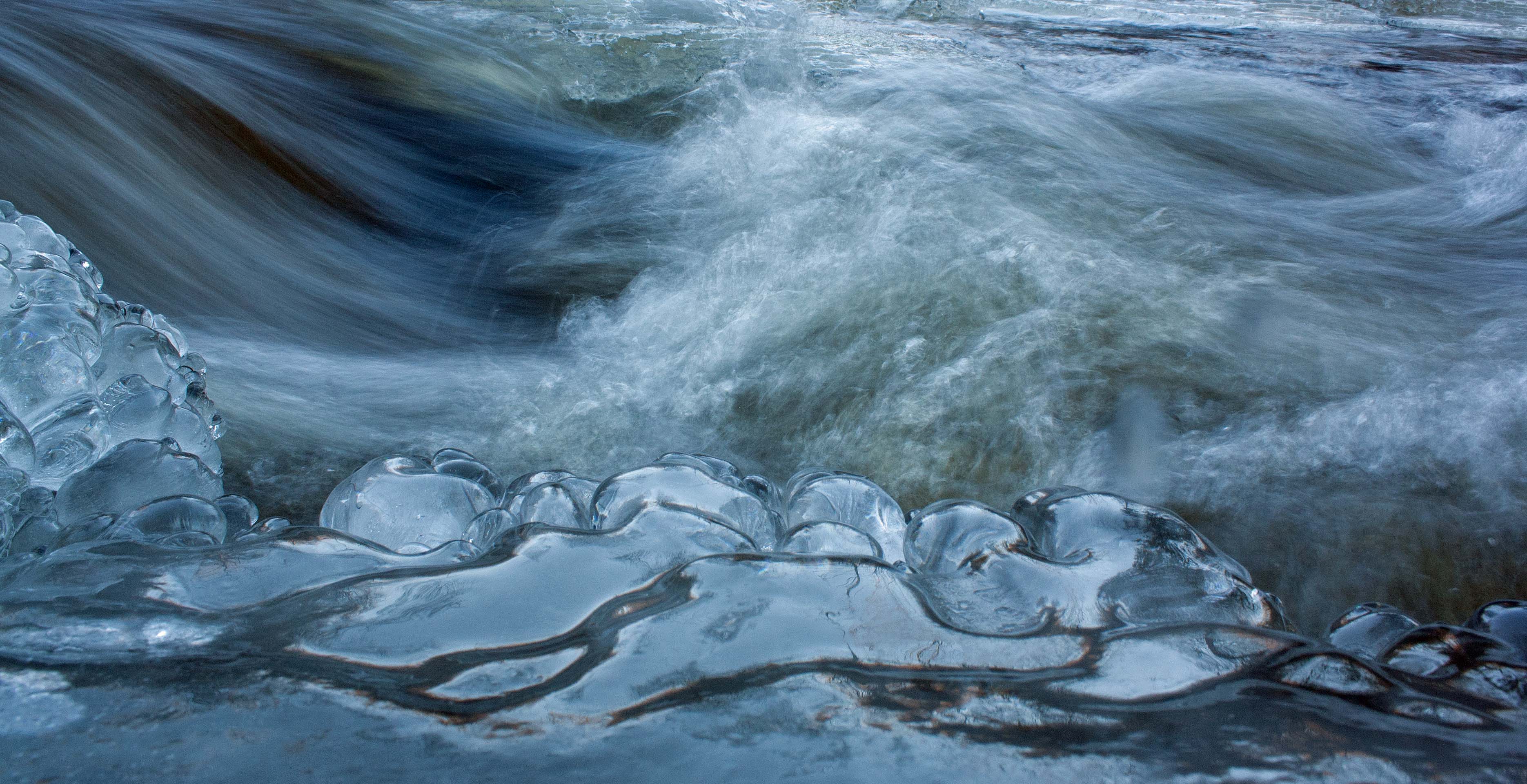
Then, on a foggy late December day, after a light dusting of snow, I returned to document the ice forming in the river. Islands and columns of ice had created a new topography for the flowing waters of Jackson Creek. Ice sheets also covered the forest path in places—making the walk somewhat treacherous. At times, I had to scramble and seize hold of branches to haul my way up precipitous banks from where I’d captured sculptures of ice ‘pearls,’ ‘platforms,’ and ‘columns’ on the river.
Ice forming on Jackson Creek in early winter, ON (photo by Nina Munteanu)
Ice ‘pearls’ forming on shore by rushing river, Jackson Creek, ON (photo by Nina Munteanu)
.
The fog grew thick as my walk eventually led me into an area of eccentric lopsided cedars in a ‘drunken’ stand by the river bank. The cedars sent out a tangled tapestry of gnarly roots I had to negotiate. I could feel the earth-magic. I dropped to my knees again and set my camera and tripod to the level of the roots. That is when I saw the blue sprite again! This time the sprite wasn’t playful; it appeared startled and disoriented. But, I managed to capture it as it fled the scene in wisps of blue smoke. As I left the forest, my thoughts returned to this serendipitous moment. Had I interrupted the wood /earth sprite in its work in the forest? These sprites are known to have the power of chlorokinesis, the ability to grow and control plants at will. When I checked my images at home, the sprite appeared to float near one of the cedars.
Blue forest sprite floats by cedar tree, Jackson Creek Park, ON (photo by Nina Munteanu)
.
When she saw the image, friend Merridy asked, “was the sprite entering the tree?” Thinking of incantations, friend Dyana asked if I’d had my recording feature on, which I’d never thought to do. On second thought, she decided that it might be dangerous. Not a good idea to anger a sprite. Friend Gabriela then challenged me: “did you ask what message they have for you, Nina? They keep showing up in your way, they might have a message for you or to be delivered through you to…” whoever… I hadn’t thought of that either. How would I hear their message when they were silent and so fleeting, I challenged back. She wisely responded, “Just ask yourself the question; you might be surprised when your next thought brings the answer. Since everything is energy, and you saw them at least twice, you’re probably connected with them.”
Sprite vaporizes behind tree, Jackson Creek Park, ON (photo by Nina Munteanu)
.
I didn’t tell her that the question that came to mind after seeing the sprite was: I wonder what’s for dinner!
I must ponder this more, however.
Cedar forest on a misty winter day, Jackson Creek Park, ON (photo by Nina Munteanu)
Thinking of Gabriela’s interesting remark, I am reminded of a rather sad but evocative tale by Vladimir Nabokov entitled “The Wood Sprite.” Told in the first person, it recounts the narrator’s experience when he was visited at his desk by an old wood sprite, “powdered with the pollen of the frosty, starry night.” The creature tells of his exile from a country wood in Russia, all cut down and burned amid the treachery of war.
Now that I think of it, I know the blue sprite’s message. And now you know it too.
Cedar forest and roots amid glacial erratics in Jackson Creek Park, ON (photo by Nina Munteanu)
Nina Munteanu is a Canadian ecologist / limnologist and novelist. She is co-editor of Europa SF and currently teaches writing courses at George Brown College and the University of Toronto. Visit www.ninamunteanu.ca for the latest on her books. Nina’s bilingual “La natura dell’acqua / The Way of Water” was published by Mincione Edizioni in Rome. Her non-fiction book “Water Is…” by Pixl Press(Vancouver) was selected by Margaret Atwood in the New York Times‘Year in Reading’ and was chosen as the 2017 Summer Read by Water Canada. Her novel “A Diary in the Age of Water” was released by Inanna Publications (Toronto) in June 2020.
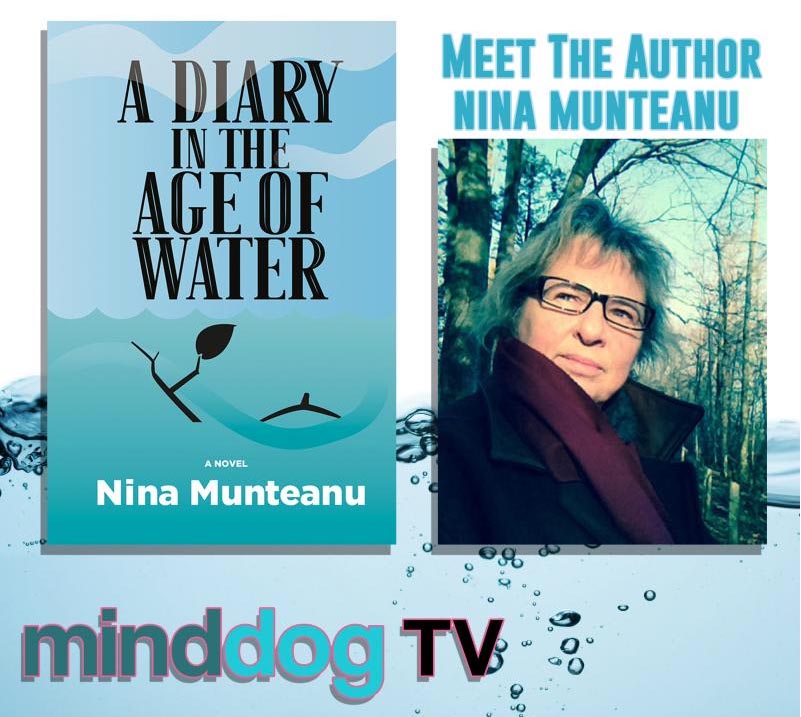
I was recently interviewed by Matt Nappo on Minddog TV in New York, where we talked about the science and magic of water, climate change and how to not become cynical, the process of writing, what scares us and what takes us through it into great storytelling.
Here’s the interview:
Matt Nappo interviews limnologist and clifi author Nina Munteanu on minddog TV
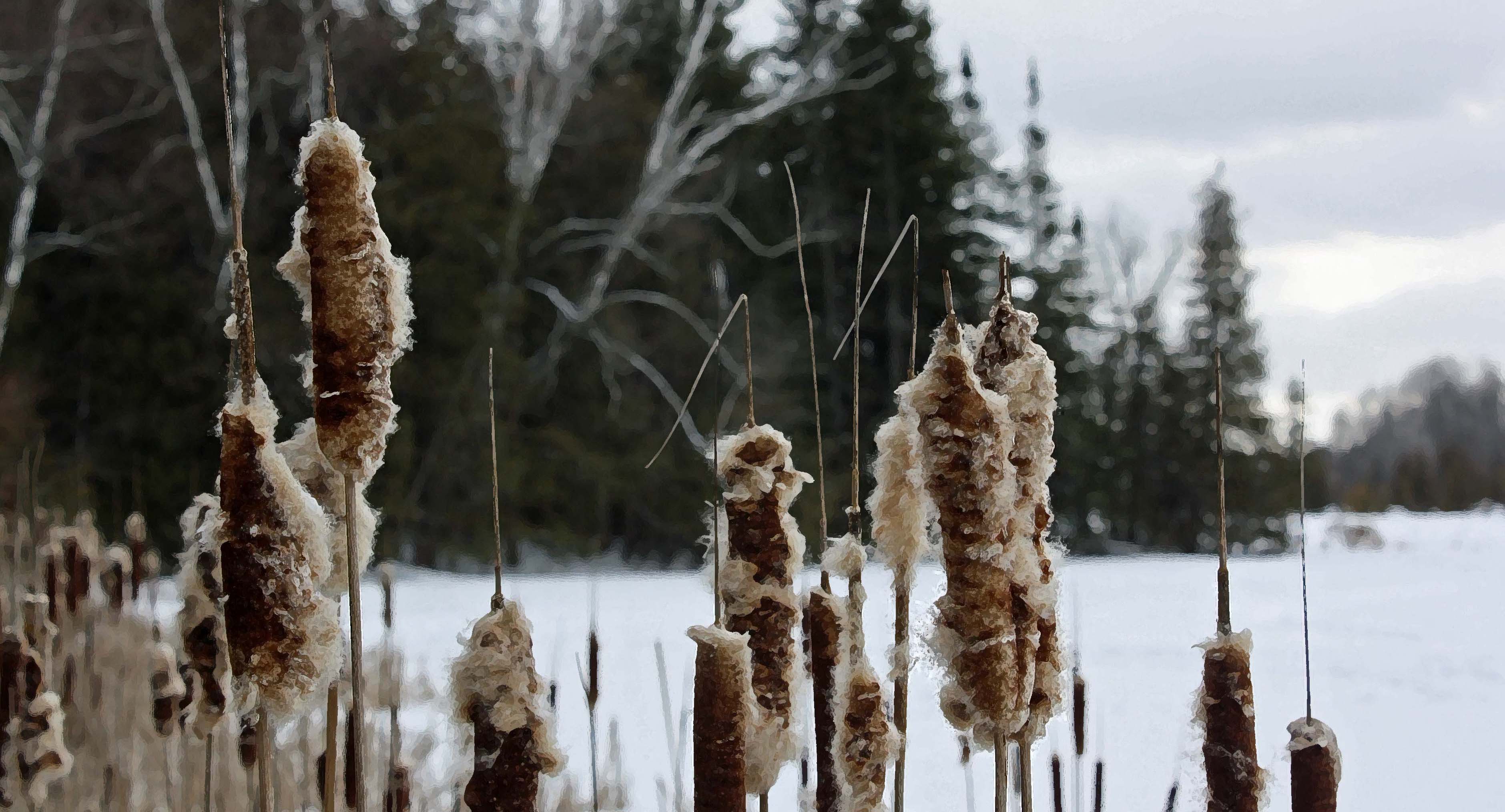
Cattails oversee the snowy plain of the iced-over Trent Canal, ON (photo and dry brush rendition by Nina Munteanu)
Nina Munteanu is a Canadian ecologist / limnologist and novelist. She is co-editor of Europa SF and currently teaches writing courses at George Brown College and the University of Toronto. Visit www.ninamunteanu.ca for the latest on her books. Nina’s bilingual “La natura dell’acqua / The Way of Water” was published by Mincione Edizioni in Rome. Her non-fiction book “Water Is…” by Pixl Press(Vancouver) was selected by Margaret Atwood in the New York Times‘Year in Reading’ and was chosen as the 2017 Summer Read by Water Canada. Her novel “A Diary in the Age of Water” was released by Inanna Publications (Toronto) in June 2020.
“In this bonus episode, we continue our conversation with limnologist and cli-fi author Nina Munteanu. We discuss her book A Diary in the Age of Water and what led her to write this dystopian tale of a future that revolves around water scarcity. Nina’s background as a limnologist gives her a unique perspective on the challenges that await us if we do not address climate change.”
Click below to listen:
Nina Munteanu is a Canadian ecologist / limnologist and novelist. She is co-editor of Europa SF and currently teaches writing courses at George Brown College and the University of Toronto. Visit www.ninamunteanu.ca for the latest on her books. Nina’s bilingual “La natura dell’acqua / The Way of Water” was published by Mincione Edizioni in Rome. Her non-fiction book “Water Is…” by Pixl Press(Vancouver) was selected by Margaret Atwood in the New York Times‘Year in Reading’ and was chosen as the 2017 Summer Read by Water Canada. Her novel “A Diary in the Age of Water” was released by Inanna Publications (Toronto) in June 2020.

































 Nina Munteanu Writing Coach