Finding the Muse … and Keeping It

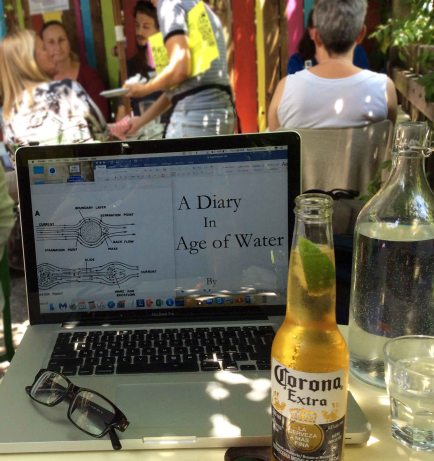
writing-Diary in Margaritas

Writing my novel in style (photo by Nina Munteanu)

I often get asked how and from where I draw my inspiration. How do I find my muse? And how do I keep it? What I’m really being asked is: how do I defeat “writer’s block”?


The Journeying Muse 

Many writers complain of experiencing writer’s block at some point in their career—that affliction of not accessing one’s creativity, when the muses have all fled to Tahiti or someplace far away and you are left with a blank page or more importantly—and alarmingly—a blank mind. No desperate search, hot shower, long walk or discussion with a friend will seduce those holidaying muses back. You’re still stuck on page 49.

Here’s my solution: don’t sweat it. Embrace the emptiness and something wonderful will fill it. I said something; not necessarily what you expect. I believe that when your muse “leaves” you, it is on a journey. More to the point you are on a journey. You’re living. More often than not, our directed muse leaves us because something has gotten in the way. What you probably need to do is pay attention to that something. It’s telling you something. Ironically, by doing this, you open yourself to something wonderful. Okay, enough of somethings!…

Writing is a lot like fishing. In order to write you need something to write about. So, when the world gets in your way, you should pay attention. This is what you’re here for. A writer is an artist who reports on her society. A good artist, at least an accessible one, needs to be both participant as well as observer. So, take a break and live. Chances are, you will have much more to write about after you do.


Invoking the Muse & Defeating Writer’s Block 

writing2-PortMcNicoll

Pat and Joan at a writing intensive (photo by Nina Munteanu)

In the over twenty years of writing both fiction and non-fiction I really hadn’t given much thought to writer’s block until recently, when I was challenged on it. This is not to say that I never experienced it. I did; I just kept on writing.

“What?” you say. “Then, you didn’t really have writer’s block!” Well, I did; but only for that particular project, and only for one aspect of that particular project. The key is to have multiple projects and to recognize that each, in turn, has multiple tasks associated with it (e.g., editing, research, discussion, etc.).

For instance, besides Novel A, whose plot had me stumped in the middle, I was working on two short stories and a non-fiction article. I was also actively posting science articles, essays and opinion pieces on my blog. In addition, I was writing news articles for an online magazine and doing my regular stint at the environmental consulting firm where I wrote interpretive environmental reports. I kept on writing.

I let the plot of Novel A sit for a while as I continued to write. That didn’t mean I couldn’t work on Novel A in other capacities: copy-editing or polishing language, for instance. The point I want to make is that it’s helpful to have other things on the go mainly because this will let you relax about the project that has you stumped. And you need to relax for it to resolve. It’s a little like looking for the watch you misplaced; it will “find you” when you stop looking.


Letting the Muse Return (on its own terms)

Each of you has felt it: that otherworldly, euphoric wave of “knowing”, of resonating with something that is more than the visible world: when the hairs on the back of your neck tingle as you write that significant scene … or tremble with giddy energy as you create that perfect line on a painting …or glow with a deep abiding warmth when you defend a principal … or the surging frisson you share with fellow musicians on that exquisite set piece …These are all what I call God moments. And they don’t happen by chasing after them; they sneak up on us when we’re not looking. They come to us when we focus outward and embrace our wonder for this world. When we quiet our minds and nurture our souls with beauty.

Merry Christmas!


Nina Munteanu is an ecologist and internationally published author of award-nominated speculative novels, short stories and non-fiction. She is co-editor of Europa SF and currently teaches writing courses at George Brown College and the University of Toronto. Visit www.ninamunteanu.ca for the latest on her books.

Writing in Your Own Hand

writing-notebook05

writing in a cafe (photo by Nina Munteanu)

How many of you still handwrite? I don’t just mean a letter to a friend or relative (although handwritten letters are growing increasingly rare) or a reminder to do something or shopping list. I’m referring to writing prose, creative non-fiction, poetry or any kind of expression with a pen or pencil.

University student Cynthia Selfe shared, “I like the motion, pushing that lead across the page…filling up pages … I like flipping papers and the action of writing. It makes me feel close to what I’m saying.”

Handwriting is an art that many of us are losing.

A June 2014 New York Times article by Maria Konnikova shares neuro-scientific evidence that links handwriting with a broader educational development. “Children not only learn to read more quickly when they first learn to write by hand, but they also remain better able to generate ideas and retain information. In other words, it’s not just what we write that matters—but how.” Experiments done with young children showed that when they drew a letter freehand, they showed increased activity in three areas of the brain activated in adults when they read and write: the left fusiform gyrus, the inferior frontal gyrus and the posterior parietal cortex. Children who typed or traced the letter showed no such effect. Researchers at Indiana University attributed the differences to the messiness inherent in free-form handwriting: “not only must we first plan and execute the action in a way that is not required when we have a traceable outline, but we are also likely to produce a result that is highly variable,” reported Konnikova. That variability may itself be a learning tool. “When a kid produces a messy letter,” said Dr. Karin James, psychologist at Indiana University, “that might help him learn it.”

We learn best heuristically, through experience. It’s known that the more senses you engage in an experience, the more efficiently you will learn and more likely you will retain what you learned.

Handwriting slows us down. It is a sensual and intimate way for us to express ourselves. I love my handwriting, especially when I am using my favorite pen (my handwriting changes depending on the pen), a fine felt marker — usually black. When you use a pen or pencil to express yourself you have more ways to express your creativity. Think of the subtleties of handwriting alone: changing the quality and intensity of strokes; designing your script, using colors, symbols, arrows or lines, using spaces creatively, combining with drawing and sketches. In combination with the paper (which could be lined, textured, colored graphed, etc.), your handwritten expression varies as your many thoughts and moods.

writing-notebook01

Writing in Niagara on the Lake (photo by Nina Munteanu)

The very act of handwriting focuses you. Writing your words by hand connects you more tangibly to what you’re writing through the physical connection of pen to paper. Researchers have proven that just picking up a pencil and paper to write out your ideas improves your ability to think, process information and solve problems. The actual act of writing out the letters takes a little more work in your brain than just typing them on a keyboard, and that extra effort keeps your mind sharp. Researchers have also shown that writing something out by hand improves your ability to remember it. Handwriting improves memory, increases focus, and the ability to see relationships.

Handwriting fuses physical and intellectual processes. American novelist Nelson Algren wrote, “I always think of writing as a physical thing.” Hemmingway felt that his fingers did much of his thinking for him.

According to Dr. Daniel Chandler, semiotician at Aberystwith University, when you write by hand you are more likely to discover what you want to say. When you write on a computer, you write “cleanly” by editing as you go along and deleting words (along with your first thoughts). In handwriting, everything remains, including the words you crossed out. “Handwriting, both product and process,” says Chandler, “is important … in relation to [your] sense of self.” He describes how the resistance of materials in handwriting increases the sense of self in the act of creating something. There is a stamp of ownership in the handwritten words that enhances a sense of “personal experience.”

writing-notebook02

Niagara on the Lake (photo by Nina Munteanu)

I know this is true in my own writing experience. This is why, although I do much of my drafting of novel, article and short story on the computer, I find that some of my greatest creative moments come to me through the notebook, which I always keep with me. Writing in my own hand is private and resonates with informality and spontaneity (in contrast to the fixed, formal look and public nature of print). Handwriting in a notebook is, therefore, a very supportive medium of discovery and the initial expression of ideas.

“I am certainly no calligrapher,” admits novelist and poet Wendell Berry, “but my handwritten pages have a homemade, handmade look to them that both pleases me in itself and suggests the possibility of ready correction.” Writer John O’Neill calls handwriting “bodily art.” He suggests that, “the writer’s fingers and the page are a working ensemble, and alternation of intelligible space and spatialized intelligence.”

Berry goes on to share that: “Language is the most intimately physical of all the artistic means. We have it palpably in our mouths; it is our langue, our tongue. Writing it, we shape it with our hands. Reading aloud what we have written — as we do, if we are writing carefully — our language passes in at the eyes, out at the mouth, in at the ears the words are immersed and steeped in the senses of the body before they make sense in the mind. They cannot make sense in the mind until they have made sense in the body. Does shaping one’s words with one’s own hand impart character and quality to them, as does speaking them with one’s own tongue to the satisfaction of one’s own ear?… I believe that it does.”

Cursive Writing: Losing More Than an Art Form
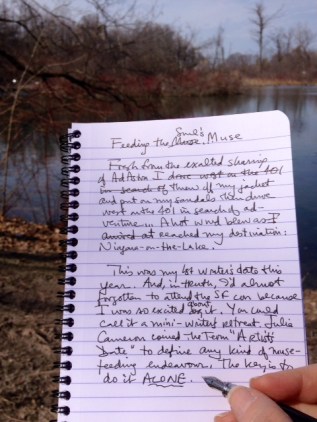
writing-notebook03

Writing in Niagara on the Lake (photo by Nina Munteanu)

John Boone’s November 15th 2013 article on Eonline reads: “Cursive handwriting will no longer be taught in schools because it’s a big, old waste of time”. Besides the controversy at the time—it’s old news now—I was curious to read how seven states, namely California, Idaho, Indiana, Kansas, Massachusetts, North Carolina and Utah, fought to keep cursive in the curriculum, arguing that it helped distinguish the literate from the illiterate. “Joke’s on them because all kids are illiterate these days,” Boone scoffs. He cites computers as the reason. Of course. Let’s not forget texting on Smart phones and other communication devices that encourage the use of a bastardized form of English. Schools promote keyboarding as a productive alternative based on its direct application to career success. But what about the subtle, integrative, sociological, psychological and creative benefits of handwriting?

There is a spill-over benefit for thinking skills used in reading and writing. Research has shown that learning cursive writing is directly related to literacy, the ability to read well and to comprehension generally. Scientists discovered that learning cursive is an important tool for cognitive development. The brain develops functional specialization through cursive writing that integrates sensation, movement control, and thinking. Brain imaging studies reveal that multiple areas of brain become co-activated during the learning of cursive writing of pseudo-letters, as opposed to typing or just visual practice. To write legible cursive, fine motor control is needed over the fingers. You have to pay attention and think about what and how you are doing it. You have to practice. Brain imaging studies show that cursive activates areas of the brain that don’t participate in keyboarding. Psychologists at Princeton and the University of California reported that students learned better when they took notes by hand than when they typed on a keyboard. Handwriting, they reported, allowed the student to process a lecture’s contents and reframe it, to reflect and manipulate that can lead to better understanding and memory encoding.

writing-notebook04

Writing at Niagara Falls (photo by Nina Munteanu)

In an April 2013 New York Times article, Kate Gladstone contended that handwriting matters, but not cursive. She further shared that adults increasingly abandon cursive. A recent survey of handwriting teachers revealed that over half used a hybrid of cursive and print: some elements resembling print-writing, others resembling cursive. I myself have adopted this hybrid form of handwriting since grade five (despite the authoritative perambulations of my teacher). But, if I hadn’t learned cursive to begin with, I wouldn’t be in the position to hybridize it with print. Cursive remains a life-skill, whose subtle merits we have yet, and may never, fully discern. Instead of using Gladstone’s inappropriate metaphors of abacus or slide rule, learning cursive is better compared with learning notes for music or learning how to add, subtract and divide to do higher math.

We are poised to slide down an insidious and dangerous path. To willingly give up a basic ability and skill that will inevitably close doors in knowledge, particularly historical knowledge, is akin to handing over a piece of your freedom and heritage. It is actually more insidious than that: When your son Johnny can’t sign his own name on a document, he loses more than his ability to identify himself as a unique individual and citizen with inalienable rights; he has lost his very identity. Printing your name is akin to marking X. And that’s the situation some kids are finding themselves in today.

In another New York Times article, Morgan Polikoff recommends that educators and policymakers resist the urge to add more skills (referring to cursive, as if it hadn’t been there to begin with). “Doing so would simply result in a crowded, less-focused curriculum, undermining the strength of the standards,” Polikoff ended. I find this ironic; because the reality is that cursive writing as a taught skill goes hand in hand with active handwriting. If time is not devoted to cursive, it’s not devoted to handwriting. And THAT will have grave consequences. The truth is that going to exclusive print-writing will eventually lead to no handwriting at all. Students will opt to use keyboarding exclusively and handwriting will go the way of the slide rule and the abacus. How will the exclusive use of the keyboard affect the act of writing and expression, generally? It will be certainly at the expense of artistic expression and creativity itself.

“Many people now cannot form legible letterforms at all except by tapping on a keyboard. For those people, writing and the alphabet have, quite literally, ceased to be human. How do you expect to be able to cook good food or make good love when you write with prefabricated letters? How do you expect to have good music if you live on a typographic diet of bad Helvetica and even worse Times New Roman—never mind the parodies of letters that flash across your cellphone screens and the parodies of numbers marching over the screens of your pocket calculators and cash-dispensing machines? How can things so ill-formed have a meaning?”—Wendel Berry, The Typographic Mind (in Everywhere Being Is Dancing)

SONY DSC

Birch trees in Ontario (photo by Merridy Cox)

In medieval times only a small elite could read and write; they created the stories and recorded them in glorious illuminated manuscripts for future storytellers. They created history. The masses made do with handing down stories through oral storytelling, which, because it was not tangibly recorded, morphed and was eventually lost like water down a flowing river. The power lay in the script. What was handed down.

If we are not careful, the ability to read and write will become the sole pursuit of an elite, those few who will hold the key to interpreting the past. And ultimately controlling the future.


References:

Munteanu, Nina. 2013. The Journal Writer: Finding Your Voice. Pixl Press, Vancouver, British Columbia. 172pp.
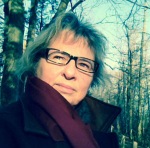
 

Nina Munteanu is an ecologist and internationally published author of award-nominated speculative novels, short stories and non-fiction. She is co-editor of Europa SF and currently teaches writing courses at George Brown College and the University of Toronto. Visit www.ninamunteanu.ca for the latest on her books.
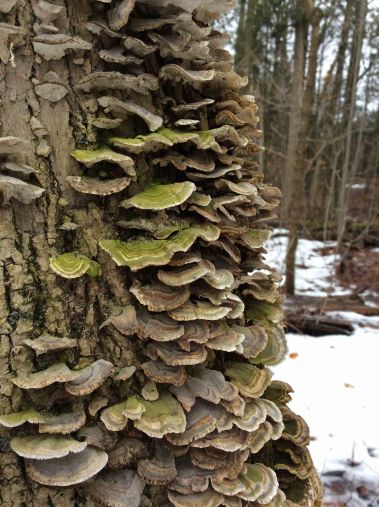
Stoking the Scintillation of Inspiration

CreditRiverWalk-oct2018

Walking along the Credit River (photo by Nina Munteanu)

“Many of us wish we were more creative,” Julia Cameron, author of The Artist’s Way, shares. “Many of us sense we are more creative, but unable to effectively tap that creativity. Our dreams elude us. Our lives feel somehow flat. Often, we have great ideas, wonderful dreams, but are unable to actualize them for ourselves. Sometimes we have specific creative longings we would love to be able to fulfill … we hunger for what might be called creative living.”

Many of us are, in fact, creatively blocked. How would you know if you were? Jealousy is an excellent clue. Are there creative people you resent? Do you tell yourself, ‘I could do that, if only…’ An old friend of mine used to constantly share that he would “start living and settle down” once he had enough money. It never happened; and he never did—twenty years later. That was sad; because he was waiting for life to begin, when it was already happening—and he was missing it.

Creative recovery (or discovery) is something you can learn. It is something you can enhance and direct. “As you learn to recognize, nurture, and protect your inner artist,” says Cameron, “you will be able to move beyond pain and creative constriction. You will learn ways to recognize and resolve fear, remove emotional scar tissue, and strengthen your confidence.”

Stoking the creative artist inside you may be as simple as giving your mind the chance to wander—and taking the time to pay attention. Rhythm and regular, repetitive actions play a role in priming the artistic well. Cameron lightheartedly describes how the “s” activities work so well for this: showering, swimming, scrubbing, shaving, steering a car. I can testify to the latter—how many great plot ideas have I cooked up while driving to work! Filmmaker Steven Spielberg claimed that his best ideas came to him while he was driving the freeway. Negotiating through the flow of traffic triggered the artist-brain with images that translated into ideas. “Why do I get my best ideas in the shower?” Einstein was known to have remarked. Scientists tell us that this is because showering is an artist-brain activity.

The magical part in this is to pay attention. Pay attention to your life experiences; don’t ignore them. Sit up in the bus and watch people, play with the images, sounds and smells. Get sensual and let your eyes, ears, nose and limbs delight in the world. It’s amazing how interesting the world becomes once you start paying attention.

Henry Miller tells us to develop interest in your daily life; in people, things, literature, and music: “the world is … simply throbbing with rich treasures, beautiful souls and interesting people. Forget yourself,” he says.

Looking outward as well as inward allows us to explore different angles and facets of the same thing. When we see the same thing through different perspectives we rediscover something new in ourselves. We create interest and connect the world to ourselves.

Julia Cameron shares that “art may seem to spring from pain, but perhaps that is because pain serves to focus our attention onto details (for instance, the excruciatingly beautiful curve of a lost lover’s neck). Art may seem to involve broad strokes, grand schemes, great plans. But it is the attention to detail that stays with us; the singular image is what haunts us and becomes art. Even in the midst of pain, this singular image brings delight. The artist who tells you different is lying.”

Brenda Ueland tells us why we should all use our creative power: “Because there is nothing that makes people so generous, joyful, lively, bold and compassionate, so indifferent to fighting and the accumulation of objects and money.”

References:

Julia Cameron. 2002. “The Artist’s Way”. Tarcher. 272pp.

Nina Munteanu. 2013. “The Journal Writer: Finding Your Voice”. Pixl Press. 132pp.

Nina Munteanu is an ecologist and internationally published author of award-nominated speculative novels, short stories and non-fiction. She is co-editor of Europa SF and currently teaches writing courses at George Brown College and the University of Toronto. Visit www.ninamunteanu.ca for the latest on her books.

Writing in Sync

hirtle beachNS

Pebbles on Hirtle Beach, NS (photo by Nina Munteanu)

“At the heart of the universe is a steady, insistent beat: the sound of cycles in sync,” says Steven Strogatz in the opening to his compelling book, Sync: the emerging science of spontaneous order. He then describes how every night along the tidal rivers of Malaysia, thousands of fireflies congregate in the mangroves and flash in unison, without any leader or cue from the environment. “Even our bodies are symphonies of rhythm, kept alive by the relentless, coordinated firing of thousands of pacemaker cells in our hearts…almost as if nature has an eerie yearning for order,” adds Strogatz. The tendency to synchronize pervades the universe, from atoms to animals, and people to planets.

To be in sync is to intuitively connect (which is what spontaneous order is) and “know”…

Each of you has felt that “knowing”: that otherworldly, euphoric wave of resonating with something that is more than the visible world: when the hairs on the back of your neck tingle as you write that significant scene or trembling with giddy energy as you create that perfect line on a painting … or glowing with a deep abiding warmth when you defend a principle … or the surging frisson you share with fellow musicians on that exquisite set piece …

These are all what I call God moments. And they don’t happen by chasing after them; they sneak up on us when we’re not looking. They come to us when we focus outward and embrace our wonder for this world. When we quiet our minds and nurture our souls with beauty. It is then that what we had been seeking naturally comes to us. Like a gift.

It’s the blue pill to a new world of synchrony.

This teaches us above all else that we are all journeying together and part of something greater.

I want to share with you my own experience of synchronicity in art. When I’m working on a story, I find that events, opportunities, actions and resources directly germane to my project present themselves: watching an applicable movie that a friend chose for us to see; picking up a newspaper (which I seldom do) and reading a relevant article; looking for something on the internet and finding something totally different (ok; that happens to me all the time); a friend out of the blue introduces a pertinent topic, or someone you haven’t seen in a long time bumps into you with significant news. As though the universe was providing me with what I needed. Well, maybe it was! Of course, my mind was focused on anything to do with my current piece. It was as though I had donned a concentrating filter, one that would amplify relevant details. I’ll go further: I was unconsciously acting in a way that was bringing me more information relevant to my project. Ask and you shall receive.

Jake Kotze says it this way: “Synchronicity happens when we notice the bleed-through from one seemingly separate thing into another—or when we for a brief moment move beyond the mind’s divisions of the world.” Swiss psychologist Carl Jung introduced synchrony in the 1920s as “temporally coincident occurrences of acausal events.” The idea of seemingly unrelated events intersecting to produce meaningful patterns has spawned new notions of thought from the scientific study of spontaneous order in the universe (synchrony), to Synchromysticism — the discovery of convergent archetypal symbols in pop culture (e.g., books, music and film). Author Sibyl Hunter tells us that “Sync operates as an undercurrent of divine awareness personified through the myriad processes and symbols that make up the building blocks of our reality. Within that current, we spin our modern-day myths into books, fairy tales and movies, subconsciously retelling ourselves the same story over and over.”

As the myth builders of today, authors tap in to the synchronicity of ancient story, of resonating archetypes and metaphor and the “mythic journey”. To write in sync.

Joseph Campbell reminds us that, “Anyone writing a creative work knows that you yield yourself, and the book talks to you and builds itself … you become the carrier of something that is given to you from the Muses or God. What the shaman or seer [or artist] brings forth is something that is waiting to be brought forth in everyone.” It’s sync in action.


Nina Munteanu is an ecologist and internationally published author of award-nominated speculative novels, short stories and non-fiction. She is co-editor of Europa SF and currently teaches writing courses at George Brown College and the University of Toronto. Visit www.ninamunteanu.ca for the latest on her books.


Finding the Right Time and Place to Write

Look and you will find it—what is unsought will go undetected —Sophocles

UniversityCollege-WestCollonade

West colonnade of inner courtyard at University College, UofT (photo by Nina Munteanu)

During a time when I had a demanding job as an scientist with an environmental consulting job, was a devoted wife and mother and community volunteer, I wrote and successfully marketed five books, over a dozen short stories and many articles and reviews. Some people, including my publishers, thought I never slept (true) or had cloned myself (possibly). They couldn’t believe my productivity when I was so busy with life.

But I did what I did, because I’d worked out a system. One that I could live by. One that fit my lifestyle. One created out of respect for my art as part of my “busy” life of commitments.

The truth of it is that we all lead busy lives. If you are going to finish that novel you’ve been working on over the years or book of poems sitting in the bottom dresser drawer, you need to make a commitment. Aside from giving your art the respect it deserves, it comes down to creating a time and place to write.

It starts with being realistic about your daily schedules and routines and inclinations and picking a time and place accordingly. Try to be consistent. It’s actually best to create a routine related to both time and place; the key is to be realistic about it. Don’t fight your inclinations or habits; instead, build your writing into your lifestyle. This will ensure success.

Choose a Sacred Time

Gate to UC courtyard

Gate to courtyard at UofT (photo by Nina Munteanu)

Finding the time to write is critical to succeeding. If you don’t dedicate time to write, you won’t write. Believe me, you won’t. Make it sacred.

Writer Louise DeSalvo shared a common story about her experience: “Many people I know who want to write but don’t (my husband, Ernie, for example) or who want to write more than they have but say they can’t find the time (my friend Marla) have told me that taking the time to write seems so, well, self-indulgent, self-involved, frivolous even. And that finding the time to write—even a diary, much less fiction or memoir or poetry—in their busy schedules is impossible. I’ll write when I have the time, they say.”

It doesn’t work that way. You don’t find time; you must create it. Writing of any kind is a commitment you make to yourself. So, choose a time that’s right for you. If you’re a morning person, don’t pick the end of the day when you don’t function as well. Instead, pick the early morning to write, a time before everyone else gets up and the day’s distractions pile up.

It’s actually best to create a routine related to time of the day (e.g., fixed time such as every morning or right after supper) or based on some other constant in your life, say the school calendar or your daily activities. The key is to be realistic about the time(s) you’ve chosen. In other words, your goals should be realistic and realizable.

The second part of the commitment is sharing it with your family and friends so that they will respect your sacred writing time. By sharing how important it is to you, you also give them the gift of sharing the experience with you and they are more likely to respect your time alone to write. This is also why choosing a routine makes more sense; it is something your family and friends will better remember and abide by. Making it easy for others is part of making it easy for you.

Find Your Own Rhythm

BambooGarden-lookingdown

Looking down at bamboo garden of Terrence Donnelly building, UofT (photo by Nina Munteanu)

There’s no rule for when and how often you write. Because frequency and schedule of writing depends on the kind of writing you do (e.g., novel, short stories, articles, research) and on your own rhythms, you must decide what works best.

Most writers recommend that you commit to a regular writing schedule that is realistic to your overall routine and biorhythms. Some recommend you write in the morning, after a refreshing sleep; others suggest you write at night, at the end of the day when your memories are more fresh with the day’s activities and stimulations. Yet others suggest you take time out during the day to jot down relevant experiences as close to the time as the muse hits you, then spend some time at the end of the day compiling it into your work.

In the end, it’s up to you to choose what works for you and your own rhythms. When is the best time for you to write? And for how long or how many pages? Once you decide, stick to that schedule.

Choose a Sacred Place

westcollonade

West colonnade, University College, UofT (photo by Nina Munteanu)

Writing is a reflective activity that requires the right environment. The best environment is a quiet one with no interruptions and where you are alone. A reflective environment will let you find a connection with your muse. You need a place where you can relax and not worry about someone barging in or other things distracting you from your reflections. You should also feel physically comfortable and the place should meet your time requirements.

Because the suitability of a place can change with the time of day, learn the rhythms that affect the place you wish to write in. For example, the kitchen may be the centre of activity during the day but an oasis of quietude during the evening. Similarly, learn what kind of environment stimulates and nurtures your writing. Does music help or do you need complete quiet? Do you respond to nature’s soft breezes and sounds or do you prefer to surround yourself with the anonymous murmur of a crowded café for company?

writing-Cafe on Baldwin

Coffee shop on Baldwin Street, Toronto (photo by Nina Munteanu)

Places that work for me include the local coffee shop, where its desultory conversations and laughter—and wonderful smells of fresh coffee—provide a pleasant living-landscape for my muse. I also enjoy my daily walk with a notebook or iPad in the park along the river near my house. I teach writing at the University of Toronto St George campus in downtown Toronto and just recently discovered an enclave that excited my muse. The outside breezeway at Knox College, with arched ceiling and columns, adorned with hanging plants, is pure magic. The breezeway cuts through an outside courtyard of gardens and yard, populated with songbirds and the gentle rustle of a refreshing breeze. Benches and small tables and chairs line the breezeway, ensuring a writer’s sanctuary.

Where you write may reflect what you’re writing and vice versa. To some extent, you are environment and environment is you. You might try a few places first and see what happens to your muse. What you write while sitting under an apple tree in the breeze hearing the birds singing may differ from what you write while sitting in your living room by the crackling fireplace with music playing or sitting at your desk in your bedroom in total silence or in a crowded café surrounded by cheerful bustle.

Again, as with your choice of time, tell your family and friends about your sacred place. Provide rules, if you have to. Let’s say it’s a desk in the study. You may, for instance, let others know that your “mess” is part of a work in progress, perhaps even explain a little about it so they understand the nature of what you’re doing and why it should not be touched or moved or used, even while you are away from it. This will ensure that they respect your things and what you’re doing.

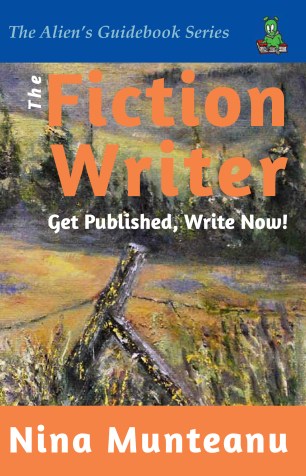
FictionWriter-front cover-2nd ed-webIn the end, it comes to finding the right integration and balance of time and place. Letting others know of your choices is equally important; this will ensure that they can help you, not hinder you in your writing. While writing is to a large extent an activity done in solitude, the journey is far from secluded. Ensure that you have a good support network.

This article is an excerpt from my fiction writing guidebook “The Fiction Writer: Get Published, Write Now!” (Starfire, 2009).


Nina Munteanu is an ecologist and internationally published author of award-nominated speculative novels, short stories and non-fiction. She is co-editor of Europa SF and currently teaches writing courses at George Brown College and the University of Toronto. Visit www.ninamunteanu.ca for the latest on her books.

Wake Up Your Muse: How My Cat Taught Me the Art of Being

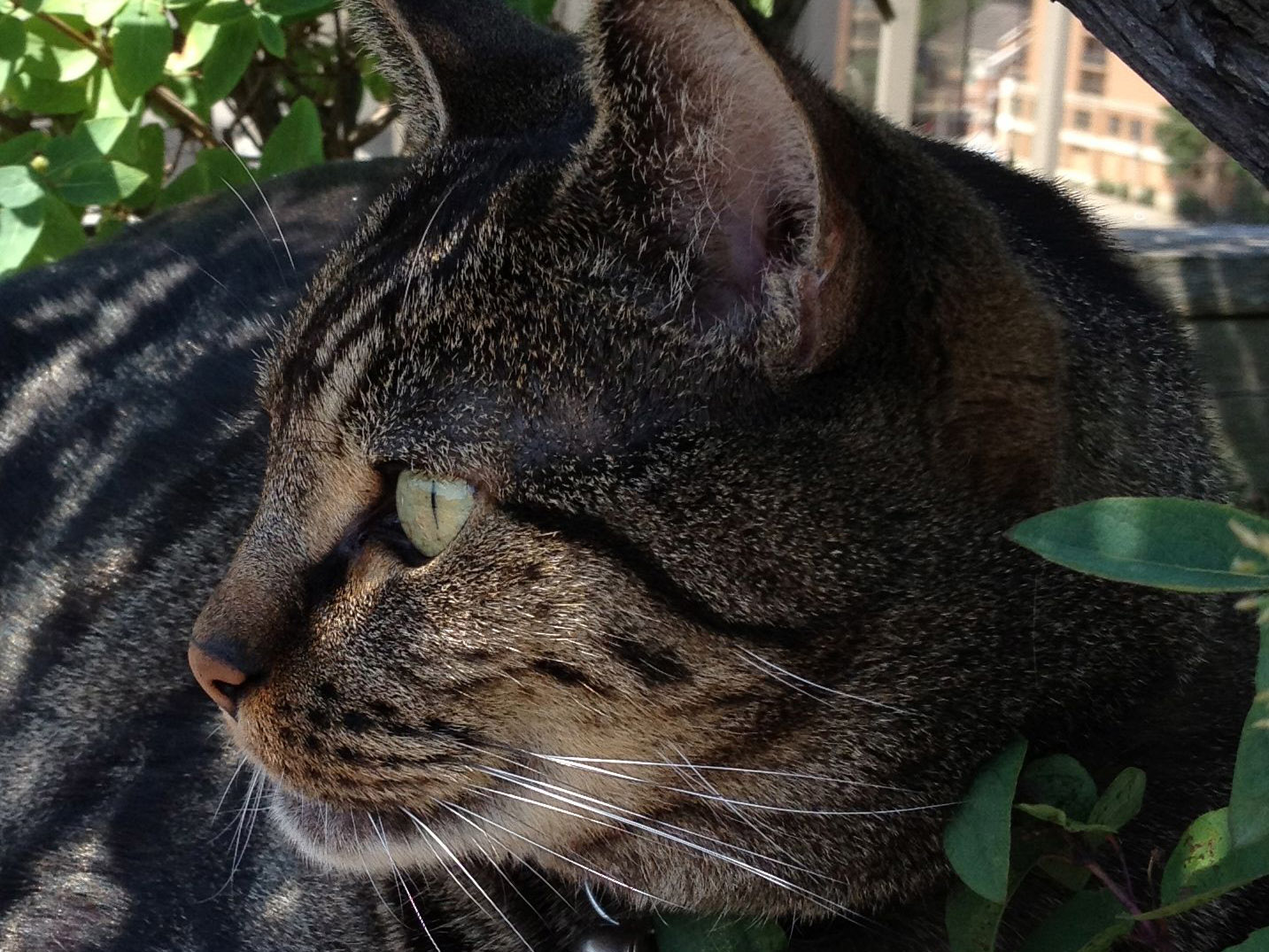
My cat, Sammy, being...

My cat, Sammy … being…

I’m not a very patient person. I make no time for writer’s block or lingering in useless limbo over some plot issue or misbehaving minor character. I write pretty much to a tight schedule: this short story to that market by this date; edits to this book to the editor by that date; blog posts created by such and such a time; an article to another market by another date. It goes on and on. When I go to my computer to write, I write.

Then there’s Sammy. My cat.

Who likes to jump on my lap, make himself all comfortable and then lie over my arm — trapping it along with five of my typing digits. Now what??? Some of you would advise me to simply pull out my pinned arm and/or shove him off. But how can I disturb such a blissful creature? He is so content furled on me, so satisfied that he has captured that wandering appendage of business that is all his now. Content in the bliss of now. In the bliss of cat-purr-meditation…

Pinned in the moment, my mind first struggles with the need to pound out the next line. My mind then rephrases and teases out nuances of that line. Finally, it wanders out with my gaze and I find myself daydreaming in a kind of trance. Giving in to the cat-purr-meditation.

And it is here that magic happens. In the being; not in the doing.

This is the irony of writing and the muse. To write we need to live; we need to have something to write about and we need to be in that state of mind that allows us to set it to print. I am at my best as a writer when I am focused on the essence of the story, its heart and soul beating through me with a life of its own.

My cat Sammy isn’t the only vehicle to my magical muses.


Waking up the Muse

Here are a few things that help me entice those capricious muses into action:

Music: music moves me in inexplicable ways. I use music to inspire my “muse”. Every book I write has its thematic music, which I play while I write and when I drive to and from work (where I do my best plot/theme thinking). I even go so far as to have a musical theme for each character.

Walks: going for a walk, particularly in a natural environment, uncluttered with human-made distractions, also unclutters the mind and soul. It grounds you back to the simplicity of life, a good place to start.

Cycling: one of my favorite ways to clear my mind is to cycle (I think any form of exercise would suffice); just getting your heart rate up and pumping those endorphins through you soothes the soul and unleashes the brain to freely run the field.

Attend writer’s functions: go to the library and listen to a writer read from her work. You never know how it might inspire you. Browse the bookshelves of the library or bookstore. Attend a writer’s convention or conference.

Visit an art gallery, go to a movie: art of any kind can inspire creativity. Fine art is open to interpretation and can provoke your mind in ways you hadn’t thought before. If you go with an appreciative friend and discuss what you’ve seen you add another element to the experience.

Go on a trip with a friend: tour the city or, better yet, take a road trip with a good friend or alone (if you are comfortable with it). I find that travelling is a great way to help me focus outward, forget myself, and open my mind and soul to adventure and learning something new. Road trips are metaphoric journeys of the soul.

Form a writer’s group: sharing ideas with people of like mind (or not, but of respectful mind) can both inspire you and provide the seeds of ideas.

Practice Cat-Purr-Meditation: you need a willing cat for this; I find that I need to study my cat’s meditative practices; where does he most like to relax? Mine loves to look outside the window onto the back yard and garden. That’s where I take him and there, together, we breathe deep and “purr” in the moment…You can read more about purring cat meditation in my Alien Next Door post, “Perfecting the Cat Purr Meditation


Nina Munteanu is an ecologist and internationally published author of award-nominated speculative novels, short stories and non-fiction. She is co-editor of Europa SF and currently teaches writing courses at George Brown College and the University of Toronto. Visit www.ninamunteanu.ca for the latest on her books.
Why We Need to Write

Words are a form of action, capable of influencing change—Ingrid Bengis

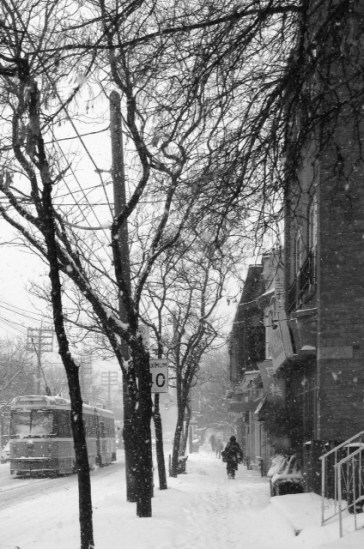
moss-covered everything

Moss-covered creek in Revelstoke Park, BC (photo by Nina Munteanu)

We’re all writers here… But how many of us, when asked about what we do, respond with “I write” or “I’m writing a book” or “I write stories”? I know. It’s complicated. It’s so much easier to leave that part out of our busy and serious lives. Besides, what do you say when the inevitable question of “so, what have you published?” comes up? All too often in North America, if you are not yet published you aren’t considered a writer. Until you’re published, you and your writing aren’t taken seriously. Even after I was published, my husband called my writing a hobby. He’s my ex-husband now.

Anne-walking-Cedars

Friend Anne walks among the giants, Revelstoke Park, BC (photo by Nina Munteanu)

What my ex-husband failed to recognize, but you and I know in our hearts, is that we live to write and write to live. Writing is the breath and light of our soul and the well-spring of our very essence. Isaac Asimov said, “I write for the same reason I breathe—because if I didn’t, I would die.” That was every bit as true when he was unpublished as after he’d published a bazillion books. This is more than metaphoric truth; it is scientifically proven.

Expressive writing — whether in the form of journaling, blogging, writing letters, memoir or fiction — improves health. Over the past twenty years, a growing body of literature has shown beneficial effects of writing about traumatic, emotional and stressful events on physical and emotional health. In control experiments with college students, Pennebaker and Beall (1986) demonstrated that college students who wrote about their deepest thoughts and feelings for only 15 minutes over four consecutive days, experienced significant health benefits four months later. Long term benefits of expressive writing include improved lung and liver function, reduced blood pressure, reduced depression, improved functioning memory, sporting performance and greater psychological well-being. The kind of writing that heals, however, must link the trauma or deep event with the emotions and feelings they generated. Simply writing as catharsis won’t do.

Whether you publish or not, your writing is important and worthwhile. Take ownership of it, nurture it, and hold it sacred. Command respect from others and respect all writers in turn; don’t let ignorance intimidate you to silence. My colleague, Louise DeSalvo wrote in her book, Writing as a Way of Healing:

GiantCedars boardwalk2

Boardwalk among giant cedars, Revelstoke Park (photo by Nina Munteanu)

“Many people I know who want to write but don’t or who want to write more but say they can’t find the time, have told me that taking the time to write seems, well, self-indulgent, self-involved, frivolous even. And that finding the time to write—even a diary, much less fiction or memoir or poetry—in their busy schedules is impossible. ‘I’ll write when I have the time,’ they say … What, though, if writing weren’t such a luxury? What if writing were a simple, significant, yet necessary way to achieve spiritual, emotional, and psychic wholeness? To synthesize thought and feeling, to understand how feeling relates to events in our lives and vice versa? What if writing were as important and as basic a human function and as significant to maintaining and promoting our psychic and physical wellness as, say, exercise, healthful good, pure water, clean air, rest and repose, and some soul-satisfying practice?”

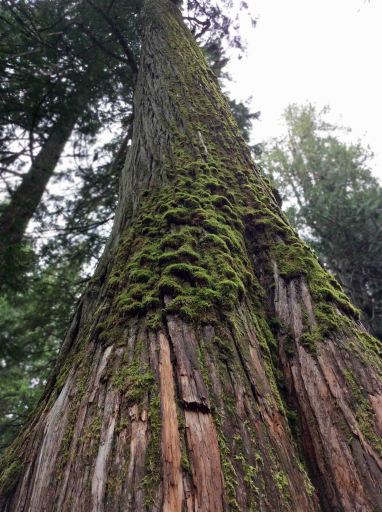
tall cedar-moss

Mossy cedar, Revelstoke Park (photo by Nina Munteanu)

Of course, in our hearts we know this is true. DeSalvo adds of her long journey toward accepting writing in her life: “I didn’t know that if you want to write, you must follow your desire to write … I didn’t know that you could write simply to take care of yourself, even if you have no desire to publish your work. I didn’t know that if you want to become a writer, eventually you’ll learn through writing … all you need to know about your craft … I didn’t know that if you want to write and don’t, because you don’t feel worthy enough or able enough, not writing will eventually begin to erase who you are.”

Writing, like any form of creativity, requires faith; in ourselves and in others. And that’s scary. It’s scary because it requires that we relinquish control. All the more reason to write. Resistance is a form of self-destruction, says Julia Cameron, author of The Artist’s Way (1992). We resist to maintain some idea of control but instead we increase depression, anxiety, and confusion. Booth et al (1997) found that written disclosure significantly reduces physiological stress on the body caused by inhibition. We were born to create. Why do we demure and resist? Because, says Cameron, “we have bought the message of our culture … [that] we are meant to be dutiful and then die. The truth is that we are meant to be bountiful and live.”

Nina-giant cedar03

Nina Munteanu in bliss with giant cedar tree, Revelstoke Park, BC (photo by Anne Voute)

Joseph Campbell wrote: “Follow your bliss and doors will open where there were no doors before.” Cameron adds, “It is the inner commitment to be true to ourselves and follow our dreams that triggers the support of the universe. While we are ambivalent, the universe will seem to us also to be ambivalent and erratic.”

Seize the muse and proclaim it proudly. I AM A WRITER.


Nina Munteanu is an ecologist and internationally published author of award-nominated speculative novels, short stories and non-fiction. She is co-editor of Europa SF and currently teaches writing courses at George Brown College and the University of Toronto. Visit www.ninamunteanu.ca for the latest on her books.

How We Will Tell Stories in the Future

Cover1_LastSummoner-frontcoverIn the early 1400s, when Lady Vivianne Schoen (the hero of my book  The Last Summoner) lived, one of the largest libraries in Europe was at the University of Cambridge; it held an impressive list of 122 books. That library currently houses over 7 million books.

Books were a work of art in the 1400s. And part of an elite. Delicate, large and beautiful, they were created in the language of the church—Latin—and in turn copied entirely by hand by the monks. With the dimensions of a current newspaper, but much thicker, these large illuminated manuscripts sometimes weighed more than 50 pounds.

There is a scene early on in The Last Summoner where, under the tutelage of Pere Daniel at her father’s castle in Grunwald, Vivianne learns this arcain craft of manuscript copying.

An illuminated manuscript, the exemplar, and its parchment copy, still in progress, lay on the desk top; both were held down from curling by several hanging weights. Ink pots, gold leaf, a pen knife and a quill lay beside the sloped desk-top—the scribe’s tools.

Père Daniel had studied the art of manuscript illumination, scribing, binding and even parchment-making at the Sorbonne. Last year he’d begun to teach Vivianne the art of creating illuminated manuscripts and she had eagerly begun her own, finding that she had a steady hand at illumination. Père Daniel had shown her how to make parchment from the skins of deer that the Baron brought back from his hunts in the Grunwald forest. Despite the availability of paper, parchment was preferred “because it is velvety, folds easily and gives an agreeable flexibility to pen strokes compared with the unyielding flatness of writing on paper,” the chaplain reasoned. He always gave a reason for the painstaking preparation that involved flaying, soaking, stretching and scraping: “Parchment wants to curl onto its darker, grain side; and hastily prepared parchment wants to do it more.” Nothing was better than parchment made from game “because the vein marks left from blood in the skin when the animal died is the animal’s contribution to the art of illumination,” he attested with the fervency of a man with a passion.

Père demonstrated with exacting care and infinite patience how to use the illuminator’s tools and create a professional-looking manuscript. He provided Vivianne with parchment, a quill for a left-handed scribe, a penknife to sharpen her quills, a pot of ink and a sloping desktop. He taught her how to make iron-gall ink by mixing a solution of tannic acids and copperas with added gum arabic from the dried-up sap of the acacia tree as thickener. It was important, said the Père, to pick a mature oak-gall, one that bore a hole from the matured wasp that had developed inside and left a juicy concoction of gallic acids. The galls were then crushed up and boiled for a long as it took to recite the Pater Noster three times, he’d said. The blackness, he told her, resulted from the chemical reaction of the oak-gall potion when copperas was stirred in. He’d shown her how to create the vermillion color, commonly used in headings, which he made from brazilwood chips infused in urine and stirred with gum arabic. Vivianne never asked Père Daniel where he got his urine. She and Père also raided Theobald’s kitchen to hunt down the outer right wing pinions of a goose for making a quill pen that naturally curved to the left, because she was left-handed.

knight-cameoPère showed Vivianne how the height of the written area should equal the width of the whole page in a well-proportioned manuscript. Père also showed her how to rule the guidelines for the script and make the initial under-drawing of her illumination in plummet then in ink after which the gold leaf was applied. Vivianne had become adept at applying the gold leaf over the raised gesso, that she made of slaked lime and white lead mixed with pink clay, sugar, a dash of gum and egg glair glue. After painstakingly painting the gesso where she wanted the gold leaf to remain and letting it dry, Vivianne then carefully lowered the fragile tissue-thin leaf over the gesso and pressed down through a piece of silk then buffed the gold to a brilliant finish with a dog’s tooth by vigorously rubbing back and forth until it was smooth and the edges where there was no gessocrumbled away.

Making books was called “black art” from the black ink that stained the worker’s hands after a long day of creating type. Readers were mostly scholars and the religious elite. In fact, reading was an elite occupation. The majority of people at the time were illiterate and had no interest in books. Moreover, books were written in the language of the church, not in the commonly spoken language of the countryside such as English, French, German or Spanish.

So, when Johannes Gutenberg invented the revolutionary printing press in 1452 to publish the Gutenberg Bible, neither monk nor Joe peasant took much notice. The monks considered the product inferior to their works of art and dismissed the new technology—until it had largely replaced their trade.

chillon-inner courtyard

Inner courtyard of Chilean Castle, Switzerland (photo by Nina Munteanu)

In fact, the presses formed the very basis of the artistic Renaissance, the religious reformations and the scientific revolution, wrote Elizabeth Eisenstein in The Printing Press as an Agent of Change. “The printing press allowed the spread of information that couldn’t be controlled by the clergy, kings, politicians, or the religious elite,” adds New York Times technology reporter Nick Bilton in I Live in the Future and Here’s How It Works. Storytelling was no longer confined to an elite clergy; books could be created by anyone and shared in the spoken languages of the people.

Bilton shares another interesting fact: Gutenberg’s printed books were as heavy and unwieldy as the original handmade books of the monks. It was much later, in 1502, that Aldus Manutius of Venice invented a more portable book that could fit in a large jacket pocket; essentially inventing “the mobile phone of his day” wrote Bilton.

Historian Alistair McCleery wrote that the political and religious leaders initially panicked over the potential for the uncensored sharing of new and varied ideas among the lay public (which brings to mind similar fears of what the internet was providing to and enabling in the lay public: uncensored self-expression by the masses for the masses). Up until then, sharing stories among the common folk was limited to oral storytelling, which suffered from inconsistency and other limitations of the oral tradition. Within a short period of time, the ability to record and share “stories” had moved from a closeted elite to the world citizen. That is what the printing press—and the Internet today—did. Both have shifted the zeitgeist of an entire world.

Storytelling today is changing again. While many people still read books and go to the cinema, watch pre-programmed TV or rent DVDs, many more enjoy their stories through other devices like computers, downloads, mobile phones and e-readers that provide material through other media and venues such as Indie and self-publishing, amateur YouTube videos, interactive games and social networks. We stand poised on the edge of a wonderful cliff that celebrates the expression — and consumer choice — of the individual. The music industry shows this the best, where people dismissed the prepackaged albums and CDs and opted to create their own unique playlists through individual song downloads. The publishing industry is currently struggling with its own painful yet thrilling metamorphosis as is the visual arts industry. In fact, they are all blurring into one large integrated amalgam of artistic expression.

NYC-times-square-lawn-chairs

Times Square in New York City (photo by Nina Munteanu)

The information you get today is coming “more and more through your friends and through your social network. It’s being distributed through channels of trust and the trust isn’t necessarily the BBCor The New York Times. It’s people,” says B.J. Fogg founder of the Persuasive Technology Lab at Stanford University.

new-york-toulouse-officer-montalvo

New York policeman sports my friend Toulouse on his gun (photo by Nina Munteanu)

During the days of packaged content, leading storytellers were published authors, journalists and writers of newspapers and magazines. “Now distribution channels matter less and anyone with an appropriate device can be a storyteller,” says Bilton, who shares that on the internet we tend to follow individuals we trust (e.g., Clive Thompson or David Carr) as much if not more than established organizations (like Wired Magazine or The New York Times). Accessible technology, platforms, free applications and software has truly enabled the individual.  No longer confined to the written word via paper books or visual expression through movies or TV shows, storytelling has embraced many forms. Amateur and professional have equally blurred.

It comes down to content. Technology and format aside, nothing compares to a good solid story. We all listen to or watch stories. We all tell or show stories, some of us more than others and some better than others.

With the advent of new and accessible technologies and applications available to individuals, the art of storytelling has entered a new renaissance. Good stories, like good content, will always prevail and surface into prominence, like cream in milk. They have just been released into a sea of possibilities like a stream previously confined in a gorge, spilling joyfully into the ocean.

Front Cover ONLY-webHarnessing the opening range of technologies available to us will only give us more choices to tell our stories. For instance, my latest book Outer Diverse (the first book of The Splintered Universe Trilogy) was published by Starfire World Syndicate in print form and e-format and will soon be available in audiobook format through Audible. I have also created associated YouTube promotional videos and am working with colleagues to produce a short story musical video on the book. Another colleague has embraced the image of the strong female hero with a jewelry line called the Rhea Hawke Collection and is looking at other “storytelling” merchandise. I am discussing with other colleagues possibilities for a graphic novel and an interactive video game version of the trilogy that will offer reader participation in storytelling.

The future embraces story in all its possible facets. Our role as storytellers is to embrace the future in all its facets.


Nina Munteanu is an ecologist and internationally published author of award-nominated speculative novels, short stories and non-fiction. She is co-editor of Europa SF and currently teaches writing courses at George Brown College and the University of Toronto. Visit www.ninamunteanu.ca for the latest on her books.

Celebrating 2014, the Year of the Horse

nina-2015-BWgrainJanuary 31st of 2014 begins the Year of the Wood Horse in the Chinese calendar as part of the sexagenary cycle of sixty 2-character terms. Each term (representing a year) consists of a “Heavenly stem” character and an “Earthly-branch” character; these combine to generate 60 unique terms that then repeat; in this case every 60 years. This means that the Year of the Wood Horse will only occur every 60 years.

I was born 60 years ago, so this is very much my year!

The Horse (馬 午)

In Chinese culture, the Horse symbolizes nobility, class, speed and perseverance.

The magical horse is heroic, strong and can fly. Think Pegasus, Tianma, Sleipnir, Epona’s horses, the Hippocamp, the white horse of Rhiannon, the unicorn, the dragon-horse of Xuanzang, the kelpie, and the bailongma. The white celestial cloud horse, sacred to the Chinese Goddess Kwan Yin—goddess of compassion—flies in the heavens and brings peace and blessings. The horse is linked to Varuna and equated to the cosmos. The white horse is also believed to be the last incarnation of Vishnu. Buddha is said to have left this physical plane riding a white horse.

SONY DSC

Nina hiking (photo by Merridy Cox)

Horses love to run, or fly in the case of mythic horses. They love freedom. They’re sexy, elegant and beautiful and embody the qualities of power, grace, nobility, strength, victory and freedom. In Native American lore, the horse symbol combines the grounded power of the earth with the whispers of wisdom found in the spirit wind. The Celts considered the horse noble, embodying qualities of stability, honor, trust, intelligence and strength. The horse was considered a vehicle and guide for transcendence, able to invoke courage and determination. The Celtic Ogham equates the horse with the Oak tree (a strong, stable life-affirming symbol, recognized for its tendency to attract lightning, symbolic of divine light and spiritual rebirth).

Some metaphysical writings describe the Horse as a “triangle” or “trinity” of hypostases: 1) bearing the gift of presence, elegance, and journey; 2) offering the energy of freedom, nomadic spirit, and endurance; and 3) holding the magic of telepathy and spirit messenger.

The Wood Horse (木馬 午)

Nina-giant cedar03

Nina leans against giant cedar in Revelstoke Park, BC (photo by Anne Voute)

2014 isn’t just the year of the Horse; it is the year of the Wood Horse, also called the Green Horse (wood being related to a growing tree and the color of young growth). The wood element is associated with spring, growth and vitality.

tall cedar-moss

Mossy cedar tree, Revelstoke Park, BC (photo by Nina Munteanu)

Mossy cedar, Revelstoke Park, BC (photo by Nina Munteanu)

Wood represents the first phase of Wu Xing, an ancient mnemonic for systems with five stages or movements, used to explain a diversity of phenomena from cosmic cycles to the interaction between internal organs and from the succession of political regimes to the properties of medicines. The five elements include wood, fire, earth, metal, and water.

As one of the generative cyclical engendering five elements, wood feeds fire; fire creates Earth (ash); Earth bears metal; metal enriches water (e.g., water with minerals is more beneficial to the body than pure water); and water nourishes wood.

Wood is yang in character and associated with the planet Jupiter (and Zeus, the god of thunder and lightning), the color blue, green, and the wind. It is also associated with the Azure Dragon (Qing Long) of the east, one of the four mythological creatures of the Chinese constellations. The Azure Dragon is represented in the Kiyomizu Temple in eastern Kyoto, Japan, where I visited in Spring 2013.

bamboo-close01 copy

Bamboo stand near Kyoto, Japan (photo by Nina Munteanu)

In Chinese Taoist thought, Wood is characterized by strength and flexibility (think bamboo and willow). Wood reflects qualities of warmth, generosity, co-operation and idealism. Wood heralds the beginning of life and embraces springtime and buds, sensuality and fecundity. Wood needs moisture to thrive. Wood, in turn, feeds fire. Wood burns. A Wood person is considered expansive, outgoing and socially conscious.

The wooden horse is a potent symbol. Perhaps the best known wooden horse is the Trojan Horse, used by the Greeks in the Trojan war to gain entry into Troy and destroy the city. As told in the Latin epic poem The Aeneid by Virgil: after a 10-year siege, the Greeks constructed a huge wooden horse—the emblem of Troy—and hid soldiers inside then pretended to leave. The horse was apparently left as a peace offering to the Trojans and to the goddess Athena to ensure safe passage home. Despite the priest Loacoon’s warning—“Don’t trust the horse! I fear Greeks, even those bearing gifts”—the Trojans pulled the horse into their city as a victory trophy. That night the elite force crept out of the horse and opened the gates for the rest of the army, which had hidden under cover of night. The Greeks won the conflict as a result of this brilliant subterfuge. This is why malicious computer programs that trick users into running them as useful or interesting are called Trojan Horses.

Today, the Trojan Horse that stands in front of ancient Troy (Truva) symbolizes vigilant peace and freedom. It is a daily reminder to thousands of tourists of the power of deception in the guise of candy-coated “truths”. The ancient Greeks cleverly subverted a noble symbol of honor, grace and power through crafty deception. The noble Wooden Horse, like any symbol, is only as good as those who embrace its original truths and noble meanings. Think swastika, the pentagram, the cross.

Were you born in the year of the horse?

Maple-sugar spring-LR

Nina’s sugar maple in Little Rouge River woodland (photo by Nina Munteanu)

Horse years include: 2014, 2002, 1990, 1978, 1966, 1954, 1942, 1930, 1918, and 1906. Horse people are bright, cheerful, popular and fun loving (big giant grin). People born in the Year of the Horse are smart fabulous speakers who have a gift for getting through to other people. They find people and crowds exciting and love parties. Hehe… Horse’s childish innocence, sunny disposition, and natural charm attract many friends. HAR! The horse is a very intuitive animal; horse-people follow their hunches. Luckily our keen judgment and natural intuition help us make the right decisions with those crazy hunches.

Rules constrain the proud horse that needs freedom to run. Horses are elegant, beautiful and highly intuitive animals. Horse people are frank and will tell you exactly what is on their mind; they dislike hidden agendas. The Horse is complex and paradoxical: considered proud yet sweet-natured, arrogant yet oddly modest in their approach to love, envious but tolerant, conceited yet humble. They want to belong, yet they need to be independent. They crave intimacy, yet refuse to be corralled or tamed. One astrologer tells us that, “The Horse will give up everything for love.”

Nina Highland Cr 1

Nina hiking Highland Creek, Ontario (photo by Merridy Cox)

What does it all mean?…

So, what does all of this have to do with you, 2014 and the Year of the Horse? Why, nothing… Perhaps everything.

It depends on whether you are mindful of the symbols around you; whether you think and write metaphorically; whether you are fanciful and whimsical; whether you appreciate the ancient wisdom of humanity and its link to the divine… Whatever your inclination, I wish you a wonderful and productive year of transformation and wonderful surprises. I for one am looking forward to 2014. I’ve embraced it as my year with its spontaneous “horse” energy for fast action and flow—my style, actually.

I expect no middle ground. It’s a year of extremes, strong fluctuations, general chaos and great opportunity. A time of fast victories and unexpected adventure. A year to travel, especially off the beaten path. A year to connect with Nature and embrace Gaia’s radiant energy. Decisive action, not procrastination, brings victory. But you have to act fast to catch up with this horse. My book about water, which I started last year (the year of the water snake), will run its course to publication this year. It is half-written and I will finish it—and get it published—this year.

Horse energy is pure unbridled spirit. Playful, wild, and independent. Horse has a refined instinct that flows through action and movement. Leap. Fly. Follow your instincts. Chase your dream. Catch it by the tail. Finish that novel. Send it off. Present that proposal. Go to that convention. Meet that publisher or agent. Assert your honesty and openness. The horse demands it.

I wish you an exciting and wonderful 2014!


Nina Munteanu is an ecologist and internationally published author of award-nominated speculative novels, short stories and non-fiction. She is co-editor of Europa SF and currently teaches writing courses at George Brown College and the University of Toronto. Visit www.ninamunteanu.ca for the latest on her books.