
Decaying cedar log (photo by Nina Munteanu)
I’m a writer and an editor. I’ve written and published novels, short stories, and non-fiction books with traditional publishing houses and indie publishers. I’ve also self-published. As editor, I serve as the in-house copy editor for a publishing house in the United States and have acted as acquisition editor for several anthologies put out by a local indie publisher. I also coach novice writers to publication and edit in that capacity. You could say I know the industry from many angles and perspectives. That’s been good for me, because this industry is a moving target, and it’s good to triangulate on a moving object. The entire publishing industry is evolving, and it’s a slippery evolution.
Even the words we use are slippery. Indie. Hybrid. Publisher.
Many people, like award-winning author Kristine Kathryn Rusch, when they use the terms indie writer and indie publishing, include what some call self-publishing in their definitions of indie, “because so many [professional] writers who are not with traditional publishers have started their own presses. It’s not accurate to lump all writers who are not following the traditional route into the self-publishing basket any longer.” According to Rusch, an indie publisher is anyone who is not a traditional publisher. For this article, I’ve adopted Rusch’s definition to provide the full range of expectations for editors working with writers in the indie field. I define a traditional publisher as an established and often larger publishing house or press that (1) follows traditional submission criteria; (2) does not charge writers; (3) pays out royalties; and (4) employs in-house editors.
Indie writing and publishing can then be described in several ways depending on where the writer submits and by what mechanism and what model they use. All of these will affect a writer’s needs and perceptions for an editor and, in turn, an editor’s expectations as well.
Table 1 (below) outlines the five major models of indie writing and publishing.
| Table 1: Types of indie writing / publishing models | ||
| 1. | Small independent press
(not writer’s)
|
Author submits to a small press that does not require author to pay for publishing costs. House may pay small royalties. Acceptance criteria limit submissions. There may or may not be formal distribution. |
| 2. | Small independent press
(not writer’s)
|
Author submits to a small press that may require author to pay for part of the publishing costs. House typically does not pay royalties but may provide complimentary copies and/or author’s rate for copies. Acceptance criteria may still apply to submissions. Distributor is typically the Ingram/Amazon model. |
| 3. | Small independent press
(writer as sole proprietor or part of a consortium; also called self-publishing by some) |
Author can write and publish as they please. Costs of publication are born solely by the writer(s), and royalties come straight from profit. No acceptance criteria apply. Distribution is typically the Ingram/Amazon model. |
| 4. | Service publisher
(e.g., iUniverse, Friessen; this is self-publishing, even though the publisher’s name appears on the work)
|
Author can write and publish as they please. All publication costs born by writer. Service will include copy editing, layout, cover design, printing, some distribution, and some promotion—all at cost (based on service package). Distribution is typically the Ingram/Amazon model. |
| 5. | Self-publishing
(e.g., the publication is in the author’s name) |
Author can write and publish as they please. Author uses à la carte style of self-publishing in which they do (or hire others to do) the production of the work (e.g., editing, layout, cover, printing, distribution, and promotion). |
Depending on which model an author uses for their work, their perceived need and actual need for an editor prior to submission and publication will be affected. I distinguish between perceived and actual because, unfortunately, in many cases, these diverge: an author may not think they need a certain kind of editing for their work when they do. The opposite is more rare: the author thinking they need an editor when they don’t. (More on this in a future article.)
The availability of these models and their hybrid cousins has provided writers with a cornucopia of often confusing choices. In many cases, I find that writers are not even aware of which choice is best for them. Part of the reason is that writers carry forward ideas from the old model. Unfortunately, this often translates into misconceived ideas about and expectations of editors. (That’s another article too.)
For editors, it’s important to recognize these different models and what they, in turn, provide and expect from authors. A savvy editor translates into a savvy author. Your advice, when driven from a place of publishing industry knowledge, will be invaluable to authors seeking your services. And they will come to rely on this as much as, if not more than, your actual editing.
By its very nature, indie publishing has given the freelance editor an opportunity to take on a new role—a service that agents used to and still do provide to many traditionally published authors: that of industry consultant. In the traditional model, an author would seek an agent who would then not only sell their work to a publisher but also provide advice on what to expect in the market as well as help with career-longevity choices (which include branding)—questions many novice authors haven’t even considered, never mind answered sufficiently. Most indie authors will not engage an agent, but most will (should) hire an editor. So, instead of an agent, the freelance editor becomes the first stop in the publishing industry for an indie author. This has become one of my primary roles as editor and writing coach. And this is again because most writers, when they start out, do not know what direction they want to go—mainly because they aren’t familiar enough with what is available to them and the ramifications to their careers.
Here’s an example: one client, working on her first novel, wanted my advice on whether she should try a traditional publisher or just forgo and self-publish. An editor possessing savvy knowledge of the industry and now knowing something of the author’s work and ambitions can bring informed and constructive advice to the author.
The ramifications on how I handle and edit a story directly follows which route the author has decided to follow. This is every bit as relevant to an author publishing with a traditional publishing house, an indie press, or self-publishing. Style—whether it’s that of a publishing house or the author’s brand—relies on consistent application of voice and tone. Just as publishing houses embrace different and unique styles, so do authors. In fact, if they are self-publishing, this is even more important.
The editor plays a crucial role in helping an author establish their voice, style, and, ultimately, their brand. And, perhaps, this becomes one of the principle differences between traditional and indie publishing. While voice and style is predetermined to some extent by traditional publishing houses (hence, they employ their own editors to impose a style in some cases), it’s left to the author—and their freelance editor—to determine this in the indie scene. The structure of traditional publishing is both more orderly and more confining. Indie publishing—particularly self-publishing—is an infinite melting pot of creativity. Some view it as one big mess. In fact, it’s a chaos of astonishing opportunity. It’s a chance for intimate collaboration that demands mutual respect. Freelance editors are poised as both gatekeepers and enabling wizards of the indie world.
Table 2 (below) describes a freelance editor’s focus in the five indie models.
| Table 2: Editing for different indie models | |||
| 1. | Small independent press
(with submission criteria similar to a traditional model)
|
Authors often think they don’t need a freelance editor if they’re submitting to a press with in-house editors; this is incorrect. Those who have had their work edited prior to submission to a press—even a small press—will have a much higher chance of being accepted. The freelance editor’s job, then, will include attending to the style of the publishing house. | |
| 2. | Small independent press
(without submission criteria)
|
While authors may not recognize the need for an editor when submitting to an indie publisher without submission criteria, the need for editing remains—particularly because many of these presses don’t employ or have sufficiently qualified editors. Excellence in presentation and nurturing a strong author voice are the freelance editor’s responsibility. | |
| 3. | Small independent press
(writer’s own press) |
Given that the author has carte blanche on what to write and publish, a freelance editor’s role in recognizing, harmonizing with, and helping to establish a genuine and strong author’s voice becomes most important. | |
| 4. | Service publisher
|
Authors have misconceptions about service publishers and particularly their editors. I’ve had several clients come to me after recognizing that their works were not well represented by the provider’s in-house editor. Service publisher in-house editors do not represent a particular style, voice, or brand (given that most are underpaid students and there is no style identity); the freelance editor role is as with #3. | |
| 5. | Self-publishing
|
The same criteria exist here as for model #3. | |

Spalting patterns on decaying log (photo by Nina Munteanu)
The take home: Freelance editors can flourish in the indie writing and publishing field by (1) establishing their expertise in the industry and what it requires (taking on the role of consultant, which agents normally provide in the traditional model); (2) recognizing a need for strong authorial voices and helping to foster them; and (3) promoting point #2 with consistency in style, tone, etc.
 Nina Munteanu is an ecologist and internationally published author of award-nominated speculative novels, short stories and non-fiction. She is co-editor of Europa SF and currently teaches writing courses at George Brown College and the University of Toronto. Visit www.ninamunteanu.ca for the latest on her books.


 Lynda Williams is the author of the ten-novel Okal Rel Saga and editor of the growing collection of works by Hal Friesen, Craig Bowlsby, Krysia Anderson, Elizabeth Woods, Nina Munteanu, Randy McCharles and others writing works set in the ORU. As a publisher, she is working with Kyle Davidson, Jeff Doten, Sarah Trick, Jennifer Lott, Paula Johanson, Lynn Perkins and Yukari Yamamoto in re-inventing publishing through Reality Skimming Press. Lynda holds three degrees and works as Learning Technology Analyst and manager of the Learn Tech support team at Simon Fraser University. She teaches part-time at BCIT.
 Sarah Kades hung up her archaeology trowel and bid adieu to Traditional Knowledge facilitation to share her love of the natural world and happily-ever-afters. She writes literary romantic eco-fiction where nature, humour and love meet. She lives in Calgary, Canada with her family. Connect with Sarah on
  Stephanie Johanson is the art director, assistant editor, and co-owner of Neo-opsis Science Fiction Magazine, publishing since 2003. She is an artist who has worked in a variety of media, though painting and soapstone carving are her passions. Stephanie paints realism with a hint of fantasy, often preferring landscapes as her subjects. Examples of her work can be viewed on the Neo-opsis Science Fiction Magazine website at
  Diane Walton is currently serving a life sentence as Managing Editor of On Spec Magazine, and loving every minute of it. She and her lovely and talented husband, Rick LeBlanc, share their rural Alberta home with three very entitled cats.

 For me this represents a palpable and gestalt cultural awakening in the realm of the “feminine archetype”.
 I mentioned that the majority of my stories are science fiction (SF). SF is a literature of allegory and metaphor and deeply embedded in culture. It draws me because it is the literature of consequence exploring large issues faced by humankind. In a February 2013 interview in The Globe and Mail I described how by its very nature SF is a symbolic meditation on history itself and ultimately a literature of great vision: “Speaking for myself, and for the other women I know who read science fiction, the need is for good stories featuring intelligent women who are directed in some way to make a difference in the world…The heroism [of women] may manifest itself through co-operation and leadership in community, which is [often] different from their die-hard male counterparts who want to tackle the world on their own. Science fiction provides a new paradigm for heroism and a new definition of hero as it balances technology and science with human issues and needs.”
 We’ve progressed from the biological to the mechanical to the purely mental, from the natural world to a manufactured world to a virtual world, writes philosopher and writer Charles Eisenstein. According to Carolyn Merchant, professor at UC Berkley, early scientists of the 1600s used metaphor, rhetoric, and myth to develop a new method of interrogating nature as “part of a larger project to create a new method that would allow humanity to control and dominate the natural world.”
 Competition is a natural reaction based on distrust—of both the environment and of the “other”—both aspects of “self” (as part) separated from “self” (as whole). The greed for more than is sustainable reflects an urgent fear of failure and a sense of being separate. It ultimately perpetuates actions dominated by self-interest and is the harbinger of “the Tragedy of the Commons”.
 Examples of creative cooperatives exist throughout the world, offering an alternative to the traditional model of competition. Cultural creatives are changing the world, Ruche tells us. These creatives, while being community-oriented with an awareness of planet-wide issues, honor and embody feminine values, such as empathy, solidarity, spiritual and personal development, and relationships. Mechanisms include reciprocity, trust, communication, fairness, and a group-sense of belonging. I give examples in my upcoming book “Water Is…” by Pixl Press, due in Spring 2016.
 Nina Munteanu is an ecologist and internationally published author of award-nominated speculative novels, short stories and non-fiction. She is co-editor of Europa SF and currently teaches writing courses at George Brown College and the University of Toronto. Visit
 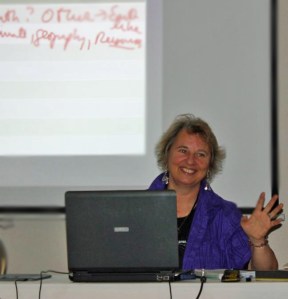 This April, I will teach my 12-week long writing course on how to write science fiction. The 12-week course “Creating Science Fiction” runs TUESDAY nights from 6:15 to 9:15 starting April 5th through to June 21st at George Brown College on King Street in Toronto and costs $285.

 Fiction characters have a dramatic function and a role in advancing the plot and theme of your story. They need a reason to be there.
 Types of Titles
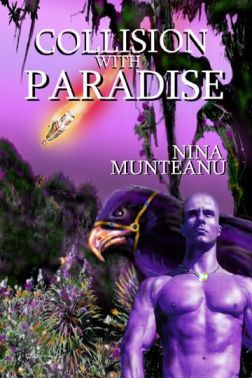 I chose the title, Collision with Paradise for my 2005 science fiction romantic thriller to convey the paradox of conflict and action in collision with the quest for well-being (paradise) that reflected my lead character’s own conflict. The two juxtaposed as oxymoron made the title provocative and readers became naturally curious. What made it particularly tantalizing—and me somewhat smug—was that the cover and the setting and premise/plot all resonated with the abstract theme. The plot involved the real collision of a spaceship with hotshot pilot on a planet with a jungle paradise. So, even though the title very accurately conveyed the overall theme, it didn’t give it away; the reader still had to tease it out through the subtext and subplots of the story.


 Driven by something inside me, I wrote over the space of a few months a book entitled “Collision with Paradise” based on some research I’d done on Atlantis, the bible and the Great Flood. The book was important to me on a number of fronts: in its ecological message of cooperation and its exploration of new paradigms of existence. I wrote it fast and well and it hardly needed editing. Without thinking and without hesitation, I submitted it for publication. As quickly as I’d written it, I had an offer from a publisher. My first published book! My first reaction was elation. My second reaction was: What have I done? I was proud of my book and its story, but it also contained erotica. My first thought was: how are my family and friends going to react? What about my parents? OMG! Fear, not of failure but of success came crashing down on me and I felt so exposed. If I could have retracted it, I might have several times. Thankfully, I didn’t. While some friends and family did in fact shake their heads and look askance at my work (and labeled it variously), the book was very well received by mainstream critics and readers alike. It was, in fact, a hit. Faced with success, I bowed to its consequences and embraced what it brought: the good, the bad and the ugly. I was, in fact, relieved. I have many times since contemplated my actions in submitting this subversive novel that exposed me incredibly. Was it brave intuition or bold recklessness that propelled me? The point is, I’d stepped out into the light, crossed the line into another paradigm. There was no way back into the shadows. And that’s good.

 Nina Munteanu Writing Coach