Reconciling Yesterday’s Future with Today’s Past

Metropolis man on clock

A worker tied to “the machine” in Fritz Lang’s Metropolis

Metropolis posterOur predictions and visions of the future are certainly predicated on our perceptions of the present and the past. So, what happens when yesterday’s “future” collides with today’s past? Well, retro-fiction, alternate history and steam-punk, you quip, eyes askance with mischief: edgy sociopathic Sherlock Holmes with bipolar or obsessive /compulsive tendencies; flying aircraft carriers in Sky Captain and the World of Tomorrow, robot-like workers of Metropolis

But what of the vision itself? History provides us with a panoply of realized predictions in speculative fiction:

In 1961, Stanislaw Lem’s novel Return From the Stars predicted the invention of the touch pad, iPhone, iPad and Kindle. The telescreens that monitored the citizens of George Orwell’s Oceania in his dystopian 1949 novel Nineteen Eighty-Four was reflected, twenty years later, in the first closed circuit TV (CCTV) installed in the United Kingdom. Almost a century before the Internet was conceived, Mark Twain alluded to the future of a global, pervasive information network. In his 1968 novel 2001: A Space Odyssey Arthur C. Clarke discussed a future where people scanned headlines online and got their news through RSS feeds. In his 1888 novel Looking Backward, Edward Bellamy describes a “future” society in 2000 where money is eliminated due to the proliferation of plastic credit cards. Philip K. Dick’s Minority Report accurately predicted personalized ads, voice-controled homes, facial and optical recognition, and gesture-based computing. Other advances and usage of technology have been predicted in speculative literature, including body scans, RFIDs, spy-surveillance, and touch screen interfaces.

Minority Report movie

Tom Cruise’s character using gesture-based computing in the film “Minority Report”

FlyingCar 1950s

1950s ad for flying car of future

But there have been many speculations not realized. Where are the flying cars? Where are the moon colonies, rotating space stations and space elevator? What of the envisioned totalitarian states not realized; civilizations not demolished; utopias not developed?

Are those past dystopian or utopian visions failed attempts at predicting a future that eluded their writers? Or is it a question more of defining vision in speculative writing?

Ray Bradbury suggested that “the function of science fiction is not only to predict the future but to prevent it.”

2001 a space odysseyThere are, in most cases, no technological impediments to the flying car, the jetpack, and moon-bases; only cultural ones.  “These SF predictions ought to be viewed as visions of where we could be, as opposed to where we will be, or, keeping Bradbury in mind, visions of where we don’t want to go and, thankfully, have mostly managed to avoid to date,” says Steve Davidson of Grasping for the Wind. “Perhaps it’s all cultural,” he adds.

How and why is it that our contemporary view of dystopian and utopian speculative fiction has shifted from an open-minded imaginative acceptance of “predictions” nested within a cautionary or visionary tale to a knowledge-based demand for largely unattainable predictive accuracy?

GeorgeOrwell 1984 signetGeorge Orwell wrote his dystopian satire in 1949 about a mind-controlled society in response to the Cold War. The book was a metaphor “against totalitarianism and for democratic socialism,” said Orwell in his 1947 essay Why I Write, adding, “Good prose is like a windowpane.” Was Orwell’s Nineteen Eighty-Four a failed novel because the real 1984 didn’t turn out quite like his 1984? Hugo Award-winning novelist Robert J. Sawyer suggests that we consider it a success, “because it helped us avoid that future. So just be happy that the damn dirty apes haven’t taken over yet.”

Dystopian and utopian literature, like all good allegory, provides us with scenarios predicated on a concrete premise. What if we kept doing this?…What if that went on unchecked?… What if we decided to end this?…

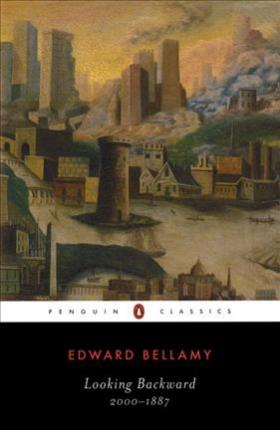
LookingBackward EdwardBellamyA hundred years before 1984, Edward Bellamy published Looking Backward, “a romance of an ideal world”. It tells the story of a young man who falls into a hypnotic sleep in 1887, waking up in 2000 when the world has evolved into a great socialist paradise.  It sold over a million copies and ranked only behind Uncle Tom’s Cabin and Ben-Hur: A Tale of the Christ as the top best-seller of the era. Looking Backward laid out a futuristic socialism, or was it a socialistic future?

At any rate, it influenced a large number of intellectuals and generated an unprecedented political mass movement. The book spawned experiments in communal living and fed socialist movements that promoted the nationalization of all industry and the elimination of class distinctions. Bellamy’s book was cited in many Marxist polemic works. Groups all over the world praised and embraced its ideals: Crusading Protestant ministers, American feminists, Australian trade unionists, British town planners, Bolshevik propagandists, French technocrats, German Zionists, and Dutch welfare-state advocates.

Bellamy’s conviction that cooperation among humans is healthier than competition formed the basis of Looking Backward. He predicted a revolution in retail that resembled today’s warehouse clubs and big-box stores. He also predicted a card system much like a modern debit card and people using enhanced telephone lines to listen to shows and music.

SF vs literary jet pack

“Socialism, of course, had different connotations in the 19th century when it rose, principally as a backlash to the brutalities of industrialization and the exploitation of the workers by the ruling class,” says Tony Long of Wired Magazine. Bellamy’s socialism is perhaps best described as a syndicalism than what most of us think of as socialism today. Long somberly adds, “Were he alive today, Bellamy might note, with interest, that while the worst excesses of the industrial age are gone, the exploitation continues. Had Bellamy lived to the ripe old age of 150, he no doubt would have been disappointed to find capitalism running amok, and his fellow man no less greedy and self-serving than in his own time. But he didn’t live to be 150. In fact, Bellamy was still a relatively young man when he died of tuberculosis in 1898.”


So, what happens when history catches up to the vision?

BraveNewWorld-AldousHuxleyIn a foreward to a later printing of Brave New World years after it was first published, Aldous Huxley explained why, when given the chance to revise the later edition, he left it exactly as it was initially written twenty years earlier:

Chronic remorse, as all the moralists are agreed, is almost an undesirable sentiment. If you have behaved badly, repent, make what amends you can and address yourself to the task of behaving better next time. On no account brood over your wrongdoing. Rolling in the muck is not the best way of getting clean.

Art also has its morality, and many of the rules of this morality are the same as, or at least analogous to, the rules of ordinary ethics. Remorse, for example is as undesirable in relation to our bad art as it is in relation to our bad behavior. The badness should be hunted out, acknowledged and, if possible, avoided in the future. To pore over the literary shortcomings of twenty years ago, to attempt to patch a faulty work into the perfection it missed at its first execution, to spend one’s middle age in trying to mend the artistic sins committed and bequeathed by that different person who was oneself in youth–all this is surely vain and futile. And that is why this new Brave New World is the same as the old one. Its defects as a work of art are considerable; but in order to correct them I should have to rewrite the book–and in the process of rewriting, as an older, other person, I should probably get rid not only of some of the faults of the story, but also of such merits as it originally possessed. And so, resisting the temptation to wallow in artistic remorse, I prefer to leave both well and ill alone and to think about something else.

And with that, I leave you with a quote:

“…the past gives you an identity and the future holds the promise of salvation, of fulfillment in whatever form. Both are illusions.”–Eckhart Tolle

DSC03969

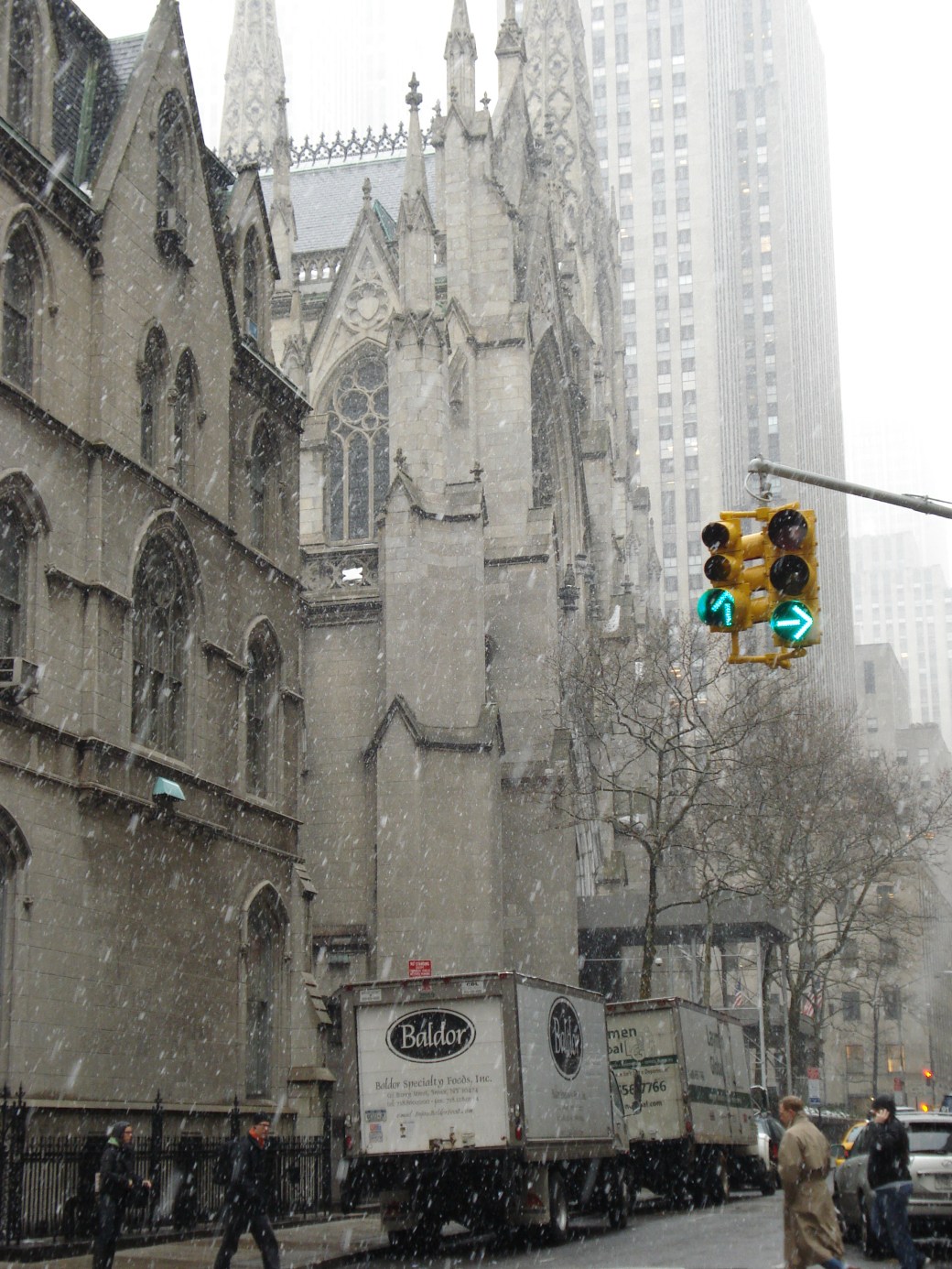
Snowing in New York City (photo by Nina Munteanu)


nina-2014aaa

Nina Munteanu is a Canadian ecologist / limnologist and novelist. She is co-editor of Europa SF and currently teaches writing courses at George Brown College and the University of Toronto. Visit www.ninamunteanu.ca for the latest on her books. Nina’s bilingual “La natura dell’acqua / The Way of Water” was published by Mincione Edizioni in Rome. Her non-fiction book “Water Is…” by Pixl Press (Vancouver) was selected by Margaret Atwood in the New York Times ‘Year in Reading’ and was chosen as the 2017 Summer Read by Water Canada. Her novel “A Diary in the Age of Waterwas released by Inanna Publications (Toronto) in June 2020.


The Legacy of Trees: Purposefully Wandering Vancouver’s Stanley Park

Winter on Sea Wall StanleyPark

Winter on the sea wall (Heritage House)

“In the gorgeously colourful fall of 2017, I had a sudden thought: “I live next to Stanley Park, one of the world’s most beloved and best parks. How have I not noticed? Of course I had noticed, but I hadn’t taken that awareness inside. I barely knew the park. I have lived beside this park for twenty-five years. I first saw the crescent beach of English Bay and the storytelling totems in the park in 1961, fifty-nine years ago. Have I been asleep? Can I wake up? Is it time?

If I am going to get to know this park—this Stanley Park—and call it “my park,” I will have to wander it purposefully, path by path, plaque by plaque, monument by monument, rock by rock, tree by tree, blossom by flowering blossom, through every season, and allow its layers of history to seep into me as though it were a living, breathing being.

Actually, it is.

Legacy of Trees Nina Shoroplova

This is how Nina Shoroplova begins her book “The Legacy of Trees” by Heritage House, 2020, a book all about “Purposeful Wandering in Vancouver’s Stanley Park.”

The beautifully laid out 288-page book with colour photos is a feast for the mind and the heart. Although the book provides an excellent human and natural history of the park—from its pre-colonial existence, and logging history, to its creation and uses and description—at its root is an expression of wonder for this natural gem in the middle of a bustling city and a true love of trees.

Shoroplova approaches the forest with the heart of a poet. Her passion for nature—and trees, particularly—lights each page with joyful discovery. Shoroplova brings this passion to Stanley Park, one of Canada’s iconic parks, and one worth both visiting and knowing through many aspects from history to ecology and from forest ecosystem to legacy tree.

Each year, Stanley Park welcomes more than eight million visitors from around the world. In the summer of 2013, Travel & Leisure magazine ranked Stanley Park second among the world’s twenty-eight most beautiful city parks in the world. In 2014, TripAdvisor named Stanley Park the best park in the world. The park features 400-hectares of natural coastal temperate rainforest with 27 km of trails and scenic views of water, mountains, and truly majestic trees. The rainforest holds an old-growth forest of +400-year old Douglas-firs and some of the largest grand firs in the world. The park also features an 8.8 km seawall, totem poles and six beautiful gardens.

Map of Stanley Park

Map of Stanley Park, Vancouver

Early in the book, Shoroplova describes a particular experience with a weeping beech in Shakespeare Garden with something close to reverence:

“When I first walked under its canopy of falling dark green drapery, tears came to my eyes. Somehow, the generosity of that tree, offering its shade and comfort to all who stand, walk, and drive underneath its south-facing leaves, opened my heart.” She then added, “As a friend says, ‘trees are divine beings.’”

Shoroplova shares why she feels calmed, centred, and connected in a forest, particularly in Stanley Park:

Hemlock on Cedar StanleyPark

Hemlock growing on cedar stump (Heritage House)

Maybe it’s because the change in a forest is constant yet unobservable, unobtrusive. Maybe it’s because I, as a human being, am so insignificant in size compared with the giants around me. Or because I, as a human being, have lived for such a short time compared with the ancient living beings around me. Or the green and the tree pheromones are so calming…

I used to feel this way when I skied downhill and when I breastfed my babies. I feel this way when I stand in the ocean and await the next wave and the next. I feel this way with my grandchildren. That’s what being in the forest does for us…It brings us to the present moment. That’s the gift.”

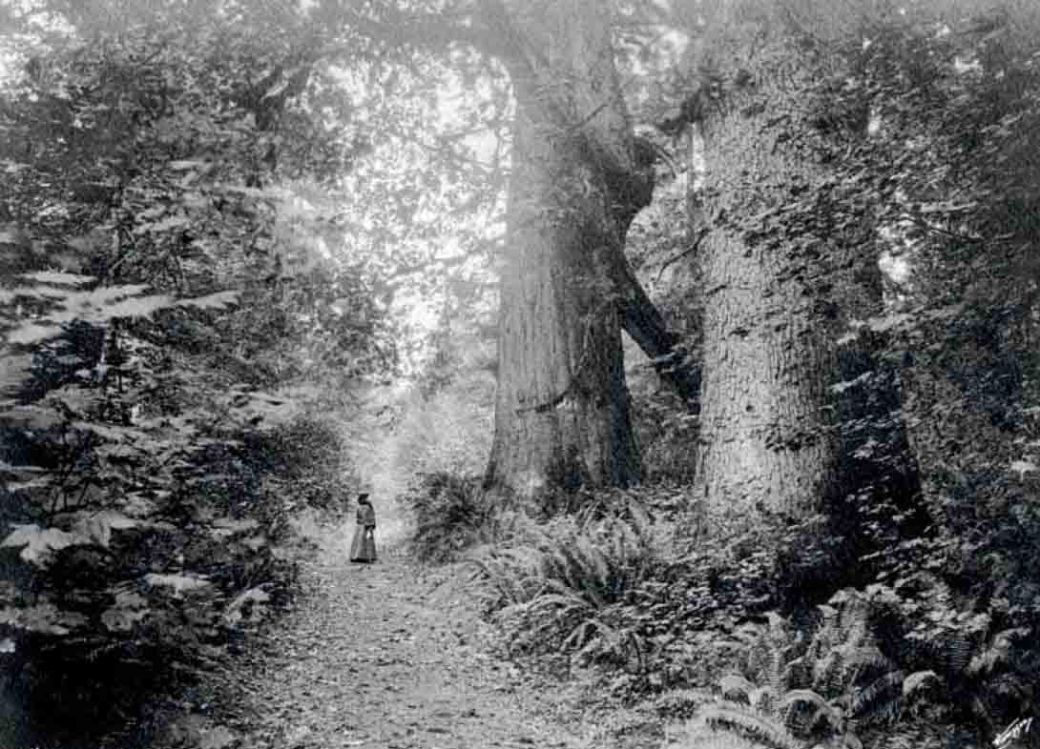
Victorian woman giant trees 1901

Woman wanders among the Seven Sisters giants, 1901 (Heritage House)

There is an abiding quality about trees and a living forest that is reassuring. “Trees are supportive, yet ambitious,” writes Shoropova. They are “quiet yet communicative, flexible yet strong, adaptive yet true to type.” They connect us to a larger world in a way that is both awe-inspiring and familiar.

“Learning the histories of the legacy trees in Stanley Park deepens our knowledge of the people of Vancouver—our history, our origins, our values,” Shoroplova explains in her opening chapter. These stories also show how Vancouver is maturing and evolving alongside its park forests and gardens. “We are shaking off the colonial identity that the park exhibited for so many decades and embracing the values of reconciliation with the first inhabitants of this land, the Squamish, Musqueam, and Tsleil-Waututh. We are also reclaiming what we can of the original nature of this land while honouring our communal history.”

Loggers springboard system Douglas-fir-1890s

Loggers using springboards to chop down a Douglas-fir giant, Stanley Park, 1890s (Heritage House)

Shoroplova arranged her tree stories into three parts: Part 1: The Trees Were Always There—trees that were already growing on the peninsula headland that became the federal reserve and then Stanley Park; Part 2: The First Trees Are Planted—those that were planted during the colonial and imperial years of the park (up to 1960); Part 3: The Park Grows Up—the years of growing independence.

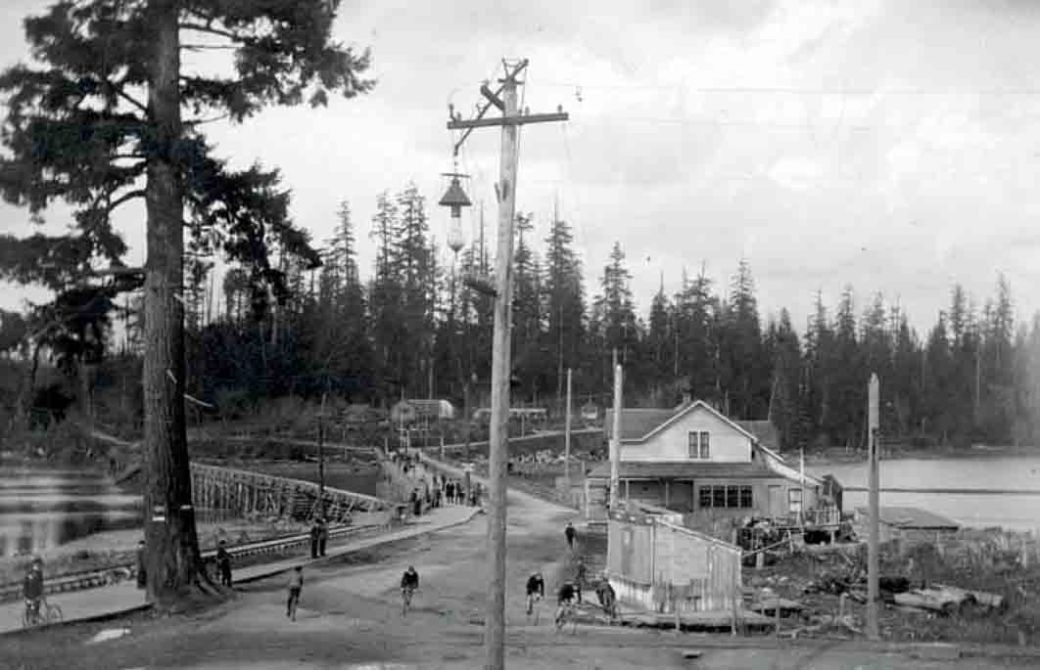
Complete with old photos and original maps, Shoroplova offers several well-described and mapped routes to learn about and appreciate the beauty of the park. Her accurate science and historical accounts are dispensed in easily-digested and understood parcels through the language of conversation. The narrative is both charming and intriguing from the sad tale of the sentinel big Douglas-fir at the entrance to Stanley Park in 1894 to the princess-poet Pauline Johnson’s naming of Lost Lagoon and stories of historic events.

GeorgiaSt Entrance StanleyPark-bigfir-1894

Georgia Street entrance to Stanley Park in 1894 (Heritage House)

In a particularly engaging chapter of the book (Chapter 8), Shoroplova compares humans to trees and, through some interesting observations on tree physiology and behaviour, she draws some interesting conclusions. One example is her description of a tree’s heartbeat: how trunk and branches use a very slow pulse of contraction and expansion to send water up and out to every branchlet and leaf. Or how trees essentially breathe in more oxygen during the day (during active photosynthesis) and breathe out more carbon dioxide at night (during respiration without photosynthesis). Shoroplova likens it to “one slow breath for every twenty-four hours.” Shoroplova extends this fractal idea to the “suggestion that the northern hemisphere of Earth breathes in every summer and breathes out every winter. One slow planetary breath for every twelve months.”

Shoroplova also discusses two theories that explain the phenomenon of crown shyness, only seen in deciduous trees: “One is that trees of the same species avoid both being shaded by and shading each other. They take up space that is not already filled, allowing each other space to grow and breathe and capture the sun’s rays. The opposing theory is that stormy weather breaks off branches that are very close to each other. I suspect a mixture of both theories is at work.”

NurseryTree StanleyPark

Decaying log provides nutrients and substrate for other life (Heritage House)

Shoroplova continues her comparison in describing the life and death of a tree. “The death of a tree is a very drawn-out affair, taking years and even decades, as the tree changes from being healthy to having its health impinged on in some way, to losing more of its branches … to becoming a standing snag, and finally to falling to the forest floor. The decomposition—the composting—of one tree provides the soil for the birth and regeneration of many others. When a tree falls in the forest, its fallen form—minerals, fibre, and glucose—nourishes all the other life forms in its environment…Fallen trees become nurse logs for seedling trees, especially for western hemlocks.” In Chapter 9, Shoroplova shares how the forest—like the ocean—releases negative ions that help in general feelings of wellness as these ions “neutralize all the free radicals that result from our natural body processes or that exist as environmental toxins.”

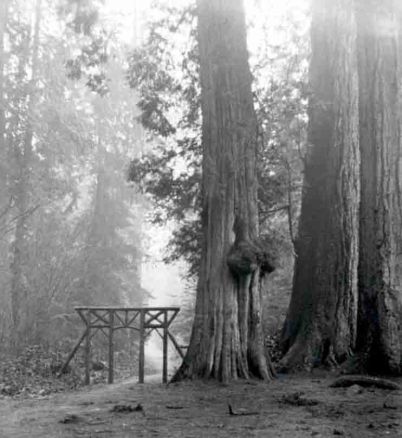
RemainingSevenSister burl

Western red cedar with burl, remaining Seven Sister in Stanley Park (Heritage House)

In Chapter 12, Shoroplova describes the cathedral-like grandeur of the Seven Sisters grove of western redcedars and Douglas-firs as witnessed by Mohawk poet E. Pauline Johnson in 1911 and the sad narrative that followed. The fame of this stately grove of giants became their undoing—in the early 1950s the Park Board cut them down, citing safety reasons. The seven stately trees became seven sad stumps—with just one western redcedar with a large burl of the originals remaining. In 1988 the Park Board planted seven young Douglas-fir trees to replace the Seven Sisters. It will take time but eventually they may rival the Seven Sisters in majestic height. The single original sister still stands, prompting Shoroplova to “return to feel the history embedded in this single sibling.”

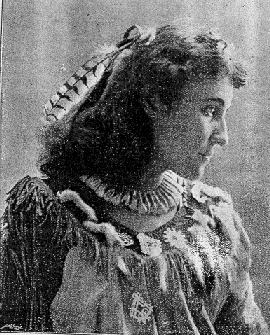
PaulineJohnson feather

E. Pauline Johnson

“But in all the world there is no cathedral whose marble or onyx columns can vie with those straight, clean, brown tree-boles that team with the sap and blood of life. There is no fresco that can rival the delicacy of lace-work they have festooned between you and the far skies. No tiles, no mosaic or inlaid marbles are as fascinating as the bare, russet, fragrant floor outspreading about their feet. They are the acme of Nature’s architecture, and in building them she has outrivalled all her erstwhile conceptions. She will never originate a more faultless design, never erect a more perfect edifice. But the divinely moulded trees and the man-made cathedral have one exquisite characteristic in common. It is the atmosphere of holiness.”—E. Pauline Johnson, Legends of Vancouver, 1911.

ProspectPoint 1891

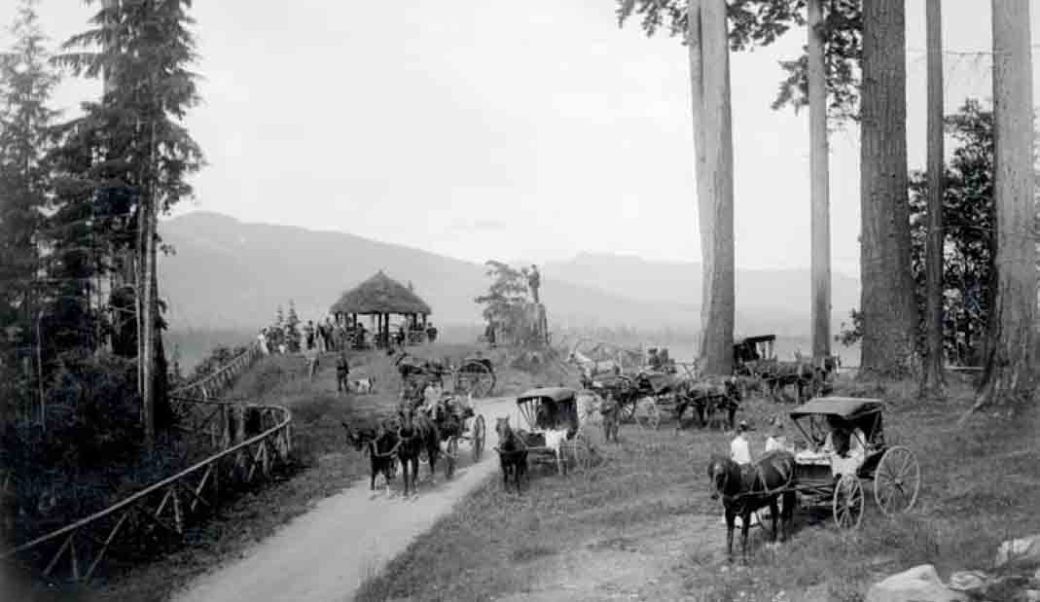
Prospect Point, Stanley Park, 1891 (Heritage House)

Subsequent chapters are devoted to singular trees and charming stories throughout the various gardens and paths of Stanley Park. Shoroplova brings them all to life with an animated history that weaves through the park to the present day.

Nina looking up dougfir-LHP

Nina Munteanu looks up at giant Douglas-fir in Lighthouse Park, BC (photo by M. Ross)

She ends on a high note for me by invoking the wisdom of UBC ecologist and forester Suzanne Simard, who parses out four simple solutions to forest managers. They include: 1) know the local region and ecology and act accordingly; 2) stop or at least curtail most logging of the old-growth forests; 3) save the legacies, the mother trees and networks so they can pass their wisdom onto the next generation of trees; 4) help regenerate the biodiversity of forest ecosystems by planting and allowing natural regeneration. “Forests aren’t just a bunch of trees competing with each other; they’re super-cooperators,” says Simard in a TED talk in June 2016. From Simard’s message I travelled to Ira Sutherland’s TEDx talk in October 2019, about the giant trees in Vancouver, which include Stanley Park; his message was also direct: 1) this is our story; and 2) Nature proves resilient.

I give Shoroplova a top score for ending her wonderful exposé on Stanley Park trees with action. Once we have connected with a forest and with a particular tree, we have walked through a door into awareness and ultimately responsibility. The wisdom and actionable message is clear. It isn’t enough to be a bystander. Just as E. Pauline Johnson raised the flag of awareness a hundred years ago for indigenous peoples and Nature by association, we must do the same. Or it will disappear. Sutherland points out that many of the sites where he has documented giant mother trees are not protected.

Bill Stephen, superintendent of urban forestry (retired), in his foreword to the book, wisely suggests how to use the book:

Read it first in a leisurely manner at home, and internalize the park’s history since its dedication in 1888. Then tuck it into your backpack and take it with you as a companion on your park wanderings. Take it on your smartphone or tablet as an ebook. Follow the maps, and use a maps app to enter the latitude/longitude coordinates of your place of interest for the day. Re-read its tales in the presence of the very trees about which it speaks, time travel with them, and return to the city with a richer sense of the connections between the trees of this great park and its human and animal actors. Then repeat…”

Vancouver StanleyPark bridge

North side of Sea Wall with view of north shore and Lion’s Gate Bridge, Stanley Park, BC (photo by Nina Munteanu)

References:

Johnson, E. Pauline 1911. “Legends of Vancouver.” Library of Alexandria. 196pp. E. Pauline Johnson (Takehionwake) was a daughter of a Mohawk Chief and a white mother.  She was one of Canada’s most famous performers, poet, feminist and indigenous activist of the Victorian era. Pauline Johnson documented legends, told to her by her great friend, Squamish Chief Joe Capilano, in the Vancouver newspaper, The Daily Province, and then a book, ‘Legends of Vancouver’, in print now for over 100 years.

Nombre, Antonio Donato. 2010. “The Magic of the Amazon: A river that flows invisibly all around us.” TEDx Talk, 21:27 min. November, 2010. The Amazon River is like a heart, pumping water from the seas through it, and up into the atmosphere through 600 billion trees, which act like lungs. Clouds form, rain falls and the forest thrives. In a lyrical talk, Antonio Donato Nobre talks us through the interconnected systems of this region, and how they provide environmental services to the entire world. A parable for the extraordinary symphony that is nature.

Simard, Suzanne. 2016. “How Trees Talk to Each Other.” TED Talk, 18:20 min. June, 2016. “A forest is much more than what you see,” says ecologist Suzanne Simard. Her 30 years of research in Canadian forests have led to an astounding discovery — trees talk, often and over vast distances. Learn more about the harmonious yet complicated social lives of trees and prepare to see the natural world with new eyes.

Shoroplova, Nina. 2020. “Legacy of Trees: Purposeful Wandering in Vancouver’s Stanley Park.” Heritage House Publishing Co.Ltd., Vancouver. 288pp.

Sutherland, Ira. 2019. “The Great Vancouver Forest: A Story of Place.” TEDx Talk, 21:04 min. Oct. 2019. Growing up among the tall forests near UBC, Ira Sutherland developed an appreciation and curiosity for forests early on. This talk invites his audience to explore Vancouver’s extensive forests and to hopefully see trees in a new light (for more information, see http://www.vancouversbigtrees.com)


nina-2014aaa

Nina Munteanu is a Canadian ecologist / limnologist and novelist. She is co-editor of Europa SF and currently teaches writing courses at George Brown College and the University of Toronto. Visit www.ninamunteanu.ca for the latest on her books. Nina’s bilingual “La natura dell’acqua / The Way of Water” was published by Mincione Edizioni in Rome. Her non-fiction book “Water Is…” by Pixl Press(Vancouver) was selected by Margaret Atwood in the New York Times‘Year in Reading’ and was chosen as the 2017 Summer Read by Water Canada. Her novel “A Diary in the Age of Waterwas released by Inanna Publications (Toronto) in June 2020.

Launch of “A Diary in the Age of Water” by Nina Munteanu

june 18 launch evite1

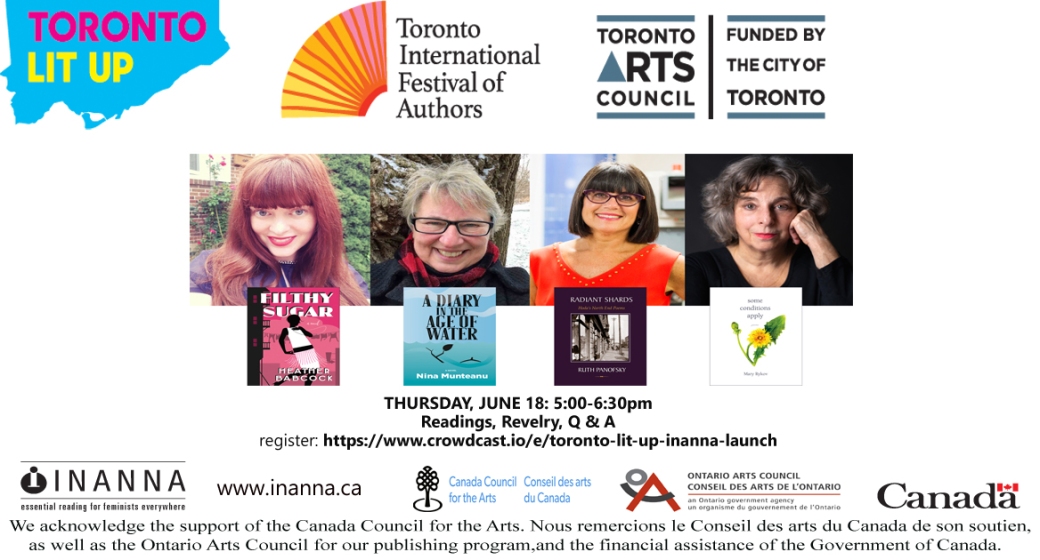
Diary Water cover finalOn June 18th, Toronto book publishing house Inanna Publications launched its second spring series and A Diary in the Age of Water, my near-future/far-future speculative fiction book was among them.

A Diary in the Age of Water follows the climate-induced journey of Earth and humanity through four generations of women, each with a unique relationship to water.

Evoking Ursula LeGuin’s unflinching humane and moral authority, Nina Munteanu takes us into the lives of four generations of women and their battles against a global giant that controls and manipulates Earth’s water. In a diary that entwines acute scientific observation with poignant personal reflection, Lynna’s story unfolds incrementally, like climate change itself. Particularly harrowing are the neighbourhood water betrayals, along with Lynna’s deliberately dehydrated appearance meant to deflect attention from her own clandestine water collection. Her estrangement from her beloved daughter, her “dark cascade” who embarks upon a deadly path of her own, is heartwrenching. Munteanu elegantly transports us between Lynna’s exuberant youth and her tormented present, between microcosm and macrocosm, linking her story and struggles – and those of her mother, daughter and granddaughter – to the life force manifest in water itself. In language both gritty and hauntingly poetic, Munteanu delivers an uncompromising warning of our future.

—Lynn Hutchinson Lee


NINA-RENEE-TOAST2a

Renee Knapp and Nina Munteanu toast Inanna and all participants at the launch

A Diary in the Age of Water starts with young Kyo in the dying boreal forest of what used to be northern Canada. Kyo yearns inordinately for the Age of Water, a turbulent time of great change, before the “Water Twins” destroyed humanity. Looking for answers and plagued by vivid dreams of this holocaust, Kyo discovers the diary of Lynna, a limnologist from a time just prior to the destruction.

At the book launch, I read from Lynna’s first diary entry—in 2045. I then answered questions from audience members who came from Canada’s coast to coast:


What inspired you to write this book?

The Way of Water-COVERWho really… My publisher in Rome (Mincione Edizioni) had asked me for a short story on water and politics. I wanted to write about Canada and I wanted something ironic… so I chose water scarcity in Canada, a nation rich in water. “The Way of Water” (“La natura dell’acqua”) resulted, which has been reprinted in several magazines and anthologies, including Cli-Fi: Canadian Tales of Climate Change (Exile Editions), Future Fiction: New Dimensions in International Science Fiction (Future Fiction/Rosarium Publishing), Little Blue Marble Magazine, and Climate Crisis Anthology (Little Blue Marble). The story was about young Hilde—the daughter of the diarist—dying of thirst in Toronto… It begged for more … so the novel came from it…


Why did you choose to write your novel as a diary?

I was writing about both the far and the near future and much of it was based—like Margaret Atwood and her books—on real events and even real people. I wanted personal relevance to what’s going on, particularly with climate change.  I also wanted to achieve a gritty realism of the mundane and a diary felt right. The diarist—Lynna—is also a reclusive inexpressive character, so I thought a personal diary would help bring out her thoughts and feelings. There’s nothing like eves-dropping to make the mundane exciting.


If the oceans are rising because the ice caps are melting, is the ocean actually getting less salty?

The short answer is “yes.” As glaciers melt and introduce fresh water to the ocean—contributing to the rise in sea level—salinity is reduced in the surrounding sea. This has far-reaching consequences that lie beyond just rising sea levels and promise to affect all ocean life. Because freshwater is less dense than seawater—hence the saltwater wedge we experience on the lower Fraser River in Vancouver—freshwater increase in seawater will interfere with the pattern, mixing, and movement of ocean currents; this could be devastating to ocean life. The overall movement of ocean currents throughout the planet is called the Great Ocean Conveyor—or Atlantic Meridional Overturning Circulation (AMOC)—which circulates ocean water very much like in a lake, with dense water sinking beneath warmer, less salty water. As my diarist in the book writes, dumping in more and more freshwater into the ocean has slowed the sinking (and mixing) and the whole machine is slowing down. Freshwater is jamming the conveyor. If it stalls, this would unbalance the heat flux of the planet with more climate devastation.

Illustration 17 AMOC

Sketch of Atlantic Meridional Overturning Circulation (AMOC) from “A Diary in the Age of Water” Inanna Publications (sketch by Nina Munteanu)

The main protagonist is a limnologist; so are you; is there any resemblance?

Oh yes! Well, apart from the obvious—we both chose the same scientific discipline, we have similar views on the environment and humanity’s place in it. I might even have some of her foibles…hopefully not ALL of them… But, I’d say that all good characters have a piece of ourselves in them. Some dark and some light. The resemblance is heightened because she is depicted through her diary, which adds a gritty realism and a highly personal aspect to the fiction. In truth there’s a piece of me in each of the four women depicted in the story.


What is happening to the water in Ontario?

Water quality in Ontario waterways has not improved in the last decade and this can be placed squarely on the shoulders of local, regional and provincial governments and their failure to legislate and act. Inaction varies from lack of regulations and policing of industry to lack of city infrastructure and lack of ecological foresight.

SONY DSC

Cladophora alga in Lake Ontario

Lake Ontario itself receives pollution from Chicago, Sarnia, Detroit, Cleveland, Buffalo, Hamilton and Toronto. Pollution includes agricultural runoff (such as excess nutrients and cancer-causing pesticides and herbicides), disease-carrying sewage, and hormone-disrupting storm water runoff. Nine million people rely on the lake for drinking water. Greatest threats to the lake’s health come from urban development, electricity generation, sewage, and storm water contamination. In cities with large amounts of impervious surfaces, storm water runs over pavement and parking lots, picking up oil and other pollutants before flowing into a nearby river or stream. Flash floods are often accompanied by sewage overflow, which carries numerous pathogens. In addition, storm water picks up toxic heavy metals, endocrine disrupting chemicals and pharmaceuticals. All with devastating consequences to humans, never mind aquatic life and other wildlife.

Every five years the Conservation Authority Watershed Report Cards provide an assessment of ground and surface water quality in various watersheds of Ontario. The latest one by the TRCA (Toronto and Region Conservation Authority) in 2018 gave an overall grade of “D” (unchanged from 2013). They cited storm water runoff and lack of its management improvement as the chief reason for the poor grade. Increasing chloride concentrations in the Toronto region (mostly from liberal use of road salt) poses a real problem to aquatic life.


Log over water forest-DeasPark copy

Forest swamp in Deas Park, BC (photo by Nina Munteanu)

You mentioned that each of the four generations of women have a singular relationship with water. What role does water play in the book?

Well, in some important way, water is the fifth character. You could say even the main character. Water is the theme that carries each woman on her personal journey with climate change and the devastation that occurs—through water, I might add. Climate change is a water phenomenon, after all… So, water—like place and setting—plays a subtle yet powerful role in the story, influencing each character in her own way and bringing them together in the overall journey of humanity during a time of great and catastrophic change.


Are there other ages/epochs?

Yes. The story begins in the far future with young Kyo during the Age of Trees, after the end of the Age of Water. It is, in fact, the end of that age as well and that is why she prepares for the Exodus to “humanity’s” new home.

All Inanna titles are 30% off with coupon code: summer20. Please also consider purchasing “A Diary in the Age of Water” from an independent bookstore this summer. Find your local bookstore: http://open-book.ca/News/Your-Community-Your-Bookstore. And here is the current map of independent bookstores that are doing curbside pick up and delivery across Canada.


Beach stones foam HB-NS drybrush

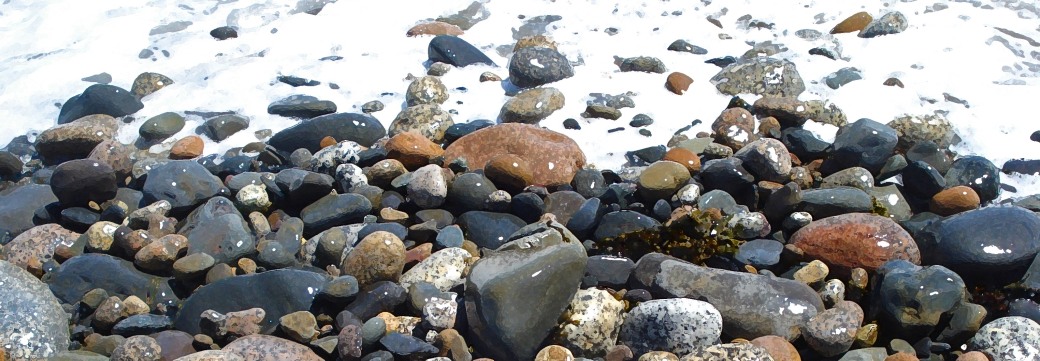
Surf on Hirtle Beach, NS (photo and illustration by Nina Munteanu)

nina-2014aaa

Nina Munteanu is a Canadian ecologist / limnologist and novelist. She is co-editor of Europa SF and currently teaches writing courses at George Brown College and the University of Toronto. Visit www.ninamunteanu.ca for the latest on her books. Nina’s bilingual “La natura dell’acqua / The Way of Water” was published by Mincione Edizioni in Rome. Her non-fiction book “Water Is…” by Pixl Press(Vancouver) was selected by Margaret Atwood in the New York Times‘Year in Reading’ and was chosen as the 2017 Summer Read by Water Canada. Her novel “A Diary in the Age of Waterwas released by Inanna Publications (Toronto) in June 2020.


Age of Water Podcast: Interview with Emmi Itäranta

Emmi Itaranta 1

Emmi Itäranta

We are now living in the Age of Water. Water is the new “gold”, with individuals, corporations and countries positioning themselves around this precious resource. Water is changing everything. The Age of Water Podcast covers anything of interest from breaking environmental news to evergreen material. This also includes human interest stories, readings of eco-literature, discussion of film and other media productions of interest.

In this episode of Age of Water, we join award-winning Finnish author Emmi Itäranta in the UK, where she talks about her eco-fiction including The Memory of Water and how her childhood in Finland helped shape her own activism.

ListenNow button


Emmi ItarantamemoryofwaterEmmi Itäranta is an award-winning Finnish author. She holds a MA in Drama from the University of Tampere and worked as a columnist, theatre critic, script writer and press officer. She wrote her debut novel Memory of Water simultaneously in Finnish and English during a creative writing course. The English version was published by HarperCollins in 2014 in the United States, United Kingdom and Australia and was nominated for the 2014 Philip K. Dick Award, and the Golden Tentacle Award and the Arthur C. Clarke Award. The book was translated into over a dozen languages throughout the world. Her novel The City of Woven Streets (The Weaver) won the City of Tampere Literary Award. Emmi Itäranta lives in Canterbury, United Kingdom.


nina-2014aaa

Nina Munteanu is a Canadian ecologist / limnologist and novelist. She is co-editor of Europa SF and currently teaches writing courses at George Brown College and the University of Toronto. Visit www.ninamunteanu.ca for the latest on her books. Nina’s bilingual “La natura dell’acqua / The Way of Water” was published by Mincione Edizioni in Rome. Her non-fiction book “Water Is…” by Pixl Press (Vancouver) was selected by Margaret Atwood in the New York Times ‘Year in Reading’ and was chosen as the 2017 Summer Read by Water Canada. Her novel “A Diary in the Age of Water” will be released by Inanna Publications (Toronto) in June 2020.

Vision 2020 and Water Is…

BHNCDSB_STEM_Poster_36x24-4.pdf

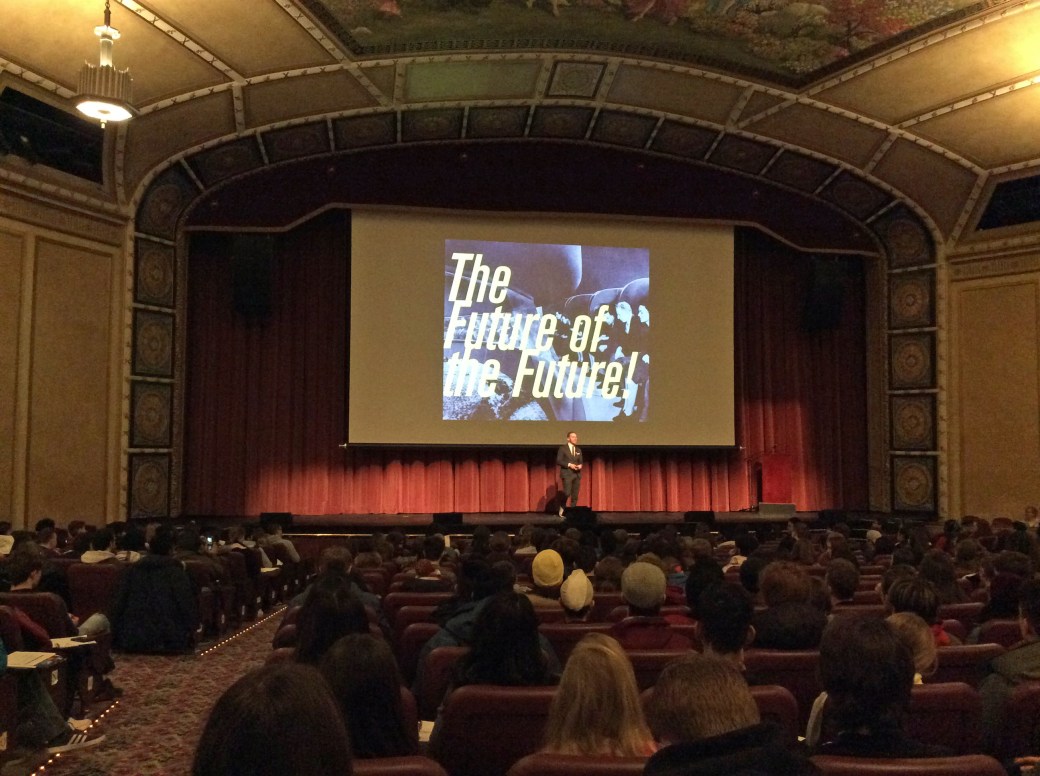
In February 2020, I was invited to speak and do workshops with over a hundred Grade 11 and 12 students about the future in the “2020 Vision into the Future” conference at Wilfrid Laurier University in Brantford, Ontario.

FutureOfFuture-GLindsay

Keynote speaker Greg Lindsay talks to students at Sanderson Centre

AerotropolisJournalist, urbanist and futurist Greg Lindsay gave a rousing keynote speech to start the conference. Greg spoke about the future of cities, technology, and mobility. He is the director of applied research at NewCities and director of strategy at its mobility offshoot CoMotion. He also co-authored the international bestseller Aerotropolis: The Way We’ll Live Next.

I joined a suite of technologists, visionaries and other scientists in presenting various scenarios of the future through workshops and seminars.

Workshop subjects included quantum cryptography, autonomous vehicles, flying cars, robotic surgery, zero waste, computer glasses, and my workshop “writing science fiction.”

Instructive seminars included topics such as feeding 9 billion people, mental health, AI & computers, the science and meaning of water, urban development, the future of transportation and space exploration.

How to Write Science Fiction

the-city-cgtrader copy

Top choice image prompt for storytelling

I gave two workshops on how to write science fiction. The workshop began with a brief discussion on what a story is (and is not) and a summary of the key tools of writing good story (e.g. premise, plot, theme, character, and setting) with a focus on world-building and the role of science.

Each group then set out to create the framework for a story based on a premise from an image prompt and shared what they’d put together. In one session we all worked together with me scribing on one whiteboard, creating together as a class; in another session, small groups formed and created their own story among four to five members as I went from team to team.

everyday hero-2 copy

Next popular storytelling image (cover illustration for “Ecology of Story” by Anne Moody)

Amazing stories emerged in both cases from the image prompts chosen. Students demonstrated imaginative, mature and original premises and carried through with thoughtful and imaginative plot, theme and character journeys. I was very impressed.

The Science and Meaning of Water

In this seminar I gave a summary of water’s life-giving anomalous properties on Earth and discussed the history and field of limnology (study of freshwater). I explored our history with water (including our impacts) and the implications of climate change on our future with water on the planet. Points of interest included water’s many weird properties, water’s ubiquity and its origins, the hydrological cycle, and the often strange adaptations of life with (or without) water.

Water Is-COVER-webWe then discussed future implications of water scarcity (and geopolitical conflict) and some of the things individuals and communities can do. Much of the talk drew from my recent book Water Is… The Meaning of Water.


nina-2014aaa

Nina Munteanu is a Canadian ecologist / limnologist and novelist. She is co-editor of Europa SF and currently teaches writing courses at George Brown College and the University of Toronto. Visit www.ninamunteanu.ca for the latest on her books. Nina’s bilingual “La natura dell’acqua / The Way of Water” was published by Mincione Edizioni in Rome. Her non-fiction book “Water Is…” by Pixl Press (Vancouver) was selected by Margaret Atwood in the New York Times ‘Year in Reading’ and was chosen as the 2017 Summer Read by Water Canada. Her novel “A Diary in the Age of Waterwill be released by Inanna Publications (Toronto) in June 2020.


Boredom in the Time of COVID-19: The Art and Satisfaction of Writing Letters

There are no boring moments; only bored people who lack the wherewithal to explore and discover—Nina Munteanu

Cedars and roots in moss JC

Cedar trees on shore of Jackson Creek, ON (photo by Nina Munteanu)

So many of us have responded intelligently to the pandemic by respecting “lock down” measures to self-isolate and socially distance. From simply staying at home to going out less often and avoiding crowds (well, there shouldn’t be any of them right now; but there will always be an irresponsible sector who must reflex their sense of entitlement and lack of compassion).

What the pandemic and our necessary reaction to it has done more than anything is to slow us down. Many people are slowly going crazy with it: we are, after all, a gregarious species. And not all of us feel comfortable with virtual meetings. Our senses are deprived; you can’t touch and smell and feel.

But, there are wonderful ways to feed the muse and get sensual…

Cedar over water-JC

Cedar tree on Jackson Creek, ON (photo by Nina Munteanu)

My good friend and poet Merridy Cox recently told me about a Facebook friend who was feeling so bored: “GETTING SO BORED BEING AT HOME” amid the social distancing and self-isolation during the ongoing COVID-19 pandemic.

Merridy counselled her friend to go outside and watch spring unfold then find a nice place to sit and write about it. A poem, she suggested: “Little white clouds are scudding across a blue sky. Trees are budding. Birds are migrating. Don’t be bored! Get outside, find a tree and see if there is a bird in it—now, you have enough to write a poem.”

What Merridy was essentially suggesting to her friend was to look outside herself. Reach out in curiosity and discover something. Boredom will fly away with curiosity and can lead to expression through poetry (or photography, sketching, journaling, memoir, or letter writing). When you open your soul to the spirit of exploration, you will find much to discover. When you share with others, you close the gap of isolation from gregariousness and find connection through meaning. The key is in sharing.

In Gifts from the Trail, Stella Body writes that, “Being Creative is a form of self-care and caring for others. The Gift by Lewis Hyde has been cited by Margaret Atwood and many others as what inspired them to share their creative work.  Sharing is part of many religions, as part of becoming ‘holy, from the word ‘whole’.   When what you share comes from your inner creative impulse, you develop a sense of your own value as an individual.  In addition, you transcend your separateness by touching the spirit of another.  In this way, all forms of art are therapeutic.”

The key to success in this is to start with 1) motivation, move through to 2) curiosity and discovery, then on to 3) creativity and expression. Sending an old-fashioned letter and handwriting provides a rich opportunity to create and express fully. And it gives us reasons to pursue. Following these three pursuits will enrich your life and provide enrichment to others through sharing.

Pine white woodpecker hole5

Woodpecker hole in white pine tree, ON (photo by Nina Munteanu)

Step 1, MOTIVATION: Find several people you wish to communicate with on a deeper level and wish to entertain and inform. Think beyond your Facebook or Twitter audience (though, I do draw inspiration from wishing to share my photography with them). They could even be your next door neighbour! Of course, you need something to share; that’s where Step 2 comes in.

Step 2, CURIOSITY and DISCOVERY: Find a place that you can observe; the natural world is incredibly suited to discovery. Look high and low, slow your pace and use all your senses. Listen. Smell. Feel. Remember to look up. And look down on the ground. Nature hides some of her most precious gems there. Find something familiar and find something new. Invest in a guidebook.

JournalWritert FrontCover copy 2Research what you’ve found on the Internet; find out more about something you’ve observed. For instance, why does the willow have such a shaggy bark? Why do alders grow so well near the edges of streams? What role do sowbugs play in the ecosystem? What do squirrels eat? What is that bird doing on my lawn? Start a phenology study (how something changes over the seasons). Keep tabs on the birds you see and what they’re doing. You can find several examples of mine in the links below.

Step 3, CREATIVITY and EXPRESSION: Depending on your relationship with people you are writing to and their own interests, you may tailor your letters with printed pictures, sketches and drawings, maps, quotes, and news clippings. This part can be really fun and can draw on all your creative talents. Let what you see and discover inspire you. Find a “story” in it and share it with someone. You can find more examples on ways to express yourself in my guidebook on writing journals: The Journal Writer.


Cedar bench river-JC

Bench next to cedar trees on Jackson Creek, ON (photo by Nina Munteanu)

Exploring and creativity don’t just cure boredom; they are good for your health:

EcologyOfStoryExpressive writing — whether in the form of journaling, blogging, writing letters, memoir or fiction — improves health. Over the past twenty years, a growing body of literature has shown beneficial effects of writing about traumatic, emotional and stressful events on physical and emotional health. In control experiments with college students, Pennebaker and Beall (1986) demonstrated that college students who wrote about their deepest thoughts and feelings for only 15 minutes over four consecutive days, experienced significant health benefits four months later. Long term benefits of expressive writing include improved lung and liver function, reduced blood pressure, reduced depression, improved functioning memory, sporting performance and greater psychological well-being. The kind of writing that heals, however, must link the trauma or deep event with the emotions and feelings they generated. Simply writing as catharsis won’t do.

In Gifts from the Trail, Stella Body writes: “Far more than a quick Selfie, a written response explores the range of the experience.  It both saves an instant from being lost in time, and holds on to the live matter of the writer’s feeling.  If shared, both writer and audience can return to that moment and draw healing from it.  What’s more, as many studies on volunteer work have shown, the process of sharing is a healing act.”

In Part 1 of my writing guidebook The Ecology of Story: World as Character, I talk about many of the interesting things in the natural world around us. In Part 2, I give many of these things meaning in story. The guidebook also has several writing exercises to capture the muse.

FictionWriter-front cover-2nd ed-webIn Chapter K of my writing guidebook The Fiction Writer: Get Published, Write Now!, I talk about writing what you know and what you discover. It’s more than you think. “In the 19th-century, John Keats wrote to a nightingale, an urn, a season. Simple, everyday things that he knew,” say Kim Addonizio and Dorianne Laux in The Writer’s Guide to Creativity. “Walt Whitman described the stars, a live oak, a field…They began with what they knew, what was at hand, what shimmered around them in the ordinary world.”

My journal writing guidebook The Journal Writer: Finding Your Voice provides advice and exercises on how to create a positive experience in observing, creating, journaling and letter or memoir writing.


Restoring the Lost Art of Handwriting

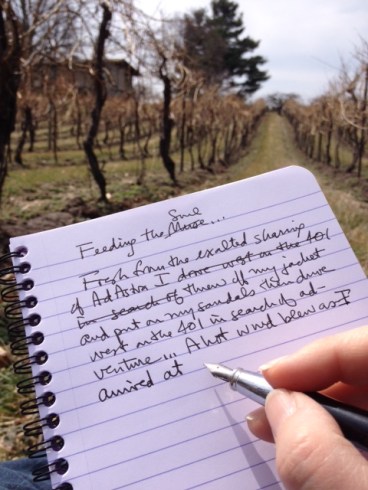
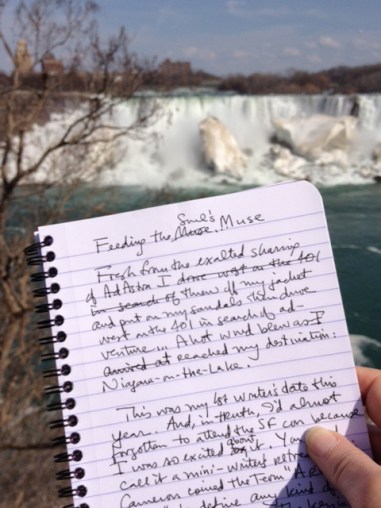
writing-notebook02

Nina writing in Niagara on the Lake (photo by Nina Munteanu)

Handwriting is a wonderful thing. It slows us down. It is a sensual and intimate way for us to express ourselves. I love my handwriting, especially when I am using my favorite pen (my handwriting changes depending on the pen), my Cross fountain pen — usually black. When you use a pen or pencil to express yourself you have more ways to express your creativity. Think of the subtleties of handwriting alone: changing the quality and intensity of strokes; designing your script, using colors, symbols, arrows or lines, using spaces creatively, combining with drawing and sketches. In combination with the paper (which could be lined, textured, colored graphed, etc.), your handwritten expression varies as your many thoughts and moods.

The very act of handwriting focuses you. Writing your words by hand connects you more tangibly to what you’re writing through the physical connection of pen to paper. Researchers have proven that just picking up a pencil and paper to write out your ideas improves your ability to think, process information and solve problems. The actual act of writing out the letters takes a little more work in your brain than just typing them on a keyboard, and that extra effort keeps your mind sharp. Researchers have also shown that writing something out by hand improves your ability to remember it. Handwriting improves memory, increases focus, and the ability to see relationships.

Handwriting fuses physical and intellectual processes. American novelist Nelson Algren wrote, “I always think of writing as a physical thing.” Hemmingway felt that his fingers did much of his thinking for him.

writing-notebook04According to Dr. Daniel Chandler, semiotician at Aberystwith University, when you write by hand you are more likely to discover what you want to say. When you write on a computer, you write “cleanly” by editing as you go along and deleting words (along with your first thoughts). In handwriting, everything remains, including the words you crossed out. “Handwriting, both product and process,” says Chandler, “is important … in relation to [your] sense of self.” He describes how the resistance of materials in handwriting increases the sense of self in the act of creating something. There is a stamp of ownership in the handwritten words that enhances a sense of “personal experience.”

Path-CreditRiver-oct2018

Path along Credit River, ON (photo by Nina Munteanu)

I know this is true in my own writing experience. This is why, although I do much of my drafting on the computer, I find that some of my greatest creative moments come to me through the notebook, which I always keep with me. Writing in my own hand is private and resonates with informality and spontaneity (in contrast to the fixed, formal look and public nature of print). Handwriting in a notebook is, therefore, a very supportive medium of discovery and the initial expression of ideas.

Develop interest in life as you see it; in people, things, literature, music—the world is so rich, simply throbbing with treasures, beautiful souls and interesting people. Forget yourself—Henry Miller


References:

Munteanu, Nina. 2009. The Fiction Writer: Get Published, Write Now. Starfire World Syndicate. 294pp

Munteanu, Nina. 2013. The Journal Writer: Finding Your Voice. Pixl Press. 172pp.

Munteanu, Nina. 2019. The Ecology of Story: World as Character. Pixl Press. 200pp.


Links:

The Ecology of Story: Revealing Hidden Characters of the Forest
Ecology, Story & Stranger Things
The Little Rouge in Winter: Up Close and Personal
The Phenology of the Little Rouge River and Woodland
White Willow–A Study
The Yellow Birch–A Study


nina-2014aaa

Nina Munteanu is a Canadian ecologist / limnologist and novelist. She is co-editor of Europa SF and currently teaches writing courses at George Brown College and the University of Toronto. Visit www.ninamunteanu.ca for the latest on her books. Nina’s bilingual “La natura dell’acqua / The Way of Water” was published by Mincione Edizioni in Rome. Her non-fiction book “Water Is…” by Pixl Press (Vancouver) was selected by Margaret Atwood in the New York Times ‘Year in Reading’ and was chosen as the 2017 Summer Read by Water Canada. Her novel “A Diary in the Age of Waterwill be released by Inanna Publications (Toronto) in June 2020.


The Ecology of Story: Revealing Hidden Characters of the Forest

 Story is place, and place is character—Nina Munteanu
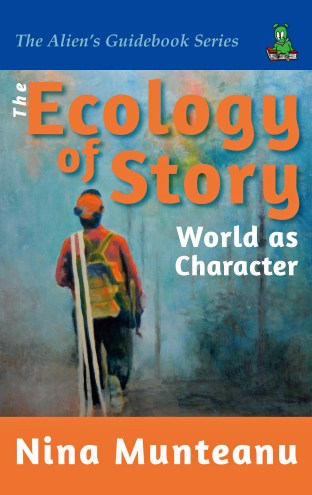
EcologyOfStory coverI remember a wonderful conversation I had several years ago at a conference with another science fiction writer on weird and wonderful protagonists and antagonists. Derek knew me as an ecologist—in fact I’d been invited to do a lecture at that conference entitled “The Ecology of Story” (also the name of my writing guidebook on treating setting and place as a character). We discussed the role that ecology plays in creating setting that resonates with theme and how to provide characters enlivened with metaphor.

Derek was fascinated by saprotrophs and their qualities. Saprotrophs take their nutrition from dead and decaying matter such as decaying pieces of plants or animals by dissolving them and absorbing the energy through their body surface. They accomplish this by secreting digestive enzymes into the dead/decaying matter to absorb the soluble organic nutrients. The process—called lysotrophic nutrition—occurs through microscopic lysis of detritus. Examples of saprotrophs include mushrooms, slime mold, and bacteria.
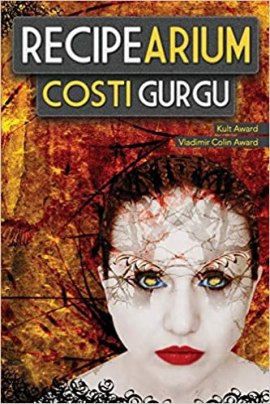
Recipearium CostiGurguI recall Derek’s eagerness to create a story that involved characters who demonstrate saprotrophic traits or even were genuine saprotrophs (in science fiction you can do that—it’s not hard. Check out Costi Gurgu’s astonishing novel Recipearium for a thrilling example). I wonder if Derek fulfilled his imagination.

I think of what Derek said, as I walk in my favourite woodland. It is early spring and the river that had swollen with snow melt just a week before, now flows with more restraint. I can see the cobbles and clay of scoured banks under the water. Further on, part of the path along the river has collapsed from a major bank scour the previous week. The little river is rather big and capricious, I ponder; then I consider that the entire forest sways to similar vagaries of wind, season, precipitation and unforeseen events. Despite its steadfast appearance the forest flows—like the river—in a constant state of flux and change, cycling irrevocably through life and death.

Cedar trunk base

Cedar tree (photo by Nina Munteanu)

As I’m writing this, the entire world struggles with life and death in the deep throws of a viral pandemic. COVID-19 has sent many cities into severe lock down to prevent viral spread in a life and death conflict. I’ve left the city and I’m walking in a quiet forest in southern Ontario in early spring. The forest is also experiencing life and death. But here, this intricate dance has seamlessly partnered death and decay with the living being of the forest. Without the firm embrace of death and decay, life cannot dance. In fact, life would be impossible. What strikes me here in the forest is how the two dance so well.

cedar log patterns2 copy

Cedar log, patterns in sapwood (photo by Nina Munteanu)

I walk slowly, eyes cast to the forest floor to the thick layer of dead leaves, and discover seeds and nuts—the promise of new life. I aim my gaze past trees and shrubs to the nearby snags and fallen logs. I’m looking for hidden gifts. One fallen cedar log reveals swirling impressionistic patterns of wood grain, dusted with moss and lichen. Nature’s death clothed in beauty.

The bark of a large pine tree that has fallen is riddled with tiny beetle holes drilled into its bark. Where the bark has sloughed off, a gallery of larval tracks in the sapwood create a map of meandering texture, form and colour.
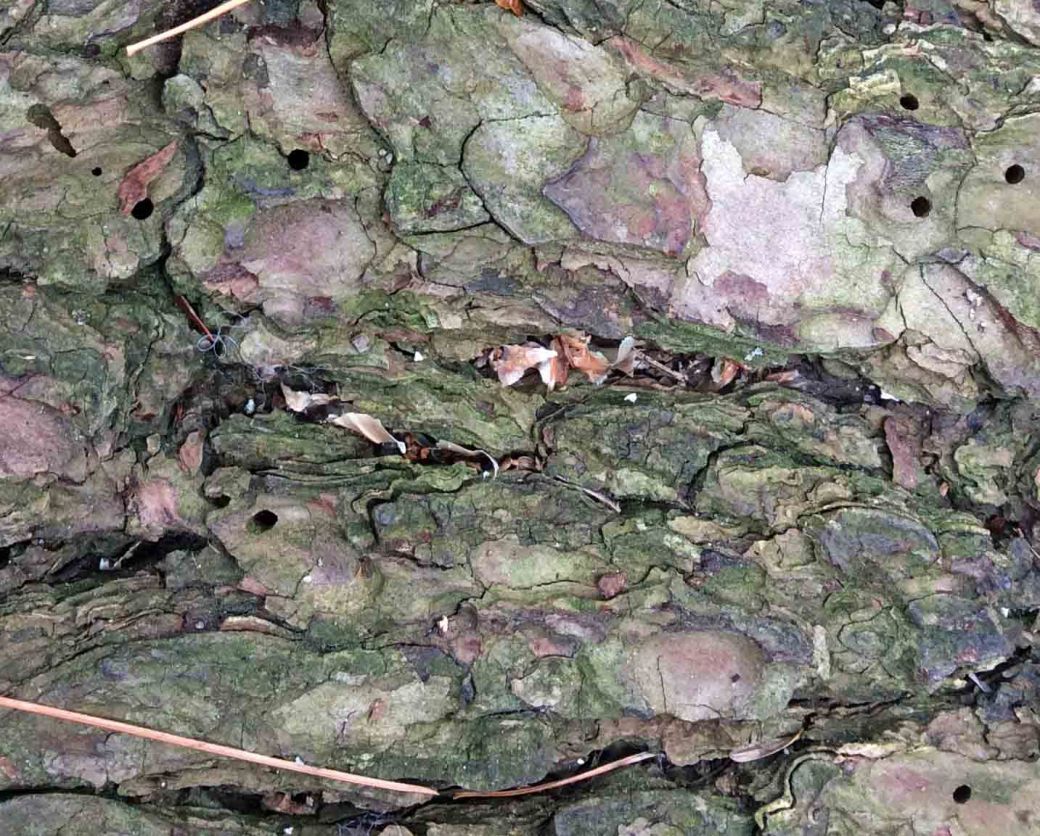
Beetle bore holes pine log

White pine bark scales with tiny beetle bore holes, Little Rouge, ON (photo by Nina Munteanu)
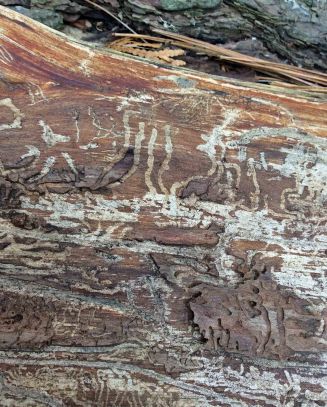
larval tracks in pine wood

Beetle larval tracks in pine sapwood (photo by Nina Munteanu)

Nearby, another giant pine stands tall in the forest. Its roughly chiselled bark is dusted in lichens, moss and fungus. The broad thick ridges of the bark seem arranged like in a jigsaw puzzle with scales that resemble metal plates. They form a colourful layered mosaic of copper to gray and greenish-gray. At the base of the tree, I notice that some critter has burrowed a home in a notch between two of the pine’s feet. Then just around the corner, at the base of a cedar, I spot several half-eaten black walnuts strewn in a pile—no doubt brought and left there by some hungry and industrious squirrel who prefers to dine here.

The forest is littered with snags and fallen trees in different stages of breakdown, decomposition and decay. I spot several large cedar, pine, oak and maple snags with woodpecker holes. The snags may remain for many decades before finally falling to the ground.

Fallen Heroes, Mother Archetypes & Saprophyte Characters

WoodpeckerHole on cedar

Woodpecker hole in a snag (photo by Nina Munteanu)

The forest ecosystem supports a diverse community of organisms in various stages of life and death and decay. Trees lie at the heart of this ecosystem, supporting a complex and dynamic cycle of evolving life. Even in death, the trees continue to support thriving detrivore and saprophytic communities that, in turn, provide nutrients and soil for the next generation of living trees. It’s a partnership.

Decomposition and decay are the yin to the yang of growth, writes Trees for Life; and together they form two halves of the whole that is the closed-loop cycle of natural ecosystems.

Snags and rotting logs on the forest floor provide damp shelter and food for many plants and animals. Most are decomposers, including earthworms, fungi, and bacteria. As the wood decays, nutrients in the log break down and recycle in the forest ecosystem. Insects, mosses, lichens, and ferns recycle the nutrients and put them back into the soil for other forest plants to use. Dead wood is an important reservoir of organic matter in forests and a source of soil formation. Decaying and dead wood host diverse communities of bacteria and fungi.
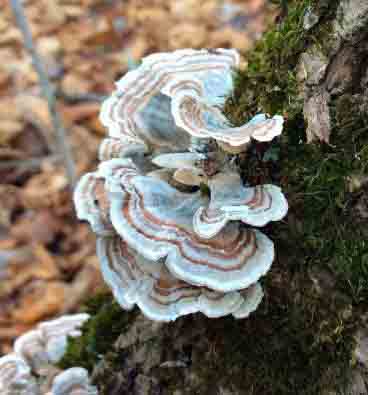
TurkeyTail fungus on tree-LR

Turkey tail fungus, Little Rouge woodland (photo by Nina Munteanu)

Mother Archetypes

Wood tissues of tree stems include the outer bark, cork cambium, inner bark (phloem), vascular cambium, outer xylem (living sapwood), and the inner xylem (non-living heartwood). The outer bark provides a non-living barrier between the inner tree and harmful factors in the environment, such as fire, insects, and diseases. The cork cambium (phellogen) produces bark cells. The vascular cambium produces both the phloem cells (principal food-conducting tissue) and xylem cells of the sapwood (the main water storage and conducting tissue) and heartwood.

stages of tree life

Forest ecologists defined five broad stages in tree decay, shown by the condition of the bark and wood and presence of insects and other animals. The first two stages evolve rapidly; much more time elapses in the later stages, when the tree sags to the ground. These latter stages can take decades for the tree to break down completely and surrender all of itself back to the forest. A fallen tree nurtures, much like a “mother” archetype; it provides food, shelter, and protection to a vast community—from bears and small mammals to salamanders, invertebrates, fungus, moss and lichens. This is why fallen trees are called “nursing logs.”

uprooted stump carbon cushion fungus

Uprooted tree covered in fungi, lichen and moss, Little Rouge, ON (photo by Nina Munteanu)


Heralds, Tricksters and Enablers
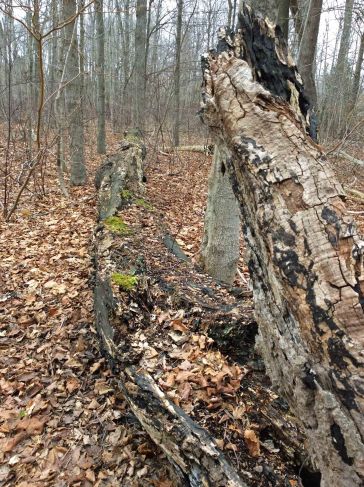
rotting maple log2

Rotting maple log (photo by Nina Munteanu)

I stop to inspect another fallen tree lying on a bed of decaying maple, beech and oak leaves. When a fallen tree decomposes, unique new habitats are created within its body as the outer and inner bark, sapwood, and heartwood decompose at different rates, based in part on their characteristics for fine dining. For instance, the outer layers of the tree are rich in protein; inner layers are high in carbohydrates. This log—probably a sugar maple judging from what bark is left—has surrendered itself with the help of detrivores and saprophytes to decomposition and decay. The outer bark has mostly rotted and fallen away revealing an inner sapwood layer rich in varied colours, textures and incredible patterns—mostly from fungal infestations. In fact, this tree is a rich ecosystem for dozens of organisms. Wood-boring beetle larvae tunnel through the bark and wood, building their chambers and inoculating the tree with microbes. They open the tree to colonization by other microbes and small invertebrates. Slime molds, lichen, moss and fungi join in. The march of decay follows a succession of steps. Even fungi are followed by yet other fungi in the process as one form creates the right condition for another form.

rotting maple log

Rotting maple log, covered in carbon cushion fungus, Little Rouge, ON (photo by Nina Munteanu)

Most hardwoods take several decades to decompose and surrender all of themselves back to the forest. In western Canada in the westcoast old growth forest, trees like cedars can take over a hundred years to decay once they’re down. The maple log I’m studying in this Carolinian forest looks like it’s been lying on the ground for a while, certainly several years. The bark has fragmented and mostly fallen away, revealing layers of sapwood in differing stages of infestation and decay. Some sapwood is fragmented and cracked into blocks and in places looks like stacked bones.

Black lines as though drawn by a child’s paintbrush flow through much of the sapwood; these winding thick streaks of black known as “zone lines” are in fact clumps of dark mycelia, which cause “spalting,” the colouration of wood by fungus. According to mycologist Jens Petersen, these zone lines prevent “a hostile takeover by mycelia” from any interloping fungi. Most common trees that experience spalting include birch, maple, and beech. Two common fungi that cause spalting have colonized my maple log. They’re both carbon cushion fungi.

Spalting

Spalting through zone lines by carbon cushion fungus, Little Rouge, ON (photo by Nina Munteanu)

hypoxylon-close

Hypoxylon fungus (photo N. Munteanu)

Brittle cinder (Kretzschmaria deusta) resembles burnt wood at maturity. Deusta means “burned up” referring to the charred appearance of the fungus. Hypoxylon forms a “velvety” grey-greenish cushion or mat (stroma). As the Hypoxylon ages, it blackens and hardens and tiny, embedded fruitbodies (perithecia) show up like pimples over the surface of the crust.

Blue-green fungus on log

Green and Blue Stain fungus (photo N. Munteanu)

Much of the exposed outer wood layer looks as though it has been spray painted with a green to blue-black layer. The “paint” is caused by the green-stain fungus (Chlorociboria) and blue-stain fungus (Ceratocystis). The blue-green stain is a metabolite called xylindein. Chlorociboria and Ceratocystis are also spalter fungi, producing a pigment that changes the color of the wood where they grow. While zone lines that create spalting don’t damage wood, the fungus responsible most likely does.

Spalting is common because of the way fungi colonize, in waves of primary and secondary colonizers. Primary colonizers initially capture and control the resource, change the pH and structure of the wood, then must defend against the secondary colonizers now able to colonize the changed wood.

Intarsia using blue-green spalted wood

Details of 16th century German bureaus containing blue-green spalted wood by the elf-cup fungus Chlorociboria aeruginascens

Wood that is stained green, blue or blue-green by spalting fungi has been and continues to be valued for inlaid woodwork. In an article called “Exquisite Rot: Spalted Wood and the Lost Art of Intarsia” Daniel Elkind writes of how “the technique of intarsia–the fitting together of pieces of intricately cut wood to make often complex images–has produced some of the most awe-inspiring pieces of Renaissance craftsmanship.” The article explores “the history of this masterful art, and how an added dash of colour arose from the most unlikely source: lumber ridden with fungus.”

Shapeshifting Characters

moss hiding under leaves

Moss in forest litter (photo by Nina Munteanu)

I find moss everywhere in the forest, including beneath the forest floor. Moss is a ubiquitous character, adapting itself to different situations and scenarios. Like a shapeshifter, moss is at once coy, hiding beneath rotting leaf litter, stealthy and curious as it creeps up the feet of huge cedars, and exuberant as it unabashedly drapes itself over every possible surface such as logs, twigs and rocks, and then proceeds to procreate for all to see.

Moss is a non-vascular plant that helps create soil; moss also filters and retains water, stabilizes the ground and removes CO2 from the atmosphere. Science tells us that mosses are important regulators of soil hydroclimate and nutrient cycling in forests, particularly in boreal ecosystems, bolstering their resilience. Mosses help with nutrient cycling because they can fix nitrogen from the air, making it available to other plants.

Moss with spores water drops2

Green moss gametophyte with sporophytes growing out of it (photo by Nina Munteanu)

Mosses thrive in the wet winter and spring, providing brilliant green to an otherwise brown-gray environment. Even when covered in snow (or a bed of leaves), moss continues its growth cycle, usually in the leafy gametophyte stage. When the winter is moderate, like it is near Toronto, sporophyte structures can already appear on stalks that hold a capsule full of spores.  In the spring the capsules release spores that can each create a new moss individual. Moss is quietly, gloriously profligate.

Symbiotic Characters

Many twigs strewn on the leaf-covered forest floor are covered in grey-green lichen with leaf-like, lobes. On close inspection, the lichen thallus contains abundant cup-shaped fruiting bodies. I identify the lichen as Physchia stellaris, common and widespread in Ontario and typically pioneering on the bark of twigs—especially of poplars, and alders.
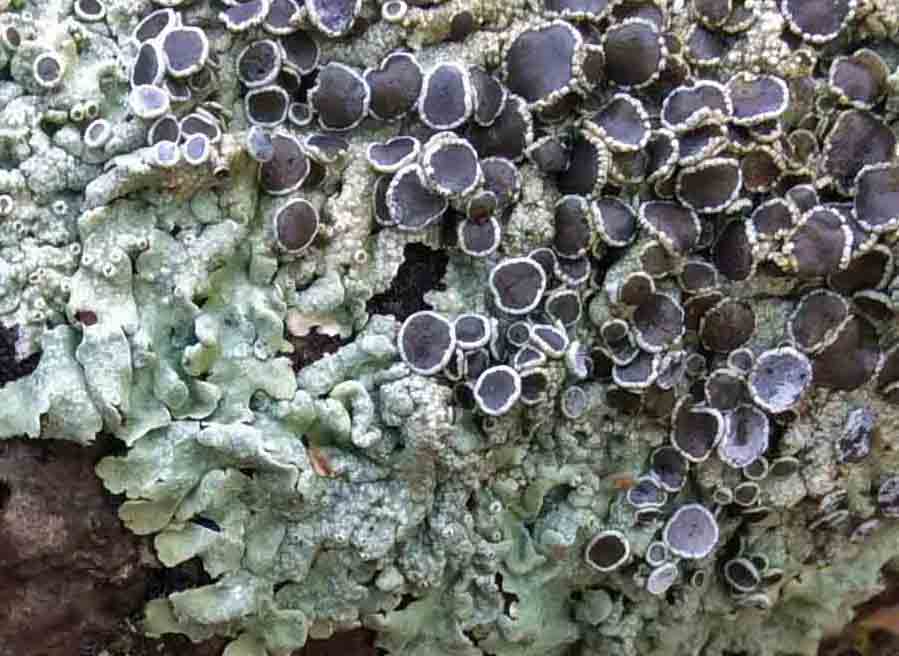
Lichen fruiting-best-2 copy

Physchia stellaris lichen with fruiting bodies (apothecia), Little Rouge, ON (photo by Nina Munteanu)

Lichens are a cooperative character; two characters in one, really. Lichens are a complex symbiotic association of two or more fungi and algae (some also partner up with a yeast). The algae in lichens (called phycobiont or photobiont) photosynthesize and the fungus (mycobiont) provides protection for the photobiont. Both the algae and fungus absorb water, minerals, and pollutants from the air, through rain and dust. In sexual reproduction, the mycobiont produces fruiting bodies, often cup-shaped, called apothecia that release ascospores. The spores must find a compatible photobiont to create a lichen. They depend on each other for resources—from food to shelter and protection.

Forest as Character
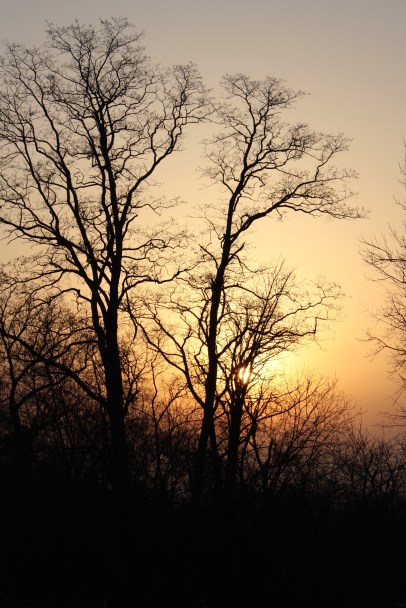
Sunset 1 Niagara

Sunset in Niagara on the Lake (photo by Nina Munteanu)

In Far from the Madding Crowd, Thomas Hardy personified trees as interpreters between Nature and humanity: from the “sobbing breaths” of a fir plantation to the stillness of trees in a quiet fog, standing “in an attitude of intentness, as if they waited longingly for a wind to come and rock them.” Trees, meadows, winding brooks and country roads were far more than back-drop for Hardy’s world and his stories. Elements of the natural world were characters in their own right that impacted the other characters in a world dominated by nature.

Place ultimately portrays what lies at the heart of the story. Place as character serves as an archetype that story characters connect with and navigate in ways that depend on the theme of the story, particularly in allegories that rely strongly on metaphor. A story’s theme is essentially the “so what part” of the story. What is at stake for the character on their journey. Theme is the backbone—the heart—of the story, driving characters to journey through time and place toward some kind of fulfillment. There is no story without theme. And there is no theme without place.
—excerpted from The Ecology of Story: World as Character


nina-2014aaa

Nina Munteanu is a Canadian ecologist / limnologist and novelist. She is co-editor of Europa SF and currently teaches writing courses at George Brown College and the University of Toronto. Visit www.ninamunteanu.ca for the latest on her books. Nina’s bilingual “La natura dell’acqua / The Way of Water” was published by Mincione Edizioni in Rome. Her non-fiction book “Water Is…” by Pixl Press (Vancouver) was selected by Margaret Atwood in the New York Times ‘Year in Reading’ and was chosen as the 2017 Summer Read by Water Canada. Her novel “A Diary in the Age of Waterwill be released by Inanna Publications (Toronto) in June 2020.


Dreams and Perceptions…And ‘The Other’

Credit Riv path in snow

path along Credit River (photo by Nina Munteanu)

It was a while ago, as I was driving home from a friend’s place in the sultry dark of night that I noticed the change…

Perhaps it was the rain and the winding road that nudged my psyche to wander into that other realm. Or was it the surrealistic motion picture The Fountain that I’d seen the evening before? Or had it more to do with the fact that I’d been, for various reasons, without sleep for over forty hours that I glimpsed the ordinary in an extra-ordinary light?

Light had everything to do with it…Amber traffic lights at a construction site pulsed like living things. Smoky back-lit clouds billowed over an inky sky. A garish screen of trees, caught in the beams of my car lights as I turned a corner, flashed. Nature recast. A half-built apartment building loomed up like some dark tower in Lord of the Rings. I was reminded of a scene early on in The Fountain where the viewer is disoriented initially by a busy street at night because it was shot upside down. Ironically, the picture was filmed in my hometown of Montreal and I didn’t even recognize it.

Have you ever done that? Looked backward while driving through a familiar scene to gain a different perspective? And felt different for just a moment? Like you’d briefly entered a different dimension and glimpsed “the other”?

What is it like to meet “the other”?

What is it like to approach the unfamiliar? A new landscape. A stranger in town. A different culture. An “alien” encounter. How do we react? Is it with wonder? Curiosity? Fear? Hatred? A mixture of these?

The genre of science fiction vividly explores our humanity through our reactions to “the other.” It does this by looking at both perspectives. By describing “the other,” science fiction writers describe “us.” In his book Orientalism: Western Conceptions of the Orient Edward W. Said contended that for there to be an ‘us’, there has to be a ‘not-us.’ According to Patricia Kerslake of Central Queensland University, this arises from a postcolonial notion of ‘the Other’, through a mutual process of exclusion. This exclusion inspires the very idea of ‘alien’ by imposing expectation on perception. Kerslake argues that: “When one culture imposes its perceptions on another, in that it begins to see the Other not as they are but as, in Said’s words, ‘they ought to be’, then the process of representation becomes inevitable: a choice is made to see a ‘preferred’ real.”

Ursula K LeGuin

Ursula K. LeGuin

In her 1975 article “American SF and the Other,” Ursula K. LeGuin unequivocally scolded the Western SF genre for representing and promoting colonialism and androcratic motives.

One of the great early socialists said that the status of women in a society is a pretty reliable index of the degree of civilization of that society. If this is true, then the very low status of women in SF should make us ponder about whether SF is civilized at all.

The women’s movement has made most of us conscious of the fact that SF has either totally ignored women, or presented them as squeaking dolls subject to instant rape by monsters—or old-maid scientists de-sexed by hypertrophy of the intellectual organs—or, at best, loyal little wives or mistresses of accomplished heroes. Male elitism has run rampant in SF. But is it only male elitism? Isn’t the “subjection of women” in SF merely a symptom of a whole which is authoritarian, power-worshiping, and intensely parochial?

The question involved here is the question of The Other—the being who is different from yourself. This being can be different from you in its sex; or in its annual income; or in its way of speaking and dressing and doing things; or in the color of its skin, or the number of its legs and heads. In other words, there is the sexual Alien, and the social Alien, and the cultural Alien, and finally the racial Alien.

Well, how about the social Alien in SF? How about, in Marxist terms, “the proletariat”? Where are they in SF? Where are the poor, the people who work hard and go to bed hungry? Are they ever persons, in SF? No. They appear as vast anonymous masses fleeing from giant slime-globules from the Chicago sewers, or dying off by the billion from pollution or radiation, or as faceless armies being led to battle by generals and statesmen. In sword and sorcery they behave like the walk-on parts in a high school performance of The Chocolate Prince. Now and then there’s a busty lass amongst them who is honored by the attentions of the Captain of the Supreme Terran Command, or in a space-ship crew there’s a quaint old cook, with a Scots or Swedish accent, representing the Wisdom of the Common Folk.

The people, in SF, are not people. They are masses, existing for one purpose: to be led by their superiors…

…What about the cultural and the racial Other? This is the Alien everybody recognizes as alien, supposed to be the special concern of SF. Well, in the old pulp SF, it’s very simple. The only good alien is a dead alien—whether he is an Aldebaranian Mantis-Man, or a German dentist. And this tradition still flourishes: witness Larry Niven’s story “Inconstant Moon” (in All the Myriad Ways, 1941) which has a happy ending—consisting of the fact that America, including Los Angeles, was not hurt by a solar flare. Of course a few million Europeans and Asians were fried, but that doesn’t matter, it just makes the world a little safer for democracy, in fact. (It is interesting that the female character in the same story is quite brainless; her only function is to say Oh? and Ooooh! to the clever and resourceful hero.)

If you deny any affinity with another person or kind of person, if you declare it to be wholly different from yourself—as men have done to women, and class has done to class, and nation has done to nation—you may hate it, or deify it; but in either case you have denied its spiritual equality, and its human reality. You have made it into a thing, to which the only possible relationship is a power relationship. And thus you have fatally impoverished your own reality.

You have, in fact, alienated yourself.

Diary Water cover finalWritten 45 years ago, Le Guin’s scathing article may have accurately represented the North American science fiction community of writers of that time. Today, despite the remnants of a strong old guard that still promotes a patriarchal colonialist hegemony, the science fiction genre has matured and grown beyond this self-limiting view. This is partly because current authors—many who are women and many who are representatives of minority or marginalized groups—have given SF a new face and voice that promises to include equality, inclusion, and a fresh look at exploration and ‘the other.’

The genre of science fiction has matured by diversifying to embrace “mundane science fiction,” literary fiction, speculative fiction, climate fiction, cli-fi, eco-fiction, indigenous futurisms and more.

memoryofwaterScience fiction that leans toward “mundane”(everyday life) and literary fiction include the works of Paulo Bacigalupi (Windup Girl), Margaret Atwood (Year of the Flood), and Kim Stanley Robinson (New York 2140). Literary fiction overlaps with science fiction through eco-fiction and climate fiction which address oppression, jingoism and neoliberalism often through dystopian themes—and often through the voice of women writers—such as Octavia Butler’s Parable of the Sower, N.K. Jemisin’s The Broken Earth series, Emmi Itäranta’s The Memory of Water, Nina Munteanu’s A Diary in the Age of Water, Barbara Kingsolver’s Flight Behavior, Annie Proulx’s Barkskins, and Richard Power’s Overstory.

CliFi Tales of ClimateChangeIn 2017, several publications addressed different aspects of society through speculative fiction.  Laksa Media published Strangers Among Us: Tales of the Underdogs and Outcasts, which explores issues of mental health. Exile Editions published Cli-Fi: Tales of Climate Change with stories on personal experience with climate change. Reality Skimming Press published Water, for which I was editor, which explored optimism in the face of climate change.

In Ann Leckie’s 2014 Ancillary Justice, the main character is a space ship. The Gethenians in Ursula K. LeGuin’s The Left Hand of Darkness are humanoids with fluid gender, adapted to environment. In Kim Stanley Robinson’s 2312,  humans have abandoned the gender binary for an intersex existence based on proven longevity.

Borderline mishell bakerNovels and anthologies of short stories that feature disabled characters are also growing. Examples include Borderline by Mishell Baker, We Who Are About To… by Joanna Russ, Murderbot series by Martha Wells, and Uncanny: Disabled People Destroy Science Fiction (edited by Elsa Sjunneson-Henry, Dominik Parisien et al.) among many others.

Indigenous futurisms, speculative writings on issues of colonialism, identity, AI, and climate change include Trail of Lightning by Rebecca Roanhorse, Mongrels by Stephen Graham Jones, Robopocalypse by Daniel H. Wilson, Take Us to Your Chief, by Drew Hayden Taylor, The Marrow Thieves by Cherie Dimaline, Walking the Clouds Anthology edited by Grace L. Dillon, and Future Home of the Living God by Louise Erdrich.

Trail of LightningIn an introduction to seven Indigenous Futurism books, Barnes and Noble writes:

So many stories, well intentioned and not-so-well-intentioned, have fixated on the dark pasts of Indigenous people, assuming that colonization stole from them any future not involving slow decline and assimilation. Though there’s plenty of tragedy to be recounted, Indigenous history didn’t end there, and a wave of modern authors are exploring Indigenous cultures as living, vibrant, and firmly fixed in both the modern and furute worlds—sovereign nations with as much claim to an endless array of possible futures as any other culture. So much of what we call classic science fiction involves tropes that look very different to colonized peoples: the heroic space explorers who travel the stars visiting (and often conquering) alien worlds look very different to people whose histories are so strongly marked by the scars of colonization.

Of Indigenous Futurisms, the Seattle Public Library writes:

Indigenous Futurisms confront many of the norms of speculative fiction by challenging, subverting, or refusing to engage with colonial, racist, and otherwise oppressive genre tropes. Indigenous Futurism draws on the strength of Indigenous knowledge systems, worldviews, stories, languages, and traditions to reimagine the past, present, and future of this world and others. Yet it is not necessarily utopic or optimistic. Many authors writing within the Indigenous Futurisms genre engage with the realities of ongoing colonialism around the world, and the apocalyptic nature of the present for many Indigenous communities. However, characters struggle despite the circumstances for a better future.


Credit River first snow

First snow on the Credit River (photo by Nina Munteanu)

nina-2014aaa

Nina Munteanu is a Canadian ecologist / limnologist and novelist. She is co-editor of Europa SF and currently teaches writing courses at George Brown College and the University of Toronto. Visit www.ninamunteanu.ca for the latest on her books. Nina’s bilingual “La natura dell’acqua / The Way of Water” was published by Mincione Edizioni in Rome. Her non-fiction book “Water Is…” by Pixl Press (Vancouver) was selected by Margaret Atwood in the New York Times ‘Year in Reading’ and was chosen as the 2017 Summer Read by Water Canada. Her novel “A Diary in the Age of Waterwill be released by Inanna Publications (Toronto) in June 2020.

Author’s Retreat: Changing the World with Your Mind and Faith

Snow hoar frost

Hoar frost-covered snow pillows, near Manning Park, B.C. (photo by Nina Munteanu)

Some time ago I went on an author’s retreat at my friend’s cabin near Manning Park in British Columbia. Some of them were going skiing at the nearby ski hill and Anne thought I’d appreciate the rustic setting as an ideal place to write. I leapt at the chance. I had lots of writing to do and had set myself up for quite a work schedule: I’d promised ten articles and some excerpts to my publisher, three articles to the online magazine I write for, a review of my manuscript contract with my other publisher, and to write as much as possible on my prequel.

zermatt-hut01

Zermatt in winter (photo by Nina Munteanu)

I’d set myself up for quite a work schedule…Hey, didn’t I say that already?…There was no internet access at the cabin. In fact, no cell phone coverage either. We were pretty isolated from the rest of the world—except for the bustling ski hill not far from us…

Then my computer refused to work…

The ski hill beckoned…

The snowshoes came out…

The sun blazed…

And the hoarfrost on the frozen lake sparkled like jewels in the snow…

…My promise to myself to write melted like giant snow crystals in the sun as I indulged in outdoor walks and diverting conversations with my friend, Anne.

Later in the evening, after the boys finally got the fire going, Anne and I got to talking about the book I’d leant her—Calculating God, by Robert J. Sawyer. We were soon discussing God and faith; what it meant to have faith in oneself and in others and ultimately what it meant to have someone show faith in you.

After returning from Manning, I ran across an article in Time that featured Dr. Andrew Newberg (professor of radiology, psychology and religious studies at the University of Pennsylvania) who’d recently authored the book, How God Changes Your Brain. What I found incredibly interesting was the connection made between faith and well-being.

manning-nina

Nina Munteanu explores with friend Kai near Manning Park

According to Newberg and other neuroscientists, when people engage in prayer or meditation they engage the frontal lobes of the brain, since they govern focus and concentration. In fact, if you pray or meditate long enough you may change your brain permanently; creating thicker frontal lobes. “People who describe themselves as highly spiritual tend to exhibit an asymmetry in the thalamus—a feature that other people can develop after just eight weeks of training in meditation skills,” says Newberg. Better functioning frontal lobes help boost memory, by the way.

manning-anne-angel

Angel-winged Anne fishes for a treat for her black lab

That faith can play a key role in how our mind and body regulate our general health and determine our own well-being is proven in experiments involving “placebos”. First described in the medical literature in the 1780s, the placebo effect has been documented in some amazing examples of mind-over-matter. Time writer Jeffrey Kluger in his February 23, 2009 article “The Biology of Belief” describes how Parkinson’s disease patients who underwent a sham surgery that they were told would boost the low dopamine levels responsible for their symptoms actually experienced a dopamine bump. Newberg described a cancer patient who regulated his tumors based on his belief of a drug’s efficacy (his tumor shrank).

manning-shrub

Hoar-frost covered shrub

In a post about Brain-Mind-Interfaces (BMI) on The Alien Next Door, I discussed the notion of using our minds to control computers and robots either inside us or close to us and the current technology that is making that possible. Then my good friend, Margaret, told me about this workshop on neurotherapy that she’d attended given by a Dr. Paul Swingle in Vancouver. “He uses biofeedback for the brain to treat attention deficit and hyperactivity

manning-hoer frost-close

Hoar frost covered buds

disorders, epilepsy, anxiety, migraine, trauma, and depression,” says Margaret. “It’s all based on the idea that we can control our brain activity and that through training, the brain can learn to modify its own electrical patterns for more efficient processing or to overcome various states of dysfunction.”


Neal Krause, a sociologist and public health expert at the University of Michigan, found that people who maintain a sense of gratitude for what’s going right in their lives have a reduced incidence of depression. In another study, he found that people who believe their lives have meaning live longer than people who don’t. Victor Frankl could have told him that!

p.s. speaking of belief, I got all my writing done in the end! My computer decided to behave itself and I got very productive…especially after the chocolate cake.

zermatt-alps03

Zermatt Alps (photo by Nina Munteanu)


nina-2014aaa

Nina Munteanu is a Canadian ecologist / limnologist and novelist. She is co-editor of Europa SF and currently teaches writing courses at George Brown College and the University of Toronto. Visit www.ninamunteanu.ca for the latest on her books. Nina’s bilingual “La natura dell’acqua / The Way of Water” was published by Mincione Edizioni in Rome. Her non-fiction book “Water Is…” by Pixl Press (Vancouver) was selected by Margaret Atwood in the New York Times ‘Year in Reading’ and was chosen as the 2017 Summer Read by Water Canada. Her novel “A Diary in the Age of Waterwill be released by Inanna Publications (Toronto) in June 2020.

Age of Water Podcast: Interview with Candas Jane Dorsey

CandasJaneDorsey

Candas Jane Dorsey with a friend

AoW Logo-smallWe are now living in the Age of Water. Water is the new “gold”, with individuals, corporations and countries positioning themselves around this precious resource. Water is changing everything. The Age of Water Podcast covers anything of interest from breaking environmental news to evergreen material. This also includes human interest stories, readings of eco-literature, discussion of film and other media productions of interest.

Join the discussion!

In this episode of Age of Water, we join award-winning Canadian author Candas Jane Dorsey in Calgary, Alberta, where she talks about “Ice and other stories”, teaching at university, what eco-fiction means, and how writers can be “sneaky.”


CandasJaneDorsey2

Candas Jane Dorsey

CanCandas Jane Dorsey is an award-winning Canadian author of novels, short stories, and poetry. She also served as editor / publisher of several literary presses.

Ice by CandasJaneDorseyShe is best known for her science fiction writing including the novels Black Wine and A Paradigm of Earth, and has also published poetry and short stories, including her well-known short-story collection Machine Sex: And Other Stories. Her latest collection of short stories Ice and other Short Stories spans thirty years of writing. Candas teaches writing and communications at MacEwan University. She was founding president of SF Canada and was president of the Writers Guild of Alberta. Candas was awarded the Province of Alberta Centennial Gold Medal award for artistic achievement and community work and the WGA Golden Pen Award for Lifetime Achievement in the Literary Arts.


DS-2008-16 copy

Nina Munteanu kayaks in Desolation Sound, British Columbia (photo by H. Klassen)


nina-2014aaa

Nina Munteanu is a Canadian ecologist / limnologist and novelist. She is co-editor of Europa SF and currently teaches writing courses at George Brown College and the University of Toronto. Visit www.ninamunteanu.ca for the latest on her books. Nina’s bilingual “La natura dell’acqua / The Way of Water” was published by Mincione Edizioni in Rome. Her non-fiction book “Water Is…” by Pixl Press (Vancouver) was selected by Margaret Atwood in the New York Times ‘Year in Reading’ and was chosen as the 2017 Summer Read by Water Canada. Her novel “A Diary in the Age of Waterwill be released by Inanna Publications (Toronto) in June 2020.