“I am Planta: On the Line, in Vancouver, British Columbia, at TheCommentary.ca.
Nina Munteanu joins me again. She has just published a new novel, A Diary in the Age of Water. The noted writer and limnologist, a freshwater scientist, has written a book that could be considered science fiction. I suppose ‘cli-fi’ is the better term, climate-based science fiction. In the book, far away in a post-climate change world, Kyo finds a diary that gives her insight into the world before water scarcity. I’ll get Nina to tell us about Kyo, about the themes in this book, especially the world ahead if we continue as we do. Nina Munteanu is an author and ecologist. She has published many books of science fiction and fantasy, and was first on the program in 2016 when her book Water Is… The Meaning of Water was published. The website for more is at www.ninamunteanu.ca. This new book is from Inanna Publications. Please welcome back to the Planta: On the Line program, Nina Munteanu; Ms. Munteanu, good morning…”
NINA MUNTEANU is a Canadian ecologist / limnologist and novelist. She is co-editor of Europa SF and currently teaches writing courses at George Brown College and the University of Toronto. Visit www.ninamunteanu.ca for the latest on her books. Nina’s bilingual “La natura dell’acqua / The Way of Water” was published by Mincione Edizioni in Rome. Her non-fiction book “Water Is…” by Pixl Press(Vancouver) was selected by Margaret Atwood in the New York Times ‘Year in Reading’ and was chosen as the 2017 Summer Read by Water Canada. Her novel “A Diary in the Age of Water” was released by Inanna Publications (Toronto) in June 2020.
I recently gave a talk at Orchard Park Secondary School during their “Eco Crawl” week. “Eco crawl is a cross curricular initiative promoting environmental awareness, natural conservation, and well-being,” says Teresa Grainger, Library Learning Commons Technician at the school. The “week long initiative will include animal visitors, presentations, displays, and outdoor activities. We like to involve as many departments as possible.”
The school invited me to participate with a presentation. I spoke about my work as a writer and as a scientist, how I was inspired to write eco-fiction and a little about the process of how I started. I shared the challenges I faced and my victories. I also spoke about the importance of eco-fiction as narrative and the importance of storytelling generally to incite interest, bring awareness and ultimately action.
The word is a powerful tool. And the stories that carry them are vehicles of change.
Here is some of that talk:
My story begins with the magic of water, Quebec water … I was born in a small town in the Eastern Townships of Quebec, a gently rolling and verdant farming community, where water bubbles and gurgles in at least two languages.
Pastoral Eastern Townships and Granby, Quebec; Nina Munteanu as a child
.
I spent a lot of my childhood days close to the ground, observing, poking, catching, destroying and creating. Perhaps it was this early induction to the organic fragrances of soil, rotting leaves and moss that set my path in later life as a limnologist, environmental consultant and writer of eco-fiction.
My mother kept a garden in our back yard that she watered mostly with rain she collected in a large barrel out back. I remember rows of bright dahlias with their button-faces and elegant gladiolas of all colours, tall like sentinels. And, her gorgeous irises.
In the winter, my mother flooded the garden to create an ice rink for the neighbourhood to use for hockey. Somehow, I always ended up being the goalie, dodging my brother’s swift pucks to the net. I got good at dodging—probably a useful life skill in later life…
Our dad frequently took us to the local spring just outside town. We walked a few miles up Mountain Road to an unassuming seepage from a rock outcrop with a pipe attached to it by the local farmer. I remember that the water was very cold. Even the air around the spring was cooler than the surrounding air. I remember that the spring water tasted fresh and that the ice it formed popped and fizzed more than tap water.
I followed my older brother and sister to the nearby forest and local river. We stirred soil, flower petals and other interesting things with water to fuel “magic potions” then told wild stories of mayhem and adventure. I became a storyteller. My passion for storytelling eventually morphed into writing; but, the underlying spark came through environmental activism.
.
In early high school, during the mid-60s, I became an environmental activist, putting up posters and writing in the school paper. I wrote letters to industry and politicians, trying to incite interest in being good corporate citizens and promoting global environmental action. I remember a well-meaning teacher chiding me for my extravagant worldview. “Stick to little things and your community—like recycling,” he suggested patronizingly. I remember the shock of realizing that not everyone felt the planet like I did. Perhaps it was a teenage-thing, or a girl-thing, or a nina-thing. I prayed it wasn’t just a nina-thing…
I started writing stories in high school. Mostly eco-fiction, though I didn’t know that’s what it was at the time. There was no genre called eco-fiction back then. It all went under the umbrella of scifi.
.
I completed my first novel, Caged in World when I was fifteen—in Grade 9—in 1969. Caged in World was a hundred-page speculative story about a world that had moved “inside” to escape the ravages of a post climate-change environment. The eco-novel was about a subway train driver and a data analyst caught in the trap of a huge lie. The story later morphed into Escape from Utopia. Several drafts—and years later—the novel became the eco-medical thriller Angel of Chaos, set in 2095 as humanity struggles with Darwin’s Disease—a mysterious neurological environmental pandemic. Icaria 5 is one of many enclosed cities within the slowly recovering toxic wasteland of North America, and where the protagonist Julie Crane works and lives. The city is run by technocrats, deep ecologists who call themselves Gaians, and consider themselves guardians of the planet. The Gaians’ secret is that they are keeping humanity “inside” not to protect humanity from a toxic wasteland but to protect the environment from a toxic humanity.
Some of the scientific papers, reports and articles I wrote or participated in
.
When I enrolled in college and university, I thought of going into environmental law then decided that I didn’t have the temperament for it and switched to biology. Without realizing it, I put fiction writing on hold while I pursued ecology at university. One professor got me very interested in limnology and it became my focus when I realized that I’d always been fascinated by water. I started out being scared of water—not being a strong swimmer—and the best thing you can do to get over a fear is to study it and understand it. That’s exactly what I did. I did some cool research on stream ecology and published scientific papers, articles and reports. Then I moved to the westcoast to teach limnology at the University of Victoria and do consulting work in aquatic ecology.
So, in a way, I’d gone back to what I loved best as a child—mucking about in nature, spending my days close to the ground, observing, poking, catching, destroying and creating.
Kevin as a toddler
.
In 1991, my son Kevin was born. I felt a miracle pass through me. Kevin became my doorway into wonder. His curiosity was boundless and lured me into a special world of transformation. I took time off work to spend with Kevin when he was young. We went on great trips, from the local mall, where we had a hot chocolate and played with Lego, to the local beach on the Fraser River, where we explored the rocks. When he was no more than three, I took him on endless adventures in the city and its surroundings. We didn’t have to go far. The mud puddles of a new subdivision after a rain were enough to keep our attention for dozens of minutes. We became connoisseurs of mud. The best kind was “chocolate mud,” with a consistency and viscosity that created the best crater when a rock was thrown into it.
Kevin and I often explored the little woodland near our house. We made “magic potions” out of nightshade flowers, fir needles, loam and moss; we fueled our concoctions with the elixir of water from a stagnant pool then told wild stories of mayhem and adventure.
Storytelling kept calling to me. It was the 1990s—twenty years after I finished Angel of Chaos—and I’d published lots of short stories and articles. But no novels.
Some of Nina’s short story publications
I spent several years shopping Angel of Chaos to agents and publishing houses. Although I received many bites, all finally let go. I kept writing short stories, some of which were cannibalized from the book, and several were published; I also wrote Angel’s prequel, The Great Revolution and Angel’s sequel Darwin’s Paradox and shopped them.
Then In 2007, Dragon Moon Press in Calgary made an offer to publish Darwins Paradox; the sequel became my debut novel. Dragon Moon Press later picked up Angel of Choas and published it in 2010 as a prequel. I haven’t stopped publishing books since (with a book pretty much every year), both fiction and non-fiction…including writing guidebooks in my Alien Guidebook Series.
Kevin hiking the mountains of the west coast, BC
My son left the nest to go to university and work and I went on walkabout and eventually left the westcoast, returning to my old home in the east. I did lots of house-sitting in the Maritimes, then ended up teaching at UofT in Toronto.
UofT, west gate to quadrangle of University College, ON (photo by Nina Munteanu)
In 2016, I published Water Is… with Pixl Press in Vancouver. It’s a biography and celebration of water—my attempt to write a lay book on my water science, something that all could appreciate. Turns out that Margaret Atwood really liked it too!
.
On its heels, I got a book deal with Inanna Publications in Toronto for my eco-novel A Diary in the Age of Water. This eco-fiction novel follows the journeys of four generations of women during a time of catastrophic environmental change. The novel explores each woman’s relationship with water, itself an agent of change…
.
Eco-fiction (short for ecological fiction) is a kind of fiction in which the environment—or one aspect of the environment—plays a major role in story, either as premise or as character. For instance, several of my eco-fiction stories give Water a voice as character. In my latest novel,A Diary in the Age of Water, each of the four women characters reflects her relationship with water and, in turn, her view of and journey in a changing world.
In eco-fiction, strong relationships are forged between the major character on a journey and an aspect of their environment and place. Such strong relationship can linger in the minds and hearts of readers, shaping deep and meaningful connections that will often move a reader into action. Our capacity—and need—to share stories is as old as our ancient beginnings. From the Paleolithic cave paintings of Lascaux to our blogs on the Internet, humanity has left a grand legacy of ‘story’ sharing. By providing context to knowledge, story moves us to care, to cherish, and, in turn, to act. What we cherish, we protect. It’s really that simple.
Eco-fiction—whether told as dystopia, post-apocalypse, cautionary tale or hopeful solarpunk—can help us co-create a new narrative, one about how the Earth gifts us with life and how we can give in return. It’s time to start giving.
That starts with story.
NINA MUNTEANU is a Canadian ecologist / limnologist and novelist. She is co-editor of Europa SF and currently teaches writing courses at George Brown College and the University of Toronto. Visit www.ninamunteanu.ca for the latest on her books. Nina’s bilingual “La natura dell’acqua / The Way of Water” was published by Mincione Edizioni in Rome. Her non-fiction book “Water Is…” by Pixl Press(Vancouver) was selected by Margaret Atwood in the New York Times ‘Year in Reading’ and was chosen as the 2017 Summer Read by Water Canada. Her novel “A Diary in the Age of Water” was released by Inanna Publications (Toronto) in June 2020.
I paint not by sight but by faith. Faith gives you sight.
Amos Ferguson
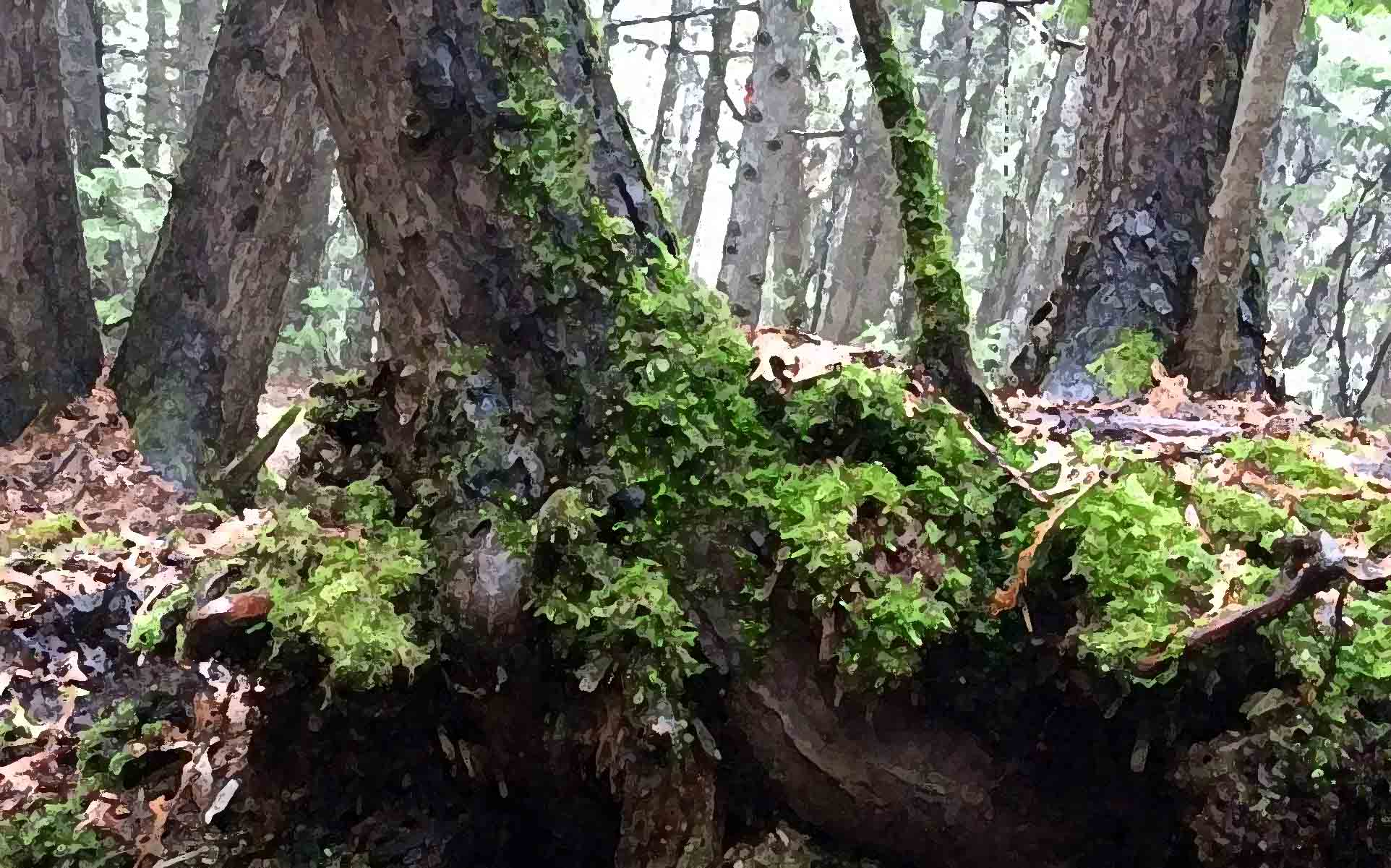
Yellow birch tree and moss-covered roots, Jackson Creek park, ON (photo and rendition by Nina Munteanu)
Doing Research
The appearance of things changes according to the emotions, and thus we see magic and beauty in them, while the magic and beauty are really in ourselves
Kahlil Gibran
Learn more by researching what you write about. This may provide solutions and ideas to help work out difficulties. It will certainly help to increase your interest and learning in the subject areas you’ve written about.
Your journal entries may serve the additional purpose of being a resource for something you later wish to investigate. Say, you had made some interesting entries on the cycles of the moon during a particular cosmic occurrence. You may wish to use these observations later in a school project on that cosmic event. Of course, this underscores the merit of keeping an accurate journal when recording natural phenomena, including date and time.
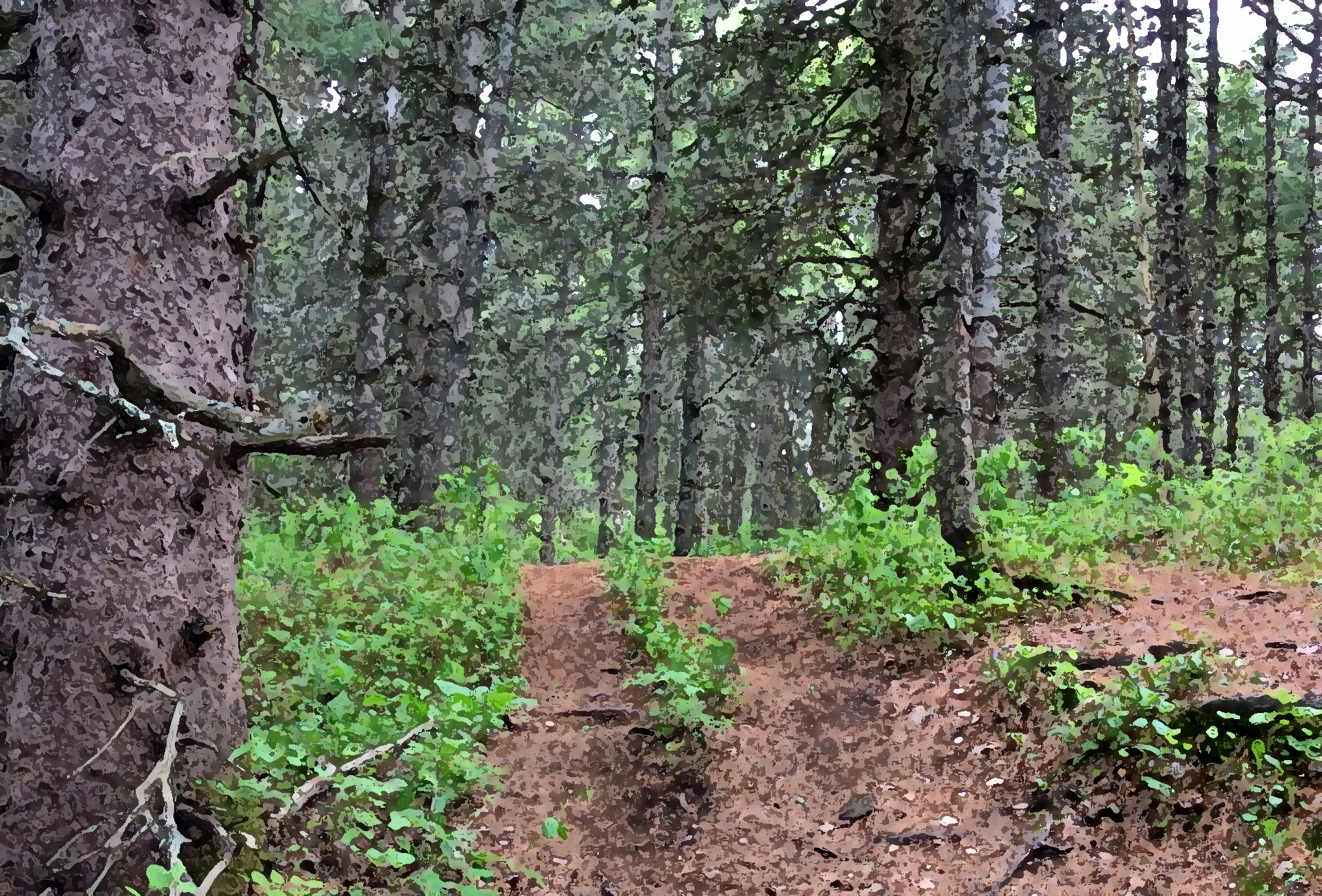
Path through red pine forest, ON (photo and rendition by Nina Munteanu)
Harvest Your Journal
He who knows others is wise; he who knows himself is enlightened
Lao Tzu
One of the real benefits of journal writing is the gift of perspective you get from the flow of ideas, experiences and learning through your journal’s sustained use over a period of time. The more frequent, detailed and honest your entries have been, the more you will get out of them when you revisit your journal to reflect on what you’ve written. This is why daily journaling can be so rewarding. Through the lens of perspective over time, you may begin to see patterns in your activities, reactions and observations that you weren’t aware of before. It’s like Max Planc said about nature: “science cannot solve the ultimate mystery of nature. And that is because, in the last analysis, we ourselves are a part of the mystery that we are trying to solve.” When you step out of the stream you were in and look in from outside, you will gain insight through a new perspective. The payoffs can include galvanizing new ideas, arriving at action items that suddenly make sense, and providing material for making new plans.
Make a point of reading your journals. Often. The three steps in harvesting your journal are: 1) read; 2) ponder; and 3) reread. These three steps can be used as many times as you wish. I would add another optional step too: research. During your revisit, you may find a benefit to researching outside your journal for answers or clarification to ideas and concepts and questions that emerge from your review.
Making sense of your journal takes time. Ken Plummer (2001) tells us that this analysis part in the journaling process is the “truly creative part of the work… It entails brooding and reflecting upon mounds of [information] for long periods of time until it makes sense and feels right, and key ideas and themes flow from it. It is also the hardest process to describe.” He suggests that the standard technique is to read and make notes (and research), leave and ponder (and research), reread without notes, make new notes, ponder (and research), reread and so on. Ideas and glimmers of understanding emerge. You can deepen these through conversation with others and through research (e.g., reading relevant texts, online searches, etc.).
—What is Truth?
Judith Barrington, author of Writing the Memoir, describes factual truth and emotional truth and that they are not necessarily the same thing.
It’s important to acknowledge the emotional truth of events and actions in our lives. How you express and remember an event tells you as much about your state of mind and heart then — and now — as the event itself. Understanding the importance of personal truth in capturing the essence of the events as they pertain to you and your life journey can empower you and can also be revealing.
Cedars growing on ancient decayed cedar logs in swamp forest, ON (photo and rendition by Nina Munteanu)
—Questions To Ask as You Review Your Journal
Here are some basic questions you can ask yourself as you reread your journal:
Do any experiences, situations or understandings stand out for you? What is it about them that is catching your attention?
Does what you have written in your journal still resonate with you? Were you fully honest and do the interpretations you made at the time still make sense? From your present standpoint and understanding, are there items you need to re-interpret?
Is there anything missing? Was there something revealed that you evaded?
Can you see any connection with any broader experience, problem or theme you were/are exploring?
You may wish to eventually use your journal(s), whether personal (mixed) or themed, as a research/resource for development of theories or later projects you may embark on — say, a memoir or a project in school or at work that relates to a theme you covered (e.g., on the subject of recycling that you covered in a journal you kept).
—Making a Themed Index
You may wish to keep the first few pages of your paper journal free to make an index later that will identify 1) particular aspects touched upon in your journal, 2) themes that have revealed themselves and 3) important milestones recognized in your life story.
Making an index for your journal will help you organize your thoughts and feelings over the time period covered. It will also help you find relevant entries more easily later on.
There are many ways to index and code your journal. It helps if you number the pages first. If you are indexing themes (say, anything to do with your friend Alison) — which you may have made entries about not chronologically but chaotically throughout the journal — you can code any relevant page to Alison with a sticky note of a certain colour and refer to that colour in your index alongside your reference to “Alison”. This way, when you wish to come back and revisit those references to do with Alison specifically, you can simply go to those pages coded with that colour.
Underbrush among rocks in swamp cedar forest, ON (photo and rendition by Nina Munteanu)
—Using Metaphor & Personification
Because metaphor compares one thing to another, when you use metaphor you are linking events or things to your personal feelings, which can reveal, heal and provide directions for action. Because metaphor relies on individual comparison and interpretation, it will mean different things to different people. Let’s take the example “the darkness embraced her”. When I wrote that line, I was comparing the darkness to a sweetheart. When I shared the metaphor with my writing students, one of them shared that what first came to her mind was an image of a vampire about to devour her. In my mind the darkness was friendly, safe and warmly thrilling; in my student’s mind the darkness was sinister, scary and suffocating. What’s important is what the metaphor means to you. It will help reveal your feelings at the time you wrote.
Exercise: Compare a person you know to the following: a peacock; a sloth; a dung beetle; a rabbit. What physical and emotional connotations do you get? Take a piece of your own writing and find all the metaphors and similes. Highlight them then interrogate them. What do they say?
Reference: Munteanu, 2009. “The Fiction Writer: Get Published, Write Now!” Pixl Press. 164pp.
Path through maple beech forest, ON (photo and rendition by Nina Munteanu)
—Become a “Connoisseur”
Journals are all about expression and learning from it. They enable us to examine ourselves and our world, analyze, conclude and develop. Learning relies on an element of artistry: the ability to improvise, devise new ways of looking at things, and then act on them in new ways. According to Donald Schőn (1987) such artistry is an exercise of intelligence — a kind of knowing. Through engaging with our experiences we can develop maxims about, say, working or relating to a group or individual. We learn to appreciate — to be aware and to understand — what we have experienced. “We become connoisseurs.” (Eisner, 1998).
According to Eisner (1998) connoisseurship involves the ability to see, not merely to look. This means developing the ability to name and appreciate the different dimensions of situations and experiences, and the way they relate to one another. It means drawing upon and making sense of a wide array of information. It means placing your experiences and understanding in a wider context. And connecting them with your values and commitments. That’s where writing and keeping journals comes in.
—Become a “Critic”
“If connoisseurism is the art of expression, criticism is the art of disclosure” (Eisner, 1998). According to Eisner, the mandate of criticism is the re-education of perception. The task of the critic is to help us see (not just look). In order to learn from what you honestly express, you must don the critic hat and analyze. Think of criticism as the “midwife of perception.” It helps perception come into being, then later refines it so you can learn from it.
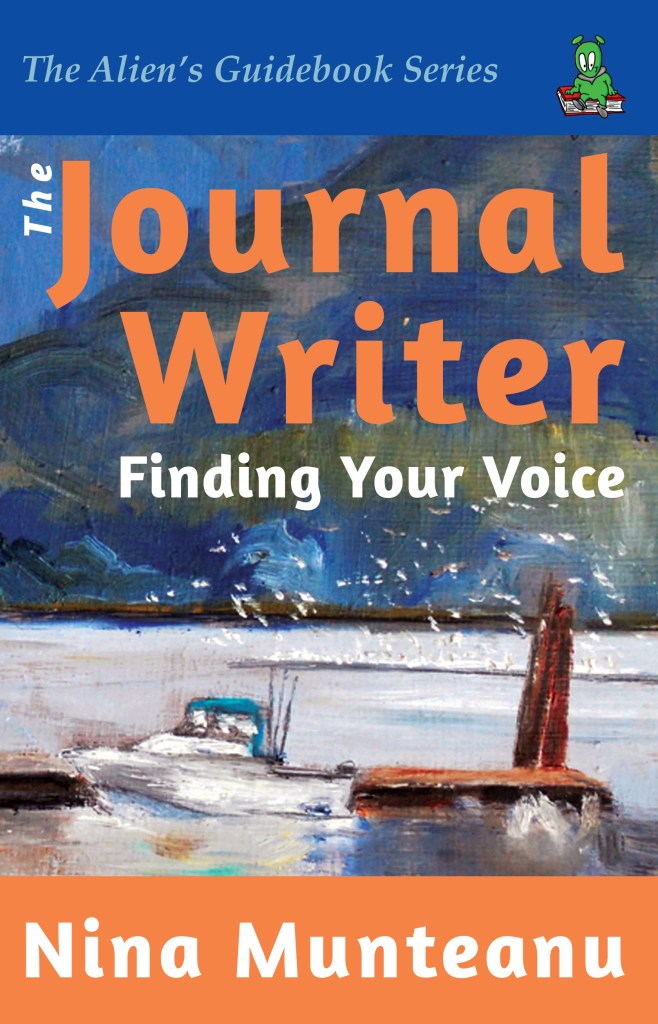
The Journal Writer is the second writing guide in the Alien Guidebook Series. This comprehensive guidebook will help you choose the best medium, style and platform for your expressive writing. The guide provides instruction on issues of safety, using the computer and electronic devices, social media and the internet.
“Engaging, accessible, and easily applicable…Brava, Nina, brava.”—David Merchant, Instructor, Louisianna Tech University
“Straight up, fact-filled, enriching, joyful and thorough…Nina is honest, she is human and she wants you to succeed.”—Cathi Urbonas, Halifax writer
References:
Barrington, Judith. 2002. Writing the Memoir. The Eighth Mountain Press. Portland, OR. 187pp.
Campbell, Joseph. 1988. The Power of Myth: with Bill Moyers. MJF Books. New York, NY. 293pp.
Eisner, Elliot W. 1998. “The art of educational evaluation: a personal view.” Falmer Press. London.
Munteanu, Nina. 2009. The Fiction Writer: Get Published, Write Now! Starfire World Syndicate. Louisville, KY. 264pp.
Plummer, Ken. 2001. “Documents of Life 2: an invitation to a critical humanism.” Sage. London.
Schőn, Donald. 1987. “The Reflective Practitioner. How professionals think in action.” Temple Smith. London.
Vogler, Christopher. 1998. “The Writer’s Journey: Mythic Structure for Writers.” 2nd Edition. Michael Wiese Productions, Studio City, California. 326pp.
Cedar tree roots during rain, ON (photo and rendition by Nina Munteanu)
NINA MUNTEANU is a Canadian ecologist / limnologist and novelist. She is co-editor of Europa SF and currently teaches writing courses at George Brown College and the University of Toronto. Visit www.ninamunteanu.ca for the latest on her books. Nina’s bilingual “La natura dell’acqua / The Way of Water” was published by Mincione Edizioni in Rome. Her non-fiction book “Water Is…” by Pixl Press(Vancouver) was selected by Margaret Atwood in the New York Times ‘Year in Reading’ and was chosen as the 2017 Summer Read by Water Canada. Her novel “A Diary in the Age of Water” was released by Inanna Publications (Toronto) in June 2020.
Creativity is harnessing universality and making it flow through your eyes
Peter Koestenbaum
Lilac meadow, ON (photo and rendition by Nina Munteanu)
“Creativity is God’s gift to us,” says Julia Cameron, author of The Artist’s Way. “Using our creativity is our gift back to God.”
Brenda Ueland answers the question of why we should all use our creative power: “Because there is nothing that makes people so generous, joyful, lively, bold and compassionate, so indifferent to fighting and the accumulation of objects and money.”
Stoke the Artist Inside You
“Many of us wish we were more creative,” Cameron shares. “Many of us sense we are more creative, but unable to effectively tap that creativity. Our dreams elude us. Our lives feel somehow flat. Often, we have great ideas, wonderful dreams, but are unable to actualize them for ourselves. Sometimes we have specific creative longings we would love to be able to fulfill … we hunger for what might be called creative living.”
Many of us are, in fact, creatively blocked (this is not unlike writer’s block, which I discuss above). How would you know if you were? Jealousy is an excellent clue, says Cameron. Are there creative people you resent? Do you tell yourself, ‘I could do that, if only…’ An old friend of mine used to constantly share that he would “start living and settle down” once he had enough money. It never happened; and he never did — twenty years later. That was sad; because he was waiting for life to begin, when it was already happening — and he was missing it.
Creative recovery (or discovery) is something you can learn. It is something you can enhance and direct. “As you learn to recognize, nurture, and protect your inner artist,” says Cameron, ‘you will be able to move beyond pain and creative constriction. You will learn ways to recognize and resolve fear, remove emotional scar tissue, and strengthen your confidence.”
— Stoke Your Brain
Stoking the creative artist inside you may be as simple as giving your mind the chance to wander — and taking the time to pay attention. Cameron talks about how “rhythm” and regular, repetitive actions play a role in priming the artistic well. She lightheartedly describes how the “s” activities work so well for this: showering, swimming, scrubbing, shaving, steering a car. I can testify to the latter — how many great plot ideas have I cooked up while driving to work! Filmmaker Steven Spielberg claimed that his best ideas came to him while he was driving the freeway. Negotiating through the flow of traffic triggered the artist-brain with images, translated into ideas. “Why do I get my best ideas in the shower?” Einstein was known to have remarked. Scientists tell us that this is because showering is an artist-brain activity.
The magic part in this is to pay attention. Pay attention to your life experiences; don’t ignore them. Sit up in the bus and watch people, play with the images, sounds and smells. Get sensual and let your eyes, ears, nose and limbs delight in the world. It’s amazing how interesting the world becomes once you start paying attention.
— “Morning Pages”
One tool for creative recovery and discovery is Julia Cameron’s “Morning Pages”, described in her book The Artist’s Way. Essentially an exercise in stream-of-conscious writing — she prescribes three pages of longhand every morning just after you rise — the “Morning Pages” or their equivalent can lead to “a connection with a source of wisdom within”.
Lilacs blooming on a country road, ON (photo and rendition by Nina Munteanu)
Relax and Have Fun
What we play is life
Louis Armstrong
—Get Comfortable with Something Familiar
I found in my daily writing that I had developed a comfortable routine that helped me to relax before I began. The time wasn’t necessarily the same when I sat down to write, but the routine of getting ready was: after supper and a good visit with my husband and son, I settled at my large oak roll top desk with a cup of hot tea, a lit candle and the cat at my feet; those were my mantra for writing. It was like a “sacred ceremony” to prepare and honor my muse.
—Tools to Relax
There’s no point in even thinking you are going to write if you are too upset, agitated or in a rage. It’s better to do something physical; go for a run, take a long walk, or visit the gym and play a sport or work out. Visit with a good friend. Browse the internet for information, watch a show or play a computer game.
Try stretching, yoga or meditation to help you relax. Playing a piece of music you enjoy can help you relax and invoke the muse at the same time (more on that below!).
—Find Your Sense of Humor & Practice Gratitude
We can only be said to be alive in those moments when our hearts are conscious of our treasures
Thornton Wilder
Celebrate the humor in things. Learn to laugh at yourself and with others. Write about what you are grateful for.
—Cultivate Gratitude
At the root of good humor lies gratitude and a secure self-identity.
“A thankful person is thankful under all circumstances,” says Bahaullah, founder of the Bahai faith. It was Lao Tse who said that if you rejoice in the way things are, the whole world will belong to you. Professor and poet Johannes A. Gaertner eloquently said: “To speak gratitude is courteous and pleasant, to enact gratitude is generous and noble, but to live gratitude is to touch Heaven.”
In her book The Magic, Rhonda Byrne shares how cultivating gratitude in all aspects of your life can empower you and provide you with a healthy joyful life. “Gratitude is magnetic,” says Byrne. “The more gratitude you have the more abundance you magnetize.” You can tell how much you have actually used gratitude in your life, says Byrne: “just take a look at all of the major areas in your life: money, health, happiness, career, home, and relationships. The areas of your life that are abundant and wonderful are where you have used gratitude and are experiencing the magic as a result. Any areas that are not abundant and wonderful are due to a lack of gratitude.” Whenever something or someone is taken for granted, it is not surprising that they often end up taking flight. The bottom line of ungratefulness, says Byrne is that “when we’re not grateful, we’re taking; we’re taking things in our life for granted. When we take things for granted we are unintentionally taking from ourselves.” To receive you have to give. And giving thanks is one of the most powerful ways of giving.
Let us rise up and e thankful, for if we didn’t learn a lot today, at least we learned a little, and if we didn’t learn a little, at least we didn’t get sick, and if we got sick, at least we didn’t die, so let us all be thankful — Gautama Buddha
— Count Your Blessings
“Intentions, compressed into words enfold magical power,” medical doctor and writer Deepak Chopra tells us. There is an ancient mantra that goes something like this: where you place your attention, there you are. It speaks to the ultimate power of intent. When intention and feeling gratitude come together, you get magic, real magic.
Byrne prescribes a daily exercise that will help you begin your day with a healthy and happy attitude. It starts with literally counting your blessings. Here’s how it works:
First thing in the morning, make a list of TEN blessings in your life that you are grateful for. It could be anything from the birds singing in your back yard, the water you are drinking to keep you alive or your eyes to see the trees or ears to hear the birds to your parents who provided for you.
Write why you are grateful for each blessing. Give at least one reason.
Go back and read your list, either in your mind or out loud. When you get to the end of each one, say the words thank you, thank you, thank you, and feel the gratitude for that blessing as much as you possibly can.
Repeat the first three steps of this magical practice every morning for the next 27 days.
Better to lose count while naming your blessings than to lose your blessing to counting your troubles
Maltbie D. Babcock
—Cultivate Humor & Happiness
Cultivating your sense of humor doesn’t mean that you need to start learning how to tell jokes. Far from it. It means cultivating an attitude in life where you recognize the irony and humor in your surroundings. Try to see the humor in situations, particularly those that make you angry. It’s always there; it just takes a bit of effort to see it. And by looking for it, you are helping your own mind gain a better and more healthy perspective on the whole situation.
You’ll find that you have your own particular sense of humor, based on your own history, background and philosophies. Because of this, some things will be funny to you and not others. Discover your humor and cultivate it. Practice smiling and laughing daily. Part of cultivating your humor is knowing what is funny to you. Ways to do this include:
watching humorous shows, movies and TV shows
reading humorous books and stories that see the lighter side of things
hanging out with fun and funny people (their humor rubs off!)
HelpGuide.org provides some ways that you can bring more humor and laughter into your life:
Smile: Smiling is the beginning of laughter. Like laughter, it’s contagious. Pioneers in “laugh therapy,” find it’s possible to laugh without even experiencing a funny event. The same holds for smiling. When you look at someone or see something even mildly pleasing, practice smiling.
Count your blessings: Literally make a list. The simple act of considering the good things in your life will distance you from negative thoughts that are a barrier to humor and laughter. When you’re in a state of sadness, you have further to travel to get to humor and laughter.
When you hear laughter, move toward it: Sometimes humor and laughter are private, a shared joke among a small group, but usually not. More often, people are very happy to share something funny because it gives them an opportunity to laugh again and feed off the humor you find in it. When you hear laughter, seek it out and ask, “What’s funny?”
Spend time with fun, playful people: These are people who laugh easily — both at themselves and at life’s absurdities — and who routinely find the humor in everyday events. Their playful point of view and laughter are contagious.
Bring humor into conversations: Ask people, “What’s the funniest thing that happened to you today? This week? In your life?”
— Ways to Take Yourself Less Seriously
HelpGuide.org gives some excellent ways to help you see the lighter side of life. These include:
Laugh at yourself: Share your embarrassing moments. The best way to take yourself less seriously is to talk about times when you took yourself too seriously.
Attempt to laugh at situations rather than bemoan them: Look for the humor in a bad situation, and uncover the irony and absurdity of life. This will help improve your mood and the mood of those around you.
Surround yourself with reminders to lighten up: Keep a toy on your desk or in your car. Put up a funny poster in your office. Choose a computer screensaver that makes you laugh. Frame photos of you and your family or friends having fun.
Keep things in perspective: Many things in life are beyond your control — particularly the behavior of other people. While you might think taking the weight of the world on your shoulders is admirable, in the long run it’s unrealistic, unproductive, unhealthy, and even egotistical.
Deal with your stress: Stress is a major impediment to humor and laughter.
Pay attention to children and emulate them: They are the experts on playing, taking life lightly, and laughing and finding joy in all things.
Lilac archway in meadow, ON (photo and rendition by Nina Munteanu)
Find Sources of Inspiration
Develop interest in life as you see it; in people, things, literature, music–the world is so rich, simply throbbing with rich treasures, beautiful souls and interesting people. Forget yourself.
Henry Miller
Look outward as well as inward and explore different perspectives. Learn something new, find a photo or quote that touches you and write about it. How and why does it affect you? A colleague of mine once said that “there is nothing uninteresting in the world; only disinterested people.” Rediscover what interests you. Create interest. Connect with the world. Find beauty.
Who inspires you? Why do they inspire you? What do they inspire in you?
Make a list of people (real or fictional, alive or dead) who inspire you and add the reasons why they do. You can take it a step further:
Research and write a tribute to them
Create a fantasy in which you meet them and interact with them
Write a fictional conversation with them or write a letter to them
Find a quote that epitomizes the essence of that person
Here’s mine for a very special mentor and advocate in my life. It’s by Albert Schweitzer:
At times our own light goes out and is rekindled by a spark from another person. Each of us has cause to think with deep gratitude of those who have lighted the flame within us.
Albert Schweitzer
Julia Cameron, author of The Artist’s Way, shares that “art may seem to spring from pain, but perhaps that is because pain serves to focus our attention onto details (for instance, the excruciatingly beautiful curve of a lost lover’s neck). Art may seem to involve broad strokes, grand schemes, great plans. But it is the attention to detail that stays with us; the singular image is what haunts us and becomes art. Even in the midst of pain, this singular image brings delight. The artist who tells you different is lying.”
Those who don’t believe in magic will never find it
Roald Dahl
Artists need to fill their reservoirs. Think magic. Think fun and mystery; not duty. Duty is dull and motionless. A mystery lures you; it keeps you moving and wondering. Do what intrigues you. Explore what interests you. “Think mystery, not mastery,” says Cameron.
You can use one of the questions below to prompt the creation of an uplifting dialogue.
If you were an animal, what would you be and why?
Name someone dead who you admire; what would you say to them if you could meet them?
Name five qualities of your best friend.
Woman reading book in lilac meadow, ON (photo and rendition by Nina Munteanu)
The Journal Writer is the second writing guide in the Alien Guidebook Series. This comprehensive guidebook will help you choose the best medium, style and platform for your expressive writing. The guide provides instruction on issues of safety, using the computer and electronic devices, social media and the internet.
“Engaging, accessible, and easily applicable…Brava, Nina, brava.”—David Merchant, Instructor, Louisianna Tech University
“Straight up, fact-filled, enriching, joyful and thorough…Nina is honest, she is human and she wants you to succeed.”—Cathi Urbonas, Halifax writer
1.7 References
Cameron, Julia. 1992 The Artist’s Way. Penguin Putnam Inc., New York, NY. 222pp.
Champagne, Rosaria. 1996. “The Politics of Survivorship.” New York University Press. New York, NY.
DeSalvo, Louise. 1999. “Writing as a Way of Healing: How Telling Our Stories Transforms Our Lives.” Beacon Press. Boston, MS. 226pp.
Munteanu, Nina. 2009. The Fiction Writer: Get Published, Write Now! Starfire World Syndicate. Louisville, KY. 264pp.
Munteanu, Nina. 2010. “The Writer’s Toolkit”. DVD set. Starfire World Syndicate, Louisville, KY.
O’Brien, Tim. 1990. “The Things They Carried”. Houghton Mifflin. New York, NY.
Pearson, Carol S. 1998. The Hero Within: Six Archetypes We Live By. Harper. San Francisco. 338pp.
Pennebaker, James W., and Sandra Klihr Beall. 1986. “Confronting a Traumatic Event: Toward an Understanding of Inhibition and Disease.” Journal of Abnormal Psychology 95, no. 3: 274-81.
Ueland, Brenda. 2007. “If You Want to Write: a Book about Art, Independence and Spirit”. Graywolf Press.
Nina Munteanu is a Canadian ecologist / limnologist and novelist. She is co-editor of Europa SF and currently teaches writing courses at George Brown College and the University of Toronto. Visit www.ninamunteanu.ca for the latest on her books. Nina’s bilingual “La natura dell’acqua / The Way of Water” was published by Mincione Edizioni in Rome. Her non-fiction book “Water Is…” by Pixl Press(Vancouver) was selected by Margaret Atwood in the New York Times ‘Year in Reading’ and was chosen as the 2017 Summer Read by Water Canada. Her novel “A Diary in the Age of Water” was released by Inanna Publications (Toronto) in June 2020.
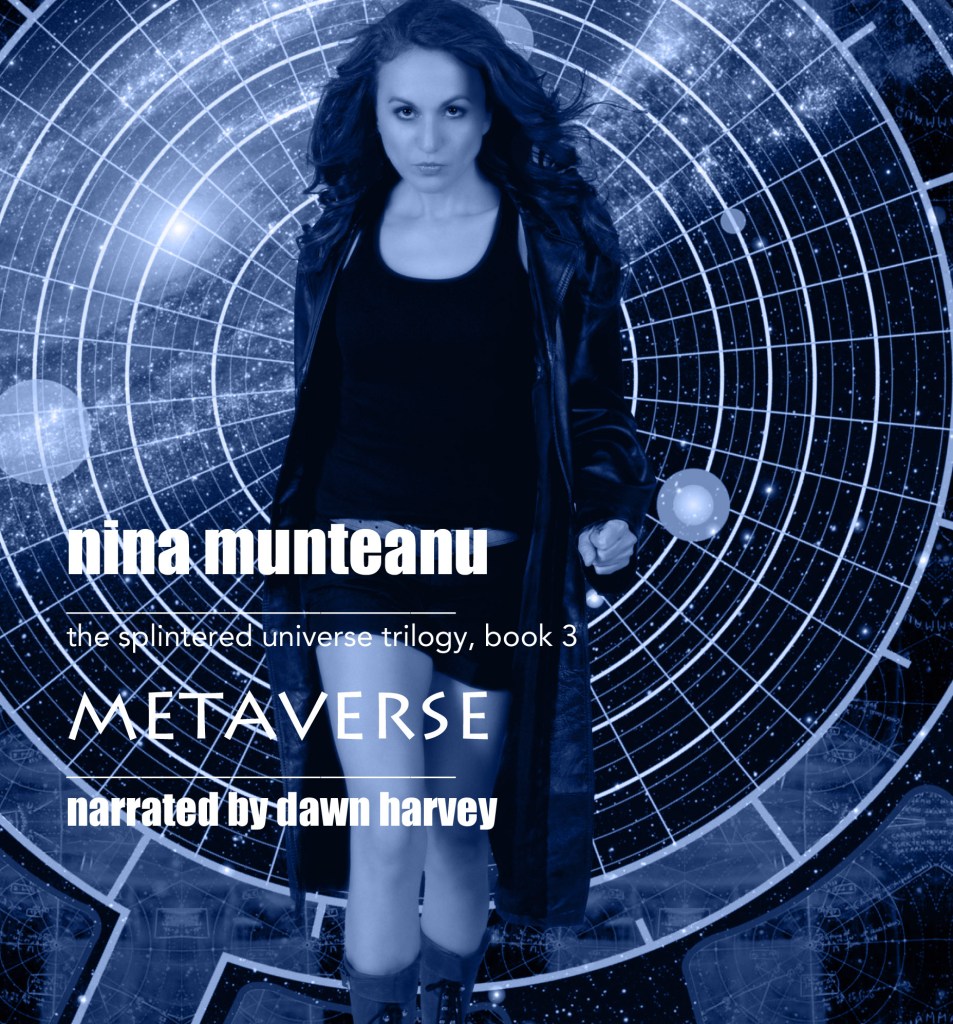
My detective thriller trilogy “The Splintered Universe,” which came out in print and ebook format in 2012-2014 were made into audiobooks by Iambik in 2019 and narrated impeccably by voice artist Dawn Harvey. When Iambik closed its doors, Spoken Realms and Pixl Press picked up the trilogy and reissued them in 2022. They are now remastered and available for purchase. Canadian author Simon Rose recently interviewed me about the re-release of The Splintered Universe Audiobooks. Part of that interview appears below. For the entire interview find the link below.
Interview with Nina Munteanu on New Audiobook Release of “The Splintered Universe” Trilogy
I had the pleasure recently of talking with Canadian author Nina Munteanu about the new release of her audiobook setThe Splintered Universe Trilogy. Nina is a scientist (limnologist) who also writes science fiction and fantasy with a focus on eco-fiction and climate fiction. She has nine novels and five non-fiction books published, including “Water Is…” recommended by Margaret Atwood as her #1 choice in the New York Times ‘Year in Reading’ in 2016.
The Splintered Universe Trilogy follows the thrilling adventures of Galactic Guardian Rhea Hawke, human detective who must save a world she hardly understands. It’s full of exciting planets, space travel, tall secrets, intrigue and even some romance. I interviewed Nina in 2019 about the trilogy when the three formats first became available and we talked about her world building, Rhea Hawke’s cool arsenal of gadgets and weapons, and concepts of metaphysics, existentialism and identity. So, what’s happening with all that now?
Simon:So, tell us about these new releases.
Nina: You’re right, Simon, the audiobooks of the trilogy did all come out in 2019, completing the three formats of print, ebook and audiobook. I was over the moon. What we’ve done recently is remaster the audiobooks and we’re now selling them as a package through the new publishers, Spoken Realms (first two audiobooks) and Pixl Press (third audiobook).
Briefly, the trilogy follows our intrepid (though slightly misguided) detective Rhea Hawke as she tries to solve the genocide of a spiritual sect on some backwater planet. She bungles her mission by killing her only lead and instead discovers a conspiracy to exterminate humanity by an alien race only she thinks exists. It goes downhill for her from there. She gets fired and her sentient ship—her only friend—is impounded. Her whole life comes apart. Her only chance to rebuild it is to prove that her discovery is true. That leads her down a rabbit hole into a dangerous world of intrigue, full of unsavory shape-shifting characters, dust smuggling, giant flying crustaceans, amorous toxic plants, and portals into mirror universes.
Rhea’s inventiveness gets her into even more trouble. She gained some notoriety with her created weapon, the MEC (short for Magnetic-Electro-Concussion) pistol, a versatile wave-weapon that can target DNA signatures and do almost anything you want with a single sweep. Her proprietary MEC design—coveted by shady crime syndicates and her own Guardians alike—becomes the centre piece to a universal war.
“An addictive start to the trilogy”–BOOK ADDICT
Simon:What makes these new audiobooks so special?
Nina: What makes these audiobooks special lies ultimately in their narration. When the original audiobook publisher took on the books as audiobooks, they provided me with three voice artists to audition. I chose Dawn Harvey because I could visualize my main character through her voice. Given that the entire trilogy is told in the first person, the narrator’s voice had to be just right. Dawn’s voice is dark and sultry like coffee. It is sexy and irreverent with a hidden vulnerability and sensitivity that perfectly captured the main character, Detective Rhea Hawke. What I didn’t realize then was how well Harvey would represent the thirty-odd other characters, mostly aliens—one who spoke through several mouths.
“Rhea is a fascinating character from the start and she continues to grow throughout the tale.”–DAB OF DARKNESS
Simon:Tell us about this narration process of the audiobooks.
Nina: Dawn is a dedicated professional. Working with her was an absolute pleasure. She created unique and consistent voices for the books many characters. She ensured that each character had the appropriate vernacular, tone, accent and cadence. She did proofs and confirmed them with me. She also tackled the “alien” vocabulary; many are made-up words. Dawn literally breathed life into Rhea Hawke and all the other characters. When I first listened to the Outer Diverse audiobook in the car on my way to Nova Scotia, I lost myself in her storytelling and forgot that I’d written it.
Here’s what one Amazon review said: “Dawn Harvey breathed incredible life into the lead character, Rhea Hawke—both sarcastic and vulnerable at the same time; a detective with a cynical edge, and sultry voice tinged with wiry sarcasm. The story unfolded through Rhea’s narrative like an old film noir as she unraveled mysteries that led to the greatest one: her own.”
Martha’s Bookshelf wrote: “Ms. Harvey manages to enthuse the personality of the characters into each voice. The wise, gentle Ka has a soft, strong sound that reminds you of a wise old bird. Shlsh She She, a slippery, slimy creature has a slurry, garbled voice like a mouthful of mushy, wet food. Dawn’s reading conveys the loneliness in Rhea, the sexiness of Serge, the frustrated friendliness of Bas, and the faithful coziness of Benny. She is able to bring emphasis to the action or romance, weariness or fear elements of the story. The narration never takes over the story; but rather enhances it.”
“An explosive ending … such a great series!”–LILLY’S BOOK WORLD
Simon:What has been the reception to the audiobooks so far?
Nina: the reception has been wonderful and overwhelming.
Dab of Darkness says: “There’s so much I have enjoyed about this series so far … There’s her AI ship, Benny, her sentient great coat, her special made gun, and her own hidden shapeshifting abilities. Then there’s a cast of interesting characters, good guys and bad guys. I love that I don’t know how things will turn out; the plot keeps me guessing.”
One Goodreads review wrote: “Rhea Hawke is a Galactic Guardian, and I love to say her name. Her name alone lets you know that there is a bad ass super hero of a woman on site. I can picture her boots, her great coat, and her side arms. I want to be her when I grow up.”
Nina: The trilogy can be purchased at most of the usual places in print and ebook formats. These include Amazon all over the world, Kobo, iBooks, Barnes and Noble and other quality retailers.
The audiobooks of the trilogy are available through Audible. The links on Audible for the three audio books are as follows: Outer Diverse, Inner Diverse, Metaverse.
Nina Munteanu is a Canadian ecologist / limnologist and novelist. She is co-editor of Europa SF and currently teaches writing courses at George Brown College and the University of Toronto. Visit www.ninamunteanu.ca for the latest on her books. Nina’s bilingual “La natura dell’acqua / The Way of Water” was published by Mincione Edizioni in Rome. Her non-fiction book “Water Is…” by Pixl Press(Vancouver) was selected by Margaret Atwood in the New York Times ‘Year in Reading’ and was chosen as the 2017 Summer Read by Water Canada. Her novel “A Diary in the Age of Water” was released by Inanna Publications (Toronto) in June 2020.
Forget not that the earth delights to feel your bare feet and the winds long to play with your hair
Kahlil Gibran
White birch tree in mixed cedar hemlock forest, ON (photo and rendition by Nina Munteanu)
According to naturalist John Muir Laws, “Keeping a journal of your observations, questions, and reflections will enrich your experiences and develop gratitude, reference, and the skills of a naturalist. The goal of nature journaling is not create a portfolio of pretty pictures but to develop a tool to help you see, wonder, and remember your experiences.”
Sketches from “The Laws Guide to Nature Drawing and Journaling” by John Muir Laws
Here are the steps for keeping a nature journal:
Decide on the kind of nature journal you want to make: your decision should take into account whether you wish to include samples, pictures or only text. If you’re using a notebook (not a computer) size is important. Keep it large enough to include what you need but small enough to be portable. You may wish to create a journal only for a specific place, topic, issue or trip (e.g., the river behind your place; local birds; recycling in your community; your trip to Tanzania or the local zoo). There are different kinds of journal styles for different uses. For instance, Grinnell journals are field journals used by scientists and phenology journals are specific to making field observations. If you are really serious about journaling in nature — rain or shine— you can get one with waterproof paper, like Rite in the Rain, or DeckExpert. Butler Survey Supplies also makes waterproof loose leaf paper.
Make or buy a suitable journal: most nature journals are compiled from notebooks or notepads of plain white paper. You can get some that have one side lined for writing and the opposite side unlined for drawing, sketches and pasting in pictures or samples. Make sure your journal is sturdy and protected against the elements. Some covers are waterproof. Otherwise, it might be a good idea to carry a plastic bag with you.
Get the other equipment you need: if you plan to make sketches or paint with watercolor or collect specimens, ensure that you have the equipment: pencils, pencil crayons, paint kit, adhesive tape, camera, other collection material. A backpack would be useful to put your journal and materials into.
Dedicate time and place to journaling: nature journals, like most themed journals, do not need to be kept daily or on a routine. Journal entries will depend on the specific topic or area you have chosen to follow. Keep your journal handy to your journal topic. You may wish to keep it and associated materials in a dedicated backpack, handy to grab when you go on your outings. If you keep lists of things to bring on various trips or outings, include the journal.
Observe the world around you: nature journaling relies mostly on observing and reflecting. Cultivate your observational skills by learning to quiet your mind from distractions and focusing on the subject matter. Sketching and taking pictures can help provide the focus you need as well as giving you something to put into your journal. Slow down. Stop and watch and listen. Get close. Don’t be afraid to crouch and move in close. The wonders of nature are often right in front of your nose, just waiting for a new way to be seen.
Write on location: your nature journal will be most valuable if you use it in the field to record what you see as you see it. If you rely on your memory to write in your journal later, it will be less accurate (though it might be more poetic). You are more likely to make an entry if you bring your journal with you; if you leave your journal at home and wait until later, you may not get to it and the magic of the moment may be lost. Once you get home and revisit your entry, you can confirm and elaborate on your observations in the field.
Begin each entry with location, date, time: “where” and “when” are important pieces of information to include in any journal entry. They are particularly important in a nature journal. Time and place relate to important natural cycles like season and diurnal cycle. If your nature journal is more scientific, you may wish to include other important descriptors like weather, temperature, wind, precipitation, etc. You may wish to leave the odd page blank as space to paste in additional information from later research related to your entry.
Record observations in several ways: regardless of whether you consider yourself a good artist or not, sketches and drawings can provide a wealth of information (that you may not have thought to add in your writing) and add an element of interest to a journal entry. Pictures are a great tool for adding accurate details to an observation. Don’t be afraid to get close. All too often we take a picture, thinking the camera sees what we see (and interpret) and when we look at the photo the object of your attention is too far away or surrounded by so much “noise” it’s hard to distinguish.
Learn more about what you saw: it’s a good idea to confirm and elaborate your observations with research. When you go to the library or read online about what you saw, you will likely generate even more interest. This is where sketches or images or samples come in handy, particularly if you want to identify something you’ve seen.
Revisit your past entries: you may wish to consult a previous entry to compare with something you’ve just observed or use it in an experiment you’re conducting. Either way, reading your nature journal can be a great learning experience and a lot of fun.
White birch tree, showing lenticels, ON (photo and rendition by Nina Munteanu)
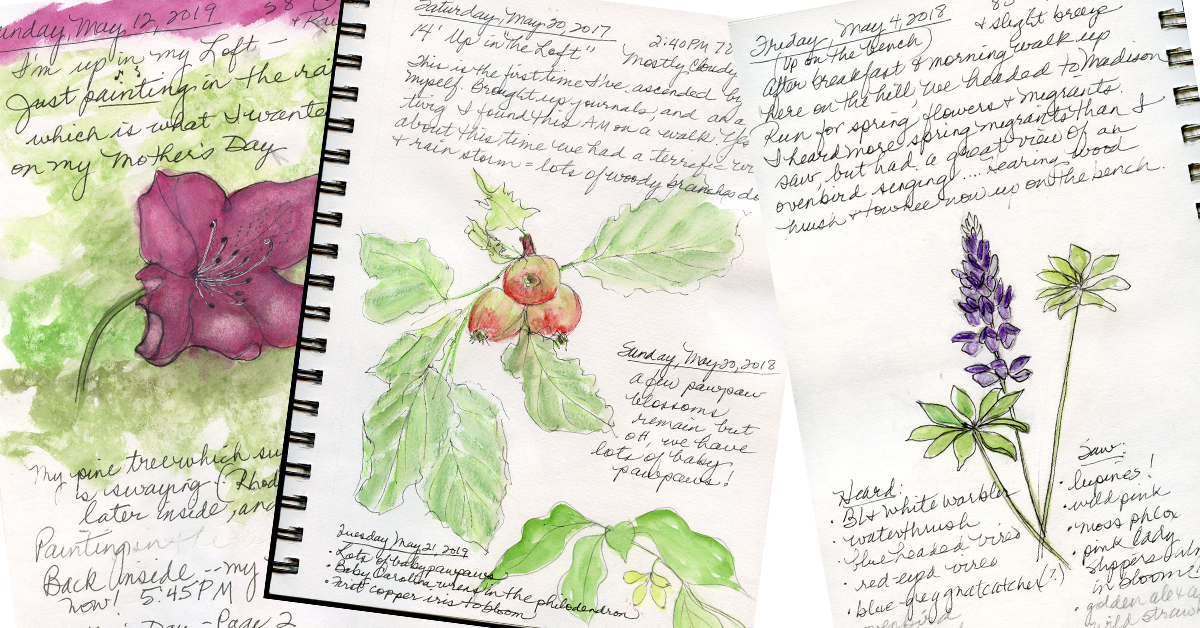
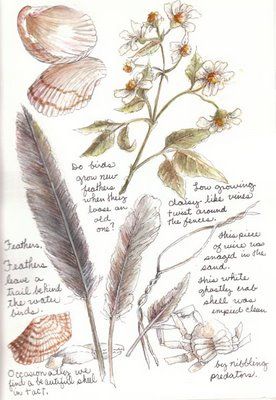
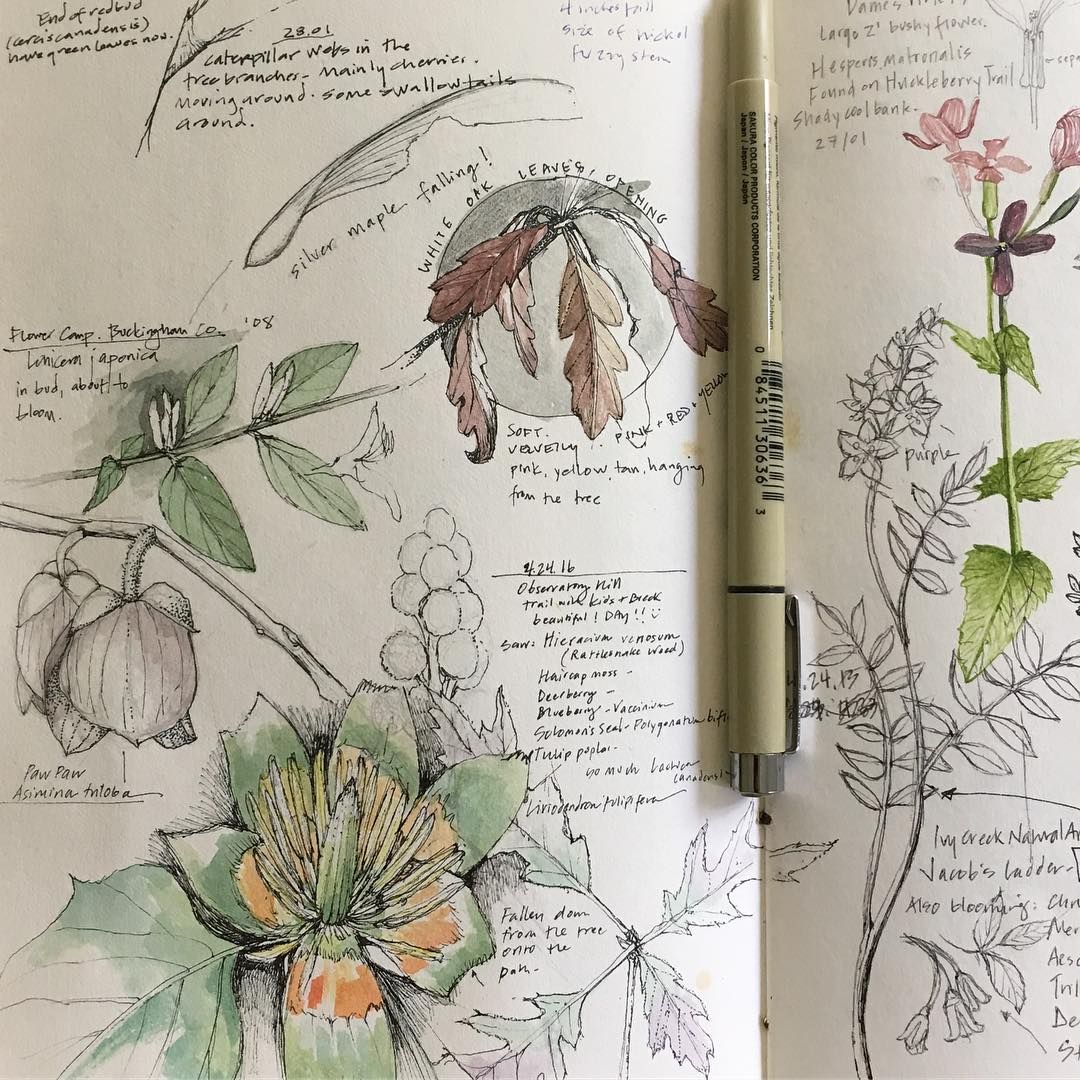
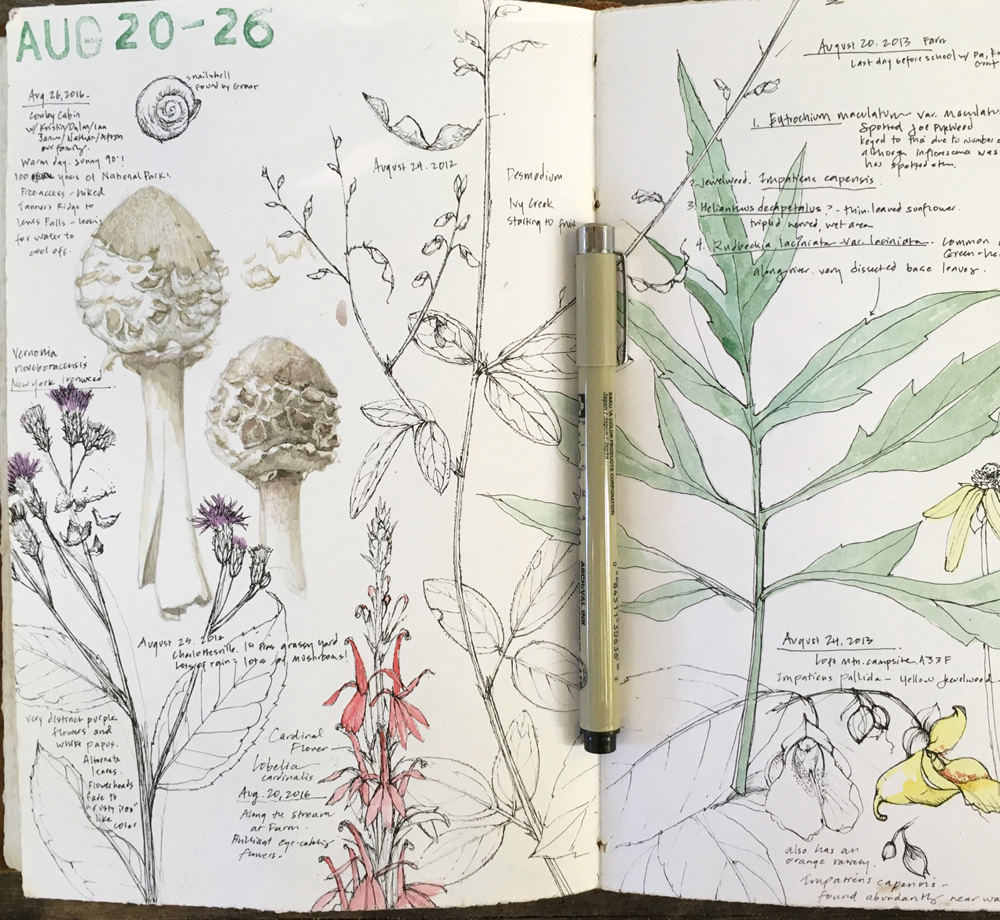
The American Museum of Natural History describes a field journal as being unique to the journalist. “There is no one way to keep a field journal,” they say. “Some scientists will sketch simple pencil drawings, and others will paint colorful, detailed images. You can use whatever tools work best for you. Try working with pens, pencils or watercolors to capture an image, whether it is a view of the Moon, the veins of a leaf, or the legs of a beetle.” You can record your observations with charts, list and labels, sketches, samples and photos. You can also write long, detailed descriptions.
Journal page (image by stowelandtrust.org)
Some questions they come up with to help prompt you include:
“What do I see?” Some things to include are: size, shape and color, what it is doing, how it relates to other things, why it is so interesting to you.
“Do I see anything that surprises me?”
“How have I traveled to this spot?” This is good information for possible later visits, especially if you wish to do a series of related observations.
“What tools do I have?” This is good to remember for later visits and to assess the appropriateness of the observation. In most scientific observations, the methods and techniques used are critical to the validity of the observation.
“Who is with me on this expedition?” Researchers always include who was there. This helps for later consultation.
“What time of day is it?” In the natural sciences time of day is critical because so much in nature is diurnal (e.g., responds and changes as the day changes)
White birch tree with polypore fungus, ON (photo and rendition by Nina Munteanu)
Lynda Richardson at Virginia Wildlife talks about keeping a nature journal, which includes plein air painting and what goes into a field kit.
Page from Lynda Richardson’s nature journal (image by L. Richardson)
Page of Fiona Gillogly’s nature journal (image by F. Gillogly)
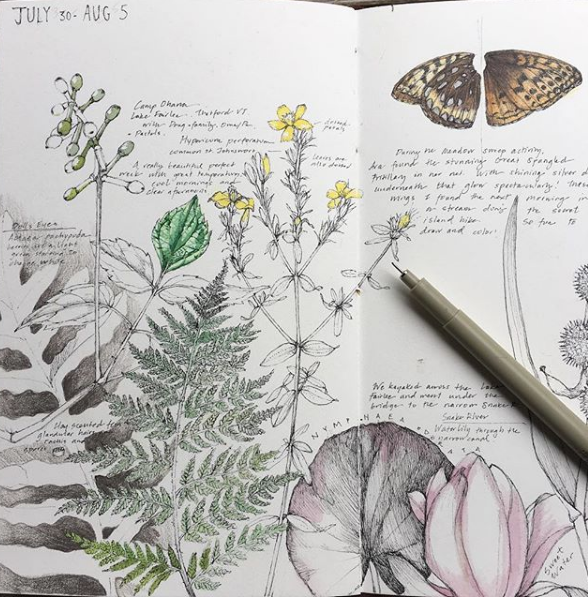
While recently browsing on the Internet, I ran across a very attractive yet simple nature blog. What made Judy Butler’s “Naturalist Journal: Down the Nature Trail” so appealing was her mixed use of regular text augmented with scanned handwritten pages containing color-pencil drawings and flower pressings. This charming “homespun” expression resembled a real three-dimensional journal.
The Journal Writer is the second writing guide in the Alien Guidebook Series. This comprehensive guidebook will help you choose the best medium, style and platform for your expressive writing. The guide provides instruction on issues of safety, using the computer and electronic devices, social media and the internet.
“Engaging, accessible, and easily applicable…Brava, Nina, brava.”—David Merchant, Instructor, Louisianna Tech University
“Straight up, fact-filled, enriching, joyful and thorough…Nina is honest, she is human and she wants you to succeed.”—Cathi Urbonas, Halifax writer
Nina Munteanu is a Canadian ecologist / limnologist and novelist. She is co-editor of Europa SF and currently teaches writing courses at George Brown College and the University of Toronto. Visit www.ninamunteanu.ca for the latest on her books. Nina’s bilingual “La natura dell’acqua / The Way of Water” was published by Mincione Edizioni in Rome. Her non-fiction book “Water Is…” by Pixl Press(Vancouver) was selected by Margaret Atwood in the New York Times ‘Year in Reading’ and was chosen as the 2017 Summer Read by Water Canada. Her novel “A Diary in the Age of Water” was released by Inanna Publications (Toronto) in June 2020.
I recently gave a webinar through the Immigrant Writers Association on how to structure an effective, compelling and meaningful short piece of writing, whether fiction or non-fiction article.
All good writing requires setting up a purposeful narrative that directs the reader seamlessly from the lead hook to the fulfilling conclusion. I went over the process and necessary steps from idea (premise) through introduction/set up (what’s at stake) and development (the journey/theme) toward a fulfilling end (message).
I used two examples (one that needed work and one that was superlative) to explore hooks, paragraphing, overall narrative structure and development, and tips on how language can enhance or detract from compelling story.
Heron in marsh of outlet stream, ON (photo and rendition by Nina Munteanu)
NINA MUNTEANU is a Canadian ecologist / limnologist and novelist. She is co-editor of Europa SF and currently teaches writing courses at George Brown College and the University of Toronto. Visit www.ninamunteanu.ca for the latest on her books. Nina’s bilingual “La natura dell’acqua / The Way of Water” was published by Mincione Edizioni in Rome. Her non-fiction book “Water Is…” by Pixl Press(Vancouver) was selected by Margaret Atwood in the New York Times ‘Year in Reading’ and was chosen as the 2017 Summer Read by Water Canada. Her novel “A Diary in the Age of Water” was released by Inanna Publications (Toronto) in June 2020.
Sample of eco-fiction publications Nina contributed as author or editor
“What is Eco-Fiction and Why Should We Care?”
In 2019, at the When Words Collide writer’s conference in Alberta, I participated in a panel on eco-fiction. The panel, consisting of Alex Reissen, Merilyn Ruth Liddell, Claudiu Murgan, Nina Munteanu, and moderated by Canadian speculative author Candas Jane Dorsey, discussed what eco-fiction is, what it means to its writers and its readers and why it’s an important genre of literature. How, for instance can eco-fiction writers influence our audience to engage in helping the planet and humanity, in turn? How can we do it without turning to the polemic of non-fiction? We discussed the importance of “storytelling”, bringing in characters to care about, making the global experience (and issue) personal. Essentially dramatizing the premise.
Candas described fiction writers as “sneaky,” exploring the issue (and message) through context and setting with a focus on character journey. This includes use of sub-text and subtleties embodied by individuals. I mentioned treating the environment as a character—a character to care about.
We explored several areas in which writers could elucidate ways to engage readers for edification, connection and participation. We discussed optimism, new perspectives, and envisioning our future.
“Science doesn’t tell us what we should do,” Barbara Kingsolver wrote in Flight Behavior. “It only tells us what is.” Stories can never be a solution in themselves, but they have the capacity to inspire action.
Cedar pine forest during winter snow, Jackson Creek Park, ON (photo and rendition by Nina Munteanu)
“People need such stories, because however dark, a darkness with voices in it is better than a silent void.”
Margaret Atwood, Maddaddam
Nina Munteanu is a Canadian ecologist / limnologist and novelist. She is co-editor of Europa SF and currently teaches writing courses at George Brown College and the University of Toronto. Visit www.ninamunteanu.ca for the latest on her books. Nina’s bilingual “La natura dell’acqua / The Way of Water” was published by Mincione Edizioni in Rome. Her non-fiction book “Water Is…” by Pixl Press(Vancouver) was selected by Margaret Atwood in the New York Times ‘Year in Reading’ and was chosen as the 2017 Summer Read by Water Canada. Her novel “A Diary in the Age of Water” was released by Inanna Publications (Toronto) in June 2020.
Country road through Kawartha region, ON (photo and rendition by Nina Munteanu)
Every blade of grass has its Angel that bends over it and whispers, ‘Grow, grow’
The Talmud
There will come a time when you just don’t feel like writing in your journal, when you are blue or frustrated or angry, even. It may be that you’re just bored with your journal, with your work and school and life in general. It may be simply that you have nothing to say, your muses have fled to Tahiti or someplace far away and you are left with a blank page or more importantly—and alarmingly—a blank mind.
Chasing the Journeying Muse
Here’s my solution: don’t sweat it. Embrace the emptiness and something wonderful will fill it. I said something; not necessarily what you expect. I believe that when your muse “leaves” you, it is on a journey. More to the point you are on a journey. You’re living. More often than not, our directed muse leaves us because something has gotten in the way. What you probably need to do is pay attention to that something. It’s telling you something. Ironically, by doing this, you open yourself to something wonderful. Okay, enough of somethings!…
Writing is a lot like fishing. In order to write you need something to write about. So, when the world gets in your way, you should pay attention. This is what you’re here for. A writer is an artist who reports on her society. A good artist, at least an accessible one, needs to be both participant as well as observer. So, take a break and live. Chances are, you will have much more to write about after you do.
Dealing with Writer’s Block
I’m not a very patient person. I make no time for writer’s block or lingering in useless limbo over some plot issue or misbehaving minor character. I write pretty much to a tight schedule: this short story to that market by this date; edits to this book to the editor by that date; blog posts created by such and such a time; an article to another market by another date. It goes on and on. When I go to my computer to write, I write.
Then there’s Sammy. My cat.
Who likes to jump on my lap, make himself all comfortable and then lie over my arm — trapping it along with five of my typing digits. Now what??? Some of you would advise me to simply pull out my pinned arm and/or shove him off. But how can I disturb such a blissful creature? He is so content furled on me, so satisfied that he has captured that wandering appendage of business that is all his now. Content in the bliss of now.
Pinned in the moment, my mind first struggles with the need to pound out the next line. My mind then rephrases and teases out nuances of that line. Finally, it wanders out with my gaze and I find myself daydreaming in a kind of trance. It is here that magic happens. In the being; not in the doing.
This is the irony of writing and the muse. To write we need to live; we need to have something to write about and we need to be in that state of mind that allows us to set it to print. I am at my best as a writer when I am focused on the essence of the story, its heart and soul beating through me with a life of its own.
My cat Sammy isn’t the only vehicle to my magical muses.
Waking Up The Muse
Here are a few things that help me entice those capricious muses into action:
Music: music moves me in inexplicable ways. I use music to inspire my “muse”. Every book I write has its thematic music, which I play while I write and when I drive to and from work (where I do my best plot/theme thinking). I even go so far as to have a musical theme for each character. You can do the same for your journals.
Walks: going for a walk, particularly in a natural environment, uncluttered with human-made distractions, also opens the mind and soul. It grounds you back to the simplicity of life, a good place to start.
Cycling: one of my favorite ways to clear my mind is to cycle (I think any form of exercise would suffice); just getting your heart rate up and pumping those endorphins through you soothes the soul and unleashes the brain to freely run the field.
Attend literary functions: go to the library and listen to a writer read from her work. You never know how it might inspire you. Browse the bookshelves of the library or bookstore. Attend a writer’s convention or conference.
Visit an art gallery, go to a movie: art of any kind can inspire creativity. Fine art is open to interpretation and can provoke your mind in ways you hadn’t thought before. If you go with an appreciative friend and discuss what you’ve seen you add another element to the experience.
Go on a trip with a friend: tour the city or, better yet, take a road trip with a good friend or alone (if you are comfortable with it). I find that travelling is a great way to help me focus outward, forget myself, and open my mind and soul to adventure and learning something new. Road trips are metaphoric journeys of the soul.
Form a writer’s or journal-keeping group: sharing ideas with people of like mind (or not, but of respectful mind) can both inspire you and provide the seeds of ideas.
The Journal Writer is the second writing guide in the Alien Guidebook Series. This comprehensive guidebook will help you choose the best medium, style and platform for your expressive writing. The guide provides instruction on issues of safety, using the computer and electronic devices, social media and the internet.
“Engaging, accessible, and easily applicable…Brava, Nina, brava.”—David Merchant, Instructor, Louisianna Tech University
“Straight up, fact-filled, enriching, joyful and thorough…Nina is honest, she is human and she wants you to succeed.”—Cathi Urbonas, Halifax writer
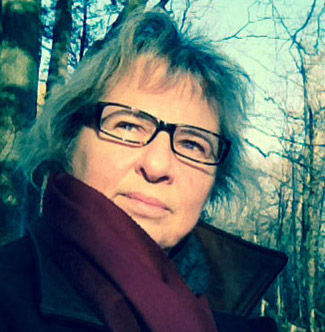
Nina Munteanu enjoys a snowstorm in Ontario
NINA MUNTEANU is a Canadian ecologist / limnologist and novelist. She is co-editor of Europa SF and currently teaches writing courses at George Brown College and the University of Toronto. Visit www.ninamunteanu.ca for the latest on her books. Nina’s bilingual “La natura dell’acqua / The Way of Water” was published by Mincione Edizioni in Rome. Her non-fiction book “Water Is…” by Pixl Press(Vancouver) was selected by Margaret Atwood in the New York Times ‘Year in Reading’ and was chosen as the 2017 Summer Read by Water Canada. Her novel “A Diary in the Age of Water” was released by Inanna Publications (Toronto) in June 2020.