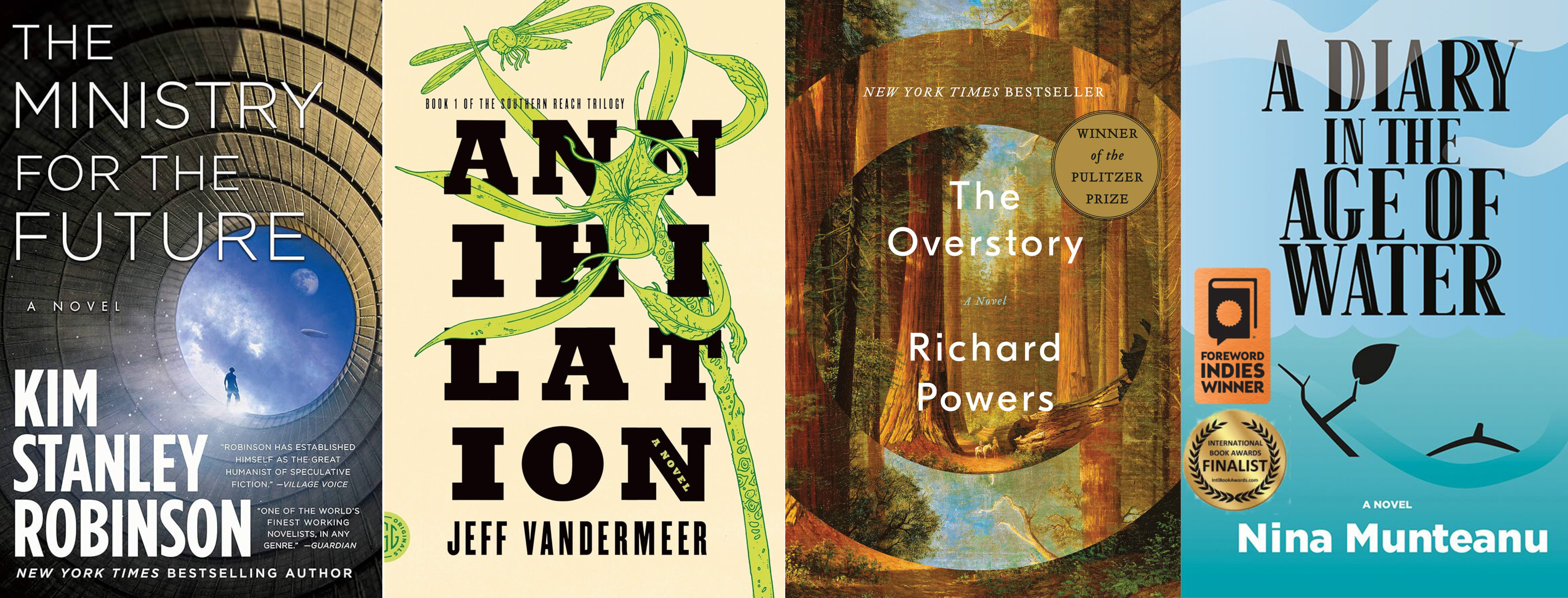
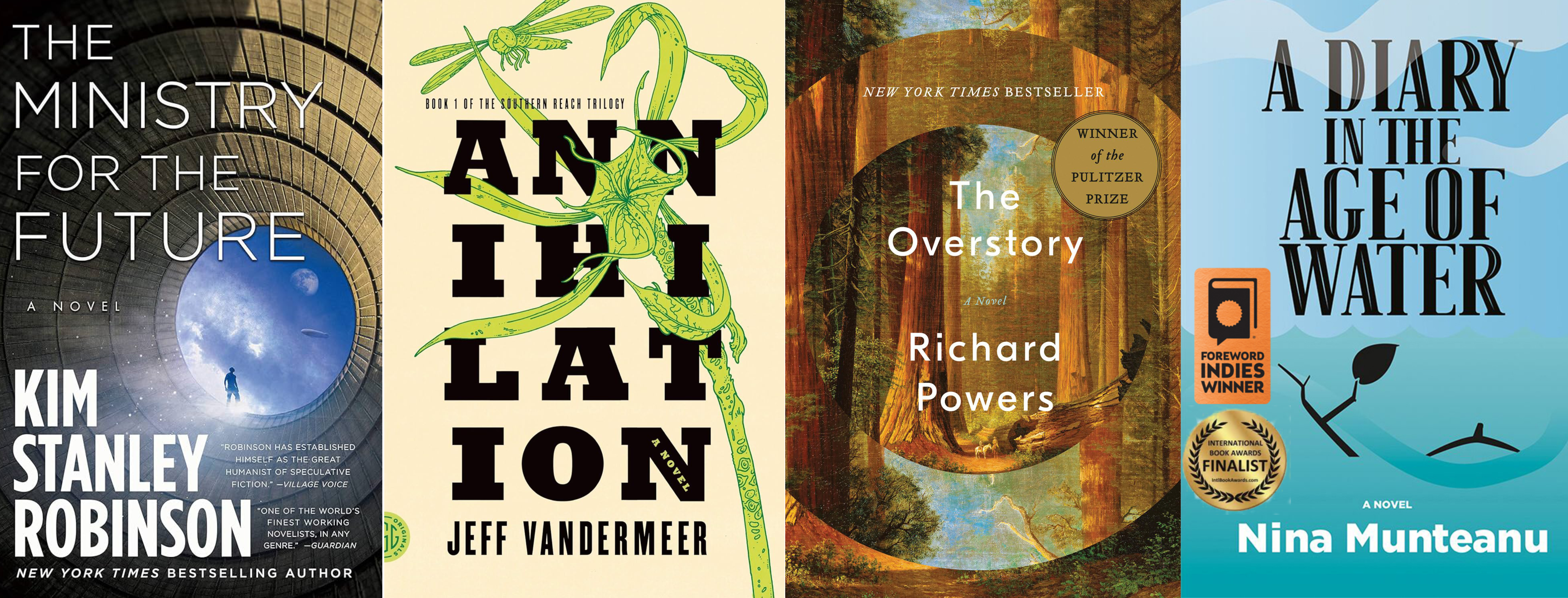
Inventor/author Kyo Hwang Cho recently identified Nina Munteanu, Kim Stanley Robinson, Jeff VanderMeer, and Richard Powers as Leading Voices in Eco-Science Fiction in an article on the LinkedIn Skyhome Newsletter.
Cho wrote:
Kim Stanley Robinson: Robinson is renowned for integrating ecological themes into his narratives. His works like The Ministry for the Future and the Mars Trilogy explore climate change, sustainability, and alternative socio-economic systems. His stories often centre around scientists striving for environmental reform.
Jeff VanderMeer: Best known for the Southern Reach Trilogy, beginning with Annihilation, VanderMeer delves into a nature-reclaimed mystery zone called Area X. His work blends ecological concerns with surreal and speculative storytelling, offering a unique lens on environmental collapse.
Richard Powers: While not strictly a science fiction author, Powers’s novels such as The Overstory and Playground revolve around nature’s impact on human lives and vice versa. His writing emphasizes the deep interconnectedness of species and ecosystems.
Nina Munteanu: A Canadian ecologist and writer, Munteanu’s stories explore how humans interact with the environment. Her narratives often examine the intersection of science, climate crisis, and spiritual transformation.
.
.
Cho included the following Noteworthy Eco-Science Fiction Works:
“The Ministry for the Future”: A speculative exploration of global climate crisis responses through policy, activism, and emergent technology.
“Annihilation”: A surreal expedition into a wilderness zone that defies scientific explanation, echoing the unpredictability of nature itself.
“The Overstory”: A web of interconnected lives bound by trees, showing how the natural world can act as both witness and protagonist. [Inclusion of this book in the eco-SciFi subgenre is a stretch: however, like my own book, there are elements of speculation, and some subtle fantastical elements that one can argue place it in a scifi setting]
“A Diary in the Age of Water”: A dystopian look at a future shaped by water scarcity, societal collapse, and ecological memory.
Cho defines Eco-SciFi this way: “Eco-SciFi is a subgenre of SciFi that foregrounds ecological consciousness, blending speculative fiction with climate science, ethics, and planetary survival.” He includes a table that distinguishes Eco-SciFi from traditional Sci-Fi in several core areas from core theme, tone and motivation to protagonists and ‘message.’
.
.
Nina Munteanu is a Canadian ecologist / limnologist and novelist. She is co-editor of Europa SF and currently teaches writing courses at George Brown College and the University of Toronto. Visit www.ninamunteanu.ca for the latest on her books. Nina’s bilingual “La natura dell’acqua / The Way of Water” was published by Mincione Edizioni in Rome. Her non-fiction book “Water Is…” by Pixl Press (Vancouver) was selected by Margaret Atwood in the New York Times ‘Year in Reading’ and was chosen as the 2017 Summer Read by Water Canada. Her novel “A Diary in the Age of Water” was released by Inanna Publications (Toronto) in June 2020.
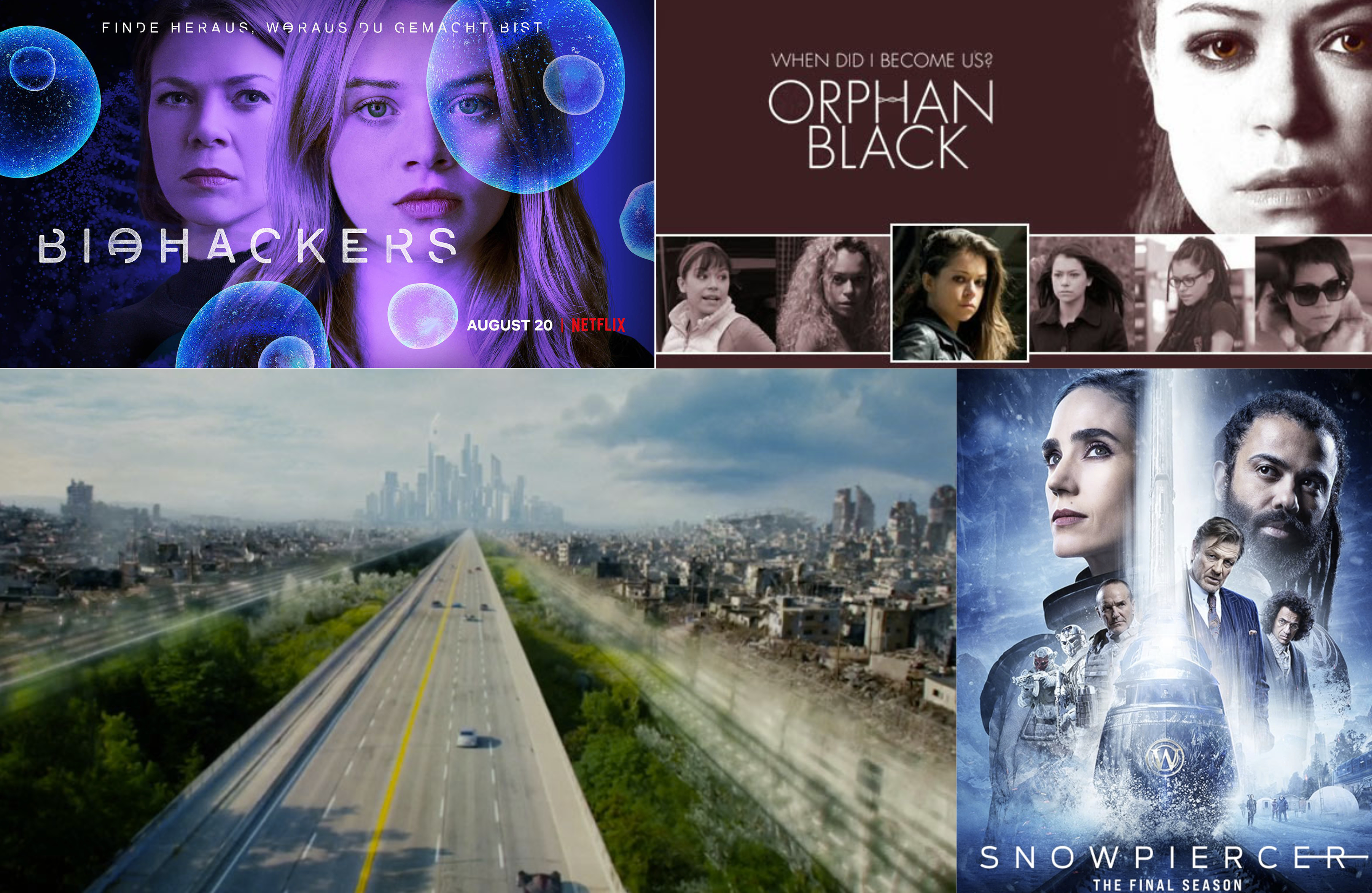
I’ve selected ten TV series that have intrigued me, moved me, and stayed with me for various reasons that touch on: abuse of justice, including eco-justice and environmental abuse; technology use and abuse; and the effects and horrors of climate change.
Some are well known; others not so well known. All approach storytelling with a serious dedication to depth of character, important themes, realistic world building, and excellent portrayal by actors. The world-building is extremely well done—in some cases rivalling Ridley Scott’s best—with convincing portrayals of worlds that are at times uncanny in their realism. Worlds that reflect story from an expansive landscape to the mundane minutiae of daily life: like the cracked phone device of Detective Miller in The Expanse or the dirty fingernails of engineer Juliette Nichols in the Down Deep of Silo. Stories vary in their treatment of important themes from whimsical and often humorous ironies to dark and moody treatises on existential questions. In my opinion, these TV series rival the best movies out there, often reflecting large budgets (but not always) and a huge commitment by producers. The ten TV series I’ve selected in this series come from around the world: Brazil, Germany, France, Norway, Canada and the United States.
In Part 2, I focus on five TV series that explore issues to do with resource allocation, adaptations to climate change and corporate / government biopolitics.
.
.
SNOWPIERCER:Capitalism is a Perpetual Motion Train in a Frozen World
.
Snowpiercer is an American post-apocalyptic dystopian thriller that reboots the 2013 film Snowpiercer by Bong Jooh-ho. Snowpiercer is a perpetually moving train that circles the globe carrying the remnants of humanity seven years after the world has become a frozen wasteland, thanks to a botched climate fix. The train is divided up by class – first class, where all the wealthy people live; second and third class where the workers reside, and the tail – the end of the train, where the poor starve, live in total darkness, and are exploited for sex and labor.
.
Passengers in the tail of the train
.
The train, of course, serves as a metaphor for class struggle, elitism and social injustices. The train’s self-contained closed ecosystem is maintained by an ordered social system, imposed by a stony militia. Those at the front enjoy privileges and luxurious living conditions, though most drown in a debauched drug stupor; those at the back live on next to nothing and must resort to savage means to survive. The TV show, as with the film, isn’t so much about climate change—as a study on how society functions—or rather copes—within a decadent capitalist system, based on an edict of productivity: serve the machine of “life” and keep the order at all cost. Chief of Hospitality Melanie Cavill (secretly chief engineer of the train) as much as tells this to homicide detective Andre Layton (from the back of the train) when she enlists him to solve the first murder in the elite section of the train.
.
Melanie Cavill, head of Hospitality, enlists Andre Layton as detective to investigate a murder on the train
.
The TV show diverges from the film in several important ways.
My original review of the movie touched on style and political agenda:
Bong Joon-Ho’s 2013 motion picture Snowpiercer is a stylish post-climate change apocalypse allegory. A dark pastiche of surrealistic insanity, welded together with moments of poetic pondering and steam-punk slick in a frenzied frisson you can almost smell. Joon-Ho casts each scene in metallic grays and blues that make the living already look half-dead. The entire film plays like a twisted steampunkish baroque symphony. Violence personified in a garish ballet.
.
Poster for the movie version of Snowpiercer
.
I drew on Aaron Bady’s commentary on the film in The New Inquiry which discussed reform capitalism* to conclude that the movie “Snowpiercer is about hard choices and transcendence. Save humanity but at the consequence of our souls? Or transcend the machine that has robbed us of our souls at the expense of our mortality? The film continually questions our definition of what life is and what makes life worth living … Ultimately, Bong Jung-Ho’s message with the ending of this baroque political allegory is the vindication of a choice against reform capitalism for something new, that there is indeed “Life after Capitalism”, not easy but worth living…”
The Snowpiercer TV series takes a different approach to the end of the world and capitalism metaphor, weaving in more intrigue in its plot (a murder) with elements of detecting by the only homicide detective left on the train and in the world—a self-styled revolutionary from the back of the train. Much of the entertaining tensions arise from the interactions of Detective Andre Layton (Daveed Diggs) and Hospitality head Melanie Cavill (Jennifer Connelly) and second in command Ruth Wardell (Alison Wright); there are also strong performances by the train’s Breakman, Bess Till (Mickey Sumner) and later Mr. Wilford (Sean Bean) who was supposedly running the train but had been secretly thrown off the train by head engineer Cavill.
.
Snowpiercer crew prepare to encounter another train in the freeze
.
The focus of the TV show has been more on the potential survival of a handful of what’s left of humanity with competing agendas on how this is best achieved, whether the freeze is indeed unfreezing and some part of the world has become hospitable or at least livable. Trading the film’s baroque metaphors to capitalism for a more literal approach to climate change and living in a post climate change world, the TV series focuses more on real questions facing this ragtag of humanity. How to keep it together when rifts naturally form based on unequal resource allocation and space in the limited ecosystem of the train. Given that the show plays out in several seasons, there is room to expand and further explore socialism, democracy, fascist rule and environmental activism. Class divisions are explored through a large cast of morally ambiguous characters, each with a plot arc, and more opportunities to explore not just first class but second and third class, showcasing more nuanced and varied elements to the class struggle and ambitions of people.
.
.
*Reform Capitalism: “Reform and revolution are shibboleths that distinguish liberals from radicals,” explains Aaron Bady of The New Inquiry. “While liberals want to reform capitalism, without fundamentally transforming it, radicals want to tear it up from the roots (the root word of “radical” is root!) and replace capitalism with something that isn’t capitalism…If you’re the kind of leftist who thinks that the means of production just need to be in better hands—Obama, for example, instead of George W. Bush, or Elizabeth Warren instead of Obama, or Bernie Sanders instead of Elizabeth Warren, and so on—then this movie buries a poison pill inside its protein bar: soylent green is people.”
Nina Munteanu is a Canadian ecologist / limnologist and novelist. She is co-editor of Europa SF and currently teaches writing courses at George Brown College and the University of Toronto. Visit www.ninamunteanu.ca for the latest on her books. Nina’s bilingual “La natura dell’acqua / The Way of Water” was published by Mincione Edizioni in Rome. Her non-fiction book “Water Is…” by Pixl Press (Vancouver) was selected by Margaret Atwood in the New York Times ‘Year in Reading’ and was chosen as the 2017 Summer Read by Water Canada. Her novel “A Diary in the Age of Water” was released by Inanna Publications (Toronto) in June 2020.
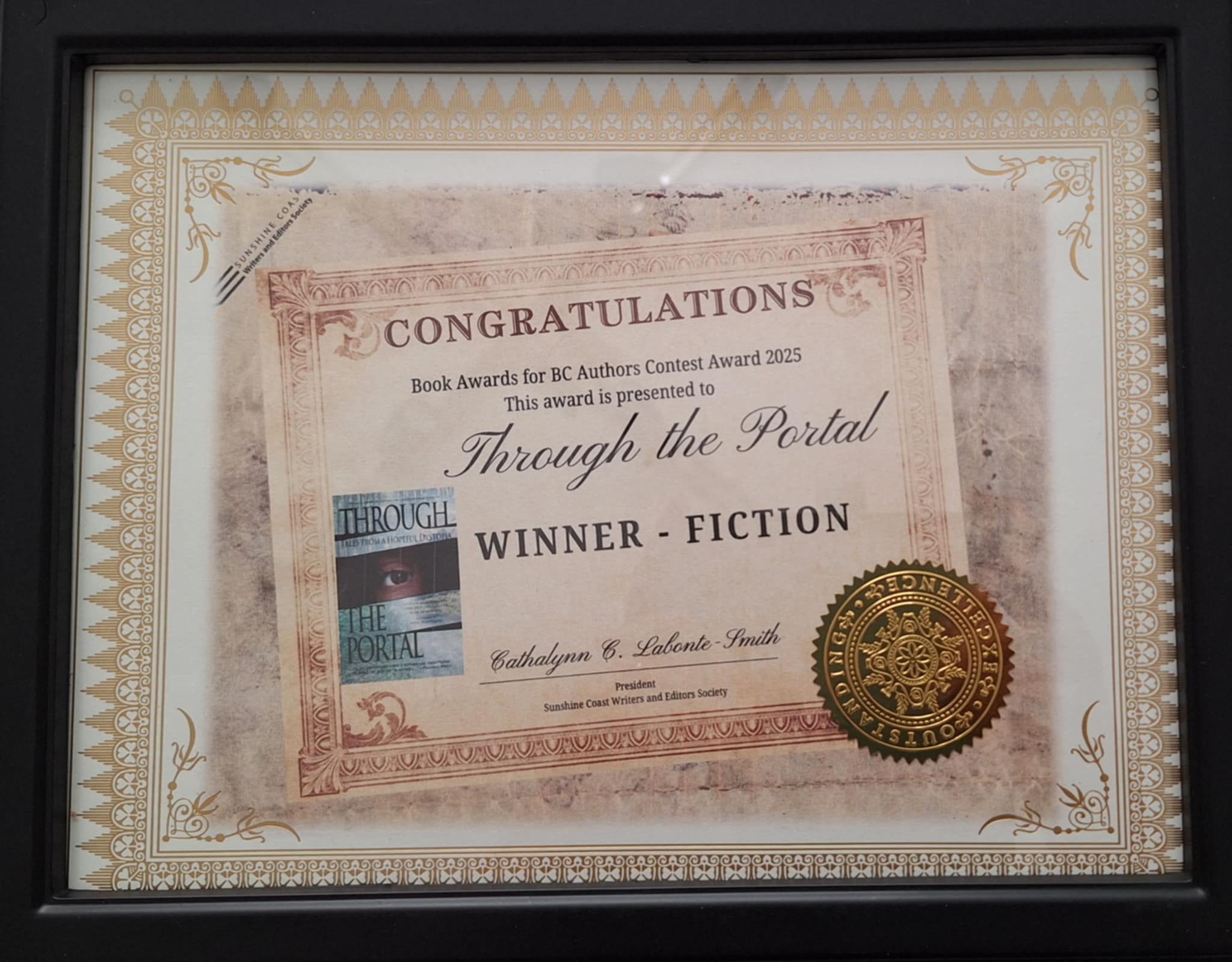
On August 23, 2025, Through the Portal: Tales for a Hopeful Dystopia, edited by Lynn Hutchinson Lee and Nina Munteanu for Exile Editions, won the BC Sunshine Coast Award for 2025.
The fiction prize was award to Exile Edition’s 20th anthology along with three other fiction works that include Blackheart Man by Nalo Hopkinson, The Cipher by Genni Gunn, and Inside Outside by Faye Arcand.
Here is what the judges said about Through the Portal:
“Every story in here is a delicious short gem.”
“An ambitious project with an unusual slant of positivity in the face of a dystopian future has turned into a solid piece of work, incorporating a good range of stories, some very literary and abstract, others simple tales of destruction and regrowth or the hope of regrowth.”
“Characters and situations in the selected stories show optimism and the power of the human spirit across a wide array of possible near- and far-term futures.”
“Most of the situations are inherently believable based on what we know about climate, industry, and the powerful politics of denialism.”
.
.
Nina Munteanu is a Canadian ecologist / limnologist and novelist. She is co-editor of Europa SF and currently teaches writing courses at George Brown College and the University of Toronto. Visit www.ninamunteanu.ca for the latest on her books. Nina’s bilingual “La natura dell’acqua / The Way of Water” was published by Mincione Edizioni in Rome. Her non-fiction book “Water Is…” by Pixl Press (Vancouver) was selected by Margaret Atwood in the New York Times ‘Year in Reading’ and was chosen as the 2017 Summer Read by Water Canada. Her novel “A Diary in the Age of Water” was released by Inanna Publications (Toronto) in June 2020.
Illustration depicting Ray Bradbury’s ‘Rocket Summer’ in The Martian Chronicles (image from The Black Cat Moan)
.
Twenty years ago, when I started seriously publishing short stories and novels, the environment was not recognized by the public or writers as an entity that deserved a literary category. Nature and environment were mostly portrayed and viewed as passive entities, to conquer, subdue, exploit and destroy at will (particularly in science fiction—with some notable exceptions such as The Martian Chronicles by Ray Bradbury). Environment and Nature were not generally considered characters on a journey like the progatonist and other major characters; the environment lacked agency and was often ‘othered’ as dangerous, treacherous and unknowable.
Despite the fact that eco-fiction has in fact been in existence for centuries, use of this literary term is quite recent. Its first recognized use was in 1971, appearing as the title in John Stadler’s anthology published by Washington Square Press, which compiled environmental scifi works from the 1930s to the 1960s.
Defining Eco-Fiction
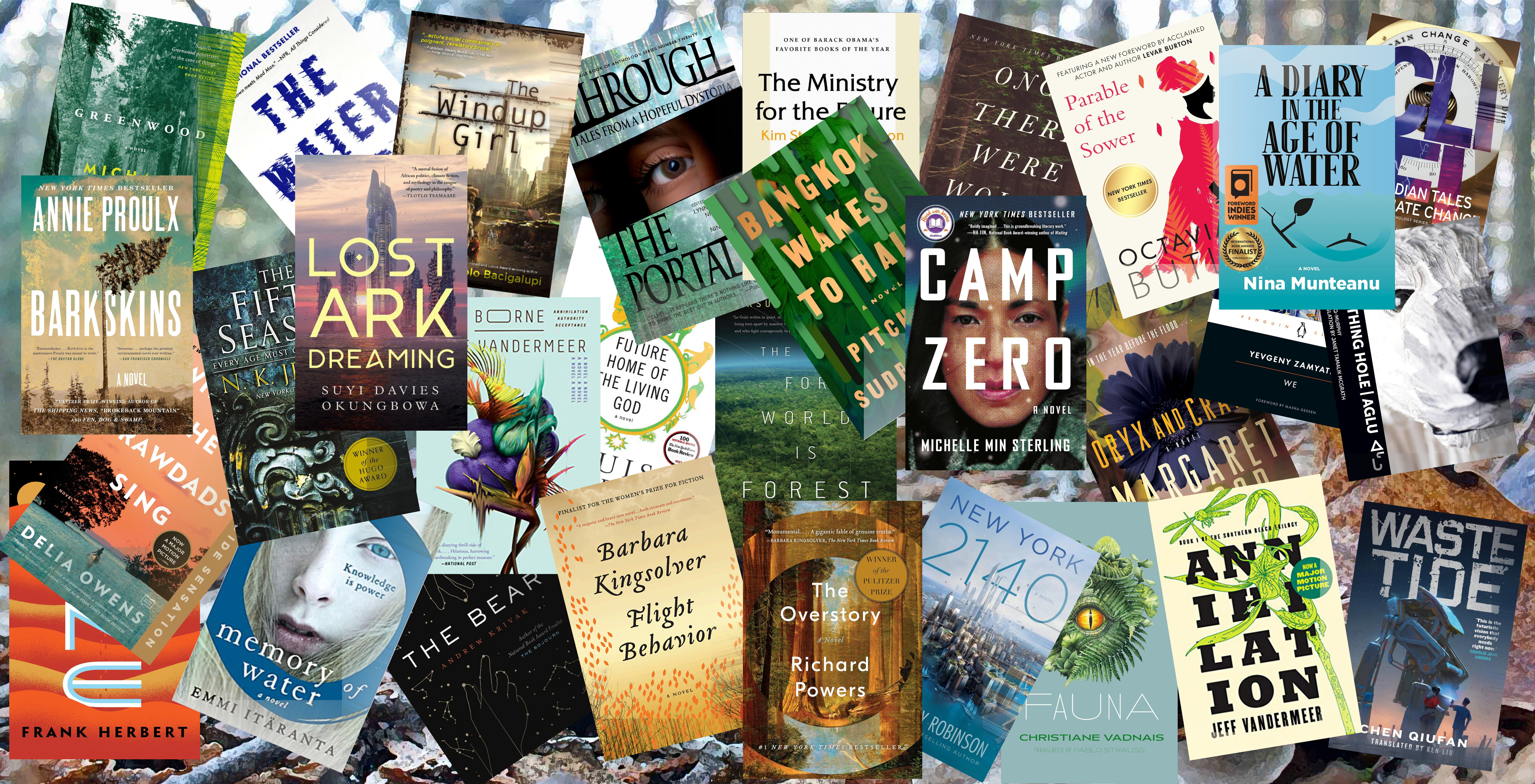
Thirty works of impactful eco-fiction
.
Author / scholar Mary Woodbury defines eco-fiction as “made up of fictional tales that reflect important connections, dependencies, and interactions between people and their natural environments.” In her article “Eco-Fiction—The SuperGenre Hiding in Plain Sight”, Judith defines eco-fiction as literature that “portrays aspects of the natural environment and non-human life as an evolving entity with agency in its relationship between and interaction with human characters.” In the preface to his 1995 book Where the Wild Boks Are: A field guide to Eco-Fiction, Jim Dwyer provides four criteria for eco-fiction:
The nonhuman environment is present not merely as a framing device but as a presence that begins to suggest that human history is implicated in natural history
The human interest is understood to be not the only legitimate interest
Human accountability to the environment is part of the text’s ethical orientation
Some sense of the environment as a process rather than as a constant or a given is at least implicit in the text.
These designations could be easily met by prehistoric cave art and first nations artwork and storytelling. These definitions also allow for the inclusion of many classics defined as eco-fiction from Herman Melville’s Moby Dick and Thomas Hardy’s Return of the Native to John Wyndham’s Day of the Triffids.
.
Evolving Eco-Fiction & Eco-SciFi
.
Like the environment it describes, Eco-Fiction is changing and evolving as a genre. Inventor/author Kyo Hwang Cho used the genre designation of Eco-SciFi when he recently identified me along with Kim Stanley Robinson, Jeff VanderMeer, and Richard Powers as Leading Voices in Eco-Science Fiction. Cho defines Eco-SciFi as: “a subgenre of SciFi that foregrounds ecological consciousness, blending speculative fiction with climate science, ethics, and planetary survival.” He includes a table that distinguishes Eco-SciFi from traditional Sci-Fi in several core areas from core theme, tone and motivation to protagonists and ‘message.’ The table can also be used to distinguish this sub-genre from other sub-categories within the umbrella term eco-fiction.
.
Cho described me as a Canadian ecologist and writer whose “stories explore how humans interact with the environment. Her narratives often examine the intersection of science, climate crisis, and spiritual transformation.” He described A Diary in the Age of Water as a noteworthy work of eco-science fiction: “a dystopian look at a future shaped by water scarcity, societal collapse, and ecological memory.”
.
Categories of Eco-Fiction
Partially due to this literature’s growing popularity there are currently many categories within and overlapping with eco-fiction; these include: climate fiction or clifi;solarpunk; eco literature, eco-horror, eco-punk, hopeful dystopia, mundane science fiction, speculative fiction, and weird fiction. Each of these focuses on particular idiosyncracies within the literary form that uniquely identify a work.
.
.
For instance,A Diary in the Age of Water has been variously described by reviewers and readers as eco-fiction, speculative fiction, science fiction or scifi, Fem-lit, mundane science fiction, hopeful dystopia, hopepunk or solarpunk, ecological science fiction or Eco-Sci-Fi. All to say that these designations and sub-genres are somewhat arbitrary and overlap; they may ultimately depend on the reader’s expectations of the work, and their own worldview and predilections. Given the still relevant reason for genre identification (to be able to best find the book in a brick and mortar or virtual bookstore), this makes sense; a work may easily satisfy several reader perspectives and therefore merit many sub-genre descriptors.
Eco-SciFi and mundane science fiction can be viewed this way. In an interview on Solarpunk Futures, I describe mundane science fiction as a sub-genre of science fiction that is very much like speculative fiction in that this sub-genre focuses on scenarios on Earth and involves matters to do with everyday life—hence the term mundane. Given the speculative aspect of mundane science fiction (e.g., set on Earth, often in the near-future), much of what Cho describes as Eco-SciFi also fits the designation of mundane science fiction. in my article “The Power of Diary in Fiction,” I describe Paolo Bacigalupi’s The Windup Girl, Emmi Itäranta’s Memory of Water and my own novel A Diary in the Age of Water as examples of mundane science fiction. Other good examples of mundane science fiction or Eco-SciFi include Kim Stanley Robinson’s New York 2041, Pitchaya Sudbanthad’s Bangkok Wakes to Rain and Michelle Min Sterling’s Camp Zero. These can all be labelled clifi as well. Min Sterling’s book also fits well under Femlit, Feminist Eco-Fiction, and Hopeful Dystopia.
The determining features provided by Cho that distinguish Eco-Sci-Fi help distinguish works that fall more easily into science fiction from those that better fit within the category of literary fiction or climate fiction.
Eco-Fiction—like Science Fiction—is a large category and provides a kind of umbrella term for all environmental fiction in which the environment plays a central role that informs the plot, theme and character-journey. In literature, it serves many literary works that do not include scifi aspects (e.g. fantastical or speculative); because of this, reserving the sub-genre of Eco-SciFi for those that do include fantastical elements makes sense. For non scifi works of Eco-Fiction, I would suggest using the term Eco-Lit (ecological literature), a term already in existence that incorporates the word ‘literature’ to suggest a type of literary fiction.
.
Ecological Literature or Eco-Lit
Eco-Lit—unlike Eco-SciFi—tends to restrict its narrative to the current time, does not include fantastical or speculative elements, and tends to use the ecological or climate elements more as metaphorical setting to examine personal drama. In all eco-fiction, however, the environmental setting/characteristic remains central to the story—as theme and/or premise— which would not work without it. Good examples of Eco-Lit include Migration and Once There Were Wolves by Charlotte McConaghy, Flight Behavior and Prodigal Summer by Barbara Kingsolver, and Greenwood by Michael Christie. In each of these works, the environmental characteristic sparks, motivates, and helps direct the actions of the main protagonist. For instance, in Flight Behavior, if the protagonist Dellarobia Turnbow had not encountered the changed migration of the monarchs (as a result of climate change), she would not have taken a drastic turn in her own journey.
Thomas Hardy’s 1878 Return of the Native was a work of powerful literary eco-fiction (Eco-Lit) that gave Egdon Heath powerful agency over the other traditional characters: destroying, enabling, enlightening, strengthening, isolating.
.
Eco-Fiction as Hyperobject
Some have suggested that eco-fiction be considered a supergenre, given that it defies strict boundaries. Elements of eco-fiction can be found in many other genres, from romance or thriller to science fiction or historical, suggesting that it is more a state of being than a category with static boundaries; more like a door or a window than a room. In my opinion, eco-fiction encompasses more than a genre or category; it is a hyperobject that has been with us since storytelling was born. In his book Hyperobjects, philosopher Timothy Morton attempts to synthesize the still divergent fields of quantum theory (weirdness of tiny objects) and relativity (weirdness of large objects), inserting them into philosophy and art. According to Morton, a hyperobject is an entity that is massively distributed in space and time, making it difficult to grasp its totality or experience it as a single, unified object. Morton argues that the hyperobjects of the Anthropocene, such as global warming, climate or oil that have extensive time/space presence, have newly become visible to humans—mainly due to the very mathematics and statistics that helped to create these disasters. Glimpsing them through our copious data, hyperobjects “compel us to think ecologically, and not the other way around.”
.
I think that much of the fiction that authors write touches on climate and environment, whether they realize it or not, whether they are conscious of it or not. Climate and environment are both large, yet penetrating at the cellular level—influencing us in so many ways from obvious and literal to subtle and visceral. Try as we might—and we have for centuries tried—to separate ourselves and ‘other’ environment, we can’t escape it. “We are always inside an object,” says Morton. Hyperobjects show us that “there is no centre and we don’t inhabit it.”
.
I’ve created my own table, fashioned after Cho’s, and adapted to include Eco-Lit with pertinent examples:
Categories of Fiction Genres Related to Ecology and Environment
SciFi
Eco-Fiction
Eco-SciFi
Eco-Lit
Setting
Science, technology, space, time travel, AI, aliens, etc.* driven by elements of science fact or fiction
Ecological systems, environmental collapse, climate change, sustainability.* Some element of science fact or fiction; speculative fiction
Ordinary people, often linked in some intimate and actionable way to Nature
Examples
Dune (Herbert) I, Robot (Asimov) Neuromancer (Gibson) 1984 (Orwell) Brave New World (Huxley) The Martian Chronicles (Bradbury) Childhood’s End (Clarke)
The Ministry for the Future (Robinson) Annihilation (VanderMeer) A Diary in the Age of Water (Munteanu) The Windup Girl (Bacigalupi) Memory of Water (Itaranta) Waste Tide (Quifan) Camp Zero (Min Sterling) Bangkok Wakes to Rain (Sudbanthad) Lost Arc Dreaming (Okungbowa)
Flight Behavior (Kingsolver) Migration by (McConaghy) Greenwood (Christie) Barkskins (Proulx) The Overstory (Powers) Oil on Water (Habila) Where the Crawdads Sing (Owens) Return of the Native (Hardy) Moby Dick (Melville)
Message
Broad speculative insight into human potential* & survival, future tech, and evolution of civilization
Warns pf ecological degradation, offers alternative visions of coexistence* often through personal or community perspective
Exploration of the human spirit, growth and inspiration through personal environmental awareness and action
Structure
Often premise-based or plot-based; environment often ‘othered’
Theme-based and character-based; environment often with agency
Character-based; environment may be metaphoric character with or without agency
*descriptions taken directly from Cho’s article
.
References:
Morton, Timothy. 2013. “Hyperobjects: Philosophy and Ecology After the End of the World.” University of Minnesota Press, Minneapolis. 240pp.
.
Nina Munteanu is a Canadian ecologist / limnologist and novelist. She is co-editor of Europa SF and currently teaches writing courses at George Brown College and the University of Toronto. Visit www.ninamunteanu.ca for the latest on her books. Nina’s bilingual “La natura dell’acqua / The Way of Water” was published by Mincione Edizioni in Rome. Her non-fiction book “Water Is…” by Pixl Press (Vancouver) was selected by Margaret Atwood in the New York Times ‘Year in Reading’ and was chosen as the 2017 Summer Read by Water Canada. Her novel “A Diary in the Age of Water” was released by Inanna Publications (Toronto) in June 2020.
I’ve selected ten TV series that have intrigued me, moved me, and stayed with me for various reasons that touch on: abuse of justice, including eco-justice and environmental abuse; technology use and abuse; and the effects and horrors of climate change.
Some are well known; others not so well known. All approach storytelling with a serious dedication to depth of character, important themes, realistic world building, and excellent portrayal by actors. The world-building is extremely well done—in some cases rivalling Ridley Scott’s best—with convincing portrayals of worlds that are at times uncanny in their realism. Worlds that reflect story from an expansive landscape to the mundane minutiae of daily life: like the cracked phone device of Detective Miller in The Expanse or the dirty fingernails of engineer Juliette Nichols in the Down Deep of Silo. Stories vary in their treatment of important themes from whimsical and often humorous ironies to dark and moody treatises on existential questions. In my opinion, these TV series rival the best movies out there, often reflecting large budgets (but not always) and a huge commitment by producers. The ten TV series I’ve selected in this series come from around the world: Brazil, Germany, France, Norway, Canada and the United States.
In Part 2, I focus on five TV series that explore issues to do with resource allocation, adaptations to climate change and corporate / government biopolitics.
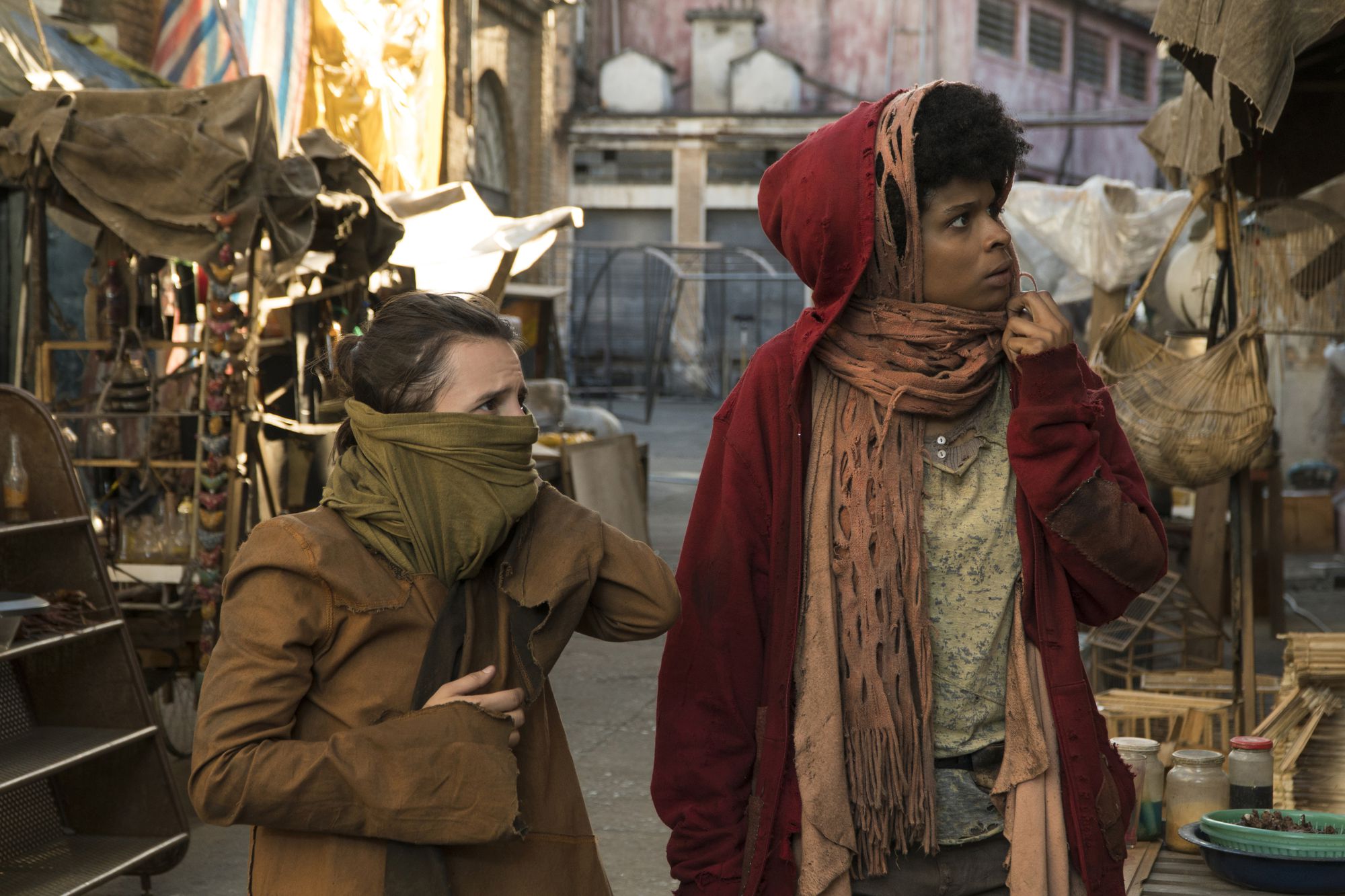
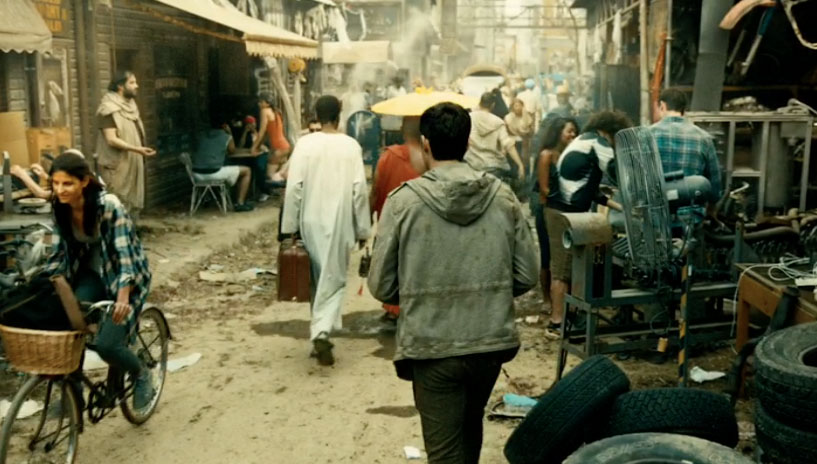
This Brazilian dystopian thriller was created by Pedro Aguilera and directed by Cesar Charlone. It is set in the near future after the planet has fallen into a divided haves and have-nots through some calamity. Three percent of the population live well on an island in the Atlantic Ocean, called Offshore (Mar Alto). The remaining 97% struggle Inland with poverty and scarcity. A selection process lies between them.
Every year the 97% send their 20-year olds to undergo The Process, a grueling Hunger Games-style contest run by the Offshore elite to replenish their numbers. Only 3% of the candidates will be considered worthy. They must pass psychological, emotional and physical tests to earn a place in Mar Alto. Candidates cheat in self-service; others violently impose Darwinian entitlement and survival of the fittest; yet others rely on reciprocal altruism.
.
Candidates undergo a test in The Process
.
By the time Season 1 is over, candidates will have committed a full range of desperate and unsavory acts to make the cut—the stakes are high, after all: secure a position in the 3% elite or die in squalor and poverty. After being eliminated during the interview process, one youth throws himself off the balcony of the testing centre.
Inland is valued by the elite only for its reserve of youth to recruit Offshore’s strictly controlled population (you only find out how in the last show of Season 1). As for what personality and fitness The Process tests for is also uncertain. “You each create your own merit,” says Ezequiel, who runs The Process, to the candidates. “No matter what happens … you deserve this.” The corollary is that if they don’t have merit—value, as determined by Ezequiel’s Process—they don’t deserve to move Offshore. There is, of course, a resistance to The Process, called The Cause. They cause stirrings of unrest and may even be responsible for the first murder in Offshore in over 100 years—which puts Ezequiel’s Process under question. Ezequiel dismisses The Cause by suggesting that it operates “in the name of a false or hypocritical equality.”
.
Ezekuiel speaks to the candidates
.
There is no inherent equality or fair entitlement in a land of scarcity; there is only proof of merit to a limited resource. This meritocratic notion—and the need to prove one’s worth to be accepted—is so ingrained in society that not even the poor question it. It was American writer John Steinbeck who argued that socialism would never take off in America because the poor see themselves as “temporarily embarrassed capitalists.”
“3% is a brutal commentary on the world’s rising income inequality and the lengths we’re all willing to go to improve our lot,” writes Matthew Gault of Motherboard. “It’s a world of extreme income inequality where techno-fascists rule with an iron fist.”
With each episode, 3% examines the motivations and paradoxes of heroism and villainy, sometimes turning them on their sides until they touch with such intimacy you can’t tell them apart. At its deepest, 3% explores the nature of humanity—from its most glorious to its most heinous—under the stress of scarcity and uncertainty. How we behave under these polarizing challenges ultimately determines who we are.
.
Two 3% candidates navigate the slums they are trying to escape with The Process
Nina Munteanu is a Canadian ecologist / limnologist and novelist. She is co-editor of Europa SF and currently teaches writing courses at George Brown College and the University of Toronto. Visit www.ninamunteanu.ca for the latest on her books. Nina’s bilingual “La natura dell’acqua / The Way of Water” was published by Mincione Edizioni in Rome. Her non-fiction book “Water Is…” by Pixl Press (Vancouver) was selected by Margaret Atwood in the New York Times ‘Year in Reading’ and was chosen as the 2017 Summer Read by Water Canada. Her novel “A Diary in the Age of Water” was released by Inanna Publications (Toronto) in June 2020.
The writing competition invites writers to submit a story about transformation, when a moment of epiphany causes one or more characters to change for the greener.
The transformative realisation doesn’t have to explicitly mention climate or the environment as long as it inspire behaviours with environmental implications (e.g. food, travel, consumption, gardening, cleaning, etc.), or the story could focus on the benefits of any greener alternative (e.g. environment, health, status, spirit, soul). For more about judging, prizes and terms and conditions, visit their site Green Stories Project.
.
The Green Stories Project
Their mission is to create a cultural body of work that entertains and informs about green solutions, inspires green behaviour and raises awareness of the necessary transformations towards a sustainable economy.
Green Stories began as a series of free writing competitions across various formats to solicit stories that showcase what a sustainable society might look like. They have run over 20 free competitions since they set up in 2018.
Green Stories engage writers, academics and policymakers in sustainability projects. They also partnered with BAFTA on the #ClimateCharacters project to research whether audiences believe presenting characters with high carbon-consumption as aspirational is still acceptable.
.
Cedar trees colonize a mossy log, ON (photo and rendition by Nina Munteanu)
.
Nina Munteanu is a Canadian ecologist / limnologist and novelist. She is co-editor of Europa SF and currently teaches writing courses at George Brown College and the University of Toronto. Visit www.ninamunteanu.ca for the latest on her books. Nina’s bilingual “La natura dell’acqua / The Way of Water” was published by Mincione Edizioni in Rome. Her non-fiction book “Water Is…” by Pixl Press (Vancouver) was selected by Margaret Atwood in the New York Times ‘Year in Reading’ and was chosen as the 2017 Summer Read by Water Canada. Her novel “A Diary in the Age of Water” was released by Inanna Publications (Toronto) in June 2020.
I’ve selected ten TV series that have intrigued me, moved me, and stayed with me for various reasons that touch on: abuse of justice, including eco-justice and environmental abuse; technology use and abuse; and the effects and horrors of climate change.
Some are well known; others not so well known. All approach storytelling with a serious dedication to depth of character, important themes, realistic world building, and excellent portrayal by actors. The world-building is extremely well done—in some cases rivalling Ridley Scott’s best—with convincing portrayals of worlds that are at times uncanny in their realism. Worlds that reflect story from an expansive landscape to the mundane minutiae of daily life: like the cracked phone device of Detective Miller in The Expanse or the dirty fingernails of engineer Juliette Nichols in the Down Deep of Silo. Stories vary in their treatment of important themes from whimsical and often humorous ironies to dark and moody treatises on existential questions. In my opinion, these TV series rival the best movies out there, often reflecting large budgets (but not always) and a huge commitment by producers. The ten TV series I’ve selected in this series come from around the world: Brazil, Germany, France, Norway, Canada and the United States.
In Part 2, I focus on five TV series that explore issues to do with resource allocation, adaptations to climate change and corporate / government biopolitics.
.
.
INCORPORATED:A Post-Climate-Change Corporate Scrabble for Resource & Power
.
This American science fiction thriller offers a chilling glimpse of a post-climate change dystopia. Created by David and Alex Pastor and produced by Ben Affleck, Matt Damon, Ted Humphrey and Jennifer Todd, the show (filmed in Toronto, Canada) opens in 82 °F Milwaukee in November 2074 after environmental degradation, widespread famine and mismanagement have bankrupted governments. We learn later that Milwaukee Airport served as a FEMA climate relocation centre that resembles an impoverished shantytown. In the wake of the governments demise, a tide of multinational corporations has swept in to control 90% of the globe and ratified the 29th amendment, granting them total sovereignty.
.
Spiga CEO talks to her employees
Corporations fight a brutal covert war for market share and dwindling natural resources. Like turkey vultures circling overhead, they position themselves for what’s left after short-sighted government regulations, lack of corporate check and FEMA mismanagement have ‘had their way’ with the planet. The world is now a very different place. There is no Spain or France. Everything south of the Loire is toxic desert; New York City reduced to a punch line in a joke. Reykjavik and Anchorage are sandy beach destinations and Norway is the new France—at least where champagne vineyards are concerned. Asia and Canada are coveted for their less harsh climates.
Corporates live in a world isolated from the real world of poverty
.
Those who work for the corporations live in privilege behind the sentried walls of the Green Zones. The rest fend for themselves with scarcity in the contaminated slums of the Red Zones.
Incorporated is an ‘Alice in Wonderland’ mixture of realizable technological advances, gadgetry and thrilling—if not chilling—consequence: like self-driving cars, intelligent writsbands, surrogate pregnancies and remote deliveries, genetic testing of ‘inferiors’, DNA theft, and malware sabotage.
Like a Seurat painting, the subtle details of the show change with perspective and build into a subliminal realism you can’t shake: from the food porn in the opening scene to eating rats in climate relocation camps or drinking dirty Red Zone water that costs $5. In Cost Containment we learn that Spiga competitor Inazagi is developing salt-tolerant crops that, like the mangroves, will thrive on irrigated seawater in the deserts left by an exploitive short-sighted America: Iowa, Missouri, Kansas—all the dust storm states. In a later episode, a murdered corporate executive is found by two dowsers on the dried lakebed of Missouri’s Lake Lotawana. We hear about the “oil wars” in Capetown.
.
A Spiga employee caught with malwear
.
The first episode (Vertical Mobility) opens to a corporate ‘traitor’ being dragged into “the quiet room”, rumoured to be a torture chamber run by taciturn head of security Julian Morse (Dennis Haysbert). The scene shifts to the Green zone suburban house of corporate climber Ben Larson (Sean Teale). As he prepares to go to work, the news streams of hurricanes breaching levies; Canada building a wall to stem the tide of illegal American climate refugees–12 million already there; offshore oil rigs in the waters of the former Arctic ice cap; and finally to the “terrorist” bombing of the R&D lab of biochemical giant Spiga, where Ben works. Spiga, we later learn, plays the same games as Monsanto and Nestle to ensure profits at the expense of well-being.
FEMA camps for climate refugees sprout everywhere
.
Aaron Pruner of Screener TV asks, “Could climate change push us into a collapsed society, informed consistently by the ongoing threat of class warfare? Will we eventually be separated by electric fences and really big walls [like Incorporated]? Are fear and greed going to be the currencies of our reality? These burning questions should sound far-fetched and silly, but as we watch tale of Incorporated unfold, it’s hard not to wonder what our own future will bring.” Far-fetched and silly? Is it any more far-fetched and silly than voting in a president who claims that the Chinese invented climate change to make American manufacturing non-competitive?
.
Climate refugee camp
.
Nina Munteanu is a Canadian ecologist / limnologist and novelist. She is co-editor of Europa SF and currently teaches writing courses at George Brown College and the University of Toronto. Visit www.ninamunteanu.ca for the latest on her books. Nina’s bilingual “La natura dell’acqua / The Way of Water” was published by Mincione Edizioni in Rome. Her non-fiction book “Water Is…” by Pixl Press (Vancouver) was selected by Margaret Atwood in the New York Times ‘Year in Reading’ and was chosen as the 2017 Summer Read by Water Canada. Her novel “A Diary in the Age of Water” was released by Inanna Publications (Toronto) in June 2020.
Given that several of the authors in the anthology are BC writers, Through the Portal: Tales from a Hopeful Dystopia(edited by Lynn Hutchinson Lee and Nina Munteanu) was considered and became part of the short list for fiction.
Post Script: On August 23, 2025, “Through the Portal” won the award for fiction. Here is what the judges said:
“Every story in here is a delicious short gem.”
“An ambitious project with an unusual slant of positivity in the face of a dystopian future has turned into a solid piece of work, incorporating a good range of stories, some very literary and abstract, others simple tales of destruction and regrowth or the hope of regrowth.”
“Characters and situations in the selected stories show optimism and the power of the human spirit across a wide array of possible near- and far-term futures.”
“Most of the situations are inherently believable based on what we know about climate, industry, and the powerful politics of denialism.”
.
Nina Munteanu is a Canadian ecologist / limnologist and novelist. She is co-editor of Europa SF and currently teaches writing courses at George Brown College and the University of Toronto. Visit www.ninamunteanu.ca for the latest on her books. Nina’s bilingual “La natura dell’acqua / The Way of Water” was published by Mincione Edizioni in Rome. Her non-fiction book “Water Is…” by Pixl Press (Vancouver) was selected by Margaret Atwood in the New York Times ‘Year in Reading’ and was chosen as the 2017 Summer Read by Water Canada. Her novel “A Diary in the Age of Water” was released by Inanna Publications (Toronto) in June 2020.
The lavender fields at Laveanne, ON (photo by Nina Munteanu)
.
Two years ago on this day, I tracked down Laveanne the lavender farm I’d heard about near Campbellcroft, Ontario. I’d seen the sign somewhere and just had to remind myself where that was. It was a sunny hot day in July and I was ready for adventure. My memory served me well and in no time I was driving east on Country Road 9 (Ganaraska Rd.) from Highway 28. The turn off to Gilmour Rd. came soon, well signed, and I was eventually driving a road that more resembled a lane until I arrived at the purple fields of the farm.
The 1.6 hectare family-run farm was started by partners Sabena and Gary in 2013 and now includes a lovely outdoor café and gift shop offering a wide diversity of lavender-related products. You can also buy a lavender plant from their nursery. When I asked her about the name they chose—Laveanne—for their enterprise, she explained: “lkjlkjlkjl”
I came to experience the lavender fields; so, relegating the café and gift shop for later, I set out into the undulating aromatic fields. As I inhaled a complex mixture of alluring mystery, I felt like I was entering some paysage Provençal painted by Annie Rivière, embraced by an arcane beauty of colour and scent and sound that conspired into an abiding sense of calm and joy.
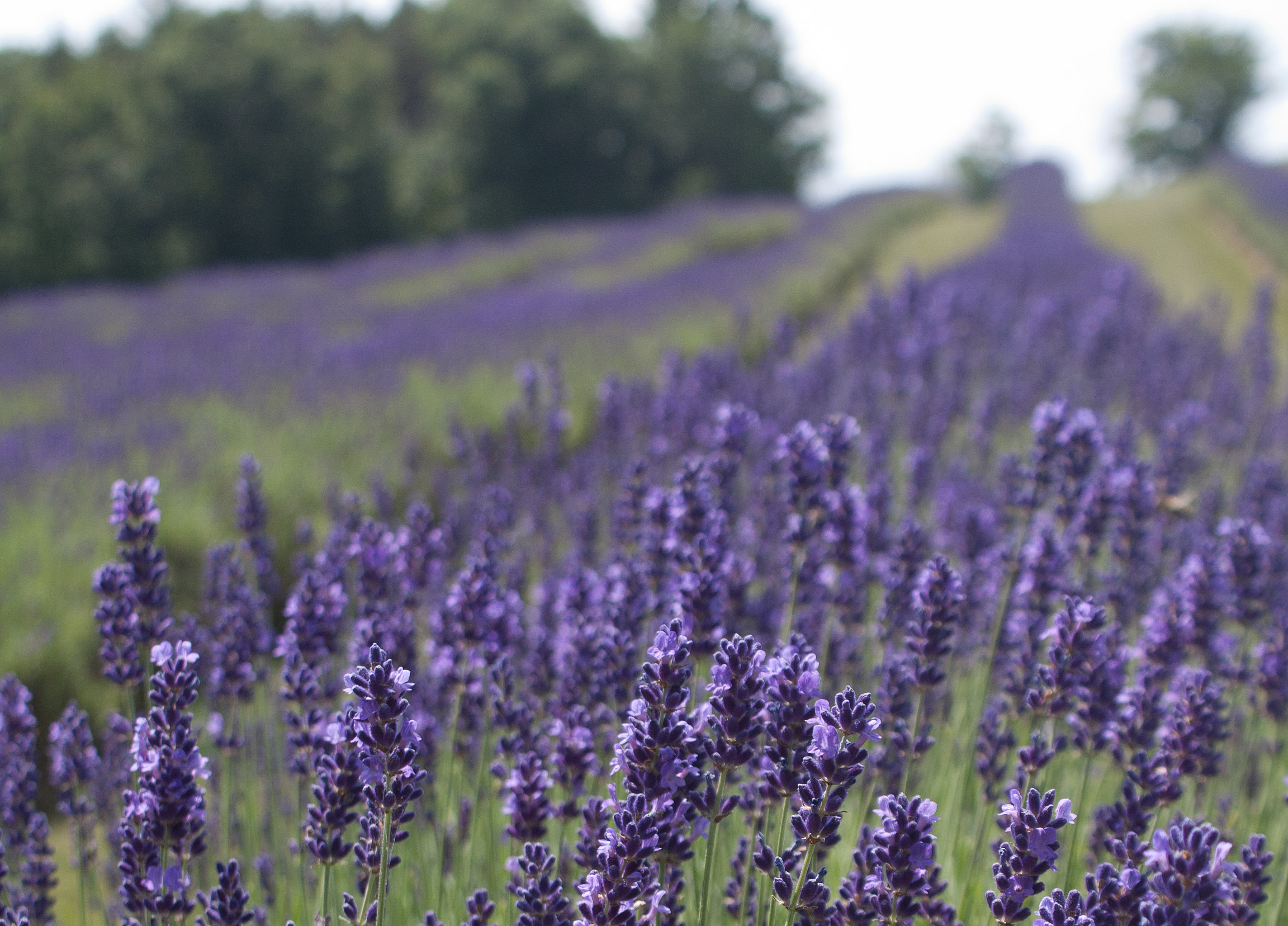
The lavender fields at Laveanne: top left, rows of English lavender; top right, lavender labyrinth; bottom left, bumblebee in flight among lavender blooms; bottom right, Red Admiral butterfly settles on a lavender influorescence. (photos by Nina Munteanu)
.
The Smell of Lavender
The aroma was subtle yet lingered as I walked the four acres of lavender, along stubby rows of deep purple that snaked up and into a rolling horizon. It was early enough for many of the flowers to still be in bud, displaying an intensely deep purple. This colour grows brighter as more flowers burst into bloom later in the month, attracting more and more honeybees. I was in a kind of aromatic heaven, accompanied by the constant hum of honeybees buzzing from flower to flower and the occasional flutter of a Red Admiral butterfly, flashing its bright blue-orange wings as it stopped briefly to gorge on the lavender’s nectar. The scent was an airy symphony of sweet floral with herbal, camphor-like woodsy undertones. I detected the mildest hint of rosemary and coriander.
.
Chemistry of lavender smells (image by Andy Brunning / Compound Interest)
.
I’m told that lavender’s aroma comes mainly from linalool and linalyl acetate, both part of the terpene family. Linalool, which helps repel mosquitos, is widely used in fragrances as well as many personal care products and aromatherapies. This terpene also found in mint, cinnamon, coriander, and citrus fruits; it is the chief chemical responsible for the recognizable spicy floral smell of marijuana (the skunky smell of cannabis is from another terpene, myrcene). Linalool is of course known for its calming and soothing effects. It reduces stress and anxiety, helps relax the body and enhance sleep quality, and helps provide relief from pain and inflammation. Two other terpenes, 1,8-cineole and camphor add some hint of scent as well as having insecticidal and repellent properities (such as repelling moths). These terpenes are also found in rosemary, hence the hint of rosemary scent in lavender. I’m told that over 300 compounds exist in lavender’s essential oil, though not all contribute to aroma. Two enantiomers of linalool include the enantiomer licareol, responsible for the scent of lavender, and the enantiomer coriandrol, also found in coriander seed oils and sweet orange flowers.
.
Lavender Labyrinth
Reflection Labyrinth at Laveanne lavender farm, ON (photo by Nina Munteanu)
.
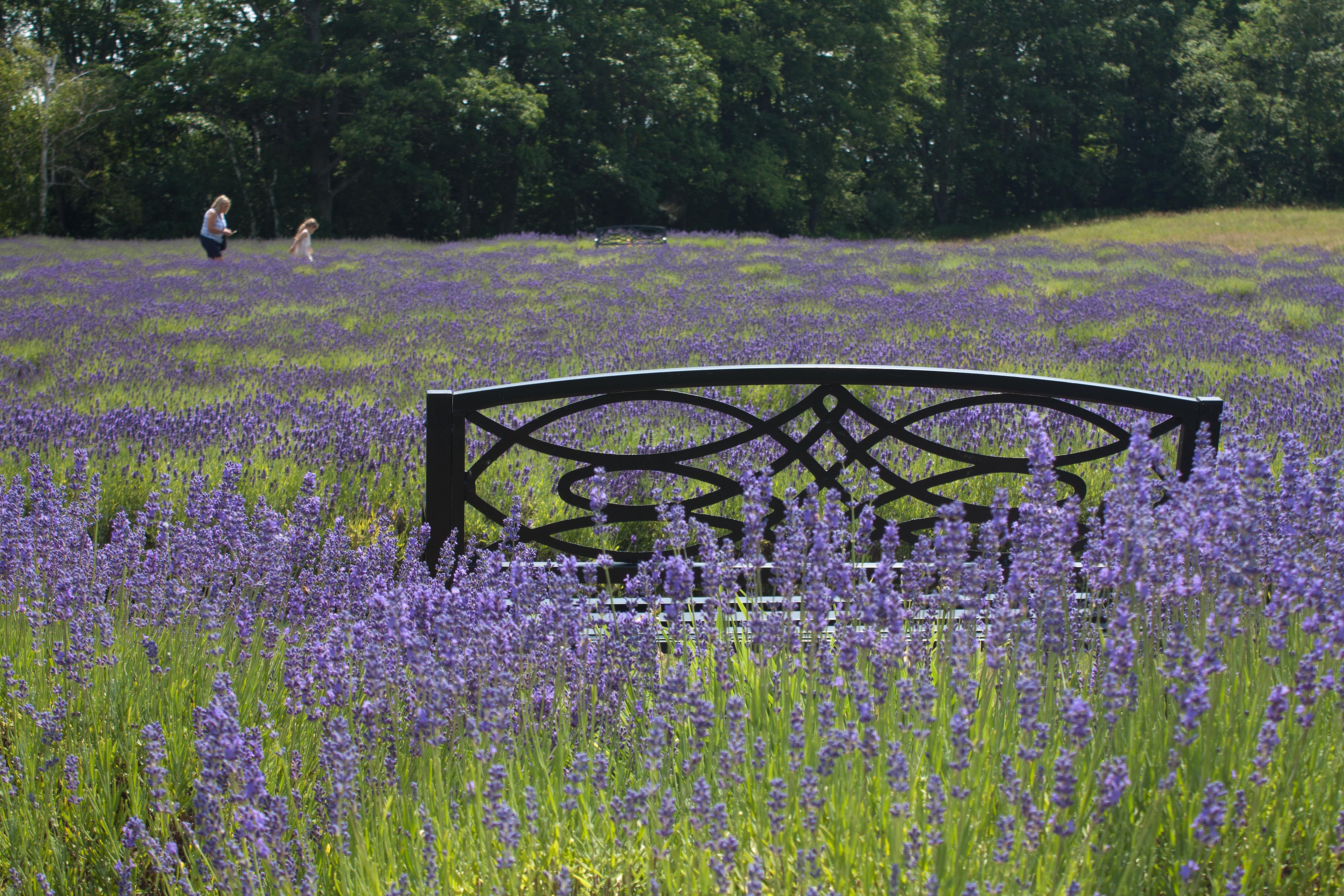
In the middle of the field I even found an over 30 metre diameter nine circuit modified Neo-Medieval labyrinth. Laveanne tells us that labyrinths are designed following sacred geometry and, unlike mazes that are built to challenge and confuse, are designed for meditation and relaxation. I walked the Reflection Labyrinth, among aromatic lavender and buzzing bees, feeling very content and relaxed.
I asked Sabena about what got them started farming lavender and she related the story of her son’s herb business “Grow Tasty”, which started a lavender collection. It went from a private collection to a larger enterprise after they saw a brochure from a lavender farm in Quebec and, after visiting the farm, were inspired to start their own lavender farm.
.
Bench faces the labyrinth at Laveanne lavender farm, ON (photo by Nina Munteanu)
.
Growing Lavender
Lavender is indigenous to the mountains of the Mediterranean region of western Europe. The plant spread rapidly to other parts of the world with travelers and by the sixteenth century, lavender was gracing English gardens. The first lavender plants made it to America with the European settlers. Lavender has been used medicinally for several millennia. It was used in ancient Egypt for mummification and Romans scented their public bathhouses with lavender. The name lavender comes from the Latin verb lavare—to wash.
High Country Gardens tells us that lavender “is known for its soothing, relaxing qualities and has been used to treat hyperactivity, insomnia, headaches, toothaches, sore joints, and rumbling digestive systems.” They add about early cleansing uses of lavender that “Early household use started with lavender strewn on the floors of castles and sick rooms as a disinfectant and deodorant. It was sold in bunches by street vendors and placed in linen closets as an insecticide to protect linens from moths.”
Sabena tells me that growing lavender successfully can be a challenge in Ontario. Given that lavender is not native to Ontario, it’s important to make it comfortable here. All species of lavender are sun lovers. These semi-woody and semi-evergreen perennials thrive in well-drained soil. They are drought tolerant and pest and disease resistant, but unless they are happy, they won’t do well. Summer pruning, after they have flowered, keeps them vigorous. They also need wind protection; being semi-evergreen makes them susceptible to windburn or drying out.
.
The Lavender Experience
At the outdoor café, which faces the fields, I treated myself to some lavender shortbread cookies with a refreshing lavender iced tea and sat to enjoy the glorious view.
Their shop offers a wonderful selection of lavender-infused products (from soaps to moisturizers, bath products to mists and essential oils), culinary goods such as spices and teas, as well as local jewelry and lavender treats. In the shop, I had to restrain myself, but managed to come away with a few prizes: homemade lavender shortbread cookies; lavender soap, and lavender essential oil.
.
A few lavender products from Laveanne (photo by Nina Munteanu)
.
Lavender Essential Oil
Leveanne’s essential oil is steam distilled from English lavender (Lavandula angustifolia), the preferred species for the oil’s healing properties and consists of a complex mixture of phytochemicals. Sebena mentions being inspired by René-Maurice Gattefossé, the father of modern aromatherapy, who widely experimented with English lavender oil in 1910 after he suffered severe burns in a laboratory experiment fire. Gattefossé found that the oil helped with so many body functions, the brain, nerves, paralysis, lethargy and rheumatism. He found it also effective in helping against stress, insomnia, headaches, acne, infections, and calming to skin irritations (burns, eczema). The oil also promotes healing and prevents scarring by stimulating the cells of a wound to regenerate more quickly. I keep my bottle handy and apply on wounds with good effect. Lavender essential oil is antibacterial, antifungal, antiseptic analgesic, anti-anxiety, antidepressant, calming, anti-inflammatory and an immune stimulant.
.
Lavender field, Laveanne, ON (photo by Nina Munteanu)
.
Nina Munteanu is a Canadian ecologist / limnologist and novelist. She is co-editor of Europa SF and currently teaches writing courses at George Brown College and the University of Toronto. Visit www.ninamunteanu.ca for the latest on her books. Nina’s bilingual “La natura dell’acqua / The Way of Water” was published by Mincione Edizioni in Rome. Her non-fiction book “Water Is…” by Pixl Press (Vancouver) was selected by Margaret Atwood in the New York Times ‘Year in Reading’ and was chosen as the 2017 Summer Read by Water Canada. Her novel “A Diary in the Age of Water” was released by Inanna Publications (Toronto) in June 2020.
Author Nina Munteanu holding copy of Tales of Science II (photo by Jane Raptor)
.
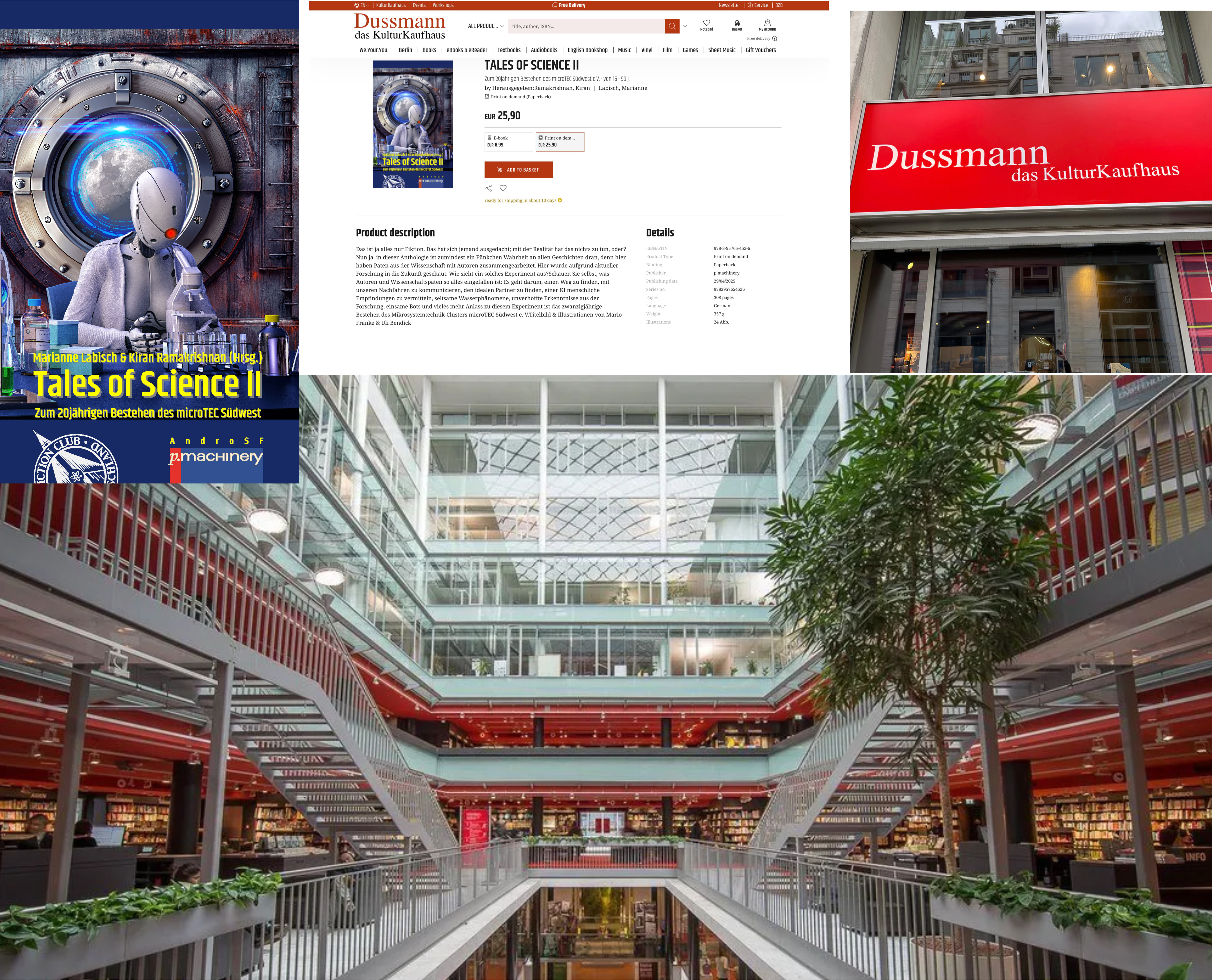
A few weeks ago, I looked into my mail box and found my contributor’s copy of “Tales of Science II” Anthology (edited by Marianne Labisch & Kiran Ramakrishnan) with my short story Die Polywasser-Gleichung (“The Polywater Equation”) inside. Beaming, I did a little dance because the anthology was marvelous looking! And it was all in German! (My mother is German, so I could actually read it; bonus!).
This science-fiction anthology, for which I was invited to contribute, collected seventeen short stories, all based on sound science. Here’s how the book jacket blurb (translated from German) describes the anthology:
.
It’s all just fiction. Someone made it up; it has nothing to do with reality, right? Well, in this anthology, there’s at least a grain of truth in all the stories, because scientific sponsors collaborated with authors. Here, they looked into the future based on current research What does such an experiment look like? See for yourself what the authors and scientific sponsors have come up with: about finding a way to communicate with our descendants, finding the ideal partner, conveying human emotions to an AI, strange water phenomena [that’s my story], unexpected research findings, lonely bots, and much more. The occasion for this experiment is the 20th anniversary of the microsystems technology cluster microTEC Südwest e. V.
(cover image and illustrations by Mario Franke and Uli Benkick)
.
In our initial correspondence, editor Marianne Labisch mentioned that they were “looking for short stories by scientists based on their research but ‘spun on’ to create a science fiction story;” she knew I was a limnologist and was hoping I would contribute something about water. I was glad to oblige her, having some ideas whirling in my head already. That is how “The Polywater Equation” (Die Polywasser-Gleichung) was born.
I’d been thinking of writing something that drew on my earlier research on patterns of colonization by periphyton (attached algae, mostly diatoms) in streams using concepts of fluid mechanics. Elements that worked themselves into the story and the main character, herself a limnologist, reflected some aspects of my own conflicts as a scientist interpreting algal and water data (you have to read the story to figure that out).
As I mentioned, the short story drew on my scientific work, which you can read about in the scientific journal Hydrobiologia. I was studying the community structure of periphyton (attached algae) that settled on surfaces in freshwater streams. My study involved placing glass slides in various locations in my control and experimental streams and in various orientations (parallel or facing the current), exposing them to colonizing algae. What I didn’t expect to see was that the community colonized the slides in a non-random way. What resulted was a scientific paper entitled “the effect of current on the distribution of diatoms settling on submerged glass slides.”
.
A. Distribution of diatoms on a submerged glass slide parallel to the current; treated diatom frustules are white on a dark background. B. diagram of water movement around a submerged glass slide showing laminar flow on the inner face and turbulent flow on the edges (micrograph photo and illustration by Nina Munteanu)
.
For more details of my work with periphyton, you can go to my article called Championing Change. How all this connects to the concept of polywater is something you need to read in the story itself.
.
The Phenomenon of Polywater
The phenomenon started well before the 1960s, with a 19th century theory by Lord Kelvin (for a detailed account see The Rise and Fall of Polywater in Distillations Magazine). Kelvin had found that individual water droplets evaporated faster than water in a bowl. He also noticed that water in a glass tube evaporated even more slowly. This suggested to Kelvin that the curvature of the water’s surface affected how quickly it evaporated.
.
Soviet chemist Boris Deryagin peers through a microscope in his lab
.
In the 1960s, Nikolai Fedyakin picked up on Lord Kelvin’s work at the Kostroma Technological Institute and through careful experimentation, concluded that the liquid at the bottom of the glass tube was denser than ordinary water and published his findings. Boris Deryagin, director of the Institute of Physical Chemistry in Moscow, was intrigued and his team confirmed that the substance at the bottom of the glass tube was denser and thicker than ordinary water and had additional anomalous properties. This phase of water had a thick, gel-like consistency; it also had a higher stability, like a polymer, over bulk water. It demonstrated a lower freezing point, a higher boiling point, and much higher density and viscosity than ordinary water. It expanded more than ordinary water when heated and bent light differently. Deryagin became convinced that this “modified water” was the most thermodynamically stable form of water and that any water that came into contact with it would become modified as well. In 1966, Deryagin shared his work in a paper entitled “Effects of Lyophile Surfaces on the Properties of Boundary Liquid Films.” British scientist Brian Pethica confirmed Deryagin’s findings with his own experiments—calling the odd liquid “anomalous water”—and published in Nature. In 1969, Ellis Lippincott and colleagues published their work using spectroscopic evidence of this anomalous water, showing that it was arranged in a honeycomb-shaped network, making a polymer of water—and dubbed it “polywater.” Scientists proposed that instead of the weak Van der Waals forces that normally draw water molecules together, the molecules of ‘polywater’ were locked in place by stronger bonds, catalyzed somehow by the nature of the surface they were adjacent to.
.
Molecular structure of polywater
.
This sparked both excitement and fear in the scientific community, press and the public. Industrialists soon came up with ways to exploit this strange state of water such as an industrial lubricant or a way to desalinate seawater. Scientists further argued for the natural existence of ‘polywater’ in small quantities by suggesting that this form of water was responsible for the ability of winter wheat seeds to survive in frozen ground and how animals can lower their body temperature below zero degrees Celsius without freezing.
When one scientist discounted the phenomenon and blamed it on contamination by the experimenters’ own sweat, the significance of the results was abandoned in the Kuddelmuddel of scientific embarrassment. By 1973 ‘polywater’ was considered a joke and an example of ‘pathological science.’ This, despite earlier work by Henniker and Szent-Györgyi, which showed that water organized itself close to surfaces such as cell membranes. Forty years later Gerald Pollack at the University of Washington identified a fourth phase of water, an interfacial water zone that was more stable, more viscous and more ordered, and, according to biochemist Martin Chaplin of South Bank University, also hydrophobic, stiffer, more slippery and thermally more stable. How was this not polywater?
.
The Polywater Equation
In my story, which takes place in Berlin, 2045, retired limnologist Professor Engel grapples with a new catastrophic water phenomenon that looks suspiciously like the original 1960s polywater incident:
The first known case of polywater occurred on June 19, 2044 in Newark, United States. Housewife Doris Buchanan charged into the local Water Department office on Broad Street with a complaint that her faucet had clogged up with some kind of pollutant. She claimed that the faucet just coughed up a blob of gel that dangled like clear snot out of the spout and refused to drop. Where was her water? she demanded. She’d paid her bill. But when she showed them her small gel sample, there was only plain liquid water in her sample jar. They sent her home and logged the incident as a prank. But then over fifty turbines of the combined Niagara power plants in New York and Ontario ground to a halt as everything went to gel; a third of the state and province went dark. That was soon followed by a near disaster at the Pickering Nuclear Generating Station in Ajax, Ontario when the cooling water inside a reactor vessel gummed up, and the fuel rods—immersed in gel instead of cooling water—came dangerously close to overheating, with potentially catastrophic results. Luckily, the gel state didn’t last and all went back to normal again.
If you read German, you can pick up a copy of the anthology in Dussmanndas KulturKaufhaus or Thalia, both located in Berlin but also available through their online outlets. You’ll have to wait to read the English version; like polywater, it’s not out yet.
.
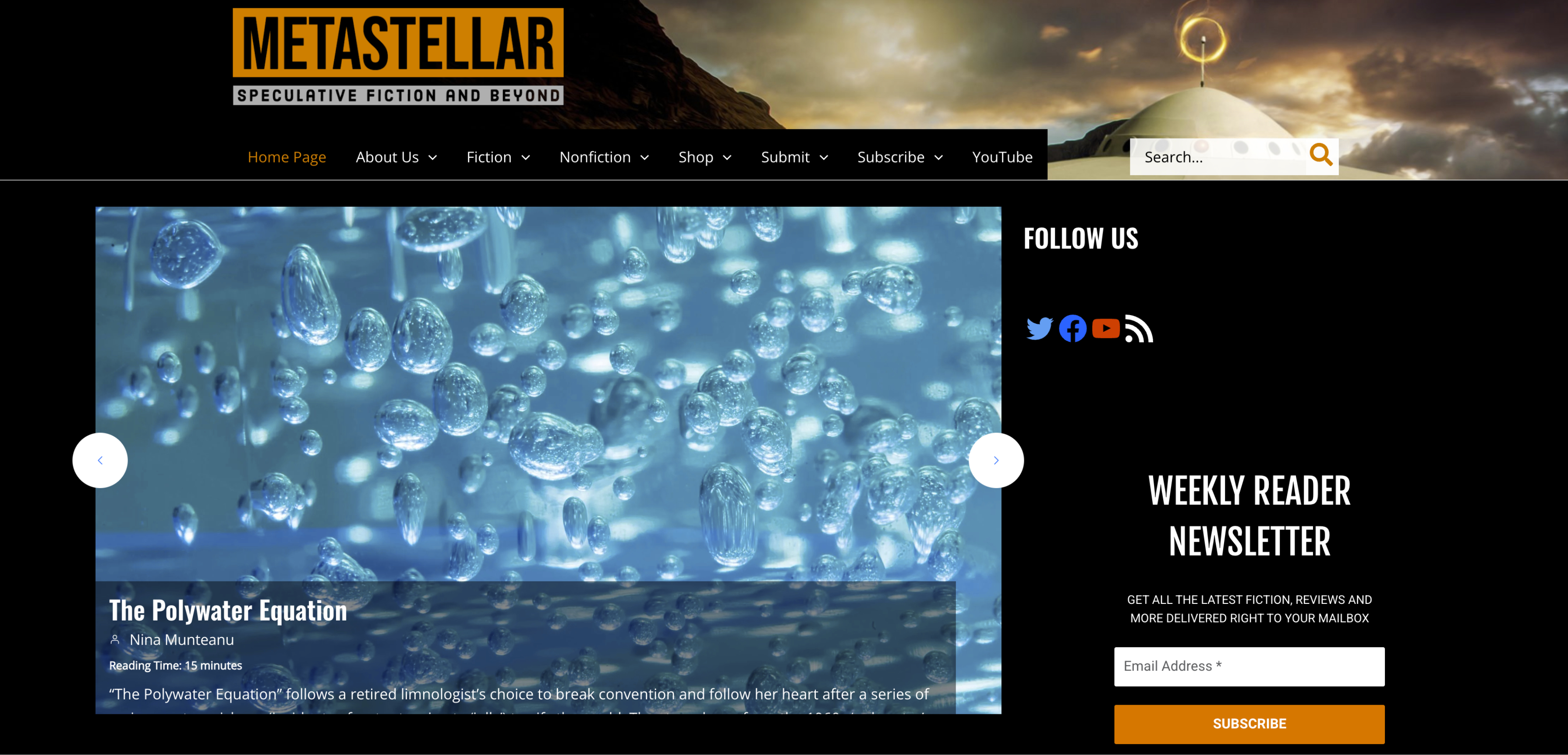
p.s. You’ll be able to read the English version “The Polywater Equation” in Metastellar Magazine, September 25, 2026.
Henniker, J.C. 1949. “The depth of the surface zone of a liquid”. Rev. Mod. Phys. 21(2): 322–341.
Kelderman, Keene, et. al. 2022. “The Clean Water Act at 50: Promises Half Kept at the Half-Century Mark.” Environmental Integrity Project (EIP). March 17. 75pp.
Munteanu, N. & E. J. Maly, 1981. The effect of current on the distribution of diatoms settling on submerged glass slides. Hydrobiologia 78: 273–282.
Szent-Györgyi, A. 1960. “Introduction to a Supramolecular Biology.” Academic Press, New York. 135 pp.
Roemer, Stephen C., Kyle D. Hoagland, and James R. Rosowski. 1984. “Development of a freshwater periphyton community as influenced by diatom mucilages.” Can. J. Bot.62: 1799-1813.
Schwenk, Theodor. 1996. “Sensitive Chaos.” Rudolf Steiner Press, London. 232 pp.
Szent-Györgyi, A. 1960. “Introduction to a Supramolecular Biology.” Academic Press, New York. 135 pp.
Wilkens, Andreas, Michael Jacobi, Wolfram Schwenk. 2005. “Understanding Water”. Floris Books, Edinburgh. 107 pp.
.
Nina Munteanu is a Canadian ecologist / limnologist and novelist. She is co-editor of Europa SF and currently teaches writing courses at George Brown College and the University of Toronto. Visit www.ninamunteanu.ca for the latest on her books. Nina’s bilingual “La natura dell’acqua / The Way of Water” was published by Mincione Edizioni in Rome. Her non-fiction book “Water Is…” by Pixl Press (Vancouver) was selected by Margaret Atwood in the New York Times ‘Year in Reading’ and was chosen as the 2017 Summer Read by Water Canada. Her novel “A Diary in the Age of Water” was released by Inanna Publications (Toronto) in June 2020.